Chemical Bull
146
05-Sep-2026
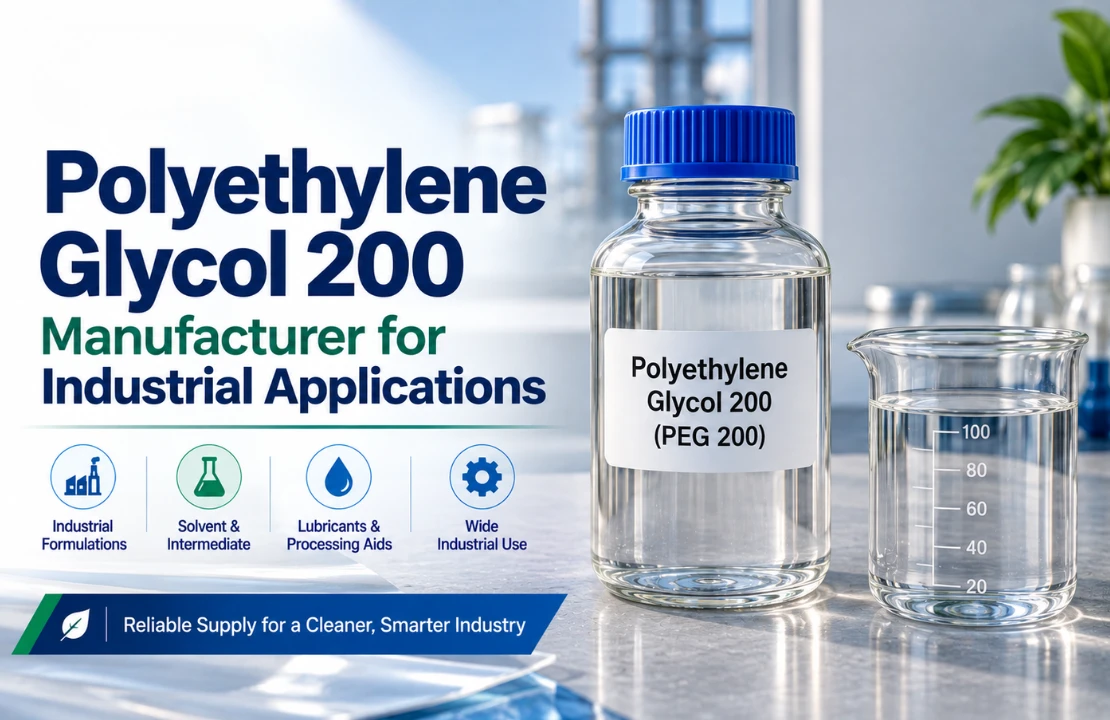
Polyethylene Glycol 200 Manufacturer for Industrial Applications
Polyethylene Glycol 200 (PEG 200) is a low-molecular-weight polyethylene glycol used in pharmaceutical formulations, cosmetics, personal care, chemical processing, coatings, adhesives, lubricants, textiles, and other industrial applications. Its water compatibility, low volatility, lubricity, and formulation flexibility make it a useful ingredient across different manufacturing systems.
For businesses sourcing Polyethylene Glycol 200, ChemicalBull supports B2B requirements with product specifications, bulk quantities, packaging options, documentation, and application-based sourcing support. Buyers can explore PEG-200 for detailed product information and procurement requirements.
Quick Answer: What Is Polyethylene Glycol 200 Used For?
Polyethylene Glycol 200 is mainly used as a solvent, humectant, plasticizer, lubricant, processing aid, and formulation component. It is used in pharmaceutical, cosmetic, chemical, coating, adhesive, lubricant, textile, and specialty industrial formulations.
The suitability of PEG 200 depends on its molecular-weight characteristics, purity, viscosity, water content, compatibility, and the requirements of the finished formulation.
What Is Polyethylene Glycol 200?
Polyethylene Glycol 200, commonly known as PEG 200, is a low-molecular-weight member of the polyethylene glycol family.
Polyethylene glycols are polymers containing repeating ethylene oxide units. Commercial PEG products contain a distribution of molecular chain lengths, so a grade such as PEG 200 refers to its approximate average molecular-weight level rather than one single molecular structure.
PEG 200 is generally supplied as a clear, colorless or nearly colorless liquid and has strong water compatibility.
Basic Properties of PEG 200
|
Property |
General Information |
|
Chemical name |
Polyethylene Glycol 200 |
|
Common name |
PEG 200 |
|
CAS Number |
25322-68-3 |
|
Chemical family |
Polyethylene glycol |
|
Physical form |
Liquid |
|
Appearance |
Clear, colorless or nearly colorless |
|
Average molecular weight |
Approximately 200 |
|
Water compatibility |
Highly soluble/miscible |
|
Volatility |
Low compared with many conventional organic solvents |
|
Key characteristics |
Solvency, lubricity, humectancy and formulation compatibility |
How Is Polyethylene Glycol 200 Manufactured?
Polyethylene Glycol 200 is manufactured through a controlled chemical process involving ethylene oxide and a suitable starting material, followed by molecular-weight control, purification, and quality testing. Manufacturing control is important because molecular-weight characteristics and impurity levels influence the final product's physical and formulation properties.
1. Raw Material Selection
Manufacturing begins with carefully controlled raw materials that meet the required quality specifications. The quality of the starting materials can influence the final product's purity, color, molecular-weight distribution, and overall consistency.
2. Controlled Ethoxylation Process
PEG production generally involves the reaction of ethylene oxide with a suitable initiator or starting material under controlled conditions. Ethylene oxide units are added during the reaction to form polyethylene glycol chains.
For PEG 200, process conditions are controlled to obtain the desired low average molecular-weight range. Factors such as reactant ratios, temperature, pressure, catalyst system, and reaction conditions can influence the resulting polymer characteristics.
3. Molecular-Weight Control
Molecular-weight control is a critical part of PEG 200 manufacturing.
Commercial PEG contains molecules with different chain lengths. The manufacturing process is therefore controlled to achieve the required average molecular-weight range and product specifications.
This helps maintain consistent properties such as:
-
Viscosity
-
Hydroxyl value
-
Physical state
-
Solubility behavior
-
Formulation compatibility
-
Processing characteristics
4. Purification and Filtration
After the desired reaction is completed, purification and filtration steps may be used to reduce unwanted impurities and prepare the material for final quality testing.
The exact purification process depends on the manufacturing technology and required product grade.
5. Quality Testing
The finished PEG 200 is tested against the applicable specification before release.
Typical quality parameters may include:
|
Quality Parameter |
Why It Matters |
|
Average molecular weight |
Confirms the intended PEG grade |
|
Hydroxyl value |
Helps characterize the material |
|
Water content |
Controls moisture level |
|
Acidity |
Supports chemical conformity |
|
Color and appearance |
Confirms visual quality |
|
Viscosity |
Important for processing and handling |
|
Purity |
Helps determine application suitability |
|
Impurity profile |
Supports consistent product quality |
The exact testing requirements depend on the intended grade and application.
6. Final Packaging and Storage
After quality approval, PEG 200 is transferred into suitable packaging for storage and transportation. Packaging should help protect the material from contamination and excessive moisture exposure.
For industrial buyers, packaging selection should also consider transportation, warehouse handling, production consumption, and storage duration.
Why Manufacturing Control Matters for PEG 200 Buyers
For industrial buyers, manufacturing control is directly connected to batch-to-batch consistency. Variations in molecular weight, moisture, purity, viscosity, or other critical parameters can affect formulation and processing performance.
When evaluating a Polyethylene Glycol 200 manufacturer, buyers should therefore consider specification consistency, quality documentation, manufacturing capability, packaging, and the supplier's ability to support repeat requirements.
PEG 200 Applications Across Major Industries
|
Industry |
Common PEG 200 Role |
|
Pharmaceutical |
Solvent, vehicle and formulation component |
|
Cosmetics |
Humectant and formulation ingredient |
|
Personal Care |
Skin-care and hair-care formulations |
|
Chemical Manufacturing |
Process and formulation component |
|
Coatings |
Formulation and processing component |
|
Adhesives |
Formulation modification and processing |
|
Lubricants |
Specialty lubricant and fluid systems |
|
Textile |
Processing and lubrication formulations |
|
Cleaning |
Selected water-compatible formulations |
|
Specialty Chemicals |
Solvent and functional formulation component |
The suitability of PEG 200 should always be assessed against the specific formulation, concentration, processing conditions, and applicable requirements.
Major Industrial Applications of Polyethylene Glycol 200
PEG 200 has multiple functions in industrial formulations. Its application depends on the required physical and chemical properties of the finished product.
1. Pharmaceutical Manufacturing
PEG 200 can be used in selected pharmaceutical formulations as a solvent, vehicle, plasticizing agent, or formulation aid.
Potential applications include:
-
Liquid pharmaceutical formulations
-
Oral formulations
-
Topical preparations
-
Pharmaceutical processing
-
Solvent systems
-
Formulation development
Different PEG molecular-weight grades have different physical characteristics. Pharmaceutical manufacturers should therefore select the appropriate grade according to formulation requirements and applicable quality standards.
For regulated applications, buyers should verify whether the material meets the required pharmacopeial or customer-specific specification.
2. Cosmetics and Personal Care
PEG 200 can be used in personal care formulations where a water-compatible liquid ingredient with solvent, humectant, or formulation functionality is required.
Potential applications include:
-
Skin-care products
-
Hair-care formulations
-
Creams and lotions
-
Cleansing products
-
Specialty cosmetic formulations
-
Personal-care preparations
The actual effect of PEG 200 depends on the complete formulation and concentration.
3. Chemical Manufacturing
PEG 200 is used in selected chemical formulations as a process ingredient, solvent, or functional formulation component.
Its water compatibility and low volatility can be useful in systems where conventional volatile solvents are not appropriate for the required formulation or process.
Potential applications include:
-
Specialty chemical formulations
-
Process solutions
-
Reaction-related systems
-
Water-compatible formulations
-
Chemical processing
The appropriate use depends on the chemistry and process conditions.
4. Lubricants and Industrial Fluids
PEG-based materials have useful lubricating properties and can be incorporated into selected industrial fluid systems.
PEG 200 may be considered when manufacturers require a water-compatible lubricant or functional additive.
Applications can include:
-
Specialty lubricants
-
Industrial fluid systems
-
Process fluids
-
Water-compatible lubrication systems
-
Metalworking-related formulations
Performance depends on concentration, temperature, additives, equipment, and the complete formulation.
5. Coatings and Paints
PEG 200 can be incorporated into selected coating and paint formulations as a formulation component or processing aid.
Depending on the system, it may influence:
-
Formulation compatibility
-
Plasticization
-
Flow characteristics
-
Processing behavior
-
Flexibility
The compatibility of PEG 200 should be evaluated with the complete coating system, including the resin, pigments, fillers, and other additives.
6. Adhesives and Sealants
PEG 200 can have applications in selected adhesive and sealant systems where formulation flexibility, compatibility, or processing characteristics need to be adjusted.
Potential applications include:
-
Specialty adhesives
-
Water-compatible adhesive systems
-
Formulation modification
-
Plasticizing applications
-
Processing aids
The appropriate PEG grade depends on the adhesive chemistry and required finished-product properties.
7. Textile Processing
PEG-based materials can be used in textile processing because of their lubricating and water-compatible characteristics.
PEG 200 may be incorporated into:
-
Textile processing formulations
-
Fiber-processing systems
-
Lubricating formulations
-
Specialty finishing formulations
The molecular-weight grade and concentration can influence viscosity, lubricity, and processing behavior.
8. Industrial Cleaning Formulations
PEG 200 can be incorporated into selected cleaning and specialty formulation systems where a water-compatible functional ingredient is required.
Depending on the formulation, it may contribute to:
-
Solvent functionality
-
Formulation compatibility
-
Moisture retention
-
Processing characteristics
PEG 200 should be selected based on the complete formulation rather than being treated as a universal cleaning solvent.
PEG 200 vs. Higher-Molecular-Weight PEG Grades
Molecular weight is one of the most important factors when selecting a polyethylene glycol grade.
PEG 200 differs from PEG 400, PEG 600, PEG 3350, and PEG 6000 in physical form, viscosity, molecular-weight characteristics, and handling behavior.
|
PEG Grade |
General Physical Form |
Relative Molecular Weight |
Typical Relevance |
|
PEG 200 |
Liquid |
Low |
Solvent and formulation applications |
|
PEG 400 |
Liquid |
Low |
Pharmaceutical, cosmetic and industrial formulations |
|
PEG 600 |
Liquid/semi-solid depending on grade |
Higher |
Specialty formulations and industrial applications |
|
PEG 3350 |
Solid |
High |
Pharmaceutical and specialty applications |
|
PEG 6000 |
Solid/flakes |
High |
Industrial and pharmaceutical applications |
These grades should not automatically be treated as interchangeable. Changing molecular weight can alter viscosity, physical state, formulation behavior, and processing performance.
Key Factors That Determine PEG 200 Selection
Molecular Weight
PEG 200 is a low-molecular-weight grade. If a process requires higher viscosity or a solid polyethylene glycol, another PEG grade may be more appropriate.
Purity
Purity requirements depend on the end use. Pharmaceutical and other regulated applications may require tighter specifications than general industrial applications.
Viscosity
Viscosity affects pumping, mixing, dosing, and formulation behavior. Buyers should compare viscosity values using the same test conditions.
Water Content
PEG 200 can absorb moisture from its environment. Water content can therefore be an important specification for applications where moisture affects processing or formulation stability.
Compatibility
PEG 200 should be evaluated for compatibility with:
-
Resins
-
Surfactants
-
Polymers
-
Active ingredients
-
Salts
-
Water
-
Other solvents
-
Additives
Technical Specifications Buyers Should Check
Before purchasing PEG 200 in commercial quantities, procurement and technical teams should review the complete product specification.
|
Specification |
Importance |
|
Chemical identity |
Confirms the intended material |
|
CAS number |
Helps identify the substance |
|
Average molecular weight |
Confirms the selected PEG grade |
|
Purity/assay |
Relevant to product performance |
|
Water content |
Important for moisture-sensitive applications |
|
Hydroxyl value |
Useful for material characterization |
|
Viscosity |
Important for processing and handling |
|
Acidity |
Helps evaluate chemical conformity |
|
Color |
Relevant to appearance-sensitive products |
|
Impurity profile |
Supports application-specific quality |
|
COA |
Provides batch-specific quality information |
|
SDS |
Provides safety and handling information |
|
Packaging |
Supports storage and logistics planning |
What Documents Should Buyers Request From a PEG 200 Manufacturer?
Documentation is an important part of commercial chemical procurement.
Depending on the application, buyers may request:
-
Certificate of Analysis (COA)
-
Safety Data Sheet (SDS)
-
Technical Data Sheet (TDS)
-
Product specification
-
Batch information
-
Packaging details
-
Applicable quality documentation
-
Regulatory documentation where required
The documentation required can differ according to the industry, application, destination, and internal quality procedures.
How to Choose a Polyethylene Glycol 200 Manufacturer
A manufacturer or industrial supplier should be evaluated on product suitability as well as commercial reliability.
Check Manufacturing Capability
Buyers should understand whether the supplier can consistently provide the required PEG 200 grade and specifications.
Review Batch Consistency
For recurring production, consistency between batches can be important for maintaining stable manufacturing conditions.
Verify Technical Documentation
COA, SDS, TDS, and other relevant documents can help quality and procurement teams verify product suitability.
Evaluate Bulk Supply Capability
Consider the supplier's ability to support:
-
Required quantity
-
Packaging requirements
-
Delivery schedule
-
Repeat orders
-
Application-specific specifications
Compare Total Procurement Cost
A lower quoted price does not necessarily represent the lowest overall procurement cost. Buyers should consider quality, packaging, freight, documentation, lead time, and consistency together.
ChemicalBull for Polyethylene Glycol 200 Sourcing
ChemicalBull supports businesses sourcing Polyethylene Glycol 200 for industrial and formulation requirements. The focus is on matching buyer requirements with the appropriate product specifications, quantity, packaging, documentation, and delivery needs.
For recurring or bulk procurement, buyers can discuss requirements such as:
-
Required PEG 200 grade and specifications
-
Bulk quantity and order requirements
-
Packaging preferences
-
COA, SDS, TDS, and available technical documentation
-
Application-specific quality requirements
-
Domestic or export sourcing requirements
-
Delivery and dispatch requirements
It can also support buyers who need to evaluate PEG 200 based on application, specifications, quantity, and procurement requirements, rather than selecting a material based only on its product name or quoted price.
Expert Insights: PEG 200 Formulation and Stability
Formulator's Note
A common formulation mistake is evaluating PEG 200 only for its immediate solvency or viscosity contribution.
Because PEG 200 interacts with other formulation components, the complete system should be evaluated after mixing and during storage, particularly when the formulation contains salts, polymers, surfactants, or other solvents.
For development work, manufacturers can monitor:
-
Appearance
-
Viscosity
-
Phase separation
-
Precipitation
-
Water content
-
pH where relevant
-
Compatibility with other ingredients
-
Stability under expected storage conditions
Packaging and Storage Considerations
PEG 200 should be stored according to the supplier's product specification and SDS.
Industrial buyers should consider:
-
Moisture protection
-
Properly closed containers
-
Clean storage conditions
-
Suitable temperature conditions
-
Protection from contamination
-
Packaging compatibility
-
Safe handling during transfer
For bulk procurement, packaging should also be selected according to transportation requirements, warehouse capacity, production consumption, and storage duration.
Why Batch Consistency Matters in PEG 200 Manufacturing
For manufacturers using PEG 200 as a recurring raw material, consistent product quality can help maintain predictable processing and finished-product performance.
Parameters such as:
-
Molecular-weight characteristics
-
Purity
-
Water content
-
Viscosity
-
Color
-
Impurity profile
can influence formulation or processing behavior.
Maintaining a defined incoming-material specification can therefore help procurement and quality teams compare future batches against an established standard.
Frequently Asked Questions About Polyethylene Glycol 200
-
What is Polyethylene Glycol 200?
Polyethylene Glycol 200, or PEG 200, is a low-molecular-weight polyethylene glycol generally supplied as a liquid. It is used in pharmaceutical, cosmetic, chemical, coating, adhesive, lubricant, textile, and other industrial formulations. -
What is the CAS number of PEG 200?
The commonly associated CAS number for Polyethylene Glycol is 25322-68-3. -
What are the main uses of PEG 200?
PEG 200 is used as a solvent, humectant, plasticizer, lubricant, processing aid, and formulation component across several industrial sectors. -
Is PEG 200 water soluble?
Yes. PEG 200 has high water compatibility, which makes it useful in aqueous and water-compatible formulation systems. -
What is the difference between PEG 200 and PEG 400?
PEG 200 and PEG 400 are different molecular-weight grades. PEG 200 generally has a lower average molecular weight and lower viscosity than PEG 400, which can affect formulation and processing behavior. -
Is PEG 200 used in pharmaceutical manufacturing?
Yes, PEG 200 can be used in selected pharmaceutical formulations. However, the material must meet the applicable grade, quality, purity, and regulatory requirements for the intended application. -
What should buyers check before purchasing PEG 200?
Buyers should check the molecular-weight grade, purity, water content, viscosity, appearance, hydroxyl value, impurity profile, COA, SDS, packaging, and application-specific requirements. -
What affects PEG 200 bulk pricing?
Bulk pricing can depend on quantity, grade, purity, packaging, raw-material and market conditions, freight, delivery location, documentation, and order frequency. -
Why is batch consistency important for PEG 200?
Consistent molecular-weight characteristics, purity, water content, viscosity, and other quality parameters can help manufacturers maintain predictable processing and formulation performance.
Conclusion
Polyethylene Glycol 200 is a versatile low-molecular-weight PEG used across pharmaceutical, personal care, chemical, coating, adhesive, lubricant, textile, and specialty industrial applications. Its water compatibility, low volatility, lubricity, and formulation versatility make it useful in a wide range of manufacturing systems.
For industrial procurement, buyers should evaluate molecular-weight grade, purity, water content, viscosity, technical documentation, packaging, quantity, batch consistency, and application suitability rather than comparing price alone.
For commercial PEG 200 requirements, contact ChemicalBull to discuss your required grade, quantity, specifications, packaging, and application.
Comment Section