Chemical Bull
519
05-Sep-2026
Benzotriazole Uses in Industrial Applications: A Complete Guide
Benzotriazole is a widely used industrial raw material known for its role in protecting copper and copper-alloy surfaces from corrosion. It is commonly considered in copper passivation, cooling-water treatment, metalworking fluids, coolants, heat exchangers and other metal-protection applications.
For industrial buyers, the value of Benzotriazole (BTA) is not only in corrosion control but also in its ability to support reliable surface protection in different process conditions.
ChemicalBull supports the sourcing of Benzotriazole and other raw chemicals for manufacturers, formulators, traders and procurement teams in India and international markets.
What Is Benzotriazole?
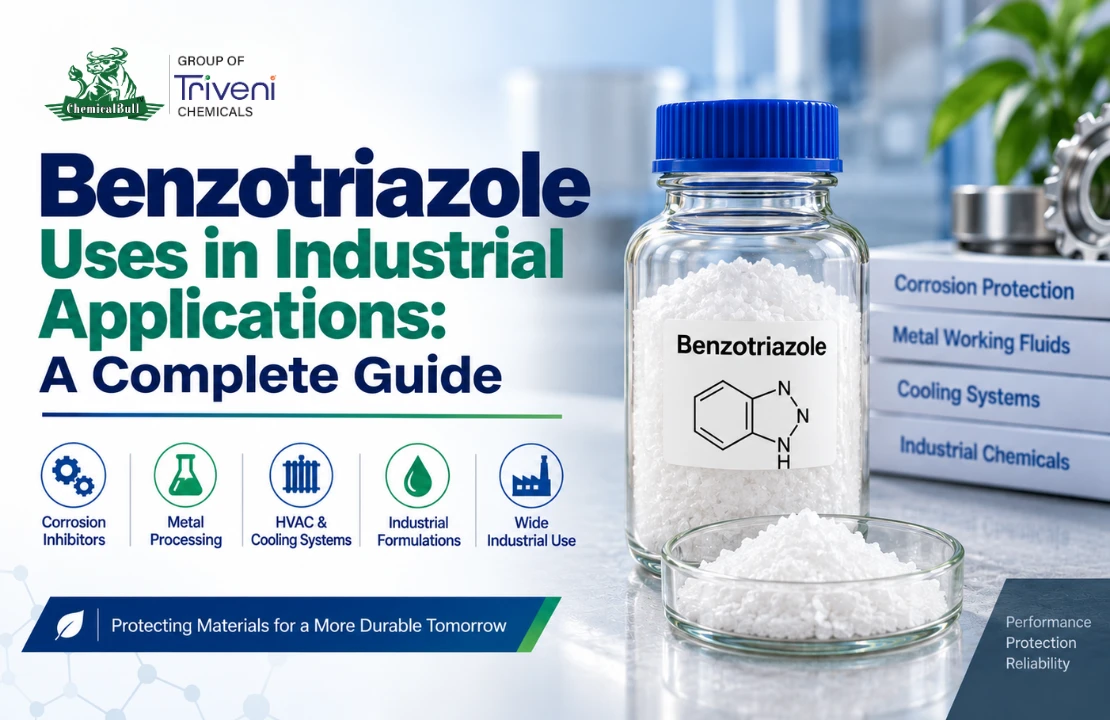
Benzotriazole is a nitrogen-containing heterocyclic compound commonly known as BTA. Its molecular structure includes a benzene ring fused with a triazole ring containing three nitrogen atoms.
It is especially valued for its interaction with copper surfaces, which makes it useful in corrosion-control and passivation systems.
|
Property |
Details |
|
Chemical Name |
Benzotriazole |
|
Common Abbreviation |
BTA |
|
CAS Number |
95-14-7 |
|
Molecular Formula |
C6H5N3 |
|
Molecular Weight |
Approx. 119.12 g/mol |
|
IUPAC Name |
1H-Benzotriazole |
|
Other Name |
1,2,3-Benzotriazole |
|
Appearance |
White crystalline solid |
|
Solubility |
Sparingly soluble in water; soluble in acetone and ethanol |
|
Melting Point |
128 °C |
|
Main Industrial Function |
Corrosion inhibitor |
|
Common Target Metal |
Copper and copper alloys |
Properties such as solubility and melting point can vary slightly with purity and test conditions, so industrial users should refer to the product specification and batch documentation for precise values.
What Is Benzotriazole Used For?
Benzotriazole is mainly used as a corrosion inhibitor and surface-protection additive for copper and copper-containing alloys.
Its main industrial applications include:
-
copper and brass protection
-
copper passivation after pickling
-
cooling-water treatment
-
heat exchangers
-
metalworking fluids
-
antifreeze and coolant formulations
-
metal surface-treatment systems
-
selected copper-processing applications
Its performance depends on the complete formulation, concentration, pH, temperature, metal type and operating conditions.
Major Industrial Applications
Copper and Brass Corrosion Protection
One of the most important applications of BTA is the protection of copper and copper alloys.
Copper is widely used in pipes, heat-transfer equipment, process systems and engineered components. In the presence of moisture, salts and other aggressive conditions, the metal surface can gradually corrode.
BTA interacts with the copper surface and helps form a protective layer. This reduces direct exposure of the metal to the surrounding corrosive environment.
It is therefore commonly considered in formulations intended for copper, brass, bronze and other copper-containing alloys.
Copper Passivation After Pickling
Copper passivation is an especially relevant application for industrial users.
After pickling or surface cleaning, freshly exposed copper can be more sensitive to oxidation or surface attack. Benzotriazole can be used in suitable post-treatment systems where a protective passivation layer is required.
BTA interacts with the cleaned copper surface and helps form a film that reduces rapid oxidation and corrosion during subsequent handling or processing.
The correct treatment conditions depend on factors such as:
-
pickling chemistry
-
copper or alloy type
-
surface condition
-
pH
-
temperature
-
downstream process
Because these factors vary from plant to plant, industrial users should evaluate the grade and treatment process according to their own operating conditions.
Cooling Water and Heat Exchangers
Cooling-water systems often contain copper or copper-alloy parts, particularly in condensers, tubes and heat exchangers.
BTA may be included in a broader water-treatment programme where copper protection is required.
Its effectiveness depends on the full water chemistry, including dissolved salts, pH, operating temperature and the presence of other treatment additives.
For this reason, formulators generally evaluate BTA as part of the complete corrosion-control system rather than using a fixed dosage for every application.
Metalworking Fluids
Metalworking fluids are used during machining, cutting, grinding and forming operations.
When these fluids come into contact with copper-containing metals, corrosion or surface staining can become a concern.
BTA may be added to suitable metalworking formulations to help protect copper surfaces and improve corrosion-control performance.
Compatibility with lubricants, emulsifiers and other formulation ingredients should be checked during product development.
Antifreeze and Coolant Formulations
Coolant systems can contain several different metals in contact with the same circulating fluid.
Where copper protection is required, BTA may be used as part of the corrosion-inhibitor package in coolant and antifreeze formulations.
Selection should consider:
-
metal combination
-
fluid chemistry
-
operating temperature
-
expected service life
-
overall inhibitor package
The material should therefore be evaluated as part of the complete formulation.
Metal Surface Treatment
BTA is also used in specialized surface-protection systems for copper-containing materials.
Its interaction with the metal surface makes it useful where temporary or longer-term protection is needed during processing, storage or handling.
The final performance depends on the surface condition, chemical environment and application method.
Copper Processing and Specialty Formulations
Some copper-processing and specialty chemical systems also use BTA where surface control is required.
In these applications, it can influence how the process solution interacts with copper.
Because process conditions vary widely, formulation trials are recommended before commercial use.
Chemical Manufacturing and Industrial Fluids
Benzotriazole may be used as a functional additive in selected industrial chemical formulations where metal protection is required. It can be incorporated into industrial fluids, corrosion-control products and specialty treatment systems depending on formulation requirements and compatibility.
UV Stabilization in Plastics and Coatings
Certain benzotriazole derivatives are widely used as UV absorbers in plastics, coatings and polymer systems. These materials help reduce damage caused by ultraviolet light, including colour fading, surface degradation and loss of material performance.
How Does BTA Protect Copper?
The mechanism of BTA is based on its interaction with copper.
When the molecule reaches the metal surface, the nitrogen atoms in its structure interact with copper species and help form a copper-BTA protective layer.
This surface film acts as a barrier and reduces direct contact between the metal and corrosive substances.
In simple terms, the process can be described as:
Surface adsorption → Interaction with copper → Protective film formation
This surface activity is the main reason BTA is widely used in corrosion-control systems.
Why Is BTA Useful in Industrial Formulations?
BTA is valued because it performs a specific functional role in metal protection.
Strong Interaction with Copper
Its molecular structure allows it to interact effectively with copper-containing surfaces.
Suitable for Several Industrial Systems
It can be considered in cooling-water treatment, metalworking fluids, coolants, passivation systems and other metal-protection applications.
Helps Reduce Corrosion
The protective surface layer reduces direct exposure of copper to aggressive environments.
Useful in Formulation Development
Manufacturers can evaluate BTA together with other additives to develop a complete corrosion-control system for a specific application.
Which Grade Is Suitable for Industrial Use?
Industrial buyers should select the grade according to the intended application, required purity and process conditions.
For applications such as:
-
copper passivation
-
pickling after-treatment
-
cooling-water systems
-
metalworking fluids
-
corrosion-control formulations
buyers should share the actual end use before finalizing the material.
This helps the supplier understand the technical requirement and recommend a suitable specification.
For technical evaluation, buyers may also request available documents such as:
-
TDS
-
SDS/MSDS
-
COA
-
product specification
-
batch details
Understanding Solubility and Formulation Compatibility
Solubility is an important consideration during formulation development.
Practical behaviour can vary depending on:
-
pH
-
temperature
-
concentration
-
solvent system
-
other additives present
For concentrated industrial products, compatibility testing should be carried out under actual production conditions.
This helps reduce issues related to instability, precipitation or poor dispersion during storage and use.
Benzotriazole Derivatives
Different Benzotriazole derivatives are also used in technical and specialty applications.
Changes in molecular structure can affect:
-
solubility
-
compatibility
-
adsorption behaviour
-
surface interaction
For this reason, the parent compound and its derivatives should not automatically be treated as interchangeable.
Selection should depend on the performance required in the final formulation.
What Should Buyers Check Before Purchasing?
Industrial procurement teams should look beyond product name and price.
Before placing an order, consider the following:
Application
Clearly mention whether the material is required for copper passivation, corrosion inhibition, water treatment, metalworking, coolants or another process.
Grade and Specification
Confirm the required purity and technical parameters before purchase.
Documentation
Ask for the available TDS, SDS/MSDS, COA and specification details.
Packaging
Choose packaging according to usage, storage and handling requirements.
Quantity
For regular consumption, sharing monthly or annual demand can help improve procurement planning.
Delivery Location
Domestic and export requirements may involve different logistics and documentation.
Benzotriazole Price and Bulk Procurement
The Benzotriazole price can vary according to commercial and supply conditions.
Important factors include:
-
required quantity
-
purity and specification
-
packaging
-
source availability
-
delivery location
-
freight
-
order frequency
-
domestic or export requirement
Buyers checking Benzotriazole price per kg should compare the complete offer, including specification, documentation, packing and logistics.
For bulk or repeat requirements, requesting a quotation based on the actual quantity and destination provides a more practical commercial reference.
Industrial Supply Support in India and International Markets
ChemicalBull operates as a raw chemical seller and sourcing partner for B2B customers.
We support enquiries from:
-
industrial manufacturers
-
water-treatment companies
-
metalworking-fluid formulators
-
coolant manufacturers
-
surface-treatment companies
-
chemical traders
-
distributors and wholesalers
-
importers
-
international procurement teams
Supply enquiries can be reviewed based on required quantity, grade, application, packaging and destination.
For export requirements, commercial documentation and logistics support can be discussed according to the destination country and order size.
Looking for Industrial Grade Benzotriazole?
If you need BTA for copper passivation, pickling after-treatment, cooling-water systems, metalworking fluids, corrosion-control formulations or other industrial applications, share your requirement with us for a suitable supply offer.
Please include:
- Required quantity
- Application or end use
- Required grade or specification
- Delivery location
- Monthly or annual requirement, if applicable
Industrial buyers can also request available TDS, SDS/MSDS, COA and product specification details for technical evaluation.
Connect with a reliable Benzotriazole supplier for bulk availability, documentation and commercial pricing support. Share your requirement to receive a relevant quotation for supply in India or international markets.
Frequently Asked Questions
1. What is Benzotriazole used for?
It is mainly used as a corrosion inhibitor and surface-protection additive for copper and copper alloys. Common applications include passivation, cooling-water systems, metalworking fluids, heat exchangers and coolant formulations.
2. Can Benzotriazole be used for copper passivation after pickling?
Yes, it can be considered in suitable copper-passivation systems after pickling or surface cleaning. It helps form a protective film on the copper surface and can reduce subsequent oxidation and corrosion.
3. What is the mechanism of action of Benzotriazole?
BTA interacts with the copper surface and helps form a protective copper-BTA layer. This film reduces direct exposure of the metal to corrosive species.
4. What documents should industrial buyers request?
Depending on the requirement, buyers may request TDS, SDS/MSDS, COA, product specification and batch-related information before purchase.
5. Where can industrial buyers source Benzotriazole?
Industrial buyers can source it through raw chemical sellers and sourcing partners such as ChemicalBull. Sharing the required quantity, application, specification and destination helps in receiving a more relevant commercial offer.
Comment Section