Chemical Bull
1126
15-Jun-2026
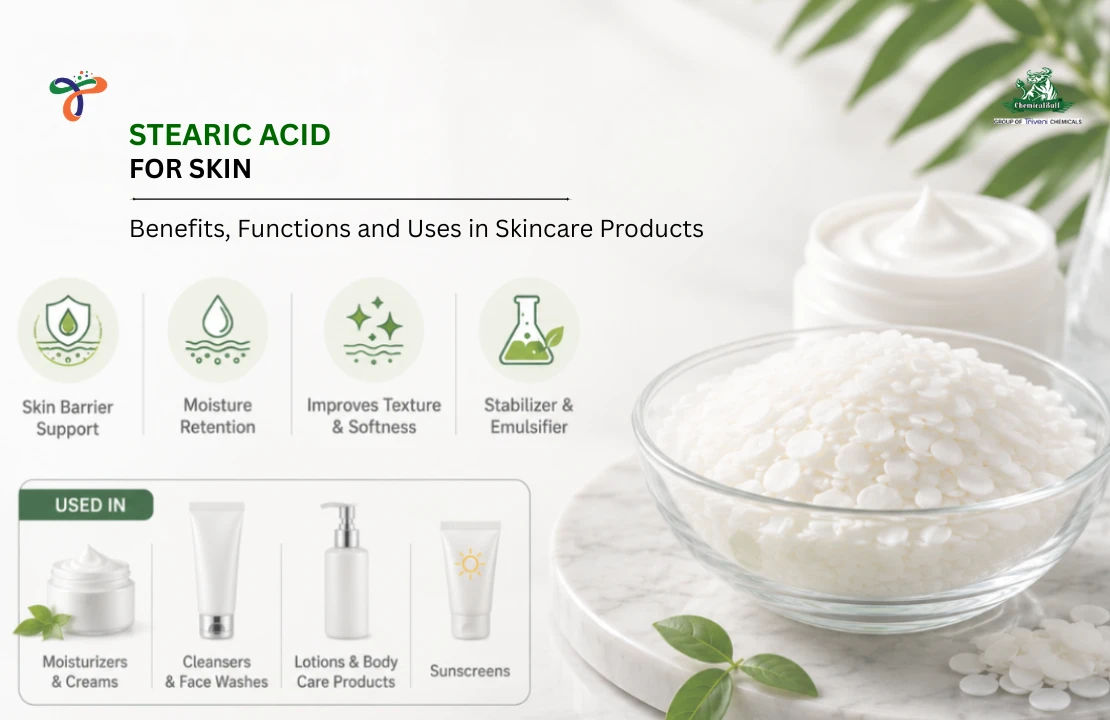
Stearic acid is a fundamental saturated fatty acid in the world of skincare formulation. In the cosmetic and personal care industry, when it comes to high-performance formulations, the consistency and quality of raw materials determine the ultimate success of the product. At ChemicalBull, we understand that for a formulator or brand owner, buying chemicals is not enough; choosing a reliable stearic acid who guarantees batch-to-batch consistency is essential.
Whether you are procuring in bulk or optimizing your current formulation, partnering with experienced stearic acid suppliers like us can significantly enhance your production efficiency. In this guide, we will cover the technical aspects, benefits, and critical procurement points for industrial stearic acid.
What is Stearic Acid? A Technical Overview
Chemically, stearic acid is known as octadecanoic acid C18H36O2. It is a long-chain saturated fatty acid derived from vegetable oils (such as shea butter, cocoa butter, and coconut oil). It can also be produced synthetically for industrial and cosmetic grades.
Chemical Structure and Properties:
- Molecular Formula: C18H36O2
- Physical State: At standard temperature, it appears as white, odorless, waxy flakes or beads.
- Amphiphilic Nature: Its structure consists of a hydrophobic (water-repelling) tail and a hydrophilic (water-attracting) head, making it an excellent emulsifier.
At ChemicalBull, we provide premium-quality stearic acid within our Personal Care Chemicals category, making it a top choice for cosmetic formulators.
Core Functions in Skincare Formulations
Stearic acid may not act as a "direct active treatment" in skincare formulations, but it serves as the "structural backbone." Without it, many premium creams and lotions would become unstable and watery.
1. Emulsification (The Binding Power)
Mixing oil and water is the biggest challenge in cosmetic formulations. Stearic acid acts as a powerful emulsifier that keeps these two phases stable, preventing cream separation.
2. Thickening and Stabilization
Stearic acid is responsible for the "rich and velvety" feel of creams and lotions. It provides structure to the formulation, ensuring the product feels premium upon application.
3. Occlusive Properties (Barrier Protection)
It forms a thin, breathable protective layer on the skin. This layer prevents Transepidermal Water Loss (TEWL) and locks moisture deep within the skin.
4. Surfactant and Cleansing
In cleansers, it reduces surface tension, making it easier to lift away dirt and excess sebum from the skin without harsh scrubbing.
Uses in Skincare Products: Application-Driven Guide
For manufacturers, stearic acid is like a "Swiss Army Knife." The table below highlights how you can effectively utilize our products:
|
Application |
Primary Function |
ChemicalBull Recommended Product |
|
Moisturizers & Lotions |
Thickening & Emollience |
|
|
Face Washes & Cleansers |
Surfactant & Lather Booster |
|
|
Vanishing Creams |
Structure & Pearlescent Finish |
|
|
Viscosity Control |
Texture Enhancement |
Stearic Acid vs. Cetyl Alcohol: Understanding the Difference
Often, formulators compare Stearic Acid with Cetyl Alcohol to achieve the right viscosity and skin feel. While Stearic Acid primarily provides structure, stabilization, and emulsification, Cetyl Alcohol acts as a high-performance thickener and emollient. At ChemicalBull, we supply both high-quality raw materials, allowing you to perfectly balance your cosmetic formulations for optimal results.
Key Skin Benefits: Why Formulators Choose Stearic Acid
Stearic acid is highly effective for dry, normal, and sensitive skin. Here is a scientific breakdown of its benefits:
1. Deep Moisturization
It supports the skin's natural lipid barrier. A strong lipid barrier ensures that moisture stays locked in while keeping external irritants out.
2. Texture Enhancement
For a formulator, "spreadability" is crucial. Stearic acid helps creams spread smoothly over the skin without feeling sticky or greasy.
3. Gentle Cleansing
Modern demand favors "gentle cleansing" over harsh chemicals. Stearic acid generates a creamy lather in cleansers that cleanses without damaging the skin.
4. Safety and Side Effects
We often get asked about stearic acid side effects. According to the Cosmetic Ingredient Review (CIR) and the Environmental Working Group (EWG), stearic acid is safe with very low health risks. It is a fatty acid, not a steroid. Despite having a comedogenic rating of 2–3, it is non-irritating for the vast majority of users.
Technical Specifications: Quality Assurance
|
Parameter |
Specification |
|
Purity |
>98% |
|
Appearance |
White Flakes |
|
Acid Value |
200 - 210 mg KOH/g |
|
Melting Point |
68°C - 70°C |
For the full Technical Data Sheet (MSDS) and COA, please visit our stearic acid Msds.
Quality Assurance & Compliance at ChemicalBull
At ChemicalBull, we understand that cosmetic formulations are highly sensitive. Our commitment goes beyond just supply; it extends to rigorous quality assurance. Every batch of stearic acid undergoes multi-stage testing to ensure it meets the 98%+ purity benchmark and remains free from impurities. We provide comprehensive documentation support, including Certificate of Analysis (COA) and Technical Data Sheets (TDS) for every order, ensuring your brand maintains regulatory compliance with ease.
Technical Pro-Tips for Formulators
Managing stearic acid in high-volume production requires precision. For our manufacturing partners, we recommend:
- Controlled Melting: Always ensure the melting phase is gradual (approx. 70°C) to prevent thermal degradation and maintain consistent texture.
- Stabilization: If you are dealing with high-water-content formulations, pair your stearic acid with our Glyceryl Monostearate to avoid any risk of emulsion separation.
- Storage: Store flakes in a cool, dry place away from direct sunlight to prevent clumping.
Why Partner with ChemicalBull?
In B2B procurement, logistics, consistency, and trust are the highest priorities. We are one of the leading stearic acid in India, committed to quality and reliability. Our strategic supply network operating from Vapi, Gujarat, ensures quick lead times and seamless distribution to factory floors across the entire country.Scale and Production: As stearic acid manufacturers for large-scale production units, our robust supply chain ensures bulk orders are delivered on time.
- Trusted Suppliers Network: If you are looking for reliable stearic acid suppliers who offer more than just a product—providing technical consultation—we are your ideal partner.
- Pan-India Presence: Our network of stearic acid distributors spans across India, ensuring seamless delivery to your doorstep.
- Competitive Pricing: As prominent stearic acid wholesalers, we provide market-competitive pricing that helps maximize your production margins.
Frequently Asked Questions (FAQ)
-
Can Stearic Acid be used for skin whitening?
No, stearic acid does not possess skin-whitening properties. It is used primarily for moisture retention, texture improvement, and emulsion stability. -
How do I use stearic acid in my formulation?
It is typically added to the oil phase of the formulation, heated to 70°C until melted, and then emulsified with the water phase. -
Is ChemicalBull a bulk Stearic Acid wholesaler?
Yes, we are a trusted wholesaler for both cosmetic and industrial-grade materials. -
Is Stearic acid safe for oily skin?
Stearic acid has a comedogenic rating of 2–3. For those with highly acne-prone skin, a patch test is recommended as high concentrations can potentially clog pores.
Conclusion
The first step to creating a stable, premium skincare product is choosing the right raw materials. Stearic acid is not just a chemical; it is the foundation of your cream, lotion, or cleanser's stability. When you choose ChemicalBull as your partner, you aren't just selecting a stearic acid manufacturer; you are choosing a technical team committed to the success of your formulation.
Request your quote now and talk to our experts for bulk procurement!
Comment Section



