Chemical Bull
1205
16-Jun-2026
Introduction
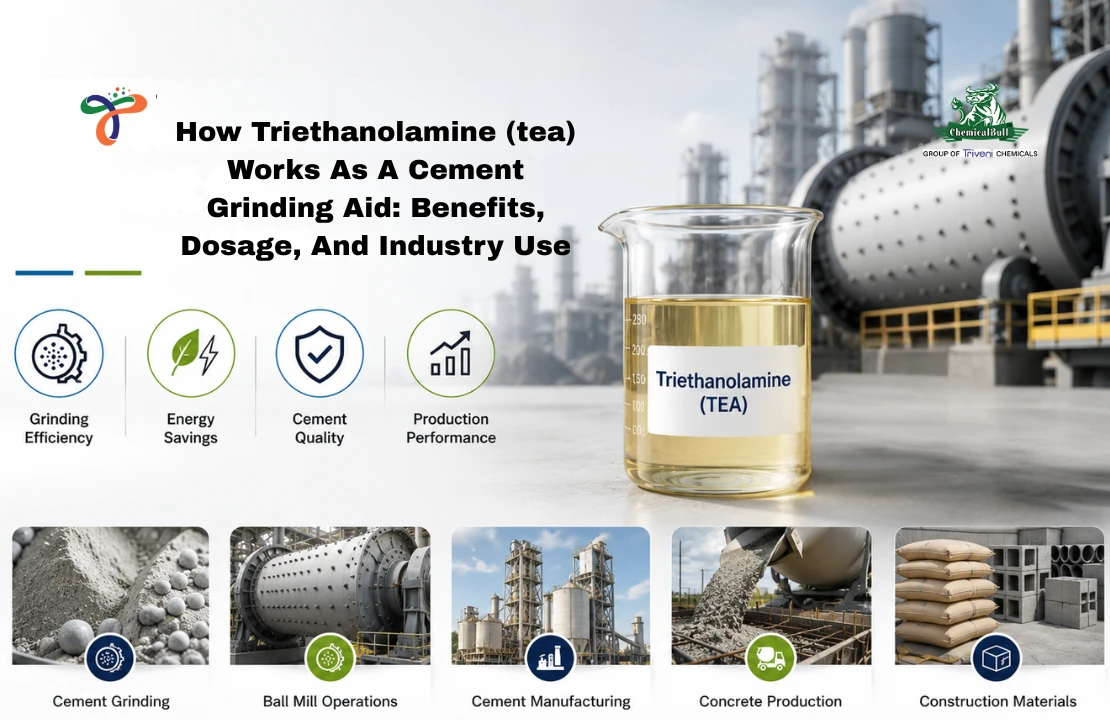
The cement industry is among the major industries that consume industrial chemicals. In addition to the numerous additives utilized for cement production, grinding aids are essential to optimizing production efficiency as well as reducing energy use. Triethanolamine, also known as TEA, is among the most extensively studied and widely used cement grinding aid chemicals around the world.
If you are in the cement manufacturing, construction chemicals, or industrial chemicals sector, understanding how triethanolamine works as a grinding aid can help you make better formulation and procurement decisions.
This blog explains the mechanism of action, benefits, recommended dosage, and industrial use of triethanolamine as a cement grinding aid — all in a clear and practical manner.
What Is a Cement Grinding Aid?
A cement grinding aid is a chemical additive added during the cement clinker grinding process. Its primary function is to improve the efficiency of the grinding operation by:
- Preventing fine cement particles from sticking together (agglomeration)
- Reducing coating on grinding media and mill liners
- Improving the flowability of cement powder
- Reducing energy consumption during grinding
Without a grinding aid, fine cement particles tend to reagglomerate (clump together), which reduces grinding efficiency, increases energy use, and affects the final quality of the cement.
Triethanolamine is one of the oldest and most effective chemical compounds used for this purpose, particularly in Ordinary Portland Cement (OPC) and blended cement manufacturing.
Looking to source high-quality triethanolamine for your cement or industrial application?
Connect with a trusted triethanolamine distributor for competitive pricing and bulk supply.
How Does Triethanolamine Work as a Cement Grinding Aid?
Triethanolamine (TEA) has a unique molecular structure — it contains both amine and hydroxyl groups, which makes it highly polar and reactive with cement mineral surfaces.
Here is how TEA works step by step during cement grinding:
1. Surface Adsorption on Cement Particles
If TEA is added to the process of grinding, its particles are drawn to and then adsorb on freshly made surfaces of cement particles. The reason for this is that the freshly formed surfaces of clinker particles contain unsaturated or insufficient charge surfaces that draw polar molecules, such as TEA.
2. Reduction of Surface Energy
When it is adsorbed, TEA reduces the surface energy of cement particles. The lower energy of the surface means that the cement particles are less likely to get attracted to each other and form clumps. This reduces the chance of agglomeration during grinding.
3. Electrostatic Repulsion Between Particles
TEA Adsorption can also alter the potential of the surface (zeta potential) of cement particles. Similar surface charges on the individual particles trigger electrostatic repulsion. This ensures their separation and increases dispersion in milling.
4. Prevention of Coating on Grinding Media
In the absence of grinding aids, small cement particles cover the mill's grinding balls and walls, decreasing the effectiveness of grinding with the course of. TEA blocks this effect of coating and helps keep the grinding medium in good condition and efficient throughout the procedure.
Key Benefits of Using Triethanolamine in Cement Grinding
The use of TEA as a cement grinding aid delivers multiple measurable benefits:
Improved Grinding Efficiency
TEA significantly increases the Blaine specific surface area of cement — a standard measure of cement fineness. A higher Blaine number means finer cement, which directly improves early and final compressive strength. Studies have shown that TEA can increase the Blaine specific surface area by up to 16% compared to cement ground without any aid.
Reduced Energy Consumption
By preventing agglomeration and reducing coating on grinding media, TEA allows mills to achieve the desired cement fineness with lower energy input. This translates directly into lower production costs, which is critical for large-scale cement manufacturers.
Higher Cement Compressive Strength
TEA not only improves grinding efficiency but also has a secondary effect on cement hydration. It can accelerate the hydration reaction of cement minerals, leading to higher early compressive strength (at 3 and 7 days) compared to untreated cement.
Better Cement Flowability
TEA improves the flowability of cement powder, which is important for handling, packing, and transportation. Cement with better flowability is easier to pack into bags and discharge from silos.
Compatibility with Multiple Cement Types
TEA-based grinding aids are effective across different types of cement, including OPC (Ordinary Portland Cement), blended cements, slag cement, and fly ash-based cement formulations.
Recommended Dosage of Triethanolamine in Cement Grinding
The effectiveness of TEA as a grinding aid is highly dependent on the dosage. Using the correct amount is important — too little may have minimal effect, and too much can cause negative effects on late-stage cement strength.
Standard Dosage Range:
- Typical dosage: 0.01% to 0.06% by weight of cement
- Commonly used dosage: 0.03% to 0.05%
- Optimal dosage for most applications: around 0.03%
At 0.03% TEA, studies have reported significant improvement in both particle fineness and early compressive strength without compromising the 28-day strength development.
Important Note: The dosage should be optimized for each specific mill type, cement composition, and production target. Ball mills and vibrating disk mills respond differently to TEA. Ball mills generally show greater improvement compared to vibrating disk mills at the same dosage level.
How Triethanolamine Affects Cement Strength?
One of the important considerations when using TEA is its effect on both early and late-stage cement strength.
Early Strength (3 to 7 Days):
TEA accelerates the hydration of cement mineral phases, which leads to faster early strength development. This is beneficial for precast concrete applications and construction projects requiring quick formwork removal.
Late Strength (28 Days):
At appropriate dosages, TEA does not negatively affect 28-day compressive strength. In fact, proper dosage leads to strength improvement at 28 days as well, due to better particle distribution and optimized hydration.
Caution: Overdosing TEA beyond the recommended range can slow the later-stage hydration and may compromise 28-day strength. This is why dosage optimization is critical.
Industrial Use of TEA as a Cement Grinding Aid
Triethanolamine as a cement grinding aid is not a new concept — it has been commercially used in the cement industry for decades. Its widespread use continues because of its proven effectiveness and availability.
Industries and applications where TEA-based grinding aids are commonly used:
- Ordinary Portland Cement (OPC) manufacturing
- Blended cement production (slag, fly ash, pozzolana)
- Ready-mix concrete chemical admixture formulations
- Precast concrete product manufacturing
- Construction chemical industry
Major global cement producers routinely use TEA or TEA-based formulations as part of their cement grinding aid programs because it consistently delivers efficiency improvements and energy savings at relatively low cost.
Why Triethanolamine Is Preferred Over Other Grinding Aids ?
There are several chemical compounds used as cement grinding aids, including glycols (propylene glycol, ethylene glycol), amines, and other alkanolamines. Triethanolamine holds a strong position among them for the following reasons:
- Dual functionality: Acts as both a grinding aid (prevents agglomeration) and a strength enhancer (accelerates hydration).
- Proven track record: Decades of commercial use in cement manufacturing globally.
- Cost-effectiveness: Available at competitive prices compared to specialty grinding aids.
- Compatibility: Works well with most cement compositions and grinding equipment.
- Multifunctional chemistry: Its amine and hydroxyl groups allow it to interact with cement mineral surfaces in multiple ways.
Triethanolamine Safety Considerations in Industrial Use
When handling triethanolamine in bulk for cement grinding applications, the following safety and handling practices should be maintained:
- Use appropriate personal protective equipment (PPE) including gloves and safety glasses
- Avoid prolonged skin and eye contact
- Store in sealed containers in a cool and dry environment
- Ensure proper ventilation in storage and handling areas
- Follow local industrial chemical handling regulations
TEA is classified as a low-hazard industrial chemical when handled according to standard practices. Its long history of safe industrial use makes it a reliable choice for cement manufacturers.
Market Demand for TEA in the Cement Sector
The global triethanolamine market continues to grow, driven in part by strong demand from the construction and cement sector. Asia Pacific — including India, China, and Southeast Asia — dominates the consumption of triethanolamine for cement applications, reflecting the rapid growth in infrastructure and construction activity across the region.
India, being the second-largest cement producer in the world, represents a significant and growing market for TEA as a cement grinding aid. With increasing urbanization and infrastructure development, demand for high-quality cement and efficient cement manufacturing chemicals is only expected to grow.
Conclusion
Triethanolamine (TEA) is a proven, versatile, and cost-effective cement grinding aid that improves grinding efficiency, reduces energy consumption, enhances particle size distribution, and contributes to better compressive strength development. Its unique molecular structure — combining amine and hydroxyl functional groups — allows it to interact with cement particle surfaces in a way that prevents agglomeration and improves dispersion during milling.
For cement manufacturers looking to optimize grinding operations, reduce costs, and improve product quality, TEA remains one of the most reliable chemical solutions available.
Whether you are formulating cement grinding aids or procuring TEA for large-scale industrial use, working with a reliable supply partner is essential.
Frequently Asked Questions (FAQ)
Q1. What is the role of triethanolamine in cement?
Triethanolamine acts as a cement grinding aid by preventing particle agglomeration during clinker grinding, improving grinding efficiency, and accelerating early cement hydration to enhance compressive strength.
Q2. What is the recommended dosage of triethanolamine in cement grinding?
The typical dosage range is 0.01% to 0.06% by weight of cement, with 0.03% being the most commonly used and effective dosage for most cement types.
Q3. Does triethanolamine affect cement strength?
Yes. At the correct dosage, TEA improves early compressive strength (3 and 7 days) and maintains or enhances 28-day strength through better particle distribution and accelerated hydration.
Q4. Is triethanolamine safe to use in cement manufacturing?
Yes. TEA is considered a low-hazard industrial chemical when handled with standard precautions, including proper PPE, storage, and ventilation.
Q5. Which types of cement can use triethanolamine as a grinding aid?
TEA is effective across OPC (Ordinary Portland Cement), blended cements, slag cement, fly ash cement, and other hydraulic cement formulations.

Comment Section