Chemical Bull
413
17-Jul-2026
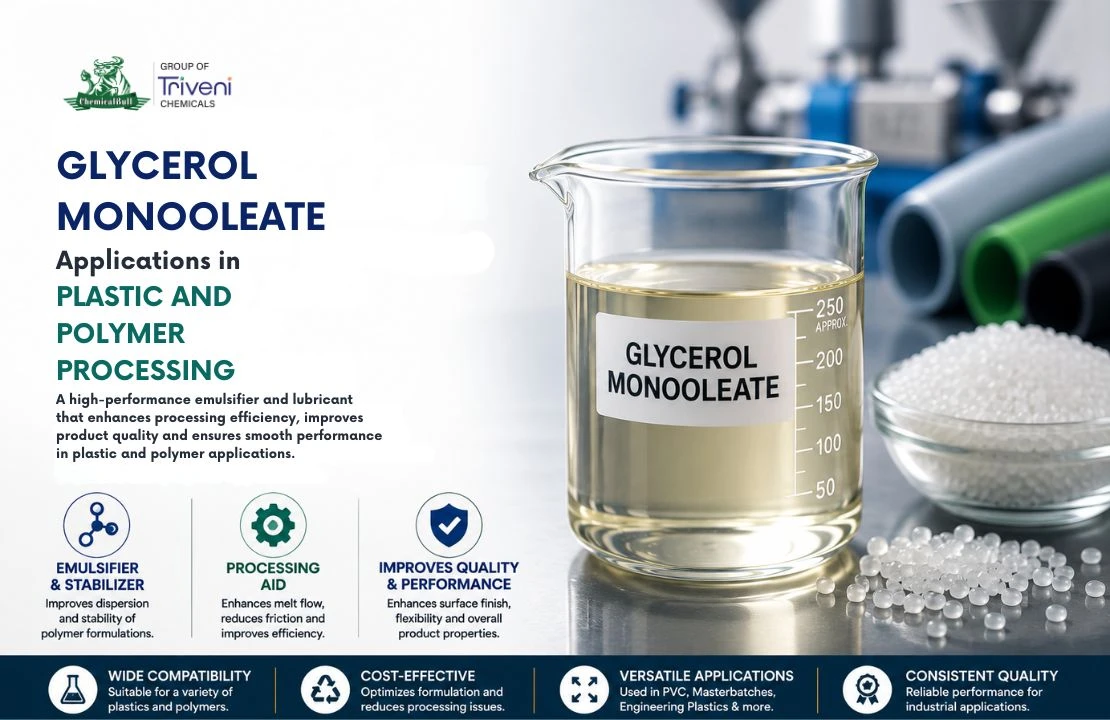
Glycerol Monooleate Applications in Plastic and Polymer Processing
In the modern manufacturing landscape, the efficiency of a production line is often determined by the precision of its chemical additives. While many manufacturers are familiar with traditional lubricants, Glycerol Monooleate (GMO)—also known as monoolein—has emerged as a specialized, high-performance solution for the plastics and polymer industry.
For businesses looking for consistent, high-purity additives, finding a reliable Glycerol Monooleate supplier is the first step toward optimizing production efficiency and product quality.
What is Glycerol Monooleate (GMO)?
Glycerol Monooleate is an amphiphilic molecule with both hydrophilic and lipophilic properties. Unlike waxy additives like glycerol monostearate uses in various sectors, GMO is typically a liquid or soft semi-solid at room temperature. This unique physical state allows for rapid migration to the surface of polymers, making it an ideal additive for performance-critical applications.
Key Benefits of GMO in Polymer Processing
Integrating GMO into your polymer formulation provides several distinct competitive advantages:
- Superior Anti-Fogging: GMO acts as a powerful anti-fogging agent in food packaging films by reducing the surface tension of condensed moisture.
- Enhanced Lubrication: It functions as both an internal and external lubricant, reducing friction within the polymer melt.
- Improved Flowability: By lowering melt viscosity, GMO facilitates smoother operation in extrusion and injection molding.
- Anti-Blocking Performance: It prevents plastic films and sheets from sticking together during winding and handling.
- Uniform Pigment Dispersion: It acts as a wetting agent for pigments and fillers, ensuring color consistency.
GMO vs. GMS: Understanding the Additives
When comparing additives, engineers often weigh the benefits of Glycerol Monooleate against glycerol monostearate benefits. While GMS is widely recognized for its structural stability and waxy consistency, GMO’s liquid phase offers faster surface activation.
It is also worth noting that while glycerol monostearate uses in food are well-documented due to its emulsifying properties, GMO is rapidly becoming the preferred industrial grade for plastics requiring high-speed processing and superior clarity.
For a detailed breakdown of how these two additives perform against each other in industrial formulations, check out our in-depth guide: Glyceryl Monooleate vs. Glyceryl Monostearate (GMO vs. GMS): A Comparison for Formulators.
Key Technical Applications
Anti-Fogging Mechanism
- The Problem: Condensation on film surfaces creates fog, making packaging look unappealing.
- The GMO Solution: GMO molecules migrate to the surface and lower the surface tension of water droplets.
- Result: Droplets "wet out" into a transparent layer, ensuring crystal-clear product visibility.
Internal & External Lubrication
- Internal: Acts as a "molecular ball-bearing" between polymer chains, reducing melt viscosity and lowering energy consumption.
- External: Forms a slip-layer between the mold and the plastic, facilitating faster cycle times and easy demolding.
Anti-Blocking Performance
- The Problem: Film layers sticking (blocking) makes unwinding industrial rolls difficult.
- The GMO Solution: Creates a microscopic slip-layer that reduces the coefficient of friction.
- Result: High-speed unwinding without film tearing or stretching.
Pigment & Filler Dispersion
- The Problem: Pigment clumping leads to streaks and brittle spots in the plastic.
- The GMO Solution: Coats particles to neutralize attraction, ensuring uniform distribution throughout the resin.
Nucleating Agent
- The Role: Acts as a nucleating agent in EPS manufacturing to create fine, uniform cell structures, which significantly enhances the thermal insulation of the final product.
Why GMO Outperforms Traditional Additives
The efficiency of GMO stems from its molecular "kink." Derived from unsaturated oleic acid, its fluidity ensures it migrates quickly to the surface—a critical requirement for immediate surface activity. Furthermore, its low Hydrophilic-Lipophilic Balance (HLB) of ~3.8 ensures seamless integration into non-polar polymer matrices without causing the "blooming" or haze seen in lower-quality formulations.
Optimizing Your Formulation with ChemicalBull
At ChemicalBull, we provide high-purity, standardized grades of GMO designed for industrial reliability. Our technical support team works closely with R&D departments to ensure that your formulation achieves:
- Reduced Cycle Times: By optimizing mold release.
- Superior Surface Finish: Achieving the perfect matte or glossy look.
- Cost Efficiency: Reducing energy loads and minimizing production scrap.
Complementary Additives for Enhanced Polymer Performance
To achieve the highest level of efficiency, GMO can be integrated with other specialized additives:
- Glycerol Monostearate (GMS): While GMO offers rapid surface activity, GMS provides structural stability. A balanced blend is often used to achieve both gloss and rigidity.
- Zinc Stearate: Pairs with GMO to provide a superior mold release effect, essential for high-heat PVC processing.
- Erucamide: Perfect for long-term slip performance in film manufacturing, complementing GMO’s short-term lubrication.
- Calcium Stearate: An essential acid scavenger that stabilizes the polymer matrix, preventing thermal degradation during processing.
Frequently Asked Questions (FAQs)
-
What is the main difference between Glycerol Monooleate (GMO) and Glycerol Monostearate (GMS)?
The primary difference lies in their physical state and migration speed. GMS is typically a waxy solid used for structural stability, whereas GMO is a liquid or soft semi-solid that migrates rapidly to the surface, making it superior for anti-fogging and high-speed processing applications. -
Why is Glycerol Monooleate (GMO) preferred in food packaging films?
GMO acts as a highly effective anti-fogging agent. Its amphiphilic nature reduces the surface tension of water droplets, allowing them to "wet out" into a transparent layer, which ensures the packaging remains crystal clear and maintains food visibility. -
Can GMO be used as a lubricant in plastic manufacturing?
Yes, GMO serves as both an internal and external lubricant. Internally, it reduces melt viscosity to save energy; externally, it acts as a mold-release agent to prevent plastic from sticking to machinery, thereby reducing cycle times. -
Is Glycerol Monooleate (GMO) safe for food contact materials?
Yes, most high-purity, food-grade GMOs are vegetable-derived, non-toxic, and comply with global safety standards for indirect food contact, making them an excellent choice for food packaging manufacturers. -
How does GMO improve the color consistency of plastic products?
GMO acts as a wetting agent for pigments and fillers. It coats the particles, preventing them from clumping together (agglomeration), which ensures that colors and additives are distributed uniformly throughout the resin for a streak-free finish.
Conclusion
Glycerol Monooleate is an essential additive for polymer manufacturers looking to maximize throughput and ensure premium product quality. From high-clarity films to precision automotive parts and sustainable bioplastics, GMO provides the reliable performance your production process demands.


Comment Section



