Chemical Bull
525
16-Jul-2026
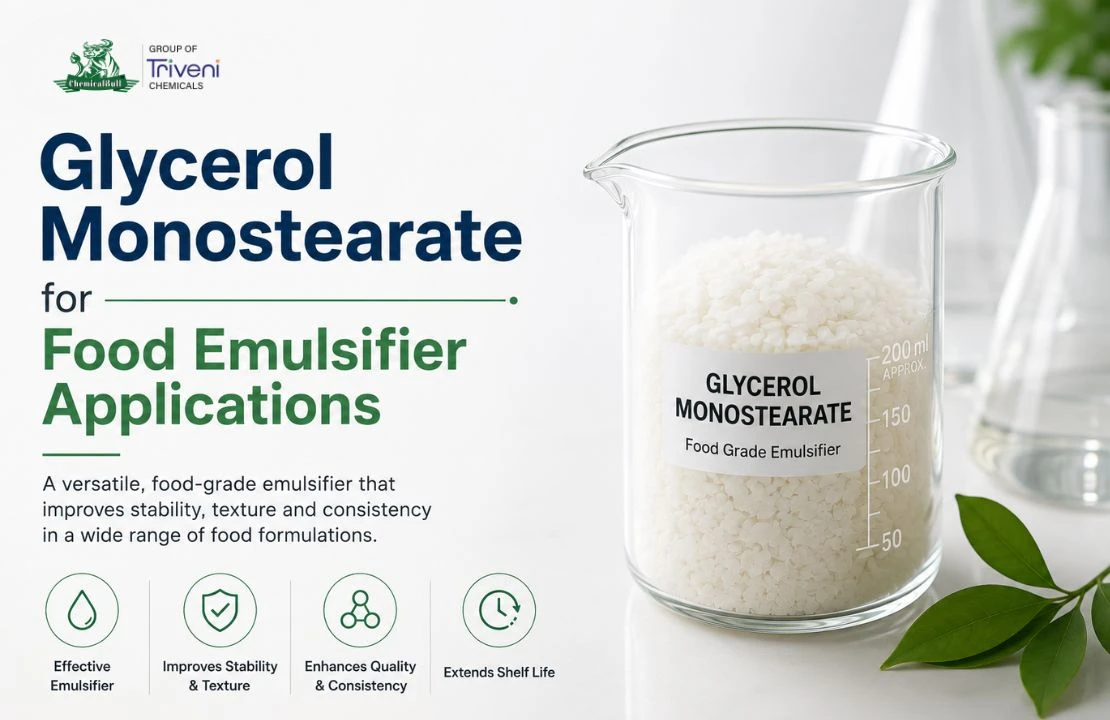
Glycerol Monostearate for Food Emulsifier Applications
In the modern food industry, achieving the perfect texture, stability, and shelf life is a continuous challenge for formulators. Among the various functional ingredients available, Glycerol Monostearate (GMS) stands out as a foundational tool. As a non-ionic, food-grade emulsifier, it bridges the gap between immiscible oil and water phases, ensuring that processed foods maintain their desired quality from the production line to the consumer’s table.
Whether you are developing shelf-stable baked goods, creamy dairy desserts, or smooth confectionery, sourcing high-purity ingredients is vital for consistent results. If you are seeking a reliable glyceryl monostearate supplier, ChemicalBull provides the technical documentation and high-quality grades necessary to streamline your manufacturing process.
The Chemistry Behind the Functionality
Glycerol Monostearate (also referred to as GMS or E471) is an amphiphilic molecule. Its structure features a glycerol backbone esterified with a single stearic acid chain. This unique configuration grants it a "split personality":
- Hydrophilic (Water-loving) head: Interacts with the aqueous phase.
- Lipophilic (Fat-loving) tail: Interacts with fats and oils.
When added to food systems, GMS positions itself at the interface of oil and water, effectively lowering surface tension and preventing the droplets from coalescing. This mechanism is the secret behind the smooth, uniform consistency found in many everyday grocery items.
Understanding GMS Composition and Types
GMS is a mixture consisting of glycerol monostearate, glycerol distearate, and glycerol tristearate. Depending on the concentration of the mono-ester, it is classified into three market types:
- GMS 40: The assay of glycerol monostearate is not less than 40%.
- GMS 60: The assay of glycerol monostearate is not less than 60%.
- DGM (Distilled Glycerol Monostearate): The highest purity level, with not less than 90% assay.
Functional Roles in Food Formulation
GMS is far more than just a simple emulsifier; it is a multi-functional additive that offers several technical advantages:
- Anti-Staling Properties: By binding with starch molecules (specifically amylose), GMS slows down retrogradation—the process responsible for bread staling and crumb hardening.
- Crystallization Inhibition: In frozen desserts and chocolates, GMS regulates the growth of fat and ice crystals, preventing gritty textures and "fat bloom."
- Aeration & Foam Stability: GMS enhances the volume and stability of air bubbles in cake batters and whipped toppings, resulting in a lighter, more appealing product.
- Viscosity Regulation: It effectively modifies the flow of sauces, dressings, and condiments, ensuring they coat products evenly without separating.
Core Food Industry Applications
1. Bakery Products
In the baking sector, GMS is widely used in bread, buns, cakes and pastries to support dough or batter performance, crumb characteristics, texture and processing consistency. It may also help maintain softness and product quality during storage, depending on the formulation.
For a broader comparison of emulsifiers used across bread, cakes and other baked products, explore our guide on bakery emulsifiers: types, uses and applications.
2. Dairy and Frozen Desserts
In ice cream manufacturing, GMS is used to manage the blend of water and dairy fat. It prevents the formation of coarse ice crystals during frozen storage, providing a creamy, professional-grade mouthfeel that resists melting fluctuations during transport.
3. Confectionery and Chocolates
GMS acts as a powerful plasticizer and crystal modifier. In chocolates, it inhibits fat migration, keeping the product glossy. In toffees and caramels, it reduces stickiness and prevents sugar crystallization, ensuring a smoother processing experience.
4. Margarine and Spreads
Without an emulsifier, fat-based spreads would suffer from oil separation. GMS creates a stable, water-in-oil emulsion that results in a smooth, knife-spreadable consistency, even after refrigeration.
Technical Specifications & Handling
For food scientists and formulators, understanding the physical parameters of GMS is essential for successful integration:
|
Parameter |
Specification Details |
|
Appearance |
White, odorless powder or waxy flakes |
|
Melting Point |
57°C to 65°C |
|
Solubility |
Insoluble in cold water; dispersible in hot water |
|
Regulatory Status |
GRAS (Generally Recognized as Safe) |
Formulation Tip: Because GMS has a high melting point, it must be melted into the oil phase (or hot water) to fully activate its emulsifying properties. Typical usage levels range from 0.1% to 1.0% of the total product weight.
Why Choose ChemicalBull for Glycerol Monostearate?
n a competitive market, sourcing high-quality GMS is about more than just the product—it’s about reliability, compliance, and technical partnership. Industry leaders choose ChemicalBull for these core reasons:
- Consistent Quality & Purity: We provide high-performance grades (GMS 40, 60, and Distilled 90) that ensure batch-to-batch consistency. Every shipment is backed by a comprehensive Certificate of Analysis (COA) to meet your strict quality standards.
- Full Technical Support: We don't just ship products; we provide the data you need. Our team offers complete technical documentation, including MSDS (Material Safety Data Sheets), to ensure seamless integration into your formulations.
- Supply Chain Reliability: With a robust global supply network, we ensure timely delivery to keep your production lines running without interruption.
- Customized Solutions: Whether you need vegetable-derived, Halal-compliant, or Kosher-certified GMS, we work closely with you to meet your specific dietary and quality requirements.
- R&D Partnership: We understand that every formulation is unique. We provide standardized sample kits for testing, allowing your R&D team to validate our GMS in your specific applications before you commit to large-scale production.
Why Quality Matters in Sourcing
As the global food industry shifts toward more complex, clean-label formulations, the consistency of your raw materials becomes the defining factor in product quality. Impurities in emulsifiers can lead to batch-to-batch variation, impacting flavor, texture, and structural stability.
By working with certified manufacturers, food producers can ensure that their ingredients meet stringent safety standards, including compliance with international food regulations. Whether you are scaling up production or refining a new recipe, prioritizing high-purity GMS is an investment in the long-term success of your brand.
Explore Our Related Solutions
- Sorbitan Monostearate (SMS): Often used alongside GMS for superior stability in complex oil-in-water emulsions.
- Propylene Glycol Monostearate (PGMS): Excellent for aeration and foam stabilization in cakes and toppings.
Frequently Asked Questions (FAQs)
-
Is Glycerol Monostearate (GMS) natural?
GMS is produced via chemical synthesis, but it is derived from natural vegetable oils (like palm or rapeseed) and is also naturally occurring in the human body during fat digestion. -
Is GMS safe for food formulations?
Yes, it is classified as GRAS (Generally Recognized as Safe) by the FDA and EFSA. It is widely used globally due to its proven safety profile in food applications. -
How should formulators manage GMS dosage?
To avoid any potential waxy mouthfeel, formulators should adhere to recommended usage levels, typically between 0.1% to 1.0% of the total product weight. -
Can GMS be used in non-food industries?
Absolutely. Beyond food, GMS is a vital ingredient in the production of cosmetics as an emollient and in plastics as an anti-static, lubricating, and anti-fogging agent. -
Why is the grade (GMS 40/60/90) important?
The grade indicates the purity of the mono-ester content. Higher grades (like Distilled GMS 90) offer superior emulsification performance and efficiency, requiring lower dosage levels for complex formulations.
Conclusion
Glycerol Monostearate (GMS) is more than just an emulsifier; it is a critical performance additive that defines the texture, stability, and sensory quality of your food products. From extending the shelf life of bakery goods to ensuring the creamy perfection of frozen desserts and the smooth finish of confectionery, GMS serves as the "hidden engine" of successful food formulations.
For food manufacturers, the difference between a good product and a market-leading one often comes down to the quality of ingredients. By choosing the right grade of GMS and partnering with a supplier that prioritizes purity, documentation, and technical transparency, you can overcome complex formulation challenges with confidence.
At ChemicalBull, we are committed to empowering your innovation with high-purity GMS and end-to-end technical support. Let’s work together to elevate the quality and consistency of your next production batch.
Need expert guidance for your next production batch? Contact our technical team here for MSDS, and personalized formulation support.




Comment Section



