Chemical Bull
787
17-Jul-2026
Why Is Sodium Oleate Used in Soap and Detergents?
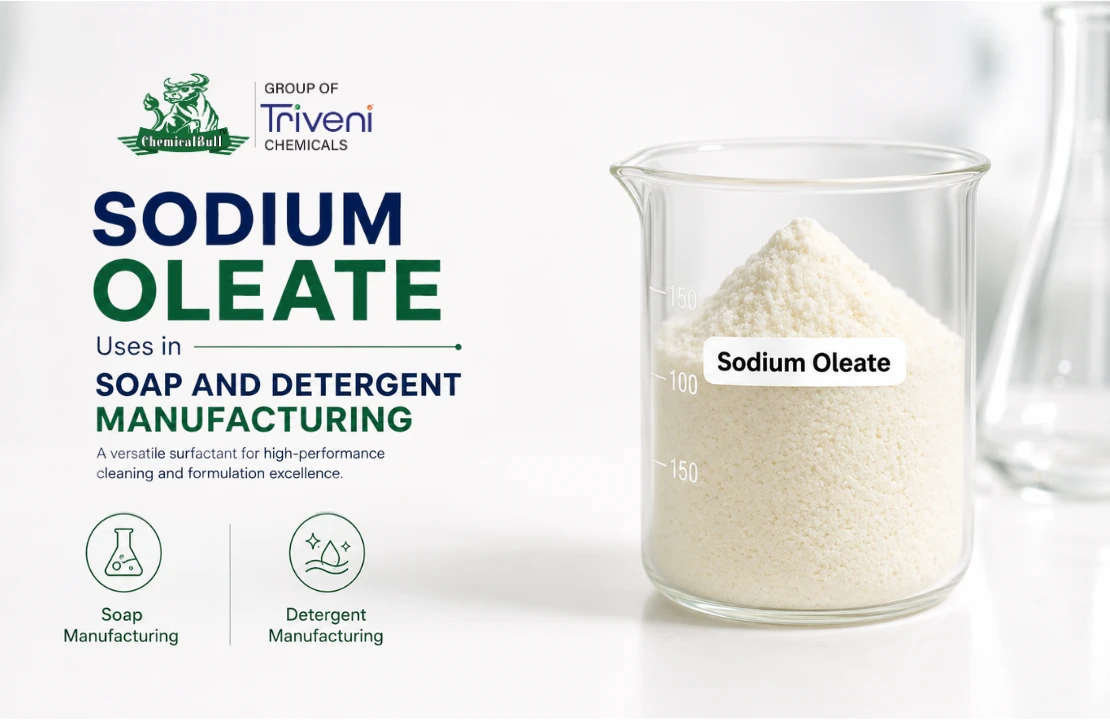
Sodium Oleate is used in soap and detergent manufacturing as an anionic surfactant, emulsifier, foam-support ingredient, wetting agent, and cleaning aid. It helps improve oil removal, soil dispersion, lather quality, and formulation performance in selected soaps, liquid detergents, textile cleaners, industrial cleaners, and personal cleansing products.
For bulk sourcing, technical documents, and grade details, buyers can connect with ChemicalBull as a reliable Sodium Oleate supplier for soap, detergent, textile, cleaning, and industrial formulation requirements.
Introduction
Soap and detergent manufacturing depends on surfactants that can reduce surface tension, remove oily dirt, support foam, and improve cleaning efficiency. Different cleaning products need different surfactant systems depending on their application, pH, water hardness, oil load, foam requirement, and end-use industry.
Sodium Oleate is one such surfactant used in selected soap, detergent, cleaning, textile, and industrial formulations. It is the sodium salt of oleic acid and is commonly valued for its emulsifying, wetting, dispersing, and cleansing-support properties.
In soap and detergent production, Sodium Oleate is mainly used where manufacturers need better oil dispersion, foam support, and cleaning action. It can be useful in personal cleansing bars, liquid soaps, laundry products, textile processing chemicals, and industrial cleaning systems.
What Is Sodium Oleate?
Sodium Oleate is an anionic surfactant formed from oleic acid and sodium. It belongs to the fatty acid salt group and has both hydrophilic and lipophilic character, allowing it to interact with water and oil-based materials.
This dual nature makes Sodium Oleate useful in cleaning products where oil, grease, dirt, and water must interact for better removal. It can help break oily deposits, disperse soils, and support the cleaning action of finished products.
|
Technical Point |
Details |
|
Product name |
Sodium Oleate |
|
CAS No. |
143-19-1 |
|
Chemical type |
Sodium salt of oleic acid |
|
Surfactant type |
Anionic surfactant |
|
Main function |
Emulsifier, wetting agent, cleaning aid |
|
Solubility |
Soluble in water |
|
Common use |
Soaps, detergents, textile cleaners, industrial cleaners |
|
Key benefit |
Helps disperse oils and improve cleaning performance |
Why Sodium Oleate Is Important in Soap Manufacturing
In soap manufacturing, cleansing performance depends on how well the product can interact with oils, dirt, and water. Sodium Oleate helps support this process by improving oil dispersion and surface wetting.
It can contribute to lather, smoothness, and cleaning feel in selected soap systems. In personal cleansing soaps, it may support a smoother wash feel when used in the right balance with other soap base ingredients and additives.
Role in Soap Products
|
Soap Product Type |
Role of Sodium Oleate |
|
Personal cleansing soaps |
Supports cleansing and lather feel |
|
Liquid soaps |
Helps improve oil dispersion and foam support |
|
Shaving soaps |
Supports glide, lather, and emulsification |
|
Industrial soaps |
Helps remove grease and oily dirt |
|
Specialty cleansing bars |
Supports uniformity and cleaning action |
In liquid soap formulations, manufacturers may also use foam-supporting and viscosity-building surfactants such as Cocamide DEA in liquid soap manufacturing
Sodium Oleate Uses in Detergent Manufacturing
Detergent manufacturing requires surfactants that can work with builders, solvents, foam modifiers, chelating agents, and other cleaning ingredients. Sodium Oleate can be used in selected detergent systems to support emulsification, wetting, and soil dispersion.
It is especially useful where oily or greasy soils need to be loosened and dispersed. In some formulations, it may work along with other surfactants to improve overall cleaning performance.
Detergent Applications
|
Detergent Type |
Functional Benefit |
|
Liquid detergents |
Supports oil and soil dispersion |
|
Laundry detergents |
Helps remove oily dirt and greasy stains |
|
Dishwashing formulations |
Supports fat and oil emulsification |
|
Industrial cleaners |
Helps remove oil, grease, and process residues |
|
Textile detergents |
Supports wetting and cleaning during processing |
Main Functions of Sodium Oleate in Cleaning Products
Sodium Oleate is valued because it can support multiple cleaning functions in one ingredient. Its role depends on formulation pH, surfactant blend, water quality, and final product application.
|
Function |
How It Helps |
|
Emulsification |
Helps oil and water phases mix better |
|
Wetting |
Helps cleaning solution spread on surfaces |
|
Soil dispersion |
Helps suspend dirt and oily particles |
|
Foam support |
Contributes to lather in selected systems |
|
Cleaning aid |
Supports removal of oily soils |
|
Processing support |
Helps improve uniformity during manufacturing |
Sodium Oleate as an Emulsifier
One of the main uses of Sodium Oleate in soap and detergent manufacturing is emulsification. Many cleaning products must remove oils, fats, and greasy residues from skin, fabric, dishes, machinery, or surfaces. Sodium Oleate helps break these oily materials into smaller droplets so they can be washed away more easily.
This emulsifying action makes it useful in formulations where oil removal is important. It can support detergency in personal care, home care, textile, and industrial cleaning products.
Sodium Oleate as a Wetting Agent
Wetting is important in detergents because the cleaning solution must spread properly over the surface. If the liquid does not wet the surface well, cleaning action becomes uneven.
Sodium Oleate can help reduce surface tension and improve spreading. This is useful in fabric cleaning, hard surface cleaning, textile processing, and industrial washing applications where better contact between the cleaning solution and the surface is required.
Sodium Oleate in Laundry and Textile Cleaning
Laundry and textile cleaning need effective wetting, soil removal, and dispersion. Sodium Oleate may be used in selected textile and laundry formulations to help remove oily dirt, improve wetting of fabric, and support uniform cleaning.
In textile processing, it may also support scouring, washing, and preparation stages where oils, waxes, and processing residues need to be removed from fibres.
Textile and Laundry Benefits
|
Application |
Benefit |
|
Fabric washing |
Supports oily soil removal |
|
Textile scouring |
Helps remove oils and waxes |
|
Industrial laundry |
Supports grease and dirt dispersion |
|
Fabric preparation |
Improves wetting and cleaning uniformity |
Sodium Oleate in Industrial Cleaning Products
Industrial cleaning formulations are used for machinery, metal parts, floors, workshops, manufacturing areas, and process equipment. These products often need to remove oils, grease, and process residues.
Sodium Oleate can support emulsification and wetting in selected industrial cleaners. It helps cleaning systems interact with oily contamination and can improve removal performance when combined with suitable builders, solvents, and other surfactants.
Sodium Oleate vs Other Cleaning Surfactants
Different surfactants are used in soap and detergent products depending on foam, cleaning power, mildness, cost, water hardness, and application requirement.
|
Ingredient |
Type |
Common Role |
Key Difference |
|
Sodium Oleate |
Anionic fatty acid salt |
Emulsifier, wetting agent, cleaning aid |
Useful for oil dispersion and soap-like systems |
|
Anionic surfactant |
Strong foam and cleansing |
Higher foam and stronger detergent action |
|
|
Anionic surfactant |
Foam and cleansing |
Common in liquid soaps and detergents |
|
|
Amphoteric surfactant |
Mildness and foam support |
Often used to reduce harshness |
|
|
Nonionic surfactants |
Nonionic |
Oil removal and low-foam cleaning |
Useful in industrial and laundry systems |
Sodium Oleate is not always a direct replacement for modern synthetic surfactants. It is selected where its fatty acid salt structure, emulsification support, and cleaning contribution match the formulation requirement.
How Manufacturers Select Sodium Oleate
Manufacturers should select Sodium Oleate based on product type, purity, appearance, solubility, pH compatibility, formulation stability, and cleaning requirement. It should be tested in the final product system before commercial production.
|
Buying Check |
Why It Matters |
|
Purity |
Supports consistent performance |
|
Appearance |
Helps confirm physical quality |
|
pH compatibility |
Important for soap and detergent systems |
|
Solubility |
Affects processing and product uniformity |
|
COA |
Confirms batch quality |
|
TDS |
Provides technical details |
|
SDS |
Supports safe handling |
|
Packing size |
Matches production requirement |
|
Batch consistency |
Important for repeat manufacturing |
Sodium Oleate Price and Bulk Buying Factors
Sodium Oleate price depends on grade, purity, packing size, order quantity, documentation, supply availability, and market conditions. Buyers should compare technical quality along with price because inconsistent material can affect cleaning performance and batch quality.
Before placing a bulk order, manufacturers should check COA, TDS, SDS, specification, packing condition, delivery timeline, and application suitability.
Request a Quote for Sodium Oleate
Looking for Sodium Oleate for soap, detergent, textile, cleaning, or industrial formulations?
Share your required quantity, grade, packing preference, delivery location, and document needs such as COA, TDS, and SDS. ChemicalBull will support you with availability, sample coordination, and bulk sourcing details.
Frequently Asked Questions
-
Why is Sodium Oleate used in soaps and detergents?
Sodium Oleate is used in soaps and detergents because it works as an anionic surfactant, emulsifier, wetting agent, and cleaning aid. It helps disperse oils, loosen greasy dirt, support foam, and improve cleaning performance in selected formulations. -
Which chemical is used to manufacture soap and detergent?
Soap and detergent manufacturing uses surfactants, fatty acid salts, builders, emulsifiers, foam boosters, wetting agents, chelating agents, preservatives, fragrances, and processing aids. Sodium Oleate is one such fatty acid salt used in selected soap and detergent formulations for cleansing, emulsification, and oil dispersion.
-
What is Sodium Oleate used for in soap manufacturing?
Sodium Oleate is used in soap manufacturing as a surfactant, emulsifier, wetting agent, and cleansing-support ingredient. It helps improve oil dispersion, lather support, and cleaning performance in selected soap systems. -
What is Sodium Oleate used for in detergent manufacturing?
In detergent manufacturing, Sodium Oleate can support emulsification, wetting, soil dispersion, and oily dirt removal. It may be used in selected liquid detergents, laundry cleaners, dishwashing products, and industrial cleaners. -
What industries use Sodium Oleate?
Sodium Oleate is used in soap manufacturing, detergent production, textile processing, industrial cleaning, personal care, and selected chemical formulation applications. -
Is Sorbitan Oleate safe for skin?
Sorbitan Oleate is different from Sodium Oleate. Sorbitan Oleate is commonly used in cosmetic and skincare formulations as an emulsifier, but final skin safety depends on concentration, purity, complete formula, product type, and individual skin sensitivity.
-
Where can I buy Sodium Oleate in bulk?
Buyers can source Sodium Oleate from suppliers that provide technical documents, sample support, packing details, and consistent bulk availability. For soap, detergent, textile, and industrial cleaning applications, grade suitability should be checked before purchase.
Conclusion
Sodium Oleate is a useful anionic surfactant and emulsifier for selected soap and detergent manufacturing applications. It supports oil dispersion, wetting, soil removal, foam contribution, and cleaning performance in suitable formulations.
For manufacturers, its value depends on correct grade selection, formulation compatibility, and consistent quality. It should be tested with the actual soap, detergent, textile, or industrial cleaning system before commercial production.
For Sodium Oleate bulk supply, technical documents, sample support, and quote assistance, connect with ChemicalBull to discuss your soap, detergent, textile, cleaning, and industrial formulation requirements.
Comment Section