Chemical Bull
16
17-Jul-2026
Polysorbate 85 Uses and Applications Across Industries
Polysorbate 85 is a non-ionic surfactant and emulsifier that has many applications that go beyond personal health. The HLB is mid-range, with a value of around 11 and its trifunctional oleate ester structure, as well as its ability to work with a variety of oil-based phases as active ingredients and formulation methods. Polysorbate 85 is used in pharmaceutical drug delivery systems formulations, agrochemical formulations processing, textiles auxiliary chemicals, as well as industrial cleaning and lubricant systems.
Understanding where and how Polysorbate 85 functions across different industries helps formulators and procurement teams make better sourcing and application decisions. For bulk industrial-grade supply with COA, MSDS, TDS, and export documentation, ChemicalBull is a trusted Polysorbate 85 supplier serving pharmaceutical manufacturers, agrochemical formulators, industrial buyers, and specialty chemical users across India and global markets.
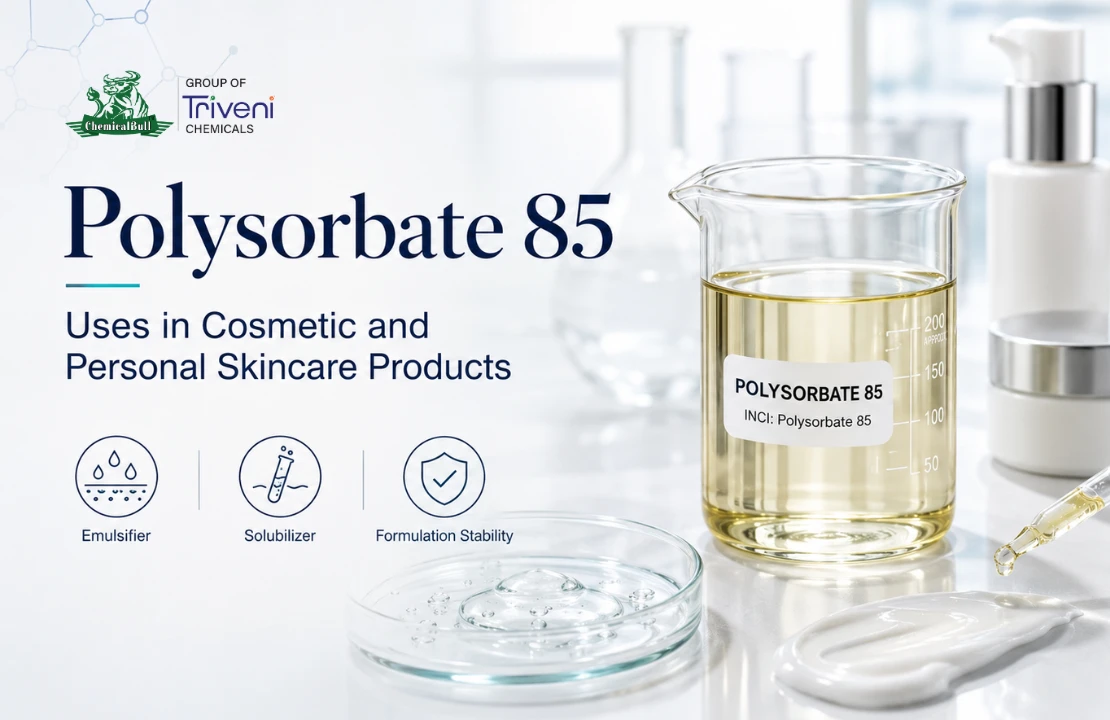
For Polysorbate 85 uses specifically in cosmetics, skincare, and personal care formulations, refer to our dedicated guide on Polysorbate 85 Uses in Cosmetics, Skincare and Personal Care. This blog focuses on its industrial and cross-sector applications.
Chemical Identity and Key Properties
|
Property |
Details |
|
INCI / Chemical Name |
Polysorbate 85 |
|
Synonym |
PEG-20 Sorbitan Trioleate, Tween 85 |
|
CAS Number |
9005-70-3 |
|
Base Fatty Acid |
Oleic acid (C18:1), three chains (trioleate) |
|
EO Units |
Approximately 20 moles of ethylene oxide |
|
HLB Value |
Approximately 11 |
|
Physical Form |
Yellow to amber oily liquid |
|
Surfactant Type |
Non-ionic |
|
Emulsion Affinity |
O/W and W/O depending on co-emulsifier system |
|
Solubility |
Dispersible in water; soluble in oils and organic solvents |
What Sets Polysorbate 85 Apart in Industrial Applications
Polysorbate 85 is structurally different from other polysorbates in one important way: it is a trioleate ester, meaning three oleic acid chains are attached to the sorbitan ring rather than one. This gives it:
- A more extensive, hydrophobic molecular center compared to mono-ester polysorbates
- The HLB is lower in effectiveness (approximately 11) than Polysorbate (HLB 15 or less), even though both use Oleic acid
- A stronger affinity for the heavy oils, waxes and active lipophilic components
- Improved performance when used in balanced or oil-continuous Emulsion systems, compared with high-HLB polysorbates
These structural features are particularly beneficial when the material is extremely heavy, complicated, intricate, or at higher levels.
Application 1: Pharmaceutical Drug Delivery Systems
Polysorbate 85 is used as a non-ionic surfactant in pharmaceutical topical and semi-solid formulations where:
Emulsification of lipophilic APIs:
Many active pharmaceutical ingredients (APIs) are poorly water-soluble and require an oil-phase carrier to be delivered effectively. Polysorbate 85 helps emulsify and stabilize oil-phase formulations containing such APIs in creams, ointments, and topical drug products.
Microemulsion and self-emulsifying drug delivery systems (SEDDS):
Polysorbate 85 is used in SEDDS formulations as a co-surfactant alongside higher HLB surfactants. Its mid-range HLB contributes to the formation of spontaneous or near-spontaneous microemulsions when diluted with aqueous media, improving the apparent solubility and bioavailability of poorly water-soluble oral drug candidates.
Solubilization of pharmaceutical preparations in liquid form:
This aids in keeping oil-soluble drugs in a stable suspension or dispersion within aqueous formulations of pharmaceutical liquids.
Always verify pharmacopoeia quality standards, purity requirements, and other regulatory documents prior to applying Polysorbate 85 for any medical applications.
Application 2: Agrochemical Formulations
Agrochemicals are one of the major industrial consumers of non-ionic surfactants from the class of polysorbates. Polysorbate 85 can be found in different types of formulations for agrochemicals:
Emulsifiable Concentrates (EC)
In EC formulations, the active ingredient is dissolved inside the oil carrier. If it is diluted in water on the field, it will form an impermeable emulsion in a single step. Polysorbate 85, which has a mid-range HLB structure and trioleate, is the ideal choice for stabilizing the oil-continuous EC system where the burden of oil is heavy, and the active ingredient is very hydrophobic.
Wettable Powder and Suspension Concentrate Adjuvants
As a wetting and dispersing adjuvant, Polysorbate 85 improves:
- Wetting of hydrophobic active ingredient particles
- Uniform dispersion in the spray tank
- Spreading and coverage on leaf and soil surfaces
Microemulsion Concentrates
In microemulsion (ME) agrochemical formulations, Polysorbate 85 is used as part of a co-surfactant system to create spontaneously forming, thermodynamically stable transparent dispersions of oil and water. Its role as a co-surfactant in combination with higher-HLB non-ionic surfactants enables the formulation of clear, stable ME concentrates for herbicide and insecticide active ingredients.
|
Formulation Type |
Role of Polysorbate 85 |
|
Emulsifiable Concentrate (EC) |
Primary emulsifier for high oil-load systems |
|
Suspension Concentrate (SC) |
Wetting and dispersing aid |
|
Microemulsion Concentrate (ME) |
Co-surfactant for transparent stable dispersions |
|
Tank mix adjuvant |
Spreading and wetting support on leaf surfaces |
Application 3: Food and Food Processing Industry
Polysorbate 85 is permitted as a food additive emulsifier in certain regulatory jurisdictions, where it is used to support emulsification, aeration, and ingredient stability in food processing.
Dough conditioning and baking:
In baked goods, non-ionic sorbitan ester emulsifiers interact with starch and gluten to improve dough strength, gas retention, and crumb softness. Polysorbate 85 contributes to the overall emulsifier system in selected baking applications.
Fat and oil emulsification:
In food emulsions containing vegetable oils or animal fats, Polysorbate 85 supports stable emulsion formation and prevents phase separation during processing, storage, and distribution.
Confectionery applications:
In chocolate and fat-based confectionery, sorbitan ester emulsifiers are used to improve fat crystal modification and flow properties during processing.
Always confirm local food safety regulatory approval (CODEX, EU, FDA) and obtain food-grade certification from your supplier before using Polysorbate 85 in any food application.
Application 4: Textile Processing
For textile processing, polysorbate 85 can be used for its wetting properties, Emulsifier, as well as lubricant:
- Fiber and yarn lubrication: Polysorbate 85 helps emulsify mineral oils and synthetic lubricants used in fiber and yarn processing operations. Stable emulsification of these lubricants in process baths ensures even application and reduces friction-related fiber damage.
- Scouring, pretreatment and so on, as an emulsifying and wetting agent for scouring baths, Polysorbate 85 aids in the removal of natural waxes, oil and other processing aids from the raw fiber prior to dyeing or finalizing.
- Dyeing as well as finishing aids in dye baths and formulations for finishing it helps ensure even wetting of the fiber's surface, assists disperse oil-based additives, and increase the consistency of chemical use throughout the entire fabric.
Application 5: Industrial Cleaning and Degreasing
For industrial cleaning, Polysorbate 85 is a non-ionic surfactant that adds properties to cleaning formulations.
- Concentrates to remove metal tar: Emulsify the mineral oil, grease, as well as cutting fluid residues that have been removed from metallic surfaces in the process of industrial clean-up.
- Systems for washing parts with non-ionic compatibility to anionic cosurfactants in the formulations for aqueous parts washing
- Solvent-blend cleaning agents Aid in the emulsification of solvent-blend semi-aqueous cleaning equipment
- Cleaning and maintenance of tanks, wetting, as well as soil penetration assistance within CIP (Clean-in-Place), as well as industrial formulations for tank cleaning
Its non-ionic property is compatible with anionic, cationic, as well as amphoteric co-surfactants that are used in industrial blends for cleaning.
Application 6: Lubricants and Metalworking Fluids
In the formulation of lubricant and metalworking fluid chemistry:
- In the emulsification of water-miscible cutting fluids, Polysorbate 85 functions as an emulsifier within soluble oils in metalworking fluids. It helps make stable emulsions of oil and water in the event that the concentrate of the fluid is diluted by water at the moment it is used. Emulsification that is stable is essential to ensure consistent coolant and lubrication, as well as the longevity of machining tools.
- Protection against corrosion: Non-ionic surfactants present in the metalworking fluids contribute to the strength of the corrosion inhibitors package and aid in maintaining an even protective layer on the metal surface that is machined.
- Hydraulic fluid and gear oil emulsification: In water-in-oil or oil-in-water hydraulic emulsions, Polysorbate 85 contributes to phase stability and compatibility of the oil and water components.
Polysorbate 85 in Specialty and Emerging Applications
Beyond the core sectors above, Polysorbate 85 is also found in:
- Veterinary formulations: As an emulsifier and solubilizer in topical veterinary drug preparations and pour-on formulations for livestock
- Paint and coatings: As a wetting and dispersing agent for pigment concentrates and emulsion polymerization systems
- Adhesive and sealant systems: Non-ionic emulsifier and wetting agent in water-based adhesive formulations
- Oilfield chemicals: Emulsifier and wetting agent in selected oilfield chemical applications, including drilling fluid additives
Grade and Quality Parameters for Industrial Use
When sourcing Polysorbate 85 for industrial applications, confirm the following with your supplier:
|
Quality Parameter |
Relevance for Industrial Use |
|
HLB value |
Confirms emulsification range and application suitability |
|
Acid value |
Indicates degree of hydrolysis and stability |
|
Hydroxyl value |
Confirms degree of ethoxylation |
|
Saponification value |
Confirms fatty acid ester content |
|
Colour (Gardner or APHA) |
Relevant for food, pharma, and light-coloured product applications |
|
Moisture content |
Affects storage stability and formulation consistency |
|
Heavy metals |
Required for food and pharmaceutical applications |
|
Peroxide value |
Relevant for stability of oleate-based materials |
Always request COA, MSDS, and TDS before procurement. For pharmaceutical and food applications, confirm applicable grade certifications and regulatory documentation.
Frequently Asked Questions
1. What industries use Polysorbate 85?
It is used in pharmaceuticals, agrochemicals, food processing, textile processing, industrial cleaning, metalworking fluids, and specialty chemical formulations.
2. What is the HLB value of Polysorbate 85?
Approximately 11, making it suitable for balanced O/W emulsion systems, W/O co-emulsifier blending, and oil-heavy formulations where higher HLB polysorbates are less effective.
3. How is Polysorbate 85 different from Polysorbate 80?
Polysorbate 85 is a trioleate ester (three oleic acid chains) with HLB ~11, while Polysorbate 80 is a monooleate ester with HLB ~15. Polysorbate 85 is more lipophilic and suited to heavier oil-phase systems and co-emulsifier applications.
4. Is Polysorbate 85 used in agrochemical formulations?
Yes. It is used as a primary emulsifier in emulsifiable concentrates, a co-surfactant in microemulsion concentrates, and a wetting adjuvant in wettable powder and suspension concentrate formulations.
5. Can Polysorbate 85 be used in pharmaceutical formulations?
Yes. It is used in topical pharmaceutical preparations and self-emulsifying drug delivery systems (SEDDS). Confirm pharmacopoeia grade and regulatory documentation with your supplier before use.
6. What is the CAS number of Polysorbate 85?
CAS 9005-70-3, also known as PEG-20 Sorbitan Trioleate and Tween 85.
7. What documentation should I request when sourcing Polysorbate 85?
Request COA, MSDS, TDS, and any applicable grade certifications. For food or pharmaceutical use, request regulatory compliance documentation specific to your target market and application.
Conclusion
Polysorbate 85 is a versatile non-ionic emulsifier with a wider industrial reach than its association with cosmetics might suggest. Its mid-range HLB value, trioleate structure, and compatibility with heavy oil phases make it a practical choice in pharmaceutical drug delivery, agrochemical EC and ME formulations, food emulsification, textile lubricant auxiliaries, industrial cleaning concentrates, and metalworking fluid systems.
Selecting the right grade, confirming documentation, and testing in the actual formulation system are the key steps for any successful industrial application. For bulk Polysorbate 85 with COA, MSDS, TDS, and cross-industry application support, connect with Chemical Bull, a trusted Polysorbate 85 supplier serving pharmaceutical manufacturers, agrochemical producers, industrial formulators, and specialty chemical buyers across India and global export markets.
Comment Section



