Chemical Bull
20
16-Jul-2026
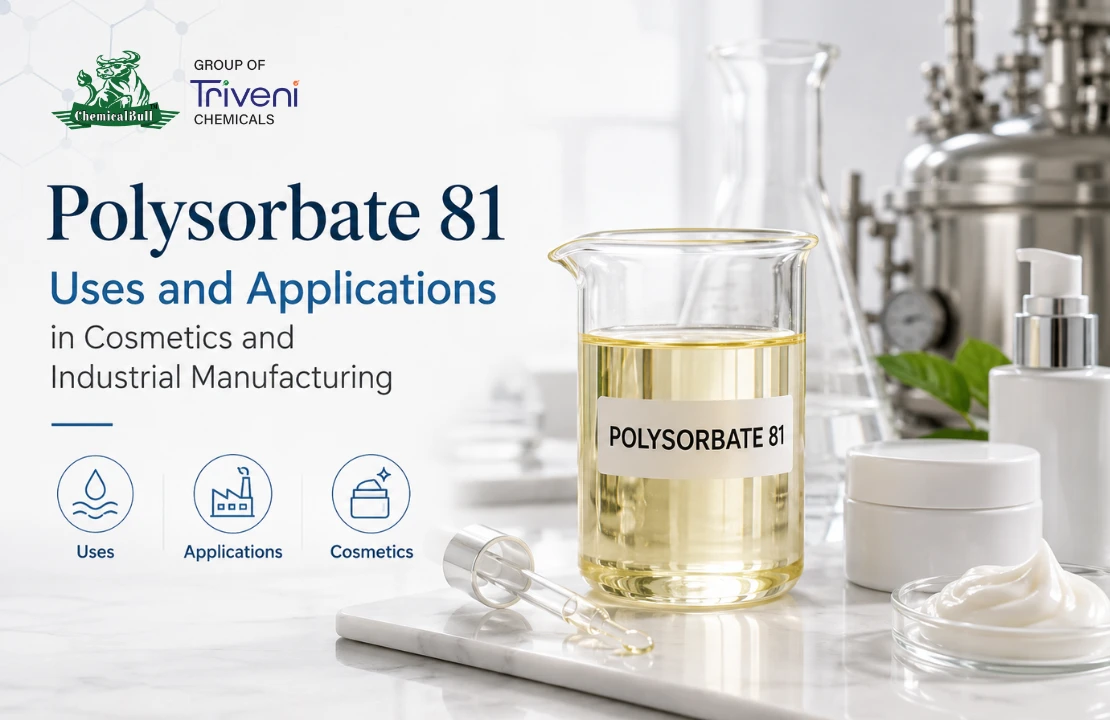
Polysorbate 81 Uses and Applications in Cosmetics and Industrial Manufacturing
Polysorbate 81 is a nonionic surfactant belonging to the polysorbate family, produced by reacting sorbitan monooleate with ethylene oxide. It functions as an emulsifier, solubilizer, and dispersing agent, making it a versatile raw material across cosmetic formulations, industrial processes, and specialty manufacturing applications.
Formulators and manufacturers rely on Polysorbate 81 for its ability to stabilize water-and-oil systems, particularly in water-in-oil (W/O) emulsions where its comparatively lower HLB value gives it an edge over higher-HLB polysorbates. If you're sourcing this ingredient for a formulation or industrial process, working with an established polysorbate 81 supplier ensures consistent quality, proper documentation, and batch-to-batch reliability for your production needs.
What Is Polysorbate 81?
Polysorbate 81 (also referenced as Polyoxyethylene Sorbitan Monooleate or Tween 81 in technical literature) is derived from sorbitan, oleic acid, and ethylene oxide units. It appears as an amber to yellow, oily liquid with a mild characteristic odor, and it disperses readily in water and common organic solvents.
|
Property |
Detail |
|
Chemical Class |
Polyoxyethylene sorbitan fatty acid ester |
|
Appearance |
Amber to yellow viscous liquid |
|
HLB Value |
Approx. 10.0 |
|
Solubility |
Dispersible in water; soluble in most organic solvents |
|
Primary Function |
Emulsifier, solubilizer, wetting agent, dispersant |
Because of its intermediate HLB value, Polysorbate 81 sits between water-in-oil emulsifiers and fully hydrophilic surfactants, giving formulators flexibility when balancing emulsion stability with texture and spreadability.
Uses of Polysorbate 81 in Cosmetics
In cosmetic and personal care formulations, Polysorbate 81 is primarily used to:
- Stabilize emulsions in creams, lotions, and balms, particularly water-in-oil systems where oil is the continuous phase.
- Solubilize oils and fragrance compounds into aqueous or semi-aqueous bases, helping active ingredients disperse evenly throughout the formulation.
- Improve texture and spreadability in topical formulations, contributing to a smoother skin-feel without altering the product's core function.
- Act as a co-emulsifier alongside other surfactants, such as sorbitan esters or higher-HLB polysorbates, to fine-tune emulsion stability across a range of oil phases.
- Support formulation stability during temperature fluctuations that occur in manufacturing, shipping, and storage.
Formulations containing Polysorbate 81 are commonly found in creams, lotions, cleansing balms, and specialty cosmetic bases where a stable, non-greasy emulsion is required. Its performance in W/O systems makes it a practical alternative when higher-HLB polysorbates don't provide the right balance for a heavier, oil-rich base.
Industrial and Manufacturing Applications
Beyond cosmetics, Polysorbate 81 plays a functional role in several industrial processes:
- Agrochemical formulations: Used as an emulsifier and dispersing agent in pesticide and herbicide concentrates, helping active ingredients mix uniformly with carrier oils and water for consistent field application.
- Textile processing: Applied as a wetting and dispersing agent in dyeing and finishing operations, improving the uniformity of dye uptake and reducing patchiness on fabric.
- Industrial cleaning and degreasing formulations: Functions as a surfactant that helps emulsify oils and grease, supporting more effective cleaning action in industrial-strength formulations.
- Metalworking fluids: Used in select formulations to stabilize oil-water mixtures, supporting consistent lubrication and cooling performance during machining and cutting operations.
- Polymer and rubber processing: Employed as a processing aid and dispersant in formulations requiring controlled emulsification of additives during compounding.
Across these applications, the common thread is Polysorbate 81's ability to bring together oil and water phases that would otherwise separate, while remaining chemically stable across a range of processing temperatures and pH conditions.
Handling and Storage Considerations
Polysorbate 81 should be stored in tightly sealed containers, away from direct sunlight and extreme temperatures, to preserve its viscosity and surfactant performance. It is generally compatible with most nonionic and anionic surfactants but should be evaluated for compatibility with strong oxidizers and alkalis before use in sensitive formulations. As with any industrial-grade raw material, referring to the current Safety Data Sheet (SDS) for handling, PPE, and storage guidelines is recommended before formulation or processing work begins.
Frequently Asked Questions
-
Is Polysorbate 81 the same as Polysorbate 80?
No. While both belong to the polysorbate family and share a similar production process, Polysorbate 80 uses a higher degree of ethoxylation, giving it a different HLB value and making it more suited to oil-in-water emulsions, whereas Polysorbate 81 is typically used in water-in-oil systems. -
What industries commonly use Polysorbate 81?
It is used across cosmetics and personal care, agrochemical formulation, textile processing, industrial cleaning, and select metalworking and polymer processing applications. -
Does Polysorbate 81 have a specific HLB range?
Yes, it typically falls around an HLB of 10.0, positioning it between predominantly lipophilic and predominantly hydrophilic emulsifiers. -
Is Polysorbate 81 water-soluble?
It is dispersible in water rather than fully soluble, and it dissolves well in a range of organic solvents, which supports its use in oil-continuous systems. -
Can Polysorbate 81 be used with other emulsifiers?
Yes, it is often combined with sorbitan esters or higher-HLB polysorbates to fine-tune emulsion stability for a specific oil phase or formulation requirement.
Conclusion
Polysorbate 81's intermediate HLB value and reliable emulsifying performance make it a practical choice for formulators and manufacturers working across cosmetic, agrochemical, textile, and industrial processing applications. Understanding its properties and typical use cases helps in selecting the right emulsifier for a given formulation or process requirement.
Comment Section