Chemical Bull
213
27-Aug-2026
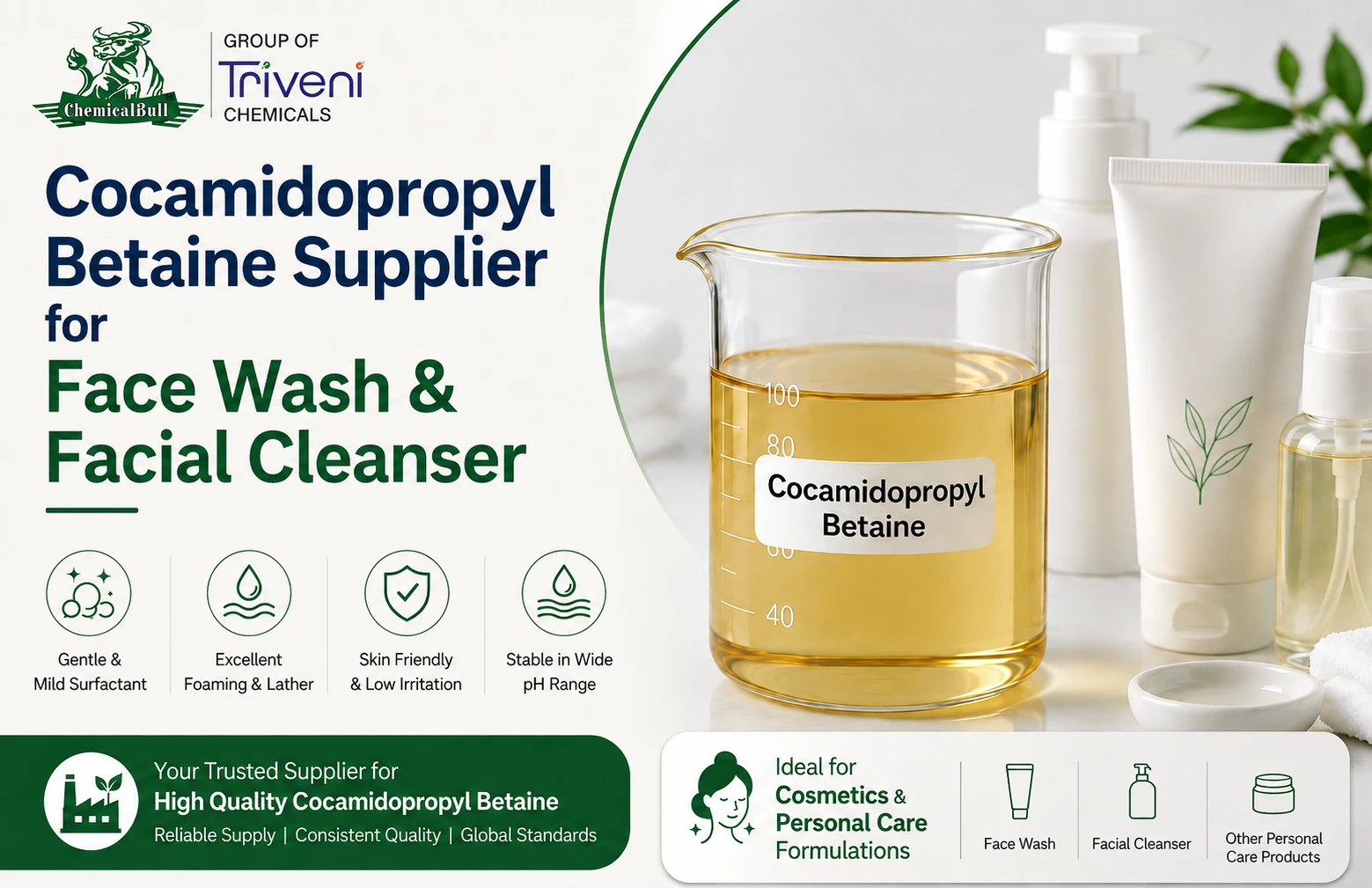
Cocamidopropyl Betaine Supplier for Face Wash & Facial Cleanser
Cocamidopropyl Betaine (CAPB) is widely used in face wash and facial cleanser formulations as a mild amphoteric surfactant and co-surfactant. It supports effective cleansing while helping formulators improve foam quality, viscosity and the overall washing experience. This makes CAPB useful for daily facial cleansers, cleansing gels, foaming face washes and sulfate-free formulations.
Personal care companies searching for a reliable cocamidopropyl betaine manufacturer or sourcing partner should check active concentration, batch consistency, technical documentation and suitability for their intended formulation. Manufacturers developing facial cleansers and other rinse-off products can connect with Chemical Bull for CAPB and related personal care raw material requirements.
In facial cleanser production, the selected CAPB grade can influence cleansing performance, foam behaviour, product thickness and after-wash feel. Understanding how the ingredient works within a complete surfactant system can therefore help formulators select and use it more effectively.
What Is Cocamidopropyl Betaine?
Cocamidopropyl Betaine, commonly abbreviated as CAPB, is an amphoteric surfactant widely used in cosmetics and personal care products.
It is commonly associated with coconut-derived fatty raw materials and is processed to produce a functional surfactant suitable for cleansing formulations.
CAPB is commonly found in:
-
Face washes
-
Facial cleansing gels
-
Foaming cleansers
-
Shampoos
-
Body washes
-
Shower gels
-
Liquid hand washes
-
Baby cleansing products
-
Sulfate-free cleansers
One important advantage of CAPB is its ability to work with different surfactant systems. This allows formulators to adjust cleansing, foam, viscosity and product feel according to the type of finished product they want to manufacture.
Businesses sourcing ingredients for skin, hair and cleansing formulations can also explore our Personal Care Chemicals range.
Why Is Cocamidopropyl Betaine Used in Face Wash?
Cocamidopropyl betaine in face wash generally works as a secondary cleanser or co-surfactant. It helps remove excess oil and surface impurities while supporting creamy foam and a milder overall cleansing system.
Its main functions include:
Gentle Cleansing Support
A facial cleanser needs to remove sebum, dust, sunscreen residue and other surface impurities without creating an unnecessarily harsh washing experience.
CAPB helps the surfactant system lift oily material and impurities so they can be rinsed away with water.
Foam Boosting
Foam plays an important sensory role in many face washes.
CAPB can help produce a richer and creamier lather when combined with compatible primary surfactants. This is particularly useful in products marketed as foaming face washes or cleansing gels.
Mildness Support
Some stronger cleansing surfactants can leave the skin feeling tight or dry if the formulation is not properly balanced.
CAPB is often combined with these surfactants to create a more balanced cleansing system.
Viscosity Support
CAPB can contribute to viscosity development in suitable surfactant combinations.
This can help formulators achieve the desired gel or liquid consistency, although the final thickness also depends on other ingredients and formulation conditions.
Improved Washing Experience
The performance of a facial cleanser is not judged only by how much dirt it removes.
Consumers also notice how the product spreads, foams, rinses and leaves the skin feeling afterwards. CAPB can support these sensory properties when used within a well-designed formulation.
For CAPB applications beyond facial cleansing, read Cocamidopropyl Betaine Uses Across Different Industries.
Key Functions of CAPB in Facial Cleansers
|
Function |
Role in Facial Cleansing Formulations |
|
Cleansing |
Helps remove excess oil and surface impurities |
|
Co-surfactant |
Works alongside primary surfactants |
|
Foam boosting |
Supports richer and creamier foam |
|
Foam stability |
Helps maintain foam during washing |
|
Mildness |
Helps balance stronger cleansing systems |
|
Viscosity support |
Can contribute to product thickness |
|
Wetting |
Helps the cleanser spread across the skin |
|
Conditioning support |
Can contribute to a more comfortable after-wash feel |
The actual performance depends on CAPB quality, active matter and the other ingredients used in the formulation.
How Does CAPB Work With Other Surfactants?
Most commercial face washes use a surfactant blend rather than depending on only one cleansing ingredient.
A basic system may follow this structure:
Primary surfactant + CAPB + humectant + viscosity modifier + preservative + pH adjuster + fragrance + functional ingredients
The primary surfactant usually provides a large part of the cleansing action.
CAPB is then added to help balance properties such as foam, mildness and viscosity.
For example, a manufacturer developing a high-foam cleanser for oily skin may select a different surfactant combination from one developing a gentle daily cleanser.
This flexibility is one reason CAPB remains useful across many rinse-off personal care formulations.
CAPB Applications in Different Types of Facial Cleansers
Cocamidopropyl Betaine can be considered for several facial cleansing formats.
Foaming Face Wash
Foaming cleansers need a surfactant system that produces pleasant and stable foam.
CAPB can support foam volume and creaminess while working with the primary cleansing ingredients.
Gel Face Cleanser
In gel cleansers, both cleansing performance and product consistency are important.
CAPB can contribute to the surfactant system while also supporting viscosity development under suitable formulation conditions.
Mild Daily Facial Cleanser
Daily-use products are often designed around balanced cleansing instead of maximum detergency.
CAPB can help formulators develop a cleansing system suitable for this type of positioning.
Sulfate-Free Face Wash
CAPB is also commonly considered when developing sulfate-free personal care products.
It can be combined with suitable non-sulfate surfactants to achieve the desired balance of cleansing, foam and skin feel.
Learn more in our guide on The Role of Cocamidopropyl Betaine in Sulfate-Free Personal Care Products.
Low-Foam Facial Cleansers
Not every cleanser needs high foam.
CAPB may also be considered in mild or lower-foam systems where the manufacturer wants controlled cleansing and easy rinsing rather than a large amount of lather.
Typical Face Wash Formulation Structure
There is no single CAPB face wash formula that is suitable for every product.
A typical commercial formulation may contain several ingredient groups.
|
Ingredient Group |
Purpose |
|
Water |
Main formulation base |
|
Primary surfactant |
Provides cleansing action |
|
Cocamidopropyl Betaine |
Supports cleansing, foam and surfactant balance |
|
Humectant |
Supports moisturised skin feel |
|
Thickener |
Controls viscosity |
|
Conditioning ingredient |
Helps improve after-wash feel |
|
Chelating agent |
Supports formulation stability |
|
Preservative |
Helps protect the product from microbial contamination |
|
pH adjuster |
Maintains the required finished-product pH |
|
Fragrance |
Provides the desired sensory profile |
|
Functional actives |
Added according to product positioning |
The suitable CAPB concentration cannot be decided from a general percentage alone.
Formulators should consider:
-
CAPB active matter
-
Primary surfactant type
-
Total surfactant concentration
-
Desired cleansing strength
-
Target foam level
-
Required viscosity
-
Final pH
-
Other functional ingredients
Laboratory trials, compatibility testing and stability evaluation should be completed before commercialising the finished formula.
Factors That Affect CAPB Performance in Face Wash
Two facial cleanser formulas containing CAPB can perform very differently.
Several factors influence the final result.
Active Matter
Commercial CAPB grades may differ in their supplied concentration.
Formulators should therefore compare materials based on specification and active content rather than only the quantity added.
Surfactant Combination
CAPB behaves differently depending on the primary and secondary surfactants used with it.
The surfactant blend influences cleansing strength, foam and overall sensory properties.
pH
The final pH should be selected according to the complete formulation, finished-product requirement and intended use.
Salt and Electrolyte Level
Electrolytes can affect the viscosity of certain surfactant systems.
Adding more salt does not always mean greater thickness, so optimisation through laboratory trials is important.
Thickener System
Polymeric thickeners and other viscosity modifiers can behave differently depending on the selected surfactants.
Fragrance and Other Additives
Fragrance oils, botanical extracts, active ingredients and other additives can change clarity, viscosity, foam or overall stability.
This is why CAPB should be evaluated as part of the complete formulation, rather than as an isolated ingredient.
CAPB in Sulfate-Free Facial Cleansers
Growing interest in mild personal care products has increased the use of alternative surfactant combinations.
CAPB can form part of a sulfate-free cleansing system, but using CAPB alone does not automatically make the finished product sulfate-free.
The complete surfactant list must be checked.
A sulfate-free face wash may combine CAPB with other compatible surfactants selected according to:
-
Required cleansing performance
-
Target foam
-
Product positioning
-
Viscosity
-
Skin feel
-
Cost
-
Ingredient compatibility
Formulators should therefore evaluate the whole cleansing system rather than replacing one surfactant on a one-to-one basis.
Cocamidopropyl Betaine vs SLES
Cocamidopropyl Betaine and Sodium Laureth Sulfate (SLES) are both used in cleansing products, but they have different roles.
|
Feature |
Cocamidopropyl Betaine |
SLES |
|
Surfactant type |
Amphoteric |
Anionic |
|
Typical role |
Co-surfactant / secondary cleanser |
Primary cleanser |
|
Cleansing |
Mild to moderate |
Stronger cleansing |
|
Foam |
Supports creamy foam |
Produces strong foam |
|
Formulation role |
Helps balance surfactant system |
Often provides main cleansing action |
|
Sulfate-free |
Yes, CAPB itself is not a sulfate |
No |
They do not always need to be treated as competing ingredients.
In many conventional formulations, CAPB and anionic surfactants can be used together to achieve the required balance between cleansing, foam and product feel.
Cocamidopropyl Betaine vs Decyl Glucoside
Decyl Glucoside is another ingredient frequently considered in mild cleansing systems.
The main difference is surfactant type:
Cocamidopropyl Betaine – amphoteric surfactant
Decyl Glucoside – non-ionic surfactant
Both can be used in facial cleansing products, but their formulation behaviour is different.
A manufacturer may select one or combine compatible surfactants depending on:
-
Required foam
-
Cleansing strength
-
Desired viscosity
-
Skin feel
-
Final pH
-
Cost target
-
Product claims
Therefore, CAPB cannot simply be replaced with Decyl Glucoside at the same percentage without formulation evaluation.
What Should B2B Buyers Check Before Purchasing CAPB?
For commercial face wash manufacturing, the lowest Cocamidopropyl Betaine price should not be the only purchasing factor.
Buyers should compare the following parameters.
Active Concentration
Confirm the active matter or supplied concentration so that different commercial grades can be compared correctly.
Product Specification
Check important specification parameters according to the intended application and internal quality requirements.
Batch Consistency
Regular manufacturing requires consistent raw-material performance.
Unexpected variation can affect viscosity, foam and finished-product appearance.
Technical Documentation
Depending on the requirement, B2B buyers may request:
-
Certificate of Analysis (COA)
-
Safety Data Sheet (SDS)
-
Technical Data Sheet (TDS)
-
Product specification
-
Batch information
Packaging
Packing requirements may vary between laboratory evaluation, pilot production and regular bulk consumption.
Supply Capability
Manufacturers working with regular production schedules should evaluate material availability and supply reliability alongside price.
Businesses comparing cocamidopropyl betaine manufacturers in India, suppliers and distributors should therefore consider product consistency, documentation, commercial terms and application suitability before finalising a source.
For a detailed purchasing overview, visit our Cocamidopropyl Betaine Bulk Sourcing Guide.
Cocamidopropyl Betaine Supplier for Personal Care Applications
While this article focuses on facial cleansers, CAPB has wider use across the personal care industry.
It may be evaluated for:
-
Shampoos
-
Body washes
-
Shower gels
-
Liquid hand washes
-
Mild cleansers
-
Baby wash formulations
-
Sulfate-free personal care products
Manufacturers developing related formulations can explore Chemical Bull's Personal Care Chemicals portfolio and Cleansing Agents application range.
How to Source Cocamidopropyl Betaine for Commercial Production
When sending an enquiry for bulk CAPB, giving complete application and purchasing information can help suppliers identify a suitable requirement more quickly.
A B2B enquiry can include:
-
Product name
-
Required grade
-
Active concentration, if specified
-
Application
-
Required quantity
-
Monthly or annual consumption
-
Preferred packing
-
Delivery location
-
Required technical documents
For example, mentioning that the material is required for a facial cleansing gel or sulfate-free face wash provides more useful information than asking only for the CAPB price.
Chemical Bull supports sourcing of Cocamidopropyl Betaine and other raw materials for personal care formulations. Visit Chemical Bull to explore chemical sourcing solutions for different industrial applications.
Frequently Asked Questions
1. What is Cocamidopropyl Betaine used for in face wash?
Cocamidopropyl Betaine is used in face wash as an amphoteric surfactant and co-surfactant. It supports cleansing, foam formation and viscosity while helping formulators create a more balanced cleansing system. CAPB is commonly combined with other surfactants rather than being relied upon as the only cleansing ingredient.
2. Is Cocamidopropyl Betaine good for facial cleansers?
CAPB is widely used in facial cleansing formulations because it can support cleansing, foam and formulation mildness. Its suitability depends on the grade, supplied concentration, usage level and complete formulation.
3. Can Cocamidopropyl Betaine be used in sulfate-free face wash?
Yes. CAPB itself is not a sulfate surfactant and can form part of a sulfate-free cleansing system. However, all other surfactants in the formulation must also be checked before describing the finished product as sulfate-free.
4. Does Cocamidopropyl Betaine help thicken face wash?
CAPB can contribute to viscosity development in certain surfactant systems. However, the final thickness also depends on the primary surfactant, electrolyte concentration, thickener, pH and other ingredients.
5. Does Cocamidopropyl Betaine make face wash foam?
CAPB is commonly used for foam boosting and can help produce creamy and stable lather when combined with compatible surfactants. Final foam performance depends on the complete cleanser formulation.
6. What is the difference between Cocamidopropyl Betaine and SLES?
Cocamidopropyl Betaine is an amphoteric surfactant commonly used as a co-surfactant, while SLES is an anionic surfactant often used as a primary cleanser. CAPB can also be considered in sulfate-free formulations, while SLES is a sulfate-based surfactant.
7. Is Cocamidopropyl Betaine the same as Coco Betaine?
No. The two names should not automatically be treated as the same ingredient. Commercial buyers should verify the INCI name, specification, active matter and technical documentation before purchase.
8. What should manufacturers check before buying Cocamidopropyl Betaine in bulk?
Manufacturers should check active concentration, specification, product consistency, COA, SDS, technical data, packing, commercial terms and supply reliability. The material should also be evaluated in the intended formulation before regular commercial production.
Conclusion
Cocamidopropyl Betaine is an important surfactant for modern facial cleansing formulations because it can support cleansing, foam, viscosity and overall formulation balance. It can be used across foaming face washes, gel cleansers, mild daily cleansers and properly designed sulfate-free systems.
For formulators, successful use of CAPB depends on the complete surfactant blend, active concentration, pH, viscosity system and compatibility with other ingredients. For purchase teams, consistent quality, technical documentation and dependable supply are equally important.
Businesses developing face wash, facial cleanser and other rinse-off personal care products can source Cocamidopropyl Betaine and related personal care raw materials through Chemical Bull for laboratory development as well as regular commercial requirements.
Comment Section