Chemical Bull
1237
27-Jan-2026
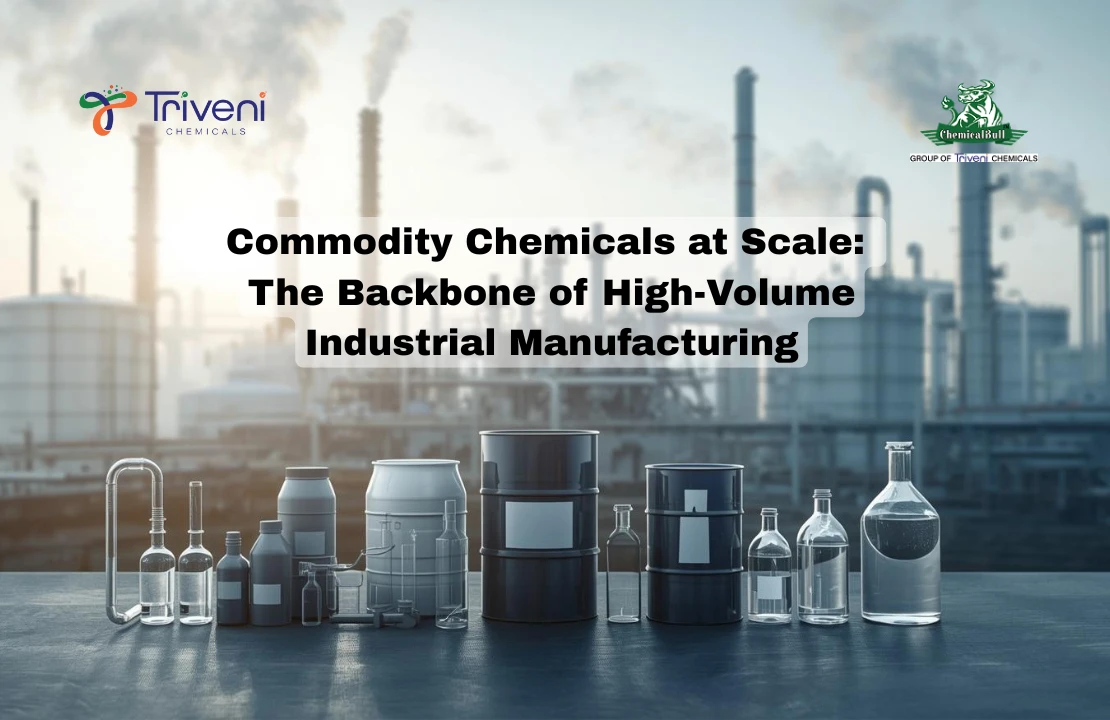
In the modern industrial ecosystem, commodity chemicals form the foundation of large-scale manufacturing. While they may not always be visible in finished products, they play a critical role in keeping industries running efficiently, cost-effectively, and at scale.
At Chemicalbull Pvt. Ltd., we operate as a bulk industrial chemicals supplier, supporting B2B industries with reliable, high-quality bulk chemicals used across construction, plastics, paints, water treatment, agriculture, and chemical processing. This blog will explain the basics of commodity chemicals used for, how they're used, and the reasons why they are the core of the global industry.
What Are Commodity Chemicals?
Commodity chemicals are high-production-volume chemicals manufactured in large quantities with standardized specifications. Their primary focus is cost efficiency, supply reliability, and consistent quality, making them suitable for mass industrial applications.
They are supplied by bulk chemical suppliers and industrial chemical distributors to manufacturers who depend on uninterrupted production and predictable performance. Typical examples include solvents, plasticizers, acids, alkalis, salts, and basic chemical intermediates.
Why Are Commodity Chemicals Important?
Commodity chemicals allow industries to increase production without the loss of efficiency or quality control. They aid in the efficient functioning of industrial processes and guarantee the availability of raw materials across industries.
Industries rely on commodity chemicals to:
-
Maintain continuous production cycles.
-
Reduce per-unit manufacturing cost.
-
Achieve uniform batch quality.
-
Support high-demand industrial applications.
This is why the commodity chemicals industry continues to grow alongside infrastructure, manufacturing, and global trade.
Commodity Chemicals Market Scope and Future Outlook
The chemical commodity marketplace will continue to grow because of the increase in industrialisation, development of infrastructure, and the worldwide demand for goods that are manufactured.
Market Scope
Commodity chemicals are widely used across:
-
Construction and infrastructure
-
Plastics and polymer manufacturing
-
Paints, coatings, and adhesives
-
Water treatment and sanitation
-
Agriculture and fertilizers
-
Chemical intermediates and catalysts
Future Outlook
The future of the commodity chemicals industry will be shaped by:
-
Rising demand for sustainable commodity chemicals
-
Increasing adoption of bio-based commodity chemicals
-
Infrastructure and housing expansion
-
Stricter environmental and safety regulations
-
More efficient bulk chemical manufacturing technologies
Manufacturers with strong scale and application knowledge will lead the next phase of industry growth.
Commodity Chemicals vs Fine Chemicals
|
Parameter |
Commodity Chemicals |
Fine Chemicals |
|
Production Volume |
Very high (bulk scale) |
Low to medium |
|
Focus |
Cost, volume, consistency |
Purity and precision |
|
Customization |
Standardized |
Highly customized |
|
Cost per Unit |
Lower |
Higher |
|
Applications |
Base industrial inputs |
Advanced formulations |
|
Industries |
Plastics, paints, water treatment |
Pharma, agrochemicals |
In simple terms, commodity chemicals support scale, while fine chemicals support precision.
Commodity Chemicals vs Specialty Chemicals
Commodity chemicals focus on quantity and standardization, whereas specialty chemicals emphasize product performance and deliver specific value to their applications. Common chemicals are utilized as raw materials for base, while specialty chemicals are designed to provide specific advantages.
This difference is also explained in detail in our blog Specialty Chemicals Revolution: High-Value Solutions for Specific Industrial Needs, which highlights how specialty products often build upon commodity chemical foundations to achieve enhanced performance.
Industrial Applications of Commodity Chemicals
Construction & Infrastructure
Commodity chemicals play a crucial role in infrastructure and construction development. In PVC processing, plasticizers like Diisononyl Phthalate are used extensively to increase the flexibility and toughness of cables, pipes, and profiles. Additionally, stabilizing agents such as Calcium Carbonate help enhance durability and dimensional stability for construction-grade polymer materials.
In the field of construction chemicals use, common chemicals are utilized in concrete admixtures, waterproofing substances, and the treatment of surfaces to enhance the strength, as well as moisture resistance, and the long-term performance for infrastructure development projects.
Manufacturing & Formulation
In manufacturing and formulation-driven industries, commodity chemicals form the base of many products, and understanding how these industrial chemicals are selected and used in real-world manufacturing applications — as explained in our detailed guide on Understanding Industrial Chemicals: Selection, Properties, and Real-World Manufacturing Applications — helps improve process efficiency.
In the formulation of coatings and paint systems, solvents such as Acetone play an important role in regulating viscosity and drying time, as well as application flow.
Water & Agriculture
Chemicals that are used for commodity production are vital in agricultural and water treatment, where consistent and large-scale use is essential. In the field of water treatment and effluent management, chemical substances are used to control hardness and maintain process stability, as well as oxidising agents such as Potassium Permanganate, which aid in disinfection and the elimination of contaminants.
In agricultural and fertilizer manufacturing, commodity chemicals ensure reliable nutrient supply and large-scale productivity across farming applications.
Polymer & Processing
In the chemical processing and polymer industries, the use of commodity chemicals can improve the efficiency and performance of the material. Certain chemicals serve as catalysts, which increase the speed of reaction and yield. Chemicals are used extensively in curing and polymerization systems that support controlled processing.
In addition, pigments like Lithopone help maintain consistent appearance, opacity, and quality in polymer formulations produced at an industrial scale.
Are you looking for a reliable partner for high-volume chemical procurement?
Chemicalbull Pvt. Ltd. provides scalable solutions tailored to your production needs. Request a Bulk Quote Today or View Our Product page to see how we can support your supply chain.
Inorganic and Bio-Based Commodity Chemicals
Inorganic commodity chemicals like acids, alkalis, and mineral salts are the basis of fertilizers, water treatment, construction materials, and chemical processing. Chemicals like these are appreciated because of their accessibility, cost efficiency, and versatility.
While at the same time, industries are increasingly embracing bio-based chemical products to minimize the impact on the environment and enhance sustainability. Bio-based alternatives provide similar performance, while also promoting greener production methods and legal compliance.
This transition is further explained in our related blogs:
-
Organic Industrial Chemicals Explained: From Petrochemicals to Bio-Based Compounds
-
Inorganic Industrial Chemicals: The Foundation of Modern Manufacturing
Choosing the Right Bulk Chemical Suppliers
In the case of B2B manufacturers, choosing reliable bulk chemical suppliers extends beyond the price. Important considerations are:
-
Consistent supply at scale
-
Technical and application support
-
Compliance with industrial standards
-
Long-term sourcing reliability
As one of the trusted industrial chemical distributors, Chemicalbull Pvt. Ltd. combines manufacturing capability with real-world industrial application expertise.
Frequently Asked Questions
-
What are commodity chemicals?
Commodity chemicals are basic industrial chemicals produced in large volumes and used as raw materials across multiple industries. -
What are commodity chemicals used for?
Commodity chemicals are used in large volumes as basic raw materials for everyday products such as plastics, fertilizers, detergents, fuels, textiles, construction materials, and industrial processing across multiple industries. -
What are examples of commodity chemicals?
Examples include plasticizers, solvents, acids and esters, alkalis, as well as organic salts. -
What is the difference between commodity and specialty chemicals?
Chemicals that are used for commodities focus on quantity and efficiency, while specialty chemicals concentrate on performance and applications. -
Why are commodity chemicals produced at such large scale?
Commodity chemicals are produced at large scale to meet continuous global demand, reduce per-unit costs, and ensure steady supply for industries that rely on them as essential raw materials.
Conclusion: Commodity Chemicals as the Backbone of Industrial Growth
Commodity chemicals are among the most underrated industrial enabling factors of today's industry. Their capacity to aid large-scale manufacturing, keep costs efficient, and ensure consistently high performance makes them indispensable across all industries.
As the need for sustainable, scalable solutions grows, the importance of trustworthy suppliers of chemical products will only increase. With solid manufacturing capabilities and a deep understanding of the industry, Chemicalbull(Group of Triveni Chemicals), a trusted bulk chemicals supplier in India, continues to provide B2B customers with reliable chemicals that support the long-term growth of industrial production.


Comment Section