Chemical Bull
232
03-Jul-2026
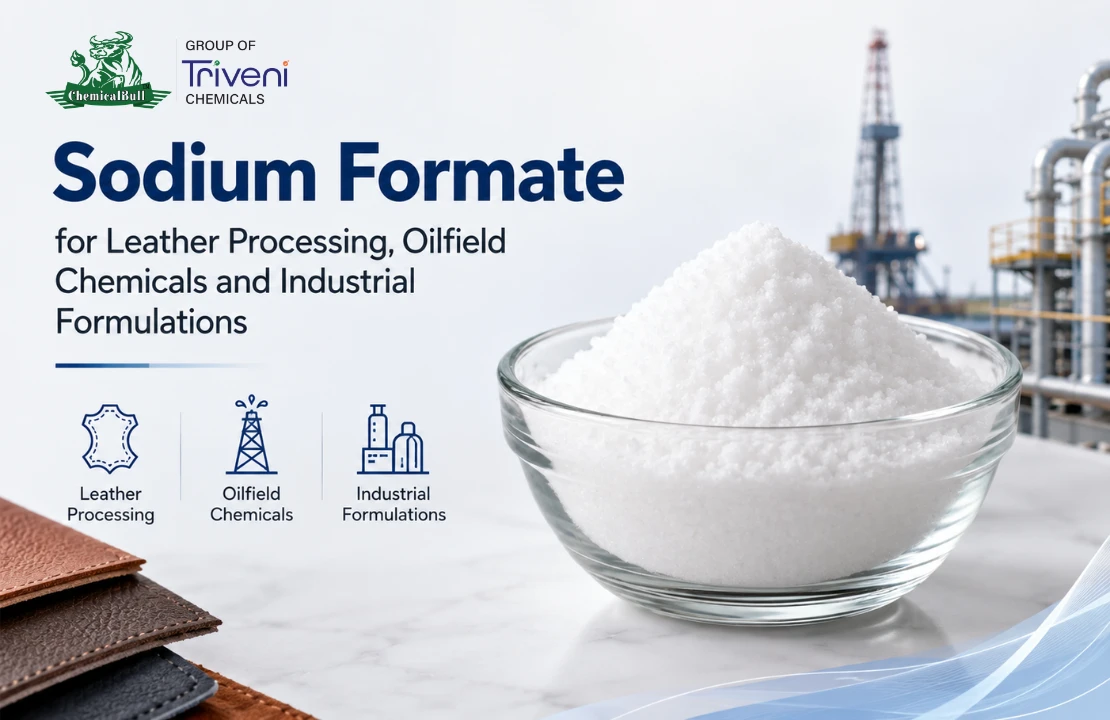
Sodium Formate for Leather Processing, Oilfield Chemicals and Industrial Formulations
Sodium Formate (HCOONa) is the sodium salt of formic acid, registered under CAS number 141-53-7. It is one of the most functionally versatile industrial chemicals in the formate family. Available as a white crystalline solid with high water solubility and excellent thermal stability, it serves as a buffering agent, reducing agent, pH regulator, density-increasing additive, and masking agent across a broad range of demanding industrial sectors. Its combination of chemical reactivity, process compatibility, and relatively low toxicity compared to other industrial salts makes it a preferred choice wherever controlled, predictable chemistry is required.
Sodium formate for leather industry applications governs the chrome tanning process, while its role in oilfield drilling fluid formulation and textile dyeing chemistry is equally significant. Sodium Formate plays a process-critical role across multiple industries simultaneously.
For industrial-grade Sodium Formate supply with consistent purity, COA, MSDS, and competitive bulk pricing, connect with trusted sodium formate manufacturers in India at ChemicalBull, serving leather manufacturers, oilfield chemical suppliers, and industrial formulators across India and global export markets.
Chemical Identity and Properties
|
Property |
Details |
|
Chemical Name |
Sodium Formate |
|
Synonyms |
Sodium Methanoate, Formic Acid Sodium Salt |
|
Molecular Formula |
HCOONa |
|
CAS Number |
141-53-7 |
|
Molecular Weight |
68.01 g/mol |
|
Physical Form |
White crystalline powder / granules |
|
Melting Point |
253°C |
|
Flash Point |
290°C |
|
Solubility |
Highly soluble in water |
|
pH (1% solution) |
Approximately 7.5 to 8.5 (mildly alkaline) |
|
Key Functions |
Buffering agent, reducing agent, pH regulator, masking agent, density additive |
Sodium Formate's high water solubility and its behaviour as a mild reducing and buffering agent across a wide pH range are the core properties that drive its usefulness across all three major application sectors covered in this guide.
Sodium Formate for Leather Industry
The leather industry is one of the largest consumers of sodium formate for leather industry applications globally. In the multi-stage process of converting raw animal hides into finished leather, sodium formate performs a critical and specific role in the chrome tanning stage, which is the most widely used method for producing soft, durable, commercially valuable leather.
Role in Chrome Tanning:
Chrome tanning uses trivalent chromium sulfate (basic chromium sulfate) as the primary tanning agent. For chrome tanning to succeed and produce leather that is soft, supple, and uniformly tanned throughout the hide cross-section, the chromium salt must penetrate deeply and evenly into the hide before it fixes by forming cross-links with the collagen protein network.
This is where Sodium Formate serves its most important function: as a masking agent and basifying agent in the chrome tanning liquor.
Masking function: Sodium Formate reacts with the chromium ions in solution, partially coating them with formate ligands. This reduces the charge and reactivity of the chromium complex, slowing its rate of fixation to collagen. The slower fixation rate allows the chromium to penetrate more deeply and uniformly into the full cross-section of the hide before it binds irreversibly, producing even-penetrating, consistent tannage.
Basifying function: As the formate ligand is progressively displaced during tanning, it gently raises the pH of the tanning bath in a controlled manner. This progressive pH increase drives the chromium fixing reaction forward at a controlled rate, preventing the surface over-tannage and uneven penetration that results from pH increases that are too rapid or too abrupt.
Results in the finished leather:
- More uniform chrome distribution through the full hide cross-section
- Softer, more pliable hand feel due to even collagen cross-linking
- Better dye uptake in subsequent retanning and dyeing operations
- Reduced chromium waste in spent tanning liquors, which is an increasingly important environmental compliance factor
Additional Leather Processing Uses:
Beyond chrome tanning, sodium formate for leather industry use extends to:
- Deliming and bating stage: Added as a buffering agent to control pH during enzyme bating, ensuring consistent enzyme activity and hide relaxation
- Retanning liquors: Used as a pH buffer to optimize the uptake of synthetic tanning agents (syntans) and vegetable tannins during retanning
- Pickle bath adjustment: At controlled concentrations, sodium formate supports stable pH conditions in the pickle stage before chrome tanning begins
Sodium Formate in Oilfield Chemicals
The oil and gas industry is the second major sector where sodium formate for industrial use plays a technically critical role. Sodium Formate dissolves in water to form a clear, high-density brine used as a drill-in fluid, completion fluid, and workover fluid in oil and gas well operations. It achieves densities up to approximately 1.33 g/cm³ without requiring solid weighting agents.
Key performance advantages:
Thermal stability:
Sodium Formate brines maintain chemical integrity and density at high downhole temperatures exceeding 200°C in ultra-deep well environments. This performance level surpasses many conventional drilling fluid systems that degrade under thermal stress.
Formation compatibility:
As a clear fluid with no suspended solids, it minimises formation damage in reservoir sections where solid particles can plug pore throats and reduce well productivity. This is a critical concern in completion and workover operations.
Corrosion inhibition:
Formate brines are significantly less corrosive to steel downhole tubulars and drill strings than alternative dense brines such as calcium chloride or zinc bromide, reducing maintenance costs and equipment replacement frequency.
Shale stability:
Sodium Formate brines help stabilize reactive shale formations through osmotic effects, reducing swelling and wellbore collapse risk in geologically sensitive formations.
Environmental profile:
Formate brines are more readily biodegradable and have a lower aquatic toxicity profile than zinc-based or bromide brines. This makes them important for offshore operations that operate under strict environmental permitting restrictions.
Sodium Formate for Industrial Use: Additional Applications
Beyond leather and oilfield, sodium formate for industrial use spans several additional high-volume sectors:
Textile Dyeing and Printing
In textile processing, Sodium Formate serves as a pH regulator and dyeing auxiliary in the dyeing of natural fibers (wool, silk, nylon) with acid dyes and metallised dyes. Its buffering capacity promotes controlled, level dye uptake across fabric width, improves dye exhaustion, and reduces uneven dyeing defects such as streaks and shade variations in both continuous and batch dyeing processes.
De-icing Formulations
Sodium Formate is used as an environmentally preferred de-icing agent for airport runways, taxiways, and road infrastructure. Compared to chloride-based de-icers, it offers lower corrosivity to aircraft aluminum alloys and steel infrastructure, faster biodegradation, and lower biological oxygen demand (BOD) impact on adjacent waterways. These properties make it the preferred choice in sensitive environments with environmental discharge restrictions.
Chemical Synthesis and Reducing Agent
As a mild reducing agent, Sodium Formate is used in catalytic hydrogenation as a hydrogen donor in transfer hydrogenation reactions. It is also used in the reduction of precious metal salts such as gold, platinum, and palladium in chemical and electrochemical processing, and as a starting material in fine chemical and pharmaceutical synthesis. Additionally, it functions as a process chemical in certain controlled polymerization reactions in rubber and polymer manufacturing.
Grades and Quality Parameters
When sourcing Sodium Formate for industrial applications, the relevant quality parameters depend on the end application:
|
Quality Parameter |
Leather / Textile Grade |
Oilfield Grade |
Chemical Synthesis Grade |
|
Purity (HCOONa) |
95% and above |
97% and above |
98 to 99% |
|
Colour (APHA) |
Low |
Very low |
Very low |
|
Moisture content |
Controlled |
Controlled |
Low |
|
Heavy metals |
Low |
Low |
Specified |
|
pH (1% solution) |
7.5 to 8.5 |
7.5 to 8.5 |
7.5 to 8.5 |
|
Physical form |
Powder / granules |
Powder / granules |
Powder |
For each application, always request a Certificate of Analysis (COA), a Material Safety Data Sheet (MSDS), and a technical specification sheet confirming the relevant purity and impurity parameters.
Frequently Asked Questions
1. What is Sodium Formate used for in the leather industry?
It acts as a masking and basifying agent in chrome tanning, controlling chromium fixation rate for deep, even penetration and a softer, more uniform finished leather.
2. Why is Sodium Formate used in oilfield drilling fluids?
It forms a clear, high-density, thermally stable brine with low corrosivity and good formation compatibility, making it ideal for drill-in, completion, and workover fluid systems.
3. What is the CAS number for Sodium Formate?
The CAS number of Sodium Formate is141-53-7
4. Is Sodium Formate used in textile processing?
Yes, it functions as a pH buffer and dyeing auxiliary that promotes level, consistent dye uptake and improved dye exhaustion in acid and metallised dye systems.
5. Is Sodium Formate environmentally safe?
It is more readily biodegradable and less toxic than many alternative industrial salts and is preferred as a de-icing agent where environmental impact on waterways and infrastructure corrosion are key concerns.
6. What purity grade is required for oilfield applications?
Oilfield-grade Sodium Formate typically requires 97% or higher purity with very low heavy metals and controlled moisture. Always confirm with a COA from your supplier.
7. Can Sodium Formate be used as a reducing agent?
Yes, it is used as a mild reducing agent in catalytic hydrogenation, precious metal reduction, and chemical synthesis applications.
Conclusion
Sodium Formate's combination of buffering capability, reducing activity, density contribution, and mild environmental profile makes it a genuinely cross-industry industrial chemical. As a masking agent in sodium formate for leather industry chrome tanning operations, a high-density brine component for oilfield drilling and completion fluids, a pH regulator in textile dyeing, an airport de-icing agent, and a reducing agent in chemical synthesis, its versatility across demanding applications is matched by relatively straightforward handling and a well-established global supply chain.
For high-purity Sodium Formate with COA, MSDS, technical data sheet, and reliable bulk supply support, connect with Chemical Bull, a trusted sodium formate manufacturers in India serving leather processors, oilfield chemical formulators, textile manufacturers, and industrial buyers across India and international export markets.


Comment Section