Chemical Bull
1630
15-Jun-2026
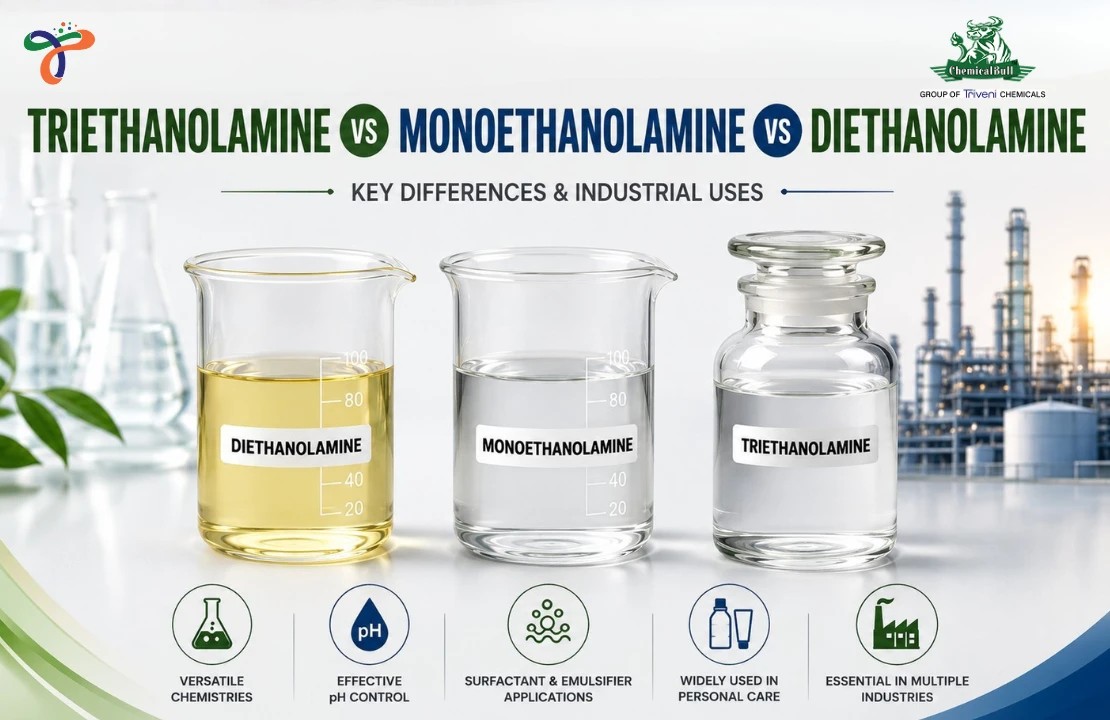
Ethanolamines comprise a range of chemical compounds that are versatile and widely employed in a variety of industries, from cosmetics and agriculture to metalworking and gas treatment. There are three main variants three major variants -the three main variants namely Triethanolamine (TEA) as well as Monoethanolamine (MEA), and Diethanolamine (DEA). Knowing the differences in structure and function is crucial to sourcing the appropriate chemical compound to suit a particular purpose. This article explains each of the three ethanolamines in greater detail, compares the properties of each, and explains the way that industries pick from them.
If you're trying for a quality TEA to be used in formulations or for industrial usage, contacting the most reliable triethanolamine manufacturer assures that you get material that is up to the standards for purity and requirements of the market.
What Are Ethanolamines?
Ethanolamines, organic chemical compounds with the amino group (-NH2 or derivatives thereof) as well as a hydroxyl group (-OH). They are made by reducing ammonia with ethylene oxide under specific conditions. The three main variants differ in the number of ethanol groups that are attached to nitrogen atoms:
- Monoethanolamine (MEA) — one ethanol group (primary amine)
- Diethanolamine (DEA) — two ethanol groups (secondary amine)
- Triethanolamine (TEA) — three ethanol groups (tertiary amine)
This structural variation directly impacts their reactivity, polarity, solubility, and suitability for different industrial processes.
Monoethanolamine (MEA): Properties and Uses
Chemical Profile
Monoethanolamine, also known as 2-aminoethanol or MEA, is the simplest of the three. With a molecular formula of C₂H₇NO, it is a colourless, viscous liquid with a mild ammonia-like odour. MEA has the highest reactivity among the three due to its primary amine structure.
Key properties of MEA:
- Molecular weight: 61.08 g/mol
- Boiling point: 170°C
- Flash point: 85°C
- Water solubility: Fully miscible
- pH (1% solution): ~11.8
Industrial Applications of MEA
1. Gas treatment (CO2 and removal of H2S):
MEA is the most frequently used solvent in removal of acidic gases such as carbon dioxide (CO2) and hydrogen sulfur (H2S) out of natural gas stream. The high reactivity of MEA makes it highly effective at taking in the gases. This makes it the foundation of natural gas processing as well as carbon capture technology.
2. Surfactants and Detergents:
MEA is used as an adjuster of pH and an emulsifier in industrial and household cleaners, helping stabilize the formulation and increase the surface-active properties.
3. Agriculture:
Within the industry of agrochemicals, MEA serves as an intermediary in the process of synthesising pesticides and herbicides like Glyphosate.
4. Cement Grinding Aid:
MEA can be used as an aid to grinding in cement manufacturing, enhancing the efficiency of the milling process as well as the distribution of particles.
Diethanolamine (DEA): Properties and Uses
Chemical Profile
Diethanolamine, with a molecular formula of C₄H₁₁NO₂, is a secondary amine that offers moderate reactivity — sitting between MEA and TEA in terms of chemical aggressiveness. It is a white solid at room temperature (melting point: ~28°C) and becomes a colourless liquid when heated.
Key properties of DEA:
- Molecular weight: 105.14 g/mol
- Boiling point: 268°C
- Flash point: 138°C
- Water solubility: Fully miscible
- pH (1% solution): ~11.0
Industrial Applications of DEA
1. Gas Sweetening
Like MEA, DEA is used in gas sweetening processes to remove CO₂ and H₂S, but it is preferred when the gas stream contains carbonyl sulphide (COS) because DEA causes less degradation in such conditions.
2. Metalworking Fluids
DEA is an essential ingredient in cutting and metalworking fluid formulations. It acts as an inhibitor of corrosion and a pH buffer that can prolong the longevity of fluids and shield the metal surface.
3. Personal Care Products:
DEA reacts with fatty acids and forms Surfactants with DEA (e.g., cocamide DEA), which serve as foam boosters and emulsifiers used in soaps, shampoos, and lotions.
4. Agrochemicals
DEA can be used as neutralising agents and the emulsifier of pesticide and herbicide formulations, especially in water-based sprays for agriculture.
Triethanolamine (TEA): Properties and Uses
Chemical Profile
Triethanolamine is a molecular formula C6H15NO3, an amine that is tertiary and most complicated of the three. It's a viscous, light yellow-colored liquid that has a slight ammonia smell. Because it is a tertiary amine, it doesn't respond as vigorously as MEA or DEA; however, it is a great choice as a pH adjuster and an emulsifier for formulations.
Key properties of TEA:
- Molecular weight: 149.19 g/mol
- Boiling point: 335°C
- Flash point: 179°C
- Water solubility: Fully miscible
- pH (1% solution): ~10.5
Industrial Applications of TEA
1. Cement and Concrete Grinding Aid:
TEA is among the most efficient grinding aids used in cement production. It enhances the efficiency of the mill, reduces energy use, and increases particle dispersion, thus making it the preferred option over MEA for the majority of modern cement plants.
2. Cosmetics and Personal Care:
TEA is widely utilized as a pH balancer as well as an emulsifier for lotions, creams, sunscreens, and hair care products. Its gentle nature and skin-friendly properties make it ideal to be used in cosmetic formulations.
3. Metalworking Fluids:
TEA acts as an inhibitor of corrosion and as an additive for lubricants in metalworking fluids. It prolongs the lifespan of a tool and maintains its high-quality surfaces during the machining process.
4. Chemicals for Agriculture:
TEA functions as an Emulsifier for pesticide and herbicide formulations. This helps in dispersing active ingredients, resulting in better results in the field.
TEA vs MEA vs DEA: Side-by-Side Comparison:
|
Property |
MEA |
DEA |
TEA |
|
Amine Type |
Primary |
Secondary |
Tertiary |
|
Molecular Weight |
61.08 g/mol |
105.14 g/mol |
149.19 g/mol |
|
Boiling Point |
170°C |
268°C |
335°C |
|
Reactivity |
High |
Moderate |
Low |
|
pH (1% solution) |
~11.8 |
~11.0 |
~10.5 |
|
Gas Treatment |
Excellent (CO₂, H₂S) |
Good (COS-resistant) |
Not commonly used |
|
Cement Grinding |
Used |
Rarely used |
Highly effective |
|
Cosmetics |
Limited |
Moderate |
Widely used |
|
Metalworking Fluids |
Some use |
Common |
Common |
|
Agrochemicals |
Synthesis intermediate |
Emulsifier |
Emulsifier |
How to Choose Between TEA, MEA, and DEA
Selecting the right ethanolamine depends on several key factors:
Reactivity requirements:
If the application demands rapid or aggressive chemical reactions — such as acid gas absorption in natural gas processing — MEA is the preferred choice due to its primary amine structure and high reactivity.
Formulation stability:
In personal care or household product formulations that require a mild pH adjuster and emulsifier with good skin tolerance, TEA is the industry standard. Its tertiary amine nature means it participates less aggressively in reactions while still providing effective buffering.
Thermal stability:
For applications involving high process temperatures — such as cement grinding or high-boiling solvent systems — TEA's high boiling point (335°C) offers a significant advantage over MEA and DEA.
Regulatory considerations:
Both DEA and its fatty acid derivatives have faced regulatory scrutiny in certain cosmetic applications due to potential nitrosamine formation. TEA is generally considered safer for cosmetic use in these contexts.
Gas sweetening selectivity:
When the gas stream contains carbonyl sulphide (COS) in addition to CO₂ and H₂S, DEA is preferred over MEA because it degrades more slowly and maintains process efficiency.
Conclusion
Triethanolamine, Monoethanolamine, and Diethanolamine each offer a distinct set of chemical properties and industrial advantages. MEA stands out for high-reactivity applications like gas treatment and agrochemical synthesis. DEA bridges the gap with moderate reactivity and COS-resistant gas sweetening performance. TEA excels in applications that require stability, mildness, and multi-functional performance — from cement grinding to cosmetics and metalworking.
Understanding these differences enables procurement teams, formulation chemists, and industrial engineers to select the most appropriate ethanolamine for their specific process needs — reducing costs, improving efficiency, and ensuring product quality.

Comment Section