Chemical Bull
647
14-Jul-2026
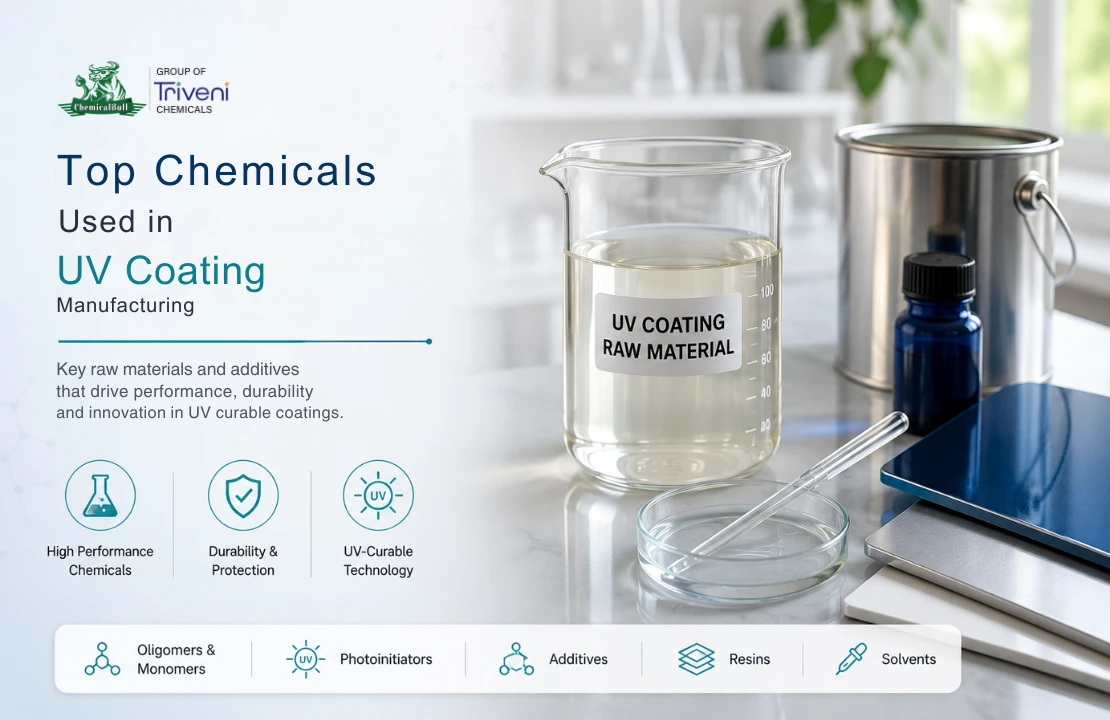
Top Chemicals Used in UV Coating Manufacturing
Quick Answer: What Chemicals Are Used in UV Coating Manufacturing?
Top chemicals used in UV coating manufacturing include monomers, oligomers, photoinitiators, additives, stabilizers, adhesion promoters, pigments, fillers, and crosslinking agents. These raw materials help UV coatings cure quickly under ultraviolet light and improve hardness, gloss, adhesion, flexibility, scratch resistance, chemical resistance, and surface durability.
For manufacturers and export buyers, choosing the right UV coating chemicals is essential for maintaining production consistency, coating performance, and reliable bulk sourcing.
TMPTA is widely used as a reactive monomer and crosslinking agent to enhance curing speed, hardness, adhesion, and overall coating performance. Looking for high-quality Trimethylolpropane Triacrylate (TMPTA) for UV coating applications? Contact our team to request technical specifications, pricing, and bulk supply options for your manufacturing requirements.
Introduction (UV Coating Chemicals)
UV coatings are used when manufacturers need fast curing, smooth finish, high gloss, strong surface protection, and better production speed. Unlike conventional coatings that dry slowly through solvent evaporation or heat, UV coatings cure rapidly when exposed to ultraviolet light.
These coatings are used in packaging, printing, wood finishing, plastic coating, paper coating, metal coating, electronics, automotive parts, and industrial surface protection. The final performance depends on the correct selection of raw materials and their compatibility with the curing system.
For buyers searching for UV coating chemicals in India or a UV coating raw material supplier India, the main requirement is not only availability. They also need COA, TDS, SDS, sample support, proper packing, storage guidance, and batch consistency.
Core Raw Materials Used in UV Coatings
The essential raw materials for UV coatings are selected based on substrate, application method, curing equipment, film thickness, and final finish. A paper coating may need fast cure and high gloss, while a wood, plastic, or metal coating may need hardness, adhesion, abrasion resistance, and chemical resistance.
|
Raw Material Category |
Main Role |
Common Examples |
|
Monomers |
Adjust viscosity, cure speed, and crosslinking |
TMPTA, TPGDA, HDDA, IBOA |
|
Oligomers |
Build film strength and coating properties |
Epoxy acrylates, urethane acrylates, polyester acrylates |
|
Photoinitiators |
Start curing under UV light |
Benzophenone, TPO, BAPO, hydroxy ketones |
|
Additives |
Improve flow, wetting, leveling, and surface finish |
Defoamers, dispersants, slip agents |
|
Adhesion promoters |
Improve bonding to substrates |
Silanes, specialty acrylates |
|
Stabilizers |
Improve storage stability |
Inhibitors, antioxidants |
|
Pigments and fillers |
Provide colour, opacity, texture, or functional value |
Titanium dioxide, matting agents, mineral fillers |
Among UV coating monomers, Trimethylolpropane Triacrylate is an important reactive crosslinking agent used when manufacturers need fast curing, hardness, and improved coating durability.
How UV Coating Formulations Are Made
UV coating formulations are made by blending reactive ingredients in a controlled process. The formulation usually starts with oligomers because they decide the main film properties. Monomers are added to adjust viscosity, flow, crosslink density, hardness, and curing response.
Photoinitiators are included to start the UV curing reaction. Additives are added to improve foam control, leveling, wetting, pigment dispersion, slip, gloss, matte effect, or adhesion.
A typical UV coating formulation is checked for:
|
Test Parameter |
Why It Matters |
Test Parameter |
|
Viscosity |
Affects flow and application |
Viscosity |
|
Cure speed |
Impacts production output |
Cure speed |
|
Adhesion |
Confirms bonding to substrate |
Adhesion |
|
Gloss |
Controls surface appearance |
Gloss |
|
Hardness |
Supports scratch resistance |
Hardness |
|
Flexibility |
Prevents cracking in selected systems |
Flexibility |
|
Chemical resistance |
Improves coating durability |
Chemical resistance |
The same formulation may perform differently on paper, wood, plastic, metal, or film. This is why trial testing on the actual substrate is important before commercial production.
Monomers Used in UV Coating Manufacturing
Monomers act as reactive diluents in UV coatings. They reduce viscosity and become part of the cured film during UV exposure. This makes them different from normal solvents, which usually evaporate during drying.
Monomers help control application flow, crosslinking, curing speed, hardness, flexibility, and final coating performance. The right monomer depends on whether the manufacturer needs fast cure, low viscosity, high hardness, better flexibility, or improved resistance.
|
Monomer |
Main Function |
Monomer |
|
Trimethylolpropane Triacrylate |
Improves crosslinking, hardness, and cure speed |
Trimethylolpropane Triacrylate |
|
Tripropylene Glycol Diacrylate |
Supports viscosity reduction and flexibility |
Tripropylene Glycol Diacrylate |
|
Hexanediol Diacrylate |
Helps balance flexibility and curing |
Hexanediol Diacrylate |
|
Isobornyl Acrylate |
Improves hardness and supports lower shrinkage |
Isobornyl Acrylate |
|
Pentaerythritol Triacrylate |
Supports high crosslink density |
Pentaerythritol Triacrylate |
Role of TMPTA in UV Coatings
TMPTA for UV coatings is used where manufacturers need fast curing and strong film formation. TMPTA is a trifunctional acrylate monomer, which means it can create a tighter crosslinked network during UV curing.
It helps improve surface hardness, scratch resistance, abrasion resistance, chemical resistance, and coating durability. It is commonly considered in UV coatings, UV inks, adhesives, sealants, and other radiation-curable systems.
|
TMPTA Property |
Benefit in UV Coatings |
TMPTA Property |
|
Multifunctional acrylate structure |
Builds stronger crosslinked film |
Multifunctional acrylate structure |
|
Fast UV response |
Supports quicker curing |
Fast UV response |
|
Hardness improvement |
Helps create a tougher surface |
Hardness improvement |
|
Chemical resistance support |
Improves coating durability |
Chemical resistance support |
|
Scratch resistance |
Useful in protective coatings |
Scratch resistance |
TMPTA should be balanced carefully in the formulation. Higher crosslink density can improve hardness and resistance, but excessive use may reduce flexibility.
For bulk TMPTA sourcing, buyers should check purity, inhibitor level, appearance, COA, TDS, SDS, packing details, storage guidance, and batch consistency before commercial use.
For specifications, availability, and bulk sourcing details, visit the Trimethylolpropane Triacrylate product page and request COA, TDS, SDS, and sample support.
Related Reading on TMPTA and UV-Curable Systems
For a detailed explanation of TMPTA performance in UV-curable coatings, inks, and adhesives, read our guide on Trimethylolpropane Triacrylate as a crosslinking agent for UV-curable coatings, inks and adhesives.
For a broader overview of its chemical properties, uses, and industrial applications, explore Trimethylolpropane Triacrylate uses, properties and applications.
Other Common Acrylate Monomers
Apart from TMPTA, formulators may use different acrylate monomers depending on the coating target. Some monomers improve flexibility, while others reduce viscosity or support faster curing.
TPGDA is often selected for viscosity reduction and balanced flexibility. HDDA may help improve flow and curing response. IBOA can support hardness and lower shrinkage in selected systems. The final selection depends on substrate, film thickness, curing equipment, and performance requirement.
Oligomers Used in UV Coatings
Oligomers form the main body of the UV coating. They influence final film strength, flexibility, adhesion, gloss, toughness, and resistance properties. While monomers adjust viscosity and curing behavior, oligomers decide much of the coating’s final character.
Epoxy Acrylates
Epoxy acrylates are used where high hardness, fast cure, gloss, and chemical resistance are needed. They are useful in wood coatings, paper coatings, plastic coatings, metal coatings, and UV inks.
Urethane Acrylates
Urethane acrylates are selected when flexibility, toughness, abrasion resistance, and adhesion are important. They are used in flexible coatings, specialty films, plastics, and high-performance industrial coatings.
Polyester Acrylates
Polyester acrylates offer balanced curing, film strength, flexibility, and cost performance. They are used in general UV coatings, inks, and industrial surface applications.
|
Oligomer Type |
Main Benefit |
Common Use |
|
Epoxy acrylate |
High hardness and chemical resistance |
Wood, metal, paper, and plastic coatings |
|
Urethane acrylate |
Flexibility and toughness |
Flexible coatings, films, and specialty finishes |
|
Polyester acrylate |
Balanced curing and film properties |
General UV coatings and inks |
|
Silicone acrylate |
Slip and surface smoothness |
Specialty surface coatings |
The best monomers and oligomers for UV coatings are selected together. For example, epoxy acrylates may provide hardness, while TMPTA can improve curing and crosslinking. Urethane acrylates may be chosen when flexibility is more important.
Photoinitiators in UV Coating Production
Photoinitiators are important because they start the curing reaction. When exposed to UV light, they generate reactive species that convert the liquid coating into a solid film.
The selection depends on coating thickness, colour, pigment loading, UV lamp type, curing speed, and final appearance. Clear coatings and pigmented coatings may need different photoinitiator systems.
|
Photoinitiator Type |
Use in UV Coatings |
Photoinitiator Type |
|
Benzophenone-based systems |
Common in surface curing |
Benzophenone-based systems |
|
TPO |
Useful in pigmented and thicker systems |
TPO |
|
BAPO |
Supports deep curing and coloured coatings |
BAPO |
|
Hydroxy ketones |
Used in clear coatings and inks |
Hydroxy ketones |
|
Amino ketones |
Used where faster surface cure is needed |
Amino ketones |
Without the right photoinitiator, the coating may remain tacky, cure unevenly, or fail in hardness and adhesion tests.
Additives Used in UV Coating Formulations
Additives are used in small quantities, but they strongly affect processing and surface quality. They help solve practical production issues such as foam, poor flow, weak pigment dispersion, surface defects, low slip, or poor adhesion.
|
Additive |
Purpose |
Additive |
|
Defoamer |
Reduces foam during mixing and coating |
Defoamer |
|
Leveling agent |
Improves smoothness and gloss |
Leveling agent |
|
Wetting agent |
Improves contact with substrate or pigment |
Wetting agent |
|
Dispersant |
Helps pigment distribution |
Dispersant |
|
Slip additive |
Improves surface feel and scratch resistance |
Slip additive |
|
Matting agent |
Reduces gloss when matte finish is needed |
Matting agent |
|
Adhesion promoter |
Improves bonding to surface |
Adhesion promoter |
A small change in additive selection can affect coating appearance, printing quality, and production stability.
UV Coating Chemicals and Their Applications
UV coating chemicals are used in many industries because they support fast processing and durable surface finishing. The required chemical system changes depending on the end-use.
|
Industry |
Application |
Industry |
|
Packaging |
Carton coating, overprint varnish, gloss finish |
Packaging |
|
Printing |
UV inks, labels, graphics, varnishes |
Printing |
|
Wood |
Furniture, flooring, decorative panels |
Wood |
|
Plastic |
Decorative and protective coating |
Plastic |
|
Paper |
High-gloss paper coating |
Paper |
|
Metal |
Protective and decorative finish |
Metal |
|
Electronics |
Protective coating and insulation support |
Electronics |
Industrial applications of UV coating chemicals are growing because manufacturers want faster production, better finish, and improved coating performance.
UV Coating Chemicals in India
Demand for UV coating chemicals in India is increasing due to growth in packaging, printing, furniture, plastics, electronics, automotive components, and industrial coatings. UV coating manufacturers in India need chemicals that support fast curing, stable performance, good finish, and regular production quality.
Buyers sourcing UV coating chemicals in India should check product specifications, storage guidance, technical documents, application suitability, packing condition, and supplier reliability before bulk purchase.
For reactive monomers such as TMPTA, proper handling, inhibitor level, and storage conditions should be reviewed carefully. These checks help avoid curing issues, storage instability, and batch variation during production.
How Manufacturers Select UV Coating Chemicals
Manufacturers should not select UV coating raw materials only by price. The right choice depends on production method, substrate, coating thickness, curing equipment, performance target, and storage condition.
|
Buying Check |
Why It Matters |
Buying Check |
|
Purity |
Affects curing and consistency |
Purity |
|
Functionality |
Controls crosslinking and film strength |
Functionality |
|
Viscosity |
Affects flow and application |
Viscosity |
|
Compatibility |
Prevents separation or performance failure |
Compatibility |
|
Inhibitor level |
Supports storage stability |
Inhibitor level |
|
COA |
Confirms batch quality |
COA |
|
TDS |
Gives technical product details |
TDS |
|
SDS |
Supports safe handling |
SDS |
|
Batch consistency |
Important for repeat production |
Batch consistency |
|
Supplier reliability |
Supports regular manufacturing needs |
Supplier reliability |
For export buyers and large-scale manufacturers, documentation, packing quality, and supply reliability are as important as product availability.
UV Coating Chemicals Supplier Guide
Buyers looking for where to buy UV coating chemicals should work with suppliers that provide product details, technical documents, sample support, bulk availability, and consistent batch quality. The best UV coating chemicals are not always the lowest-priced chemicals; they are the materials that match the formulation, substrate, curing system, and performance requirement.
ChemicalBull supplies UV coating chemicals for manufacturers, formulators, traders, and export buyers. For TMPTA sourcing support, visit the Trimethylolpropane Triacrylate product page to request product details, COA, TDS, SDS, sample support, and bulk supply information.
Frequently Asked Questions
-
What are the common chemicals used in UV-curable coatings?
Common chemicals used in UV-curable coatings include TMPTA, TPGDA, HDDA, epoxy acrylates, urethane acrylates, polyester acrylates, benzophenone, TPO, BAPO, leveling agents, defoamers, wetting agents, and dispersants. -
What is the role of monomers in UV coatings?
Monomers reduce viscosity, improve flow, support curing, and become part of the cured coating film. They also help control hardness, flexibility, and crosslink density. -
What is the role of TMPTA in UV coatings?
TMPTA is used as a multifunctional acrylate monomer and crosslinking agent. It helps improve curing speed, film hardness, scratch resistance, chemical resistance, and coating durability. -
What are the industrial applications of UV coating chemicals?
UV coating chemicals are used in packaging, printing inks, wood coating, paper coating, plastic coating, metal coating, electronics, automotive parts, and industrial surface finishing. -
Where can buyers source UV coating chemicals in India?
Buyers can source UV coating chemicals in India from suppliers that provide bulk availability, COA, TDS, SDS, sample support, technical details, proper packing, and consistent supply quality.
Conclusion
UV coating manufacturing depends on the right selection of monomers, oligomers, photoinitiators, additives, stabilizers, and crosslinking agents. These chemicals work together to provide fast curing, surface hardness, gloss, adhesion, flexibility, and durability.
TMPTA is one of the important acrylate monomers used where fast curing and strong crosslinking are required. Along with suitable oligomers, photoinitiators, and additives, it helps manufacturers create high-performance UV coating systems.
For manufacturers, formulators, UV coating manufacturers in India, and export buyers, chemical selection should be based on performance, compatibility, documentation, storage stability, and supplier reliability. ChemicalBull supports sourcing of UV coating raw materials with technical documents, sample assistance, and bulk supply support.
Comment Section