Chemical Bull
11
29-Aug-2026
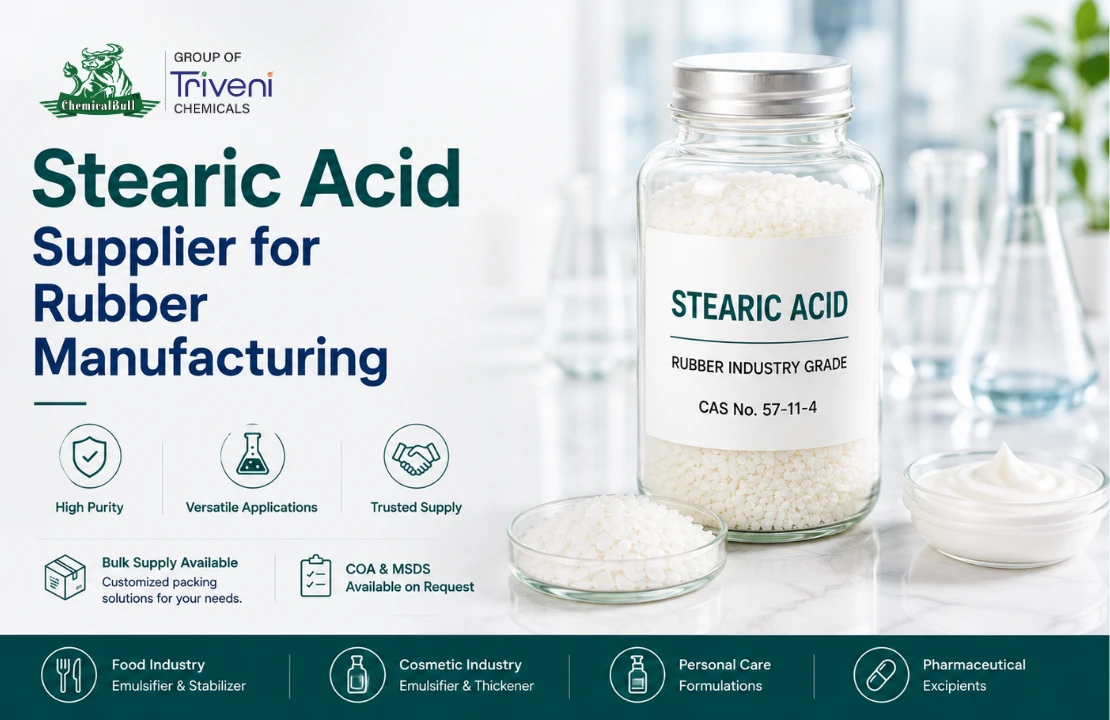
Stearic Acid Supplier for Rubber Manufacturing
Stearic acid is an important raw material used in rubber manufacturing, especially in sulfur-cured rubber compounds. It supports vulcanization, processing, lubrication and the dispersion of compounding ingredients. In many rubber formulations, stearic acid works together with zinc oxide to help activate the curing system and improve overall compound processing.
For rubber manufacturers, compounders and industrial buyers, choosing a reliable stearic acid supplier for rubber manufacturing is important for maintaining consistent quality, predictable processing and stable commercial production.
Businesses searching for a dependable Stearic Acid Manufacturer or bulk sourcing partner should compare product specifications, fatty-acid composition, batch consistency, technical documentation and supply capability before finalizing a requirement.
What Is Stearic Acid?
Stearic acid is a long-chain fatty acid widely used in industrial applications, including rubber compounding.
Commercial stearic acid is often a mixture containing stearic acid along with other fatty acids such as palmitic and oleic acids. Commercial grades may be produced from animal- or vegetable-derived feedstocks.
In rubber processing, it is valued because it can perform more than one function within the compound.
Typical roles include:
-
Vulcanization activator support
-
Processing aid
-
Internal lubricant
-
Dispersion support
-
Flow improvement
-
Assistance in zinc oxide activation
This combination of functions makes stearic acid widely used in both natural and synthetic rubber formulations.
Why Is Stearic Acid Used in Rubber Manufacturing?
Stearic acid is commonly used because it supports both the curing system and the physical processing of the rubber compound.
Vulcanization Activation
One of its most important functions is its interaction with zinc oxide.
During sulfur vulcanization, stearic acid can react with zinc oxide to form zinc stearate or related zinc soaps. These species help make zinc available in a form that supports accelerator activity during curing.
Processing Support
Stearic acid can also act as an internal lubricant.
This helps reduce friction within the compound and can support smoother processing during:
-
Mixing
-
Milling
-
Extrusion
-
Calendering
-
Molding
Its processing effect can make rubber compounds easier to handle during manufacturing.
Dispersion of Compounding Ingredients
Good dispersion of zinc oxide, fillers and other additives is important for consistent rubber performance.
Stearic acid can help improve the distribution of some ingredients within the rubber matrix, depending on the complete formulation and mixing conditions.
How Stearic Acid Works With Zinc Oxide in Rubber
The zinc oxide-stearic acid system is widely used in sulfur-cured rubber.
In simple terms:
Stearic Acid + Zinc Oxide → Zinc-based soap/complex → Better accelerator activation
The resulting zinc-containing species can support the accelerator system and help improve the efficiency of sulfur crosslinking.
This is why stearic acid is commonly discussed together with:
-
Zinc oxide
-
Sulfur
-
Accelerators
-
Antioxidants
-
Fillers
-
Processing aids
However, the final cure behavior depends on the complete formulation rather than stearic acid alone.
Main Functions of Stearic Acid in Rubber Compounding
|
Function |
Role in Rubber Manufacturing |
|
Cure activation |
Supports zinc oxide and accelerator activity |
|
Lubrication |
Helps reduce internal friction during processing |
|
Processing aid |
Improves movement during mixing, extrusion and molding |
|
Dispersion support |
Helps distribute some compounding ingredients |
|
Flow improvement |
Can support better compound handling |
|
Zinc soap formation |
Contributes to the vulcanization activation system |
These functions may vary according to rubber type, dosage, grade and the rest of the formulation.
Stearic Acid in Natural Rubber and Synthetic Rubber
Stearic acid can be used in a wide range of rubber systems.
Natural Rubber
In natural rubber compounds, stearic acid is commonly incorporated into sulfur cure systems with zinc oxide and accelerators.
It can support:
-
Cure activation
-
Compound processing
-
Internal lubrication
-
Filler dispersion
SBR
Styrene-butadiene rubber often uses stearic acid in sulfur-cured formulations where processing and cure balance are important.
NBR
In nitrile rubber compounds, stearic acid may be used as part of the cure and processing system depending on the formulation.
EPDM
Stearic acid may also be used in selected EPDM formulations, although the role and dosage depend on the curing system and compound design.
Applications of Stearic Acid in Rubber Products
Stearic acid is used in many rubber-manufacturing segments.
Tires and Automotive Rubber
It may be used in formulations for:
-
Tires
-
Inner tubes
-
Automotive seals
-
Hoses
-
Gaskets
-
Vibration-control components
Industrial Rubber Products
Other applications can include:
-
Conveyor belts
-
Rubber sheets
-
Industrial hoses
-
Rubber rollers
-
Molded rubber parts
-
Flooring
-
Seals and gaskets
Footwear and Consumer Rubber
Stearic acid may also be used in:
-
Shoe soles
-
Rubber footwear
-
Mats
-
General molded articles
Its exact role depends on the compound formulation and target processing properties.
Stearic Acid as a Processing Aid in Rubber
A rubber compound must move through mixers, mills, extruders and molds before curing.
Stearic acid can help support this processing behavior by acting as a lubricant and reducing friction between polymer chains and other ingredients.
This may help with:
-
Easier mixing
-
Improved flow
-
Reduced sticking
-
Better milling behavior
-
More consistent extrusion
-
Smoother molding
These benefits are formulation-dependent, and excessive or insufficient levels can change compound behavior.
Does Stearic Acid Improve Rubber Vulcanization?
Yes. Stearic acid can support sulfur vulcanization when used with zinc oxide and suitable accelerators.
It is not normally considered the main vulcanizing agent itself.
Its role is better described as a co-activator or activator-support material within the curing system.
The final cure depends on:
-
Zinc oxide level
-
Accelerator type
-
Sulfur level
-
Rubber polymer
-
Fillers
-
Processing temperature
-
Cure temperature
-
Other compounding ingredients
Rubber-Grade Stearic Acid vs General Industrial Grade
Not every grade is equally suitable for rubber production.
Rubber manufacturers should evaluate the supplied grade based on the formulation requirement.
Important points can include:
-
Acid value
-
Iodine value
-
Fatty-acid composition
-
Moisture
-
Color
-
Melting range
-
Physical form
-
Batch consistency
The required specification depends on the rubber compound and finished-product requirement.
How Much Stearic Acid Is Used in Rubber Compounding?
There is no single dosage suitable for every rubber formulation.
The required level depends on:
-
Rubber type
-
Zinc oxide concentration
-
Accelerator system
-
Sulfur system
-
Filler loading
-
Processing requirement
-
Target cure behavior
-
Finished rubber properties
Formulators should determine the correct level through laboratory trials and cure testing rather than relying on one universal percentage.
Stearic Acid and Rubber Compound Processing
Stearic acid should be considered as part of the complete rubber formulation, not as an isolated ingredient.
Its performance can interact with:
-
Zinc oxide
-
Accelerators
-
Fillers
-
Oils
-
Antioxidants
-
Resins
-
Plasticizers
-
Other processing aids
For this reason, changes in stearic acid grade should ideally be validated before full commercial production.
Why Consistent Stearic Acid Quality Matters
Rubber manufacturers often run continuous or repeat production batches.
Variation in raw-material quality can affect:
-
Mixing behavior
-
Compound flow
-
Cure characteristics
-
Dispersion
-
Extrusion behavior
-
Finished-product consistency
A lower purchase price may not provide a real cost advantage if inconsistent material causes processing adjustments or rejected batches.
Consistent specification and reliable supply are therefore important for industrial buyers.
What Should B2B Rubber Manufacturers Check Before Buying Stearic Acid?
Rubber manufacturers and compounders should evaluate more than price.
Product grade: Confirm that the supplied material is suitable for rubber compounding.
Fatty-acid composition: Review the stearic and palmitic acid distribution where required.
Specification: Check acid value, iodine value, moisture, melting characteristics and other relevant parameters.
Physical form: Confirm whether flakes, beads, powder or another form is preferred for handling.
Batch consistency: Consistent quality helps maintain predictable processing.
Documentation: Buyers may request COA, SDS/MSDS, TDS and product specifications.
Packing: Confirm packaging according to trial, regular production or bulk consumption.
Supply reliability: Regular rubber production requires dependable material availability.
Stearic Acid Supplier for Rubber Manufacturing
For commercial rubber manufacturing, buyers need a sourcing partner that can support both technical and supply requirements.
Companies looking for a stearic acid supplier for rubber manufacturing should provide details such as:
-
Required grade
-
Expected monthly quantity
-
Application
-
Rubber type
-
Preferred packing
-
Delivery location
-
Required documentation
This helps identify the suitable commercial requirement more quickly. Looking for Stearic Acid for rubber compounding, tire manufacturing or industrial rubber production? Connect with Chemical Bull for product specifications, COA, MSDS/SDS, TDS, packing options and bulk supply requirements.
Frequently Asked Questions
-
What is stearic acid used for in rubber manufacturing?
Stearic acid is used in rubber compounding mainly to support vulcanization activation, processing, lubrication and dispersion. It commonly works with zinc oxide in sulfur-cured rubber systems. -
Why is stearic acid used with zinc oxide in rubber?
Stearic acid reacts with zinc oxide to form zinc-based soaps or complexes that help activate accelerator chemistry during sulfur vulcanization. -
Is stearic acid a vulcanizing agent?
No. Stearic acid is not normally considered the main vulcanizing agent. It acts as a co-activator or activator-support material in many sulfur-cured systems. -
Does stearic acid act as a lubricant in rubber?
Yes. Stearic acid can provide internal lubrication and support smoother mixing, milling, extrusion and molding, depending on the formulation. -
What grade of stearic acid is suitable for rubber manufacturing?
The correct grade depends on the compound requirements. Buyers should review fatty-acid composition, acid value, iodine value, moisture, color, melting characteristics and batch consistency. -
What documents should a stearic acid supplier provide?
Depending on the buyer's requirement, common documents include a Certificate of Analysis, SDS/MSDS, Technical Data Sheet and product specification. -
Where can rubber manufacturers buy stearic acid in bulk?
Rubber manufacturers can source stearic acid through industrial raw-material suppliers serving tire, automotive and general rubber-compounding applications. Buyers should compare grade consistency, documentation, packing and supply capability in addition to price.
Conclusion
Stearic acid plays an important role in rubber manufacturing by supporting vulcanization activation, processing, lubrication and ingredient dispersion. Its interaction with zinc oxide is especially important in many sulfur-cured rubber systems, where it helps support accelerator activity and cure efficiency.
For rubber compounders, tire manufacturers and industrial rubber producers, the best results depend on selecting the right grade, maintaining consistent quality and validating the material in the complete formulation.
B2B buyers sourcing stearic acid should therefore compare specification, fatty-acid composition, documentation, batch consistency, packing and dependable bulk supply alongside commercial pricing.
Comment Section