Chemical Bull
17
31-Aug-2026
Diethylene Glycol Dibenzoate Uses in Adhesives and Sealants
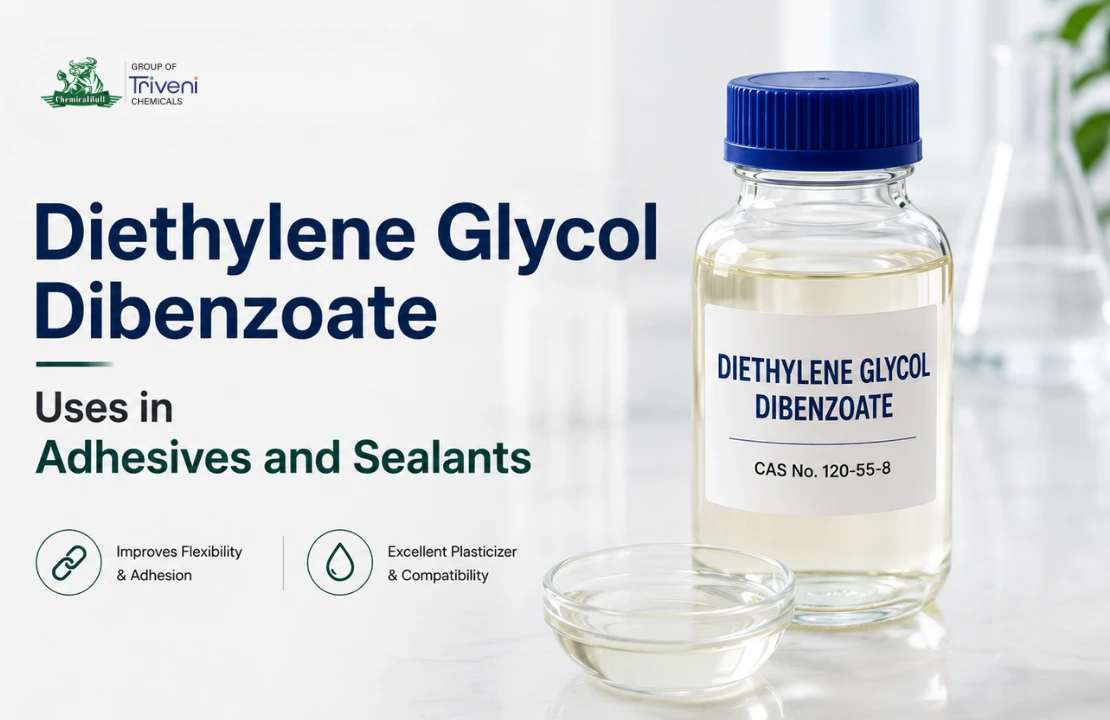
Diethylene Glycol Dibenzoate uses in adhesives and sealants are primarily associated with its role as a specialty plasticizer that can modify flexibility, workability, polymer compatibility, and application characteristics. Also known as DEGDB, Diethylene Glycol Dibenzoate is a benzoate ester with CAS No. 120-55-8 and is used in selected adhesive, sealant, coating, and polymer formulations.
For manufacturers evaluating Diethylene Glycol Dibenzoate for adhesive or sealant formulations, ChemicalBull provides product information and commercial sourcing support based on required quantity and specification.
This guide explains how Diethylene Glycol Dibenzoate works in adhesive and sealant systems, which formulations may use it, what properties formulators should evaluate, and how buyers can select a reliable supplier.
Quick Answer: What Is Diethylene Glycol Dibenzoate Used For?
Diethylene Glycol Dibenzoate is primarily used as a plasticizer and formulation modifier in polymer-based products. In adhesives and sealants, it can help modify flexibility, processability, tack, film formation, and other formulation properties when it is compatible with the polymer system.
It is particularly relevant to water-based and latex adhesive systems, as well as selected caulks, sealants, coatings, and other polymer formulations. Dibenzoate plasticizers are established in adhesive and sealant applications, including emulsion adhesives, latex sealants, and some hot-melt systems.
The exact effect depends on the polymer, resin, plasticizer concentration, formulation design, and application conditions.
What Is Diethylene Glycol Dibenzoate?
Diethylene Glycol Dibenzoate is an ester derived from diethylene glycol and benzoic acid. It belongs to the benzoate ester family and is used as a specialty plasticizer in polymer formulations.
Chemical Identity
|
Property |
Information |
|
Chemical Name |
Diethylene Glycol Dibenzoate |
|
Abbreviation |
DEGDB |
|
CAS Number |
120-55-8 |
|
Chemical Family |
Benzoate ester |
|
Functional Role |
Plasticizer / formulation modifier |
|
Physical Form |
Liquid or low-melting material depending on grade |
|
Appearance |
Typically clear to pale liquid |
|
Main Application Areas |
Adhesives, sealants, coatings, polymers |
Important Distinction: Pure DEGDB vs Dibenzoate Blends
Buyers should pay attention to the product identity.
A product sold commercially as a dibenzoate plasticizer may contain Diethylene Glycol Dibenzoate together with other benzoate esters such as Dipropylene Glycol Dibenzoate.
For example, commercial Benzoflex products can contain combinations of dibenzoate compounds rather than pure DEGDB.
Therefore, when sourcing the material, always confirm:
- CAS number
- Composition
- Purity
- Product specification
- CoA
- Whether the material is a pure compound or a blend
Why Is DEGDB Used in Adhesives?
The central reason is its plasticizing effect and compatibility with selected adhesive polymers.
Plasticizers can modify polymer behavior by increasing flexibility and changing properties such as glass-transition temperature, viscosity, and workability. In adhesive systems, plasticizer compatibility with the base polymer is particularly important.
When DEGDB is compatible with an adhesive polymer, it can influence several formulation characteristics.
Key functions can include:
- Plasticization
- Flexibility modification
- Improved workability
- Tack modification
- Film-formation support
- Viscosity modification
- Polymer softening
- Processing improvement
The exact effect depends strongly on the polymer system.
Diethylene Glycol Dibenzoate Uses in Adhesives
1. Uses in Water-Based Adhesives
Water-based adhesives are an important application area for dibenzoate plasticizers.
DEGDB can be evaluated in latex and emulsion adhesive formulations where compatibility with the polymer phase allows it to modify the physical properties of the dried adhesive film.
Potential formulation effects include:
- Improved flexibility
- Modified tack
- Improved film formation
- Changes in viscosity
- Modified open time
- Improved wetting
- Changes in bond performance
Research and industry literature describe dibenzoate plasticizers in waterborne acrylic and latex adhesive systems, where plasticizer selection influences wetting, peel strength, tack, viscosity response, and polymer glass-transition behavior.
2. PVAc Adhesive
Polyvinyl acetate, or PVAc, is widely used in adhesive formulations.
Dibenzoate plasticizers have been studied in PVAc-based systems because the plasticizer can interact with the polymer and modify its physical behavior.
For a PVAc adhesive, a formulator may evaluate:
- Polymer compatibility
- Viscosity response
- Tack
- Open time
- Set time
- Flexibility
- Film formation
- Peel strength
- Aging behavior
A plasticizer should not be selected solely because it belongs to the dibenzoate family. Compatibility with the specific PVAc grade and complete formulation must be verified experimentally.
3. Acrylic Adhesives
Acrylic adhesive systems can have different performance requirements depending on whether they are designed for pressure-sensitive, construction, packaging, or specialty applications.
Dibenzoate plasticizers have been evaluated in waterborne acrylic pressure-sensitive adhesives.
Plasticizer addition can influence:
- Wetting
- Tack
- Peel strength
- Polymer Tg
- Film flexibility
- Adhesive flow
- Processing characteristics
However, there is an important formulation trade-off.
Increasing plasticization may improve flexibility or tack while potentially reducing holding power or cohesive strength if the formulation becomes excessively softened. Research on dibenzoate plasticizers in acrylic PSAs specifically highlights the need to balance these properties.
Formulator's Note
Do not optimize an adhesive solely for maximum tack.
A successful adhesive needs a balance between:
Tack + Peel + Cohesion + Shear/Holding Power + Flexibility
If DEGDB increases tack but reduces cohesive strength beyond the application's requirement, simply increasing the plasticizer level is not a successful formulation strategy.
The better approach is to evaluate the complete formulation and identify the optimum plasticizer level for the intended end use.
Diethylene Glycol Dibenzoate Uses in Sealants
Sealants need a different performance balance from many conventional adhesives.
A sealant often needs to accommodate movement, maintain adhesion to the substrate, and resist cracking or loss of integrity during service.
Plasticizers can help modify flexibility and workability in polymer-based sealant systems.
Dibenzoate plasticizers have been used in caulks and sealants, including latex-based systems.
Potential formulation roles include:
- Flexibility modification
- Workability improvement
- Viscosity adjustment
- Polymer softening
- Improved application characteristics
- Modification of low-temperature behavior
The suitability of DEGDB depends on the polymer and sealant chemistry.
Latex Sealants
Latex sealants are particularly relevant because benzoate plasticizers have an established history in water-based adhesive and sealant formulations.
In a latex sealant, DEGDB may be evaluated for its interaction with the polymer phase and its effect on the final dried or cured material.
Important tests can include:
|
Test |
What It Helps Evaluate |
|
Viscosity |
Processing and application behavior |
|
Tack |
Initial adhesive interaction |
|
Elongation |
Flexibility |
|
Tensile strength |
Mechanical strength |
|
Adhesion |
Substrate bonding |
|
Shore hardness |
Material hardness |
|
Low-temperature flexibility |
Resistance to brittle behavior |
|
Aging |
Long-term performance |
|
Water resistance |
Performance under moisture exposure |
How Does DEGDB Work as a Plasticizer?
A plasticizer interacts with polymer chains and modifies their mobility.
In practical formulation terms, this can result in:
- Lower polymer glass-transition temperature
- Greater flexibility
- Modified viscosity
- Improved workability
- Changed tack
- Modified film formation
The reduction in polymer Tg is commonly used as one indicator of plasticizer effectiveness and compatibility.
However, Tg reduction alone does not determine whether an adhesive is better.
An adhesive must still meet its application-specific requirements for strength, tack, adhesion, durability, and processing.
Technical Factors in Adhesives
When evaluating DEGDB, formulators should consider more than the plasticizer itself.
Polymer Compatibility
Compatibility is one of the most important factors.
If the plasticizer is insufficiently compatible with the polymer, problems can include:
- Phase separation
- Migration
- Surface defects
- Inconsistent viscosity
- Reduced long-term performance
Plasticizer Level
More plasticizer does not automatically mean better performance.
Excessive plasticization can result in:
- Excessive softness
- Reduced cohesive strength
- Lower holding power
- Changes in tack
- Altered drying behavior
The optimum level must be determined experimentally.
Viscosity
The plasticizer can change the viscosity of an adhesive or latex system.
This matters for:
- Mixing
- Pumping
- Coating
- Application
- Filling
- Spray or dispensing processes
Film Formation
For waterborne adhesives, film formation is particularly important.
The plasticizer can influence polymer mobility and film development as water evaporates.
Technical Factors in Sealants
Sealant formulators should consider:
Flexibility
The sealant needs sufficient flexibility for the intended movement and service environment.
Adhesion
Plasticizer selection should not compromise adhesion to the target substrate.
Cohesion
The sealant must maintain internal strength while remaining flexible.
Water Resistance
For construction and exterior applications, moisture exposure can become an important performance variable.
Aging
The formulation should be evaluated under realistic temperature, humidity, UV, and mechanical conditions where relevant.
Expert Insight / Formulator's Note
One of the most important formulation principles is that plasticizer performance is system-dependent.
For example, a plasticizer that performs well in one PVAc latex may not produce the same result in an acrylic emulsion or a different sealant polymer.
Therefore, instead of asking:
“Is Diethylene Glycol Dibenzoate a good plasticizer?”
the better technical question is:
“Is Diethylene Glycol Dibenzoate compatible with my polymer and capable of delivering the required balance of flexibility, adhesion, cohesion, and processing?”
That distinction is important when moving from laboratory formulation to production.
DEGDB vs Other Dibenzoate Plasticizers
DEGDB is part of a broader group of benzoate plasticizers.
One commonly encountered comparison is between Diethylene Glycol Dibenzoate and Dipropylene Glycol Dibenzoate.
|
Characteristic |
Diethylene Glycol Dibenzoate |
Dipropylene Glycol Dibenzoate |
|
Abbreviation |
DEGDB |
DPGDB |
|
CAS Number |
120-55-8 |
27138-31-4 |
|
Chemical family |
Dibenzoate ester |
Dibenzoate ester |
|
General role |
Plasticizer |
Plasticizer |
|
Adhesive applications |
Yes |
Yes |
|
Sealant applications |
Yes |
Yes |
|
Formulation behavior |
Depends on polymer/system |
Depends on polymer/system |
Dibenzoate blends are also commercially used because combining different benzoate esters can change compatibility and formulation behavior.
Diethylene Glycol Dibenzoate Supplier for Industrial Applications
For manufacturers sourcing Diethylene Glycol Dibenzoate for adhesives, sealants, coatings, and polymer formulations, choosing the right supplier involves more than comparing prices. Product specifications, composition, documentation, packaging, quantity, and delivery reliability should also be evaluated.
ChemicalBull supports industrial buyers looking for a reliable Diethylene Glycol Dibenzoate supplier for different quantity and application requirements. Buyers can discuss specifications, CoA and SDS documentation, packaging options, bulk requirements, and delivery needs.
When selecting a supplier, buyers should verify the CAS No. 120-55-8, product composition, specification, CoA, SDS, packaging, MOQ, lead time, and repeat-supply capability. This is particularly important when sourcing DEGDB for consistent adhesive, sealant, coating, or polymer production.
Why Choose ChemicalBull as Your Diethylene Glycol Dibenzoate Supplier?
Choosing the right Diethylene Glycol Dibenzoate supplier is important for maintaining consistent quality and reliable production. ChemicalBull supports industrial buyers with sourcing solutions for Diethylene Glycol Dibenzoate (CAS No. 120-55-8) for adhesives, sealants, coatings, and polymer applications.
ChemicalBull can support buyers with:
- Consistent product specifications
- CoA and SDS documentation
- Trial and bulk quantity requirements
- Suitable packaging options
- Domestic and export supply support
- Competitive commercial quotations
- Support for recurring industrial requirements
Whether you are evaluating Diethylene Glycol Dibenzoate for a new formulation or require regular bulk supply for production, ChemicalBull can help coordinate the sourcing process based on your specification, quantity, and delivery requirements.
Frequently Asked Questions
-
What is Diethylene Glycol Dibenzoate used for?
Diethylene Glycol Dibenzoate is mainly used as a plasticizer and formulation modifier in adhesives, sealants, coatings, polymers, and related applications. It can help modify flexibility, tack, workability, film formation, and viscosity in compatible formulations. -
What are the uses of Diethylene Glycol Dibenzoate in adhesives and sealants?
It is used in selected adhesive and sealant formulations to modify flexibility, tack, workability, polymer mobility, and application performance. Its effectiveness depends on the polymer, formulation composition, concentration, and specific end-use requirements. -
What is the CAS number of Diethylene Glycol Dibenzoate?
The CAS number of Diethylene Glycol Dibenzoate is 120-55-8. Buyers should verify the CAS number, composition, and applicable specification against the supplier's technical documentation before purchasing. -
Is Diethylene Glycol Dibenzoate a plasticizer?
Yes. Diethylene Glycol Dibenzoate is a benzoate ester used as a specialty plasticizer and formulation modifier. Its performance depends on its compatibility with the polymer and its interaction with other ingredients in the formulation. -
What is the difference between DEGDB and DPGDB?
DEGDB and DPGDB are different dibenzoate esters. Diethylene Glycol Dibenzoate (DEGDB) has CAS No. 120-55-8, while Dipropylene Glycol Dibenzoate (DPGDB) has CAS No. 27138-31-4. Their compatibility and formulation performance can differ. -
How do I choose a Diethylene Glycol Dibenzoate supplier?
Look for a supplier that can provide the required specification, CAS confirmation, CoA, SDS, suitable packaging, quantity, lead time, and reliable supply. For bulk purchases, also compare total delivered cost and the supplier's ability to support repeat requirements.
Conclusion
Diethylene Glycol Dibenzoate uses in adhesives and sealants are primarily connected to its role as a specialty plasticizer and formulation modifier. In compatible polymer systems, it can help modify flexibility, tack, workability, film formation, viscosity, and other performance characteristics.
Its value in adhesive and sealant formulation comes from the interaction between the plasticizer and the polymer—not simply from adding a particular percentage of DEGDB.
For formulators, the most important considerations are polymer compatibility, plasticizer level, viscosity response, Tg modification, adhesion, cohesion, flexibility, aging, and application-specific performance.
For procurement teams, the key considerations are CAS No. 120-55-8, product composition, specification, CoA, SDS, packaging, batch consistency, supply continuity, and total delivered cost.
If you are evaluating a Diethylene Glycol Dibenzoate manufacturer & distributor, or bulk supplier, provide the required quantity, specification, packaging, destination, and documentation requirements to obtain a quotation suited to your application.
Comment Section