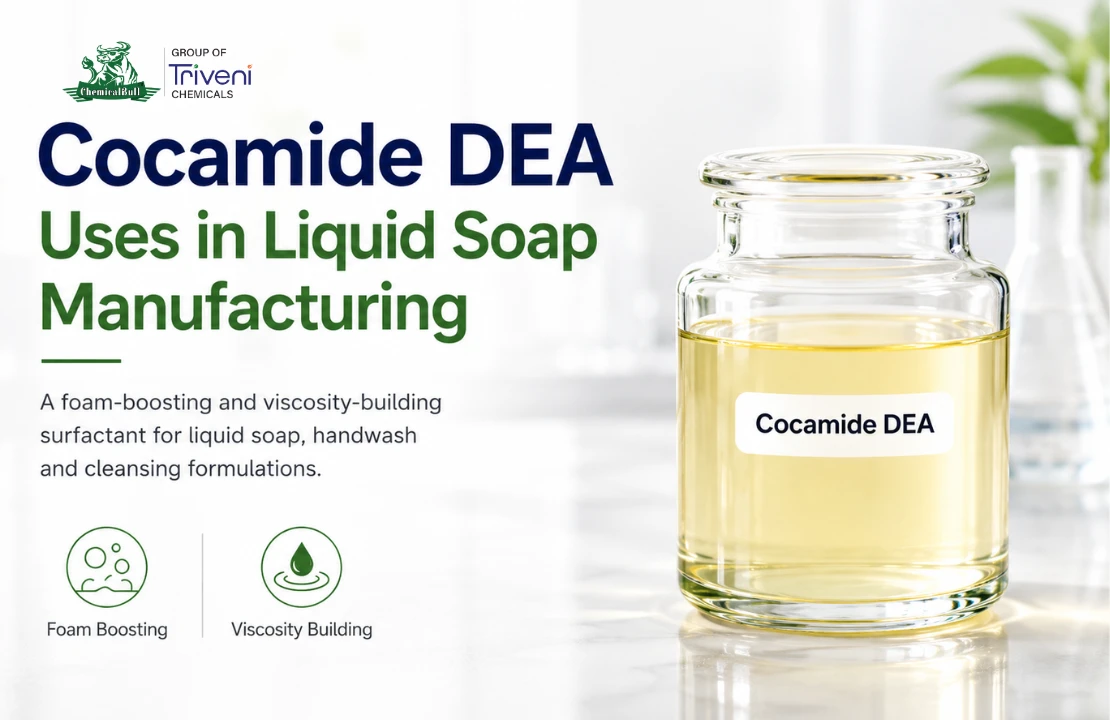
Cocamide DEA Uses in Liquid Soap Manufacturing
Liquid soap formulations need a balance of cleansing, foam, viscosity and product stability. If the surfactant system is not properly balanced, the finished product may appear watery, produce weak foam or lose consistency during storage.
Cocamide DEA, also known as Cocamide Diethanolamine or CDEA, is used as a secondary surfactant, foam stabiliser and viscosity-building ingredient in liquid soap manufacturing. It is commonly used in handwash, dishwashing liquid, shampoo, body wash and selected household-cleaning formulations.
Quick Answer
Cocamide DEA is a coconut-fatty-acid-derived surfactant used to boost foam, improve lather stability and build viscosity in liquid soap formulations. It normally works alongside primary cleansing surfactants such as SLES rather than acting as the main cleanser.
|
Key detail |
Information |
|
Primary function |
Foam boosting, foam stabilisation and viscosity building |
|
Typical use level |
Formulation-dependent; confirm through technical guidance and trials |
|
Common CAS number |
68603-42-9 |
Its suitability depends on grade quality, free DEA level, surfactant compatibility, finished-product performance and applicable market regulations.
For bulk requirements, connect with a reliable Cocamide DEA supplier to review grade specifications, packing options, COA, TDS and SDS before selecting material for liquid soap production. Chemical Bull supports B2B enquiries with documentation and quotation assistance.
What Is Cocamide DEA?
Cocamide DEA is a mixture of fatty acid diethanolamides derived from coconut fatty acids and diethanolamine. It is produced by reacting coconut-derived fatty acids or fatty-acid intermediates with diethanolamine under controlled processing conditions.
It is generally supplied as a viscous liquid or semi-solid, depending on the grade and storage temperature.
Other common names include:
- Cocamide Diethanolamine
- CDEA
- Coconut diethanolamide
- Coconut fatty acid diethanolamide
Cocamide DEA acts mainly as a supporting surfactant. It improves foam structure, viscosity and product texture rather than replacing the main cleansing surfactant.
Is Cocamide DEA Coconut Oil?
Cocamide DEA is not pure coconut oil. It is a chemically processed derivative made using fatty acids obtained from coconut oil together with diethanolamine.
Its composition and formulation behaviour are therefore different from unmodified coconut oil.
Cocamide DEA Formula and Identification
Commercial Cocamide DEA contains a mixture of coconut fatty acid diethanolamides. For this reason, one fixed molecular formula does not accurately represent every grade.
|
Parameter |
General information |
|
INCI name |
Cocamide DEA |
|
Common abbreviation |
CDEA |
|
Common CAS number |
68603-42-9 |
|
Product type |
Fatty acid diethanolamide surfactant |
|
Main functions |
Foam boosting, viscosity building and surfactant support |
|
Appearance |
Viscous, pale-yellow liquid |
|
Solubility |
Soluble in water and most organic solvents |
Buyers should confirm the applicable identity, active content and impurity specifications from the current COA, TDS and SDS.
What Is Cocamide DEA Used For?
Cocamide DEA is used to improve foam, viscosity and product consistency in surfactant-based formulations.
Common Cocamide DEA products include:
- Liquid soap
- Liquid handwash
- Dishwashing liquid
- Shampoo
- Body wash
- Shower gel
- Face wash
- Household liquid cleaners
- Institutional cleaning products
Role of Cocamide DEA in Liquid Soap
Foam Boosting and Stabilisation
Primary surfactants generate foam during washing, but the lather may feel thin or collapse quickly. Cocamide DEA helps create denser, creamier and more stable foam.
This is useful in liquid handwash and dishwashing products where foam quality influences the user’s perception of product performance.
Viscosity Development
Cocamide DEA helps increase the body and thickness of compatible surfactant systems. It can reduce the watery appearance of liquid soap and improve dispensing control.
Final viscosity also depends on:
- Primary surfactant concentration
- Salt or electrolyte level
- pH
- Fragrance load
- Processing temperature
- Mixing order
- Other thickeners
Surfactant-System Support
Cocamide DEA works alongside anionic, amphoteric and selected non-ionic surfactants.
For example, Sodium Laureth Sulfate (SLES) provides primary cleansing and foam generation, while Cocamide DEA mainly improves foam stability and product thickness.
Product Texture
A properly balanced Cocamide DEA level helps create a smoother and more uniform liquid-soap texture. The finished product feels more substantial during dispensing without becoming excessively thick.
Cocamide DEA in Shampoo and Face Wash
Cocamide DEA in Shampoo
Cocamide DEA in shampoo is used mainly as a foam booster and viscosity modifier. It helps produce richer lather and supports the required shampoo consistency.
The phrase Cocamide DEA for hair generally refers to its use within shampoo or rinse-off hair-cleansing products. It is not primarily a direct hair-conditioning active.
Cocamide DEA in Face Wash
Cocamide DEA in face wash supports foam and viscosity. It can help create the desired gel or liquid consistency when combined with suitable cleansing surfactants.
Because face wash is applied to a sensitive area, the finished formulation should be assessed for pH, irritation potential, ingredient purity and skin compatibility.
Cocamide DEA vs Cocamide MEA
Cocamide DEA and Cocamide MEA are both coconut-fatty-acid-derived alkanolamides, but they differ in structure, physical form and processing requirements.
|
Factor |
Cocamide DEA |
Cocamide MEA |
|
Full name |
Cocamide Diethanolamine |
Cocamide Monoethanolamine |
|
Abbreviation |
CDEA |
CMEA |
|
Main role |
Foam boosting and viscosity building |
Foam boosting, thickening and texture support |
|
Typical form |
Viscous liquid or semi-solid |
Often supplied as flakes, beads or solid material |
|
Processing |
Generally easier to incorporate into liquid systems |
May require heating for proper incorporation |
|
Foam support |
Strong foam stabilisation |
Good foam and body support |
|
Common preference |
Processing ease and compatibility |
Often evaluated for DEA-free systems |
Which Is Better: Cocamide DEA or Cocamide MEA?
Neither ingredient is universally better.
Cocamide DEA may be preferred where easy incorporation, foam stability and viscosity support are important. Cocamide MEA may be selected where a DEA-free formulation or a different viscosity profile is required.
Replacing Cocamide DEA with Cocamide MEA is not normally a one-to-one substitution. Processing temperature, clarity, foam and viscosity may change.
CDEA vs SLES
Cocamide DEA and SLES perform different formulation functions.
|
Factor |
Cocamide DEA |
|
|
Main role |
Supporting surfactant |
Primary cleansing surfactant |
|
Primary function |
Foam stabilisation and thickening |
Cleansing and foam generation |
|
Cleaning contribution |
Secondary |
Primary |
|
Viscosity role |
Builds product body |
Responds to salt and formulation conditions |
|
Typical use |
Used with a primary surfactant |
Forms the main detergent base |
CDEA and SLES are complementary rather than interchangeable. SLES provides primary detergency, while Cocamide DEA supports foam stability and viscosity.
CDEA vs CAPB
Cocamide DEA and Cocamidopropyl Betaine also serve different roles.
|
Factor |
Cocamide DEA |
CAPB |
|
Surfactant type |
Fatty acid diethanolamide |
Amphoteric surfactant |
|
Main role |
Foam boosting and viscosity building |
Mild cleansing and foam support |
|
Common applications |
Liquid soap, detergent and shampoo |
Shampoo, face wash, body wash and handwash |
|
Mildness contribution |
Depends on the complete formulation |
Commonly used in milder surfactant systems |
Replacing CDEA with CAPB can change viscosity, clarity, foam, cleansing performance and cost. Laboratory reformulation is required.
Cocamide DEA Safety and Skin Compatibility
Cocamide DEA safety depends on the raw-material grade, concentration, impurity control, formulation type and destination-market regulations.
Formulators should review:
- Free DEA specification
- Nitrosamine-related controls
- Ingredient concentration
- Product pH
- Rinse-off exposure
- Irritation potential
- Current local regulations
The finished liquid soap, shampoo or face wash should be assessed as a complete formulation before commercial release.
Properly formulated rinse-off products may be tolerated by many users, while concentrated raw material or an unsuitable cleansing system may cause irritation.
Cocamide DEA Side Effects
Possible Cocamide DEA side effects in sensitive individuals may include:
- Skin irritation
- Eye irritation
- Redness
- Itching
- Dryness
- Allergic contact reactions
These effects may also be influenced by fragrances, preservatives and other surfactants in the finished product.
A suspected Cocamide DEA allergy should be evaluated by a qualified healthcare professional.
Nitrosamine and Impurity Control
Impurity control is an important part of Cocamide DEA grade selection. Nitrosamines can form under certain conditions when susceptible amine-containing ingredients come into contact with nitrosating agents.
Buyers and formulators should review:
- Free DEA level
- Nitrosamine-related specifications
- Raw-material purity
- COA and SDS information
- Preservative compatibility
- Intended-market regulations
Purchasing decisions should not be based only on price. Grade consistency and impurity control are important for product quality and compliance.
Alternatives to Cocamide DEA
Alternatives may be considered when formulators require a DEA-free system, different mildness profile or alternative viscosity-building mechanism.
Common alternatives include:
- Cocamide MEA
- Cocamidopropyl Betaine
- Amine oxide surfactants
- PEG-based thickeners
- Associative rheology modifiers
- Alkanolamide-free surfactant blends
- Electrolyte adjustment
- Alternative non-ionic surfactants
Formulators can also compare suitable home and personal care surfactants according to foam, viscosity, mildness and processing requirements.
No alternative is a universal one-to-one replacement. Substitution can change foam, clarity, viscosity, fragrance compatibility and processing conditions.
Selecting Cocamide DEA for Liquid Soap Manufacturing
Before selecting a commercial grade, buyers should review:
- Active matter or amide content
- Free DEA specification
- Appearance and colour
- Moisture content
- Viscosity
- Compatibility with SLES, CAPB and other surfactants
- COA, TDS and SDS availability
- Packing size
- Supply consistency
- Regulatory suitability
Pilot batches should be tested for viscosity, foam, clarity, pH, odour and storage stability before production-scale use.
Cocamide DEA Price Factors
Cocamide DEA price depends on grade, active content, purity, raw-material availability, packing size, order quantity and delivery location.
Buyers should compare pricing with batch consistency, impurity specifications, documentation support and suitability for the intended liquid-soap formulation.
Frequently Asked Questions
1. What is Cocamide DEA used for?
Cocamide DEA is used as a foam booster, foam stabiliser, viscosity builder and supporting surfactant in liquid soap, shampoo, dishwashing liquid, body wash and selected cleaners.
2. Is Cocamide DEA coconut oil?
No. Cocamide DEA is a chemically processed derivative of coconut fatty acids and diethanolamine. It is not pure coconut oil.
3. What is Cocamide DEA derived from?
Cocamide DEA is derived from coconut fatty acids and diethanolamine.
4. Is Cocamide DEA safe in shampoo?
Its suitability depends on concentration, purity, impurity control, formulation quality and applicable regulations. The finished shampoo should be assessed as a complete product.
5. What is the difference between Cocamide DEA and Cocamide MEA?
Cocamide DEA is generally easier to incorporate into liquid formulations, while Cocamide MEA is often supplied in solid form and may require heating. They are not direct one-to-one substitutes.
6. What is the difference between CDEA and SLES?
SLES is primarily a cleansing surfactant, while CDEA mainly supports foam stability and viscosity. They perform complementary roles.
7. What are the alternatives to Cocamide DEA?
Alternatives include Cocamide MEA, CAPB, amine oxides, PEG-based thickeners and alkanolamide-free surfactant blends. The correct replacement depends on the formulation target.
Conclusion
Cocamide DEA supports foam stability, viscosity development and product texture in liquid soap manufacturing. It is commonly used with primary surfactants in handwash, dishwashing liquid, shampoo and other rinse-off cleansing products.
The appropriate grade should be selected according to active content, free DEA specification, surfactant compatibility, processing requirements and destination-market regulations. Cocamide MEA, CAPB, amine oxides and specialised thickeners can be evaluated when an alternative formulation system is required.
Connect with Chemical Bull for Cocamide DEA grade details, COA, TDS, SDS, bulk packing and quantity-based quotation support for liquid soap formulations.