Chemical Bull
158
29-Aug-2026
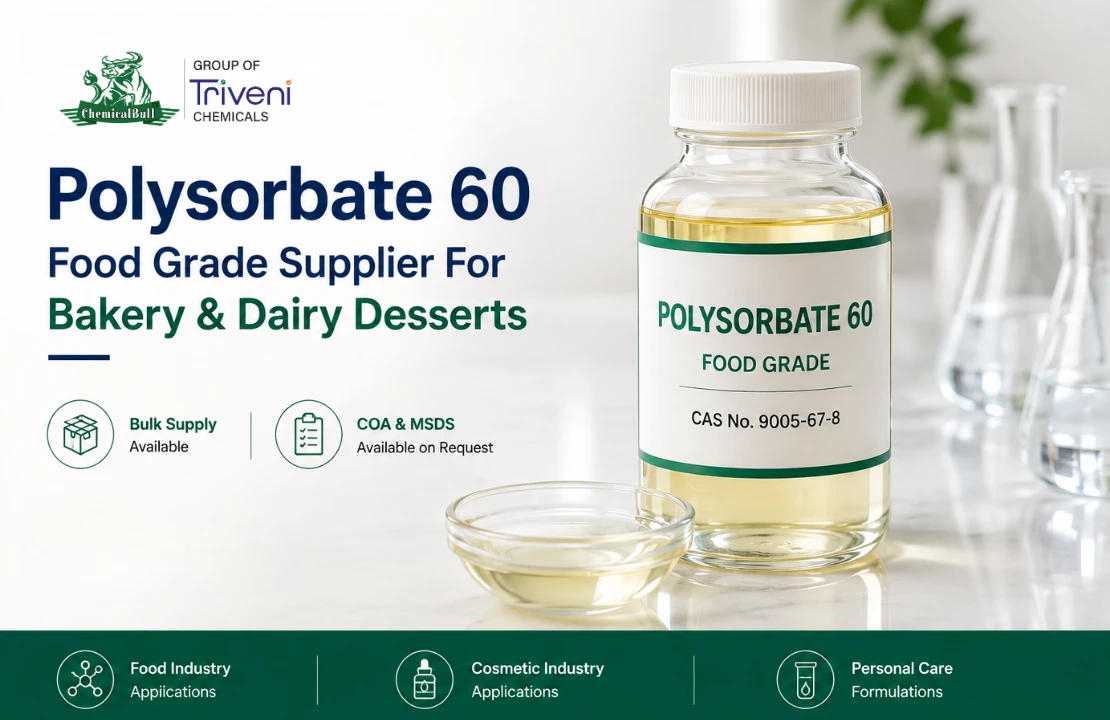
Polysorbate 60 Food Grade Supplier for Bakery & Dairy Desserts
Polysorbate 60 is a food-grade emulsifier used in bakery, dairy dessert and other processed food formulations where stable mixing of fat and water, improved texture and consistent product quality are important. Also known as E435, it can support emulsification, aeration, texture development and product stability in suitable food systems.
Food manufacturers searching for a reliable food grade polysorbate 60 supplier should evaluate food-grade specifications, batch consistency, documentation and suitability for the intended application. Bakery and dairy dessert producers also need dependable supply for regular production, formulation trials and bulk procurement.
For commercial production, the correct grade and dosage should always be selected according to the food category, formulation, applicable regulations and finished-product requirements. Buyers looking for a reliable Tween 60 supplier can review product specifications, technical documentation, packing options and bulk supply support before finalizing their sourcing requirement.
What Is Polysorbate 60?
Polysorbate 60 is a non-ionic emulsifier produced from sorbitol-derived components, stearic acid and ethylene oxide. In food applications, it is commonly identified by the additive number E435.
Its main role is to help ingredients that normally separate, especially oil or fat and water, remain more evenly distributed within a formulation.
Polysorbate 60 may be used in selected:
-
Bakery products
-
Cakes and cake mixes
-
Whipped toppings
-
Frozen desserts
-
Ice cream formulations
-
Dairy-based desserts
-
Dessert fillings
-
Cream-based food systems
-
Other permitted emulsified foods
Its exact use depends on the formulation and applicable food-additive regulations.
For a broader view beyond food applications, read our guide on Polysorbate 60 uses and applications across industries, covering its role in different industrial formulation systems.
What Is E435 or INS 435?
E435, also known as INS 435, is the food additive number for Polysorbate 60. It is a non-ionic emulsifier used in permitted food applications to support fat-and-water dispersion, texture, aeration and formulation stability.
Food manufacturers should confirm food-grade specifications, permitted use conditions and applicable regulations before commercial use.
Why Is Polysorbate 60 Used in Food Products?
Many bakery and dairy dessert formulations contain both fat-based and water-based ingredients. Without an effective emulsification system, these phases may separate or produce inconsistent texture.
Polysorbate 60 helps stabilize these systems by improving interaction between the oil and water phases.
Its key formulation functions can include:
-
Emulsification
-
Fat dispersion
-
Texture support
-
Aeration support
-
Product stability
-
Processing consistency
The final performance depends on the complete ingredient system rather than Polysorbate 60 alone.
Polysorbate 60 in Bakery Products
Polysorbate 60 in bakery products can be used as part of an emulsifier system to support batter structure, fat dispersion, aeration and finished-product consistency.
Bakery formulations often contain flour, water, fat, sugar, eggs, milk solids and other ingredients with different physical properties. An effective emulsifier system can help these ingredients work together more consistently during processing.
For a broader comparison of emulsifiers used across bread, cakes, bakery mixes and other baked products, explore our guide on bakery emulsifiers for bread, cakes and baked products.
Polysorbate 60 in Cakes
In cake formulations, Polysorbate 60 can help distribute fats more evenly throughout the batter.
Depending on the complete formulation, it may support:
-
Uniform batter structure
-
Better aeration
-
Consistent crumb
-
Softer texture
-
Improved batch-to-batch consistency
This makes it useful in selected industrial cake and bakery systems where predictable processing is important.
Bakery Mixes
Commercial bakery mixes require ingredients that perform reliably after preparation.
Polysorbate 60 may be used in selected bakery mixes to support emulsification and processing consistency, depending on the formulation and regulatory requirements.
Cream Fillings and Toppings
Bakery products containing cream fillings, whipped toppings or other emulsified components may also require effective fat and water stabilization.
In suitable formulations, Polysorbate 60 can support smoother texture and more consistent dispersion.
Polysorbate 60 Emulsifier in Ice Cream
The use of Polysorbate 60 emulsifier in ice cream is linked to the need for stable fat distribution, controlled aeration and smooth texture.
Ice cream and frozen dessert formulations typically contain:
-
Water
-
Milk fat or vegetable fat
-
Milk solids
-
Sugar
-
Stabilizers
-
Emulsifiers
-
Flavors
-
Air
The finished texture depends on how these components interact during mixing, homogenization, freezing and storage.
Why Emulsifiers Matter in Ice Cream
Ice cream is a complex food structure rather than simply a frozen dairy mixture.
Manufacturers need to manage:
-
Fat distribution
-
Air incorporation
-
Ice crystal development
-
Texture
-
Mouthfeel
-
Melting behavior
Polysorbate 60 may be used as part of the emulsifier system to support these properties in suitable formulations.
Polysorbate 60 in Dairy Desserts
Polysorbate 60 may also be evaluated for selected dairy and dairy-style dessert formulations where emulsification and texture are important.
Potential applications can include:
-
Frozen dairy desserts
-
Whipped dessert systems
-
Cream-based desserts
-
Dessert toppings
-
Selected pudding systems
-
Emulsified fillings
Its suitability should always be confirmed for the specific food category and applicable additive requirements.
How Does Polysorbate 60 Work as an Emulsifier?
Oil and water naturally tend to separate.
Polysorbate 60 contains both oil-compatible and water-compatible characteristics. This allows it to position itself between the two phases and help create a more stable dispersion.
In practical terms, it can support:
-
More uniform fat distribution
-
Better emulsion stability
-
Smoother texture
-
More consistent appearance
-
Improved processing behavior
The result depends on the fat system, other emulsifiers, stabilizers, processing temperature and mixing conditions.
Polysorbate 60 vs Polysorbate 80 in Food
Polysorbate 60 is mainly associated with stearic acid and is identified as E435, while Polysorbate 80 is mainly associated with oleic acid and is identified as E433. Both are emulsifiers, but their formulation behaviour and application suitability differ.
|
Feature |
Polysorbate 60 |
Polysorbate 80 |
|
Food additive number |
E435 |
E433 |
|
Main fatty-acid association |
Stearic acid |
Oleic acid |
|
Main function |
Emulsifier |
Emulsifier |
|
Typical behavior |
Generally more structured |
Generally more fluid |
|
Food use |
Depends on formulation and permitted category |
Depends on formulation and permitted category |
Both can function as emulsifiers, but they should not automatically be substituted at the same dosage.
Selection should consider:
-
Fat system
-
Desired texture
-
Processing conditions
-
Other emulsifiers
-
Stabilizers
-
Product category
-
Regulatory requirements
Polysorbate 60 With Other Food Emulsifiers
Food formulators may use Polysorbate 60 alongside other emulsifiers rather than relying on one ingredient.
Depending on the formulation, it may be combined with ingredients such as:
-
Mono- and diglycerides
-
Lecithin
-
Other permitted emulsifiers
-
Stabilizer systems
A combination can sometimes provide better balance between emulsification, aeration, texture and product stability.
The right system should be determined through formulation trials.
Is Polysorbate 60 Safe in Food?
Is Polysorbate 60 safe in food? For commercial manufacturers, the key point is that food additives should be used only in permitted food categories and within the applicable regulatory conditions.
Food manufacturers should confirm:
-
Food-grade quality
-
Product purity
-
Intended food category
-
Permitted use level
-
Complete formulation
-
Applicable labeling requirements
-
Current regulatory requirements
A technical or non-food grade should not be substituted for food-grade Polysorbate 60.
How to Source Food Grade Polysorbate 60 in Bulk
Food manufacturers should confirm food-grade specification, application suitability, COA, TDS, SDS, packing, batch consistency, stock availability and delivery timeline before placing a bulk order.
For accurate quotation support, buyers should share the intended application, required quantity, packing preference and delivery location. This helps suppliers provide suitable product details, availability and commercial terms without repeated clarification.
For bakery, ice cream and dairy dessert requirements, buyers can connect with Chemical Bull for food grade Polysorbate 60 sourcing and documentation support.
Frequently Asked Questions
-
What is Polysorbate 60 used for in food?
Polysorbate 60 is used as an emulsifier in permitted food applications. It can support fat and water dispersion, texture, aeration and formulation stability in suitable bakery, dairy dessert and emulsified food systems. -
What is Polysorbate 60 used for in bakery products?
In bakery products, Polysorbate 60 can support fat dispersion, batter emulsification, aeration and consistent texture. Its exact effect depends on the complete formulation. -
Why is Polysorbate 60 used in ice cream?
Polysorbate 60 may be used as part of an emulsifier system to support fat distribution, aeration, smooth texture and structural development in suitable frozen dessert formulations. -
What is the difference between Polysorbate 60 and 80 in food?
Polysorbate 60 is mainly associated with stearic acid, while Polysorbate 80 is mainly associated with oleic acid. Both function as emulsifiers, but their formulation behavior differs and they should not automatically be substituted one-for-one. -
Is Polysorbate 60 safe in food?
Food-grade Polysorbate 60 can be used where permitted under applicable food-additive regulations and within the allowed conditions of use. Manufacturers should verify the requirements for the specific finished food. -
What should buyers check before purchasing food grade Polysorbate 60?
Buyers should confirm food-grade specification, application suitability, documentation, batch consistency, packing, supply capability and applicable regulatory requirements.
Conclusion
Polysorbate 60 is a useful food emulsifier for selected bakery, ice cream, frozen dessert and dairy-based formulations where stable fat distribution, texture, aeration and consistent processing are important.
Its effectiveness depends on the complete formulation, including fat type, stabilizers, other emulsifiers, proteins and processing conditions. Manufacturers should also verify food-grade specifications and applicable regulatory requirements before commercial use.
For B2B procurement, selecting the right food grade Polysorbate 60 supplier means comparing specification, documentation, batch consistency, application suitability, packing and dependable bulk supply alongside commercial pricing.
Comment Section