Chemical Bull
13
10-Sep-2026
A small change in emulsifier selection can influence how dough handles, how cake batter performs and how consistently a bakery product turns out across production batches.
For commercial bakeries, emulsifiers are not simply added to mix oil and water. The right bakery emulsifier can support dough processing, crumb structure, texture, aeration, fat distribution and formulation consistency depending on the product and process.
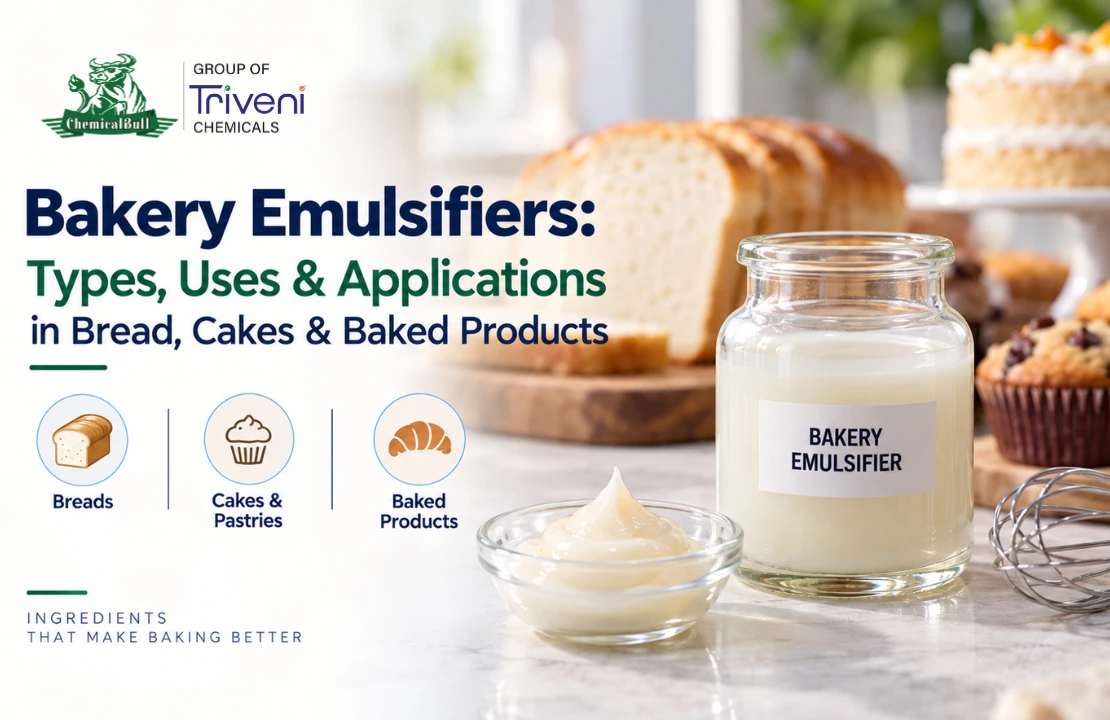
Bread, cakes, buns, rolls, biscuits and cookies may all use emulsifiers differently. This guide explains the main types of emulsifiers used in baking, their applications, common E-numbers and the factors manufacturers should consider when choosing an emulsifier for commercial bakery production.
What Are Bakery Emulsifiers?
Bakery emulsifiers are functional ingredients used to help ingredients with different properties, particularly fat- and water-based components, work more effectively within a bakery formulation.
An emulsifier in baking may help improve the distribution of fats, support dough or batter characteristics and contribute to more consistent finished-product performance.
Depending on the emulsifier and application, it may help with:
-
Dough handling
-
Batter consistency
-
Fat distribution
-
Texture and crumb characteristics
-
Aeration and volume
-
Processing consistency
-
Formulation stability
Not every emulsifier provides every benefit. Its performance depends on the formulation, processing method and type of bakery product.
What Are the Uses of Emulsifiers in Bakery Products?
The main purpose of emulsifiers in baking is to improve interaction between ingredients and support more controlled formulation performance.
|
Function |
Role in Bakery Products |
|
Dough handling |
Helps support processing characteristics in dough-based products |
|
Batter performance |
Can support more consistent mixing and batter characteristics |
|
Fat distribution |
Helps distribute fats more evenly through the formulation |
|
Texture |
Can contribute to desired crumb and mouthfeel |
|
Aeration |
Certain emulsifiers may support air incorporation in relevant formulations |
|
Volume |
Can contribute to structure and finished-product volume |
|
Consistency |
Supports more uniform processing from batch to batch |
|
Shelf stability |
Certain emulsifiers may help maintain product characteristics over time |
The required functionality should always be matched with the specific bakery application.
Types of Emulsifiers Used in Baking
A typical bakery emulsifiers list can contain several emulsifier categories. Their suitability varies between bread, cakes, biscuits and other baked products.
Sodium Stearoyl Lactylate (SSL)
Sodium Stearoyl Lactylate, commonly known as SSL, is widely associated with bread and other dough-based bakery formulations.
Depending on the recipe and processing conditions, SSL may support:
-
Dough handling
-
Dough strength
-
Crumb characteristics
-
Product structure
-
Processing consistency
It is commonly considered when manufacturers require a bread emulsifier for commercial bakery production.
Glycerol Monostearate (GMS)
Glycerol Monostearate (GMS), is used as an emulsifier and formulation aid in several food and bakery systems.
In bakery formulations, it may help support:
-
Fat distribution
-
Emulsification
-
Texture
-
Batter or dough consistency
-
Overall formulation performance
GMS is particularly relevant where manufacturers are evaluating emulsifiers for cakes and other fat-containing bakery formulations.
Sorbitan Monostearate
Sorbitan Monostearate is a sorbitan-based emulsifier used in selected food formulations.
In bakery applications, it may be considered where fat-phase emulsification and ingredient distribution are important.
Its suitability depends on the type of product, formulation design and processing conditions.
Polysorbate 60
Polysorbate 60 is an emulsifier used in selected food and bakery formulations.
It may be considered where manufacturers require support for:
-
Emulsification
-
Batter characteristics
-
Fat distribution
-
Formulation uniformity
It is particularly relevant to certain cake and batter-based applications.
Other Bakery Emulsifiers
Other emulsifiers that may be evaluated for bakery formulations include:
-
DATEM
-
Calcium Stearoyl Lactylate
-
Polyglycerol Esters of Fatty Acids
The right choice depends on the intended application rather than the emulsifier name alone.
Common Bakery Emulsifiers and E-Numbers
Bakery manufacturers may encounter emulsifiers identified by chemical name, functional name or food additive E-number.
|
Emulsifier |
E-Number |
Common Bakery Relevance |
|
Lecithin |
E322 |
Used for emulsification in bakery and other food formulations |
|
Mono- and Diglycerides of Fatty Acids |
E471 |
Used for emulsification, texture and formulation support |
|
DATEM |
E472e |
Commonly associated with bread and dough systems |
|
Sodium Stearoyl Lactylate |
E481 |
Used in bread and other bakery formulations |
|
Calcium Stearoyl Lactylate |
E482 |
Used in selected dough and bakery applications |
|
Polysorbates |
E432–E436 |
Used as emulsifiers in selected food systems |
|
Polyglycerol Esters of Fatty Acids |
E475 |
Used for emulsification in various food formulations |
Is E471 an Emulsifier?
Yes. E471 is an emulsifier category referring to mono- and diglycerides of fatty acids.
Glycerol Monostearate may be associated with the broader E471 category depending on its composition and applicable specification.
Manufacturers should still review the exact product composition and regulatory documentation instead of relying only on the E-number.
What Is SSL E481?
Sodium Stearoyl Lactylate is identified as E481 under the European food additive numbering system.
SSL E481 is commonly associated with bread and dough applications where manufacturers require an emulsifier that supports dough and finished-product characteristics.
Emulsifiers for Bread
Bread manufacturing places specific demands on dough handling, structure and consistency.
A suitable emulsifier for bread may help support:
-
Dough characteristics
-
Crumb structure
-
Finished-product volume
-
Processing consistency
-
Ingredient distribution
Sodium Stearoyl Lactylate and Glycerol Monostearate are among the emulsifiers that may be considered depending on the formulation.
Why Are Emulsifiers Used in Bread?
Emulsifiers are used in bread to help improve ingredient interaction and support the physical characteristics required during dough processing.
The choice can depend on:
-
Flour type
-
Fat content
-
Dough system
-
Fermentation process
-
Desired crumb
-
Required volume
-
Production conditions
For industrial bread manufacturers, formulation trials are important because emulsifier performance can change depending on the complete recipe.
Bread Emulsifier vs Bread Improver
A bread emulsifier and a bread improver are not necessarily the same.
A bread emulsifier is an individual functional ingredient used for a specific formulation purpose.
A bread improver is usually a broader formulation that may contain several ingredients, such as:
-
Emulsifiers
-
Enzymes
-
Dough conditioners
-
Processing aids
-
Other functional ingredients
Manufacturers should therefore determine whether they require a single emulsifier or a complete improver system.
Emulsifiers for Cakes
Cake formulations differ from bread because the focus is generally on batter performance, aeration, fat distribution and texture.
A suitable emulsifier for cake may help support:
-
Batter consistency
-
Air incorporation
-
Fat distribution
-
Texture
-
Finished-product structure
-
Production uniformity
Glycerol Monostearate and selected Polysorbates are among the emulsifiers that may be considered in cake formulations.
Cake Emulsifier Uses
The main cake emulsifier uses relate to managing batter composition and supporting consistent processing.
Depending on the formulation, cake emulsifiers may help:
-
Distribute fat more uniformly
-
Support batter stability
-
Assist aeration
-
Improve mixing consistency
-
Support finished-product texture
The correct emulsifier should be selected according to cake type, fat system, process and desired product characteristics.
Bread vs Cake: How Emulsifiers Work Differently
Bread and cake manufacturing have different formulation priorities.
|
Bread |
Cake |
|
Dough-based system |
Batter-based system |
|
Dough handling is important |
Batter stability is important |
|
Crumb structure is a key consideration |
Aeration and texture are major considerations |
|
Dough strength may influence performance |
Fat distribution can strongly affect batter performance |
|
SSL and GMS may be considered |
GMS and selected Polysorbates may be considered |
For this reason, manufacturers should not assume that the same emulsifier will give the same result in every bakery product.
Emulsifiers for Buns and Rolls
Buns and rolls generally require good dough handling and consistent crumb characteristics.
Suitable emulsifiers may support:
-
Processing consistency
-
Dough characteristics
-
Fat distribution
-
Texture
-
Finished-product structure
Selection should be based on the flour system, fat content and manufacturing process.
Emulsifiers for Biscuits and Cookies
In biscuits and cookies, emulsifiers may help improve the distribution of fats and other ingredients within the dough.
The common emulsifiers used in biscuits can vary depending on the formulation, but manufacturers may evaluate Glycerol Monostearate, sorbitan-based emulsifiers and other suitable food-grade emulsifiers.
The right choice depends on:
-
Fat type
-
Dough composition
-
Mixing process
-
Required texture
-
Finished-product characteristics
Cake Gels and Bakery Emulsifiers
Cake gels and individual emulsifiers are related but should not automatically be treated as the same product.
A cake gel is generally a formulated system that may contain:
-
One or more emulsifiers
-
Water or carrier components
-
Other functional ingredients
Cake gels are often designed to support aeration and batter performance.
Individual emulsifiers, on the other hand, give manufacturers more control over the formulation because they can be incorporated according to specific technical requirements.
Powder Emulsifiers for Bakery Applications
Powder emulsifiers may be preferred by manufacturers where dry blending, easier handling or dosing compatibility is important.
However, physical form does not determine functionality on its own.
Bakery buyers should evaluate:
-
Chemical composition
-
Food-grade specification
-
Recommended application
-
Dosage
-
Solubility or dispersion behaviour
-
Processing compatibility
-
Documentation
This helps ensure that the selected powder emulsifier is suitable for the intended bakery formulation.
How to Choose the Right Bakery Emulsifier
Choosing the right bakery emulsifier should begin with the application rather than the product name.
Manufacturers should consider:
Type of Bakery Product
Bread, cakes, buns and biscuits all have different formulation requirements.
Desired Texture and Structure
Determine whether the formulation needs support for crumb, aeration, mouthfeel, dough properties or batter performance.
Fat and Water Content
The composition of the formulation can affect emulsifier selection and performance.
Processing Conditions
Mixing, temperature, fermentation, baking conditions and production scale can influence functionality.
Food-Grade Requirements
Confirm that the product specification is appropriate for the intended food application.
Regulatory Requirements
Food additive regulations can differ between markets. Manufacturers should verify applicable requirements for the destination country.
Supplier Documentation
Commercial buyers may require specifications, technical documents and supporting quality information before approval.
Supply Consistency
For industrial production, reliable availability and consistent product quality are important for maintaining formulation performance.
Bakery Emulsifiers vs Other Functional Bakery Ingredients
Bakery emulsifiers perform a different function from several other ingredients used in baked products.
|
Ingredient Type |
General Function |
|
Emulsifiers |
Support interaction between fat- and water-based components |
|
Stabilizers |
Help maintain formulation stability |
|
Humectants |
Help retain moisture |
|
Leavening agents |
Help generate gas and product volume |
|
Dough conditioners |
Modify dough characteristics |
|
Bread improvers |
May combine multiple functional ingredients |
A bakery formulation may use several of these ingredient categories together depending on the finished-product requirements.
Bakery Emulsifier Supplier for Commercial Requirements
For commercial bakery manufacturers, choosing a bakery emulsifier supplier involves more than finding an available product.
Buyers should evaluate whether the supplier can support:
-
Required emulsifier type
-
Commercial quantities
-
Suitable packaging
-
Product specifications
-
Food-grade documentation
-
Consistent supply
-
Delivery requirements
Chemical Bull supplies selected emulsifiers and specialty ingredients for bakery and food formulation applications, including Sodium Stearoyl Lactylate, Glycerol Monostearate, Sorbitan Monostearate and Polysorbates for commercial requirements.
Buyers looking to buy emulsifiers for baking in bulk can share the required product, quantity, application, packaging preference and delivery location to discuss suitable supply options.
Frequently Asked Questions
What are the uses of emulsifiers in bakery products?
Bakery emulsifiers help manage interactions between fat, water and other formulation ingredients. Depending on the emulsifier, they may support dough handling, batter consistency, fat distribution, texture, aeration and processing consistency.
What emulsifier is used in bread?
Sodium Stearoyl Lactylate, Glycerol Monostearate and other suitable food emulsifiers may be used in bread depending on the formulation and required functionality.
What emulsifier is used in cakes?
Glycerol Monostearate and selected Polysorbates may be considered for cake formulations where batter consistency, emulsification and fat distribution are important.
Is E471 an emulsifier?
Yes. E471 refers to mono- and diglycerides of fatty acids, which are widely used as emulsifiers in food and bakery formulations.
Where can I buy emulsifier for baking?
Commercial bakery manufacturers can source emulsifiers from suppliers that provide suitable product specifications, food-grade documentation, packaging and bulk supply support. Chemical Bull supplies selected bakery emulsifiers for commercial and industrial formulation requirements.

Comment Section