Chemical Bull
21
29-Sep-2026
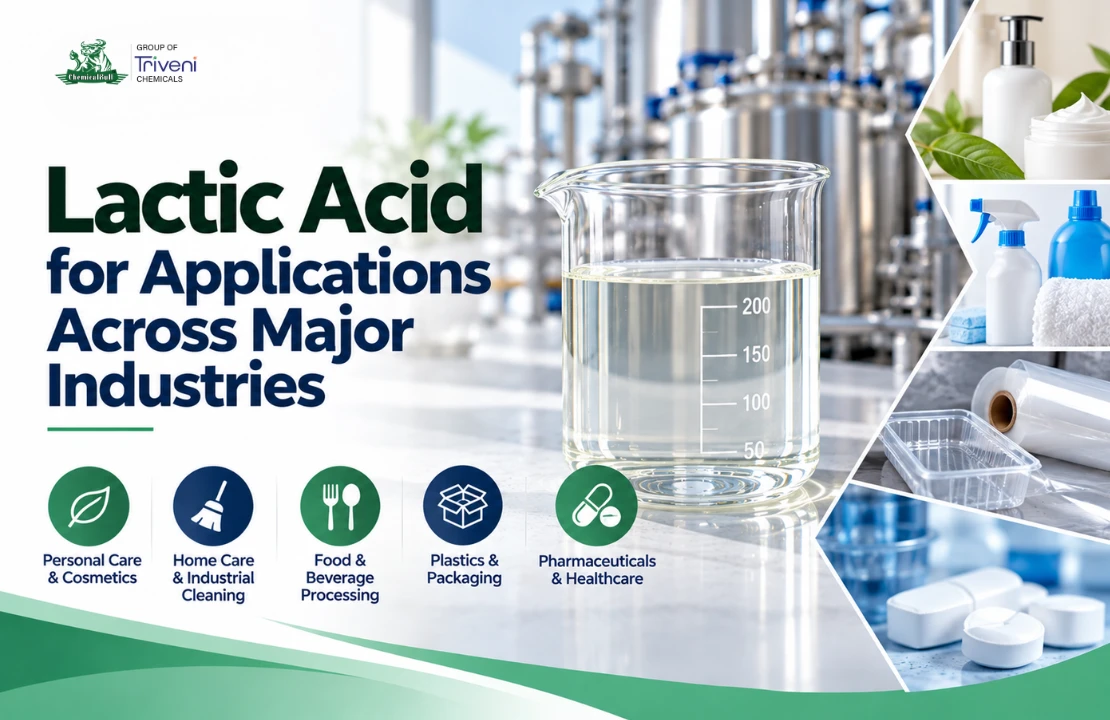
Lactic Acid for Applications Across Major Industries
Lactic Acid is a versatile organic acid used across food and beverages, cosmetics and personal care, pharmaceuticals, agriculture, industrial processing, and biodegradable polymer production. Its combination of acidity, water solubility, and hydroxy-carboxylic functionality makes it useful for applications ranging from pH adjustment and acidulation to formulation processing and chemical manufacturing.
Lactic Acid is available in different grades and concentrations for food, pharmaceutical, personal care, and industrial applications. ChemicalBull is a Lactic Acid supplier offering material according to specific application and specification requirements.
Quick Answer: What Is Lactic Acid and Where Is It Used?
Lactic Acid is an organic acid with the molecular formula C₃H₆O₃ and CAS number 50-21-5. It is widely used in food and beverages as an acidulant and acidity regulator, in cosmetics and personal care for pH adjustment and AHA-based formulations, and in pharmaceutical, agricultural, industrial, and polymer applications.
The required grade, concentration, purity, and supporting documentation depend on the intended application. Food, pharmaceutical, cosmetic, and industrial users may therefore require different commercial specifications even though the underlying chemical is the same.
What Is Lactic Acid?
Lactic Acid, also known as 2-hydroxypropanoic acid, is an alpha-hydroxy carboxylic acid containing both a hydroxyl group and a carboxylic acid group.
It occurs naturally in biological systems and is also manufactured commercially. Industrial production commonly involves either fermentation-based processes or chemical synthesis, depending on the required specification and manufacturing route.
Commercial Lactic Acid is generally supplied as a liquid or aqueous solution. Its concentration and physical characteristics can vary between grades and suppliers.
Technical Profile of Lactic Acid
|
Property |
Information |
|
Chemical Name |
2-Hydroxypropanoic Acid |
|
Common Name |
Lactic Acid |
|
CAS Number |
50-21-5 |
|
Molecular Formula |
C₃H₆O₃ |
|
Molecular Weight |
90.08 g/mol |
|
Chemical Class |
Alpha-hydroxy carboxylic acid |
|
Physical Form |
Liquid / aqueous solution |
|
Water Solubility |
Highly soluble |
|
Functional Groups |
Hydroxyl and carboxyl |
|
Main Commercial Sources |
Fermentation and chemical synthesis |
Commercial specifications such as concentration, color, purity, optical composition, ash, metals, and other parameters may vary. For procurement, the supplier's current specification and batch-specific COA should be considered rather than relying only on general chemical-property data.
How Is Lactic Acid Produced?
Fermentation-Based Production
Fermentation is an important commercial route for producing Lactic Acid.
In this process, carbohydrate-based raw materials such as glucose, dextrose, starch hydrolysates, or other fermentable sugars are converted into Lactic Acid by microorganisms.
A simplified reaction is:
Glucose → Lactic Acid
After fermentation, the resulting broth undergoes downstream processing to separate, purify, and concentrate the Lactic Acid. Depending on the manufacturing process, steps may include filtration, clarification, purification, concentration, and other separation technologies.
Why Is Fermentation Important?
Fermentation can use renewable carbohydrate feedstocks and allows manufacturers to control the composition of the resulting Lactic Acid.
The fermentation organism and process conditions can also influence the proportion of different optical forms, which may be important for applications requiring a particular stereochemical composition.
Lactic Acid Applications by Industry
|
Industry |
Typical Applications |
|
Food & Beverage |
Acidulation, acidity regulation, pH control |
|
Cosmetics |
AHA formulations, pH adjustment, exfoliating products |
|
Personal Care |
Skin-care formulations, pH control |
|
Pharmaceutical |
pH adjustment, formulation and processing |
|
Agriculture |
Selected feed and fermentation applications |
|
Industrial |
Cleaning, descaling, metal treatment, chemical processing |
|
Polymer |
Feedstock for PLA production |
Major Applications of Lactic Acid
Lactic Acid has broad industrial relevance because its chemical properties allow it to perform different functions depending on the formulation and grade.
Lactic Acid in the Food and Beverage Industry
Food and beverage applications are an important area of Lactic Acid use.
Food-grade Lactic Acid can function as an acidulant, acidity regulator, and pH-control ingredient, depending on the formulation and applicable regulations.
Common Food Applications
- Processed foods
- Sauces and dressings
- Pickled products
- Bakery products
- Confectionery
- Dairy-related products
- Meat and poultry processing
- Beverages
- Fermented food products
Lactic Acid can provide controlled acidity and may be selected when manufacturers want a particular acid profile in the finished product.
The appropriate grade and concentration should be selected according to the food application and applicable regulatory requirements.
Lactic Acid in Cosmetics and Personal Care
Lactic Acid is widely used in cosmetics and personal care formulations.
It belongs to the alpha-hydroxy acid (AHA) family and can be incorporated into formulations where controlled exfoliation or pH adjustment is required.
Common Cosmetic Applications
- Facial care products
- Exfoliating formulations
- Skin-care products
- Cleansers
- Serums
- Creams
- Lotions
- Body-care formulations
- Professional cosmetic products
Lactic Acid for pH Adjustment
Lactic Acid can be used to adjust the pH of water-based formulations.
Formulation pH can influence several characteristics, including:
- Product stability
- Preservative performance
- Skin compatibility
- Viscosity
- Active ingredient behavior
The required quantity should therefore be established through formulation testing rather than applying a universal dosage across different products.
Lactic Acid in Pharmaceutical Applications
Lactic Acid can also be used in pharmaceutical manufacturing and formulation processes.
Depending on the product and formulation, applications may include:
- pH adjustment
- Buffer systems
- Formulation processing
- Pharmaceutical intermediates
- Selected topical formulations
- Biodegradable polymer production
Pharmaceutical Grade Considerations
For pharmaceutical applications, buyers may need to verify:
- Applicable pharmacopoeial standard
- Assay
- Identification
- Impurity profile
- Elemental impurities, where applicable
- Residual solvents, where relevant
- Microbiological specifications
- Manufacturing documentation
- Batch-specific COA
A material should not be considered pharmaceutical-grade solely because its chemical identity matches the required compound. The actual specification and documentation must be reviewed.
Lactic Acid in Industrial Applications
Lactic Acid also has applications in industrial chemical processing.
Depending on the process, it may be used in:
- Cleaning formulations
- Descaling systems
- Metal surface treatment
- Chemical processing
- Textile-related processing
- Industrial formulation systems
- Polymer production
Its carboxylic acid and hydroxyl functionality allows it to participate in chemical reactions and interact with certain metal ions, supporting its use in selected industrial processes.
Lactic Acid in Biodegradable Polymer Production
One important industrial application of Lactic Acid is its use as a feedstock for producing polylactic acid (PLA).
Lactic Acid can be converted into intermediates that are subsequently polymerized to produce PLA.
PLA is used in areas such as:
- Packaging
- 3D printing materials
- Fibers
- Disposable products
- Agricultural materials
- Medical and biomedical products
For polymer applications, factors such as purity, moisture, optical composition, and other process-specific specifications can influence suitability.
Lactic Acid in Agriculture
Lactic Acid and lactic-acid-based systems can also be used in selected agricultural and animal-related applications.
Depending on the formulation and applicable regulations, uses may include:
- Feed-related formulations
- Silage-related systems
- Fermentation applications
- Agricultural formulation processing
The permitted use and concentration depend on the specific application, product formulation, and applicable regulatory requirements.
Lactic Acid Grades and Concentrations
Lactic Acid is commercially available in different grades and concentrations.
The correct selection depends on the application rather than simply the chemical name.
|
Grade / Specification |
Typical Application |
Key Considerations |
|
Food Grade |
Food & beverage |
Food-use specification, purity, concentration |
|
Pharmaceutical Grade |
Pharmaceutical applications |
Pharmacopoeial or internal specification |
|
Cosmetic Grade |
Personal care |
Purity, color, odor, formulation compatibility |
|
Industrial Grade |
Industrial processing |
Technical specification and process requirements |
|
High-Purity Grade |
Specialized applications |
Tight impurity and quality requirements |
Concentration is also an important procurement parameter. A formulation designed for one concentration should not automatically substitute another concentration without recalculating the formulation and evaluating the resulting process behavior.
What Should Buyers Check Before Purchasing Lactic Acid?
Selecting Lactic Acid should involve more than comparing the price per kilogram.
1. Grade
Confirm whether the product is intended for food, pharmaceutical, cosmetic, industrial, or another specific application.
2. Concentration
Verify the actual concentration stated in the technical specification and COA.
3. Purity
Check assay and relevant impurity specifications according to the intended end use.
4. Optical Composition
For applications where stereochemistry matters, determine whether the material contains predominantly L-Lactic Acid, D-Lactic Acid, or a specific mixture.
5. Documentation
Depending on the application, buyers may require:
- COA
- TDS
- SDS/MSDS
- Product specification
- Regulatory documentation
- Origin information
- Batch information
6. Packaging
Packaging should be appropriate for the product concentration, transportation conditions, storage requirements, and intended commercial quantity.
Formulator's Note: Lactic Acid Stability and pH Control
A practical formulation consideration is that adding Lactic Acid is not simply a matter of reaching a target pH immediately after addition.
In water-based formulations, pH can change after initial adjustment because of interactions between the acid, buffering components, salts, active ingredients, and the overall ionic environment.
For more consistent formulation results:
- Add Lactic Acid gradually rather than making one large addition.
- Dilute concentrated material appropriately when required by the formulation procedure.
- Allow sufficient equilibration time before recording the final pH.
- Measure pH at the specified formulation temperature.
- Recheck pH after the formulation has equilibrated.
- Record the actual addition level for future batch consistency.
This is particularly useful when Lactic Acid is being used for both pH adjustment and functional performance.
Lactic Acid Handling and Storage
Lactic Acid should be handled according to the supplier's current SDS and the concentration-specific safety classification.
General considerations include:
- Use suitable personal protective equipment.
- Avoid unnecessary contact with concentrated material.
- Use compatible packaging and storage containers.
- Keep containers properly closed.
- Follow the supplier's specified storage conditions.
- Review the current SDS before commercial-scale handling.
Storage requirements can differ according to concentration, packaging material, and supplier specification. Therefore, the current product SDS should take precedence over generic storage recommendations.
Lactic Acid vs Other Common Acids
Different organic acids provide different combinations of acidity, solubility, sensory properties, chemical functionality, and formulation behavior.
|
Acid |
Common Applications |
General Characteristic |
|
Lactic Acid |
Food, cosmetics, pharmaceuticals, industrial |
AHA, acidity and pH control |
|
Food, beverages, cosmetics, cleaning |
Acidulation and chelation |
|
|
Cosmetics, personal care |
AHA used in exfoliating formulations |
|
|
Skin care, pharmaceutical products |
Aromatic hydroxy acid |
|
|
Food, chemicals, industrial |
Organic acid and chemical feedstock |
Frequently Asked Questions About Lactic Acid
-
What is Lactic Acid mainly used for?
Lactic Acid is widely used in food and beverages as an acidulant and acidity regulator, in cosmetics and personal care for pH adjustment and AHA-based formulations, and in pharmaceutical and industrial applications for formulation and chemical processing. -
What is the CAS number of Lactic Acid?
The CAS number of Lactic Acid is 50-21-5. Its molecular formula is C₃H₆O₃, and its molecular weight is approximately 90.08 g/mol. -
Is Lactic Acid used in cosmetics and personal care?
Yes. Lactic Acid is used in cosmetic and personal care formulations as an alpha-hydroxy acid (AHA) and for pH adjustment. It can be found in products such as exfoliating formulations, cleansers, serums, creams, and lotions. -
Is Lactic Acid used in food?
Yes. Food-grade Lactic Acid is used in various food and beverage applications, including acidity regulation, acidulation, pH control, and selected food-processing applications. The appropriate grade should be selected according to the intended food use and applicable requirements. -
What should I check when buying Lactic Acid?
Buyers should check the grade, concentration, purity, optical composition where relevant, packaging, technical specification, and supporting documents such as COA, TDS, and SDS/MSDS. The selected specification should match the intended application.
Looking for Lactic Acid for a specific food, personal care, pharmaceutical, or industrial requirement? Share your required grade, concentration, quantity, and application to identify the appropriate specification and supporting documentation.

Comment Section