Chemical Bull
1523
30-Jun-2026
How PEG 40 Hydrogenated Castor Oil Works as a Solubilizer
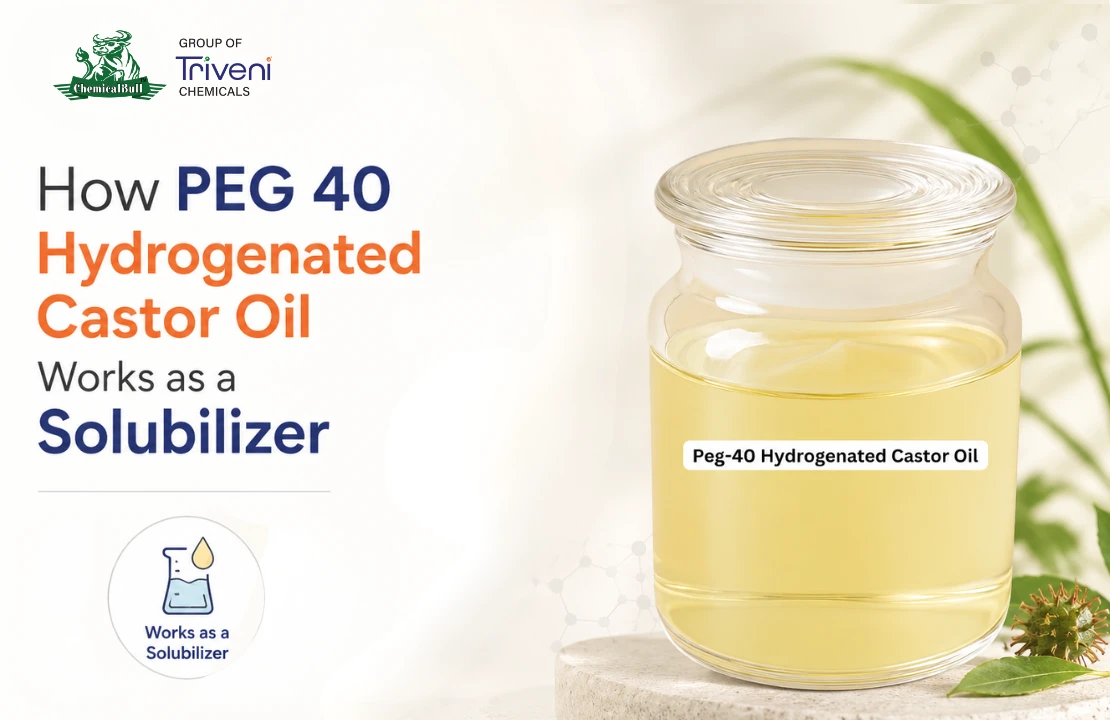
PEG 40 Hydrogenated Castor Oil commonly abbreviated as PEG-40 HCO or HCO-40 is one of the most trusted solubilizing agents in cosmetic and personal care formulation. Formulators reach for it whenever a fragrance oil, essential oil, or oil-soluble active needs to be dispersed evenly into a water-based product without causing cloudiness, oil separation, or instability. But understanding that it works is only half the picture understanding how it works at a molecular level helps formulators use it more precisely, troubleshoot stability issues, and select the correct usage ratio for their specific oil load.
This guide breaks down the chemistry and mechanism behind PEG-40 Hydrogenated Castor Oil's solubilizing action from its molecular structure and HLB value to the micelle formation process that actually traps and disperses oil molecules in water. For cosmetic-grade PEG-40 HCO with consistent batch quality and low odor, connect with a reliable peg 40 hydrogenated castor oil supplier offering full documentation for your production requirements.
What Is PEG 40 Hydrogenated Castor Oil? A Quick Structural Overview
PEG-40 Hydrogenated Castor Oil is produced through a two-step chemical process. First, natural castor oil rich in ricinoleic acid triglycerides is hydrogenated, converting its unsaturated bonds into saturated bonds. This hydrogenation step improves the oil's oxidative stability and gives it a more uniform, waxy character. Second, the hydrogenated castor oil is reacted with approximately 40 moles of ethylene oxide in a process called ethoxylation, attaching long polyethylene glycol (PEG) chains to the hydroxyl groups of the hydrogenated castor oil molecule.
|
Property |
Details |
|
INCI Name |
PEG-40 Hydrogenated Castor Oil |
|
Common Names |
HCO-40, PEG-40 HCO, Cremophor RH 40 (trade name) |
|
CAS Number |
61788-85-0 |
|
HLB Value |
~15 |
|
Physical Form |
Pale yellow to amber waxy solid / soft paste |
|
Solubility |
Soluble in water and many organic solvents |
|
Ionic Character |
Non-ionic |
|
Structure Type |
Amphiphilic ethoxylated triglyceride |
This molecular architecture a hydrophobic hydrogenated castor oil "core" surrounded by hydrophilic PEG chains is the structural foundation of every function PEG-40 HCO performs as a solubilizer.
The Core Mechanism: How PEG-40 HCO Solubilizes Oil in Water
Step 1: The Amphiphilic Molecule
PEG-40 Hydrogenated Castor Oil is an amphiphilic molecule meaning it has two distinct regions with opposite affinities:
- The hydrophobic tail: the hydrogenated castor oil portion of the molecule is oil-loving and naturally wants to associate with oil-soluble substances such as fragrance compounds, essential oils, and lipophilic actives.
- The hydrophilic head: the long chain of approximately 40 ethylene oxide units is water-loving and readily dissolves in aqueous systems.
This dual character is what allows a single molecule to bridge two substances (oil and water) that would otherwise never mix.
Step 2: Micelle Formation
When PEG-40 HCO is added to water above a specific concentration threshold known as the Critical Micelle Concentration (CMC), the molecules spontaneously self-organize into spherical structures called micelles. In a micelle, the hydrophobic hydrogenated castor oil tails cluster together at the center, shielded from water, while the hydrophilic PEG chains face outward into the surrounding aqueous phase.
This micelle structure creates a hydrophobic "pocket" suspended within an otherwise fully aqueous environment a microscopic oil-compatible compartment that did not exist in the water phase before the surfactant was added.
Step 3: Oil Solubilization Within the Micelle Core
When a fragrance oil or oil-soluble active is introduced into this system, the oil molecules migrate into the hydrophobic core of the micelles, where they are thermodynamically stable and shielded from the surrounding water. This is the actual solubilization event : the oil is not truly "dissolved" in water in the traditional chemical sense; it is encapsulated within thousands of microscopic micelle cores distributed evenly throughout the aqueous phase.
Because each micelle is extremely small (typically in the nanometer range), the resulting dispersion appears optically clear or near-clear to the human eye, even though it technically contains a separate oil phase trapped within the surfactant structure. This is precisely why properly solubilized fragrance toners, mists, and clear formulations remain transparent rather than cloudy.
Step 4: Stabilization and Even Distribution
Once the oil is captured within the micelle cores, the outward-facing PEG chains keep the entire micelle-oil complex suspended and evenly distributed throughout the water phase. The electrostatic and steric repulsion between the PEG chains of neighboring micelles prevents them from clumping together or coalescing maintaining long-term formulation stability and preventing the oil from separating out or rising to the surface over time, even during temperature fluctuations or extended storage.
Why the HLB Value of ~15 Makes This Process Effective
The Hydrophilic-Lipophilic Balance (HLB) value of PEG-40 Hydrogenated Castor Oil approximately 15 sits firmly in the hydrophilic range on the HLB scale (which generally runs from 1 to 20). This high HLB value is directly responsible for its strong water solubility and its effectiveness as a solubilizer rather than a simple emulsifier.
An HLB of 15 means the molecule's hydrophilic character dominates over its hydrophobic character, allowing the surfactant to readily disperse in water and accommodate the relatively small oil loads typical of solubilized systems (usually below 1%–2% oil content). At higher oil loads, formulators typically shift toward emulsifier systems rather than solubilizers, because the same HLB-driven mechanism becomes less efficient at managing larger oil volumes.
What Drives Efficient Solubilization: Practical Factors
Understanding the mechanism also clarifies which practical factors affect how well PEG-40 HCO performs in a real formulation:
Solubilizer-to-oil ratio:
Because each micelle can only hold a limited volume of oil within its hydrophobic core, the ratio of PEG-40 HCO to the oil being solubilized directly determines whether the system remains clear. Too little solubilizer relative to oil load means insufficient micelle capacity, resulting in cloudiness or oil separation.
Order of addition:
Pre-mixing the fragrance or oil-soluble ingredient with PEG-40 HCO before introducing it to the water phase allows the hydrophobic tails to associate with the oil molecules more efficiently, producing a clearer, more stable final solution than adding the oil and solubilizer to water separately.
Mixing energy:
Adequate agitation during formulation helps distribute the surfactant-oil micelles evenly throughout the water phase, reducing the chance of localized oil pockets that have not been fully captured within micelle structures.
Temperature:
PEG-40 HCO's solubilization efficiency can vary slightly with temperature, as the CMC and micelle stability are temperature-dependent. Most cosmetic applications use room-temperature or mild-warming processes for optimal results.
Electrolyte and pH sensitivity:
As a non-ionic surfactant, PEG-40 HCO's micelle-forming behaviour is relatively stable across a broad pH range and tolerates electrolytes better than ionic solubilizers an advantage in formulations containing salts or pH-adjusting acids.
Why This Mechanism Makes PEG-40 HCO Suitable for Heavier Oil Loads
Because the hydrogenated castor oil tail of PEG-40 HCO is a relatively large, branched lipid structure compared to many other non-ionic solubilizers, its micelle core has a comparatively higher oil-holding capacity. This structural characteristic is the underlying reason PEG-40 HCO performs particularly well with heavier, more concentrated fragrance oils and essential oils that smaller-tailed solubilizers struggle to fully encapsulate without cloudiness.
This same large hydrophobic tail also contributes a mild emollient quality to the finished product, since trace amounts of the hydrogenated castor oil structure interact favourably with the skin surface during application a secondary benefit that emerges directly from the same molecular architecture responsible for its solubilizing mechanism.
Frequently Asked Questions
1. How does PEG 40 Hydrogenated Castor Oil solubilize oil in water?
It forms micelles that trap oil molecules inside a hydrophobic core, creating a stable, clear dispersion in water.
2. What is the HLB value of PEG-40 Hydrogenated Castor Oil?
Approximately 15, placing it in the hydrophilic range and making it effective for water-based solubilization.
3. What is a micelle?
A spherical cluster of surfactant molecules that forms in water and traps oil inside its core — the basis of solubilization.
4. Why does PEG-40 HCO handle heavy fragrance oils well?
Its large hydrogenated castor oil tail gives each micelle higher oil-holding capacity than smaller-tailed solubilizers.
5. Does the order of ingredient addition matter?
Yes, pre-mixing the oil with PEG-40 HCO before adding water gives a clearer, more stable result.
6. Is PEG-40 HCO sensitive to pH or electrolytes?
No, being non-ionic, it remains stable across a wide pH range and tolerates electrolytes well.
7. What happens if too little PEG-40 HCO is used?
The oil isn't fully captured by micelles, causing cloudiness or visible oil separation.

Comment Section