Chemical Bull
764
29-Jun-2026
Quick Answer: What Is Polyethylene Glycol 6000 Used For?
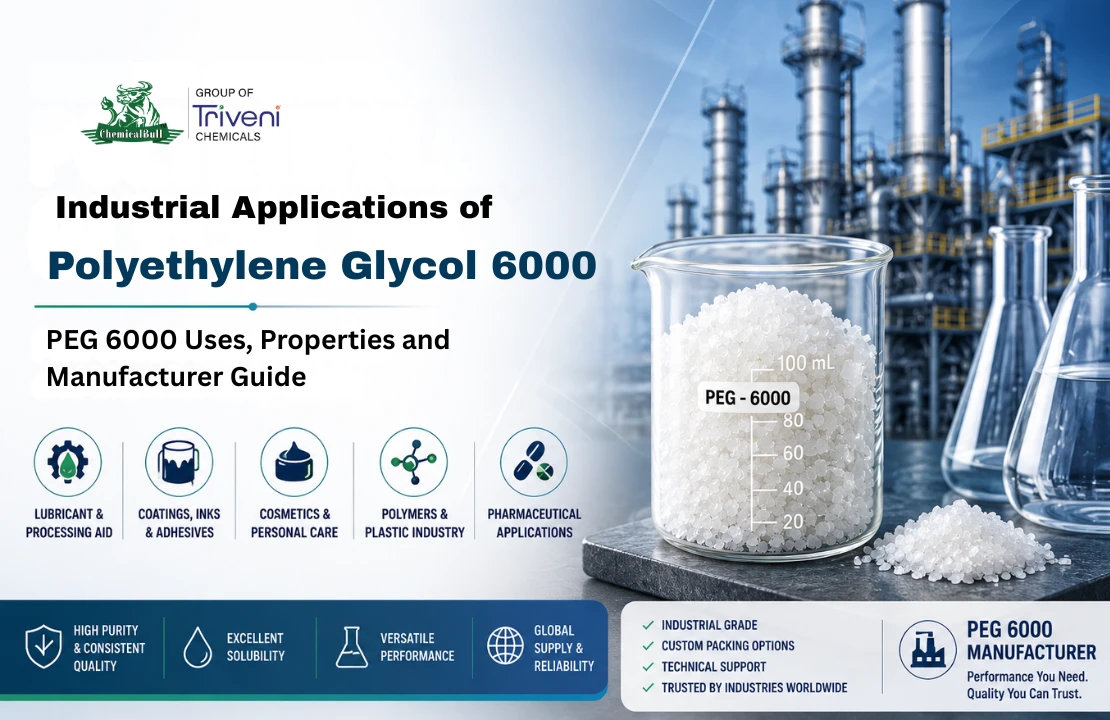
Polyethylene Glycol 6000, also known as PEG 6000, is a solid, water-soluble polyethylene glycol grade used as a binder, lubricant, coating aid, thickener, dispersing agent, and processing aid in pharmaceutical, cosmetic, rubber, plastic, ceramic, coating, adhesive, and industrial chemical applications.
In India, manufacturers use PEG 6000 when they need a stable solid PEG grade that supports controlled processing, smooth texture, powder handling, binding strength, and consistent batch performance.
Introduction
Polyethylene Glycol 6000 is an important industrial and commercial grade from the polyethylene glycol family. It is usually supplied as white to off-white powder, flakes, granules, or wax-like solid material. Because it dissolves in water and has a solid physical form, it is useful in both aqueous systems and solid processing applications.
PEG 6000 is widely used by manufacturers in India across pharmaceuticals, cosmetics, rubber compounds, plastics, ceramics, coatings, adhesives, and industrial chemical formulations. Its role changes by industry. In pharmaceutical formulations, it supports excipient systems, coating, binding, and base preparation. In cosmetics, it helps improve texture and viscosity. In rubber, plastic, and ceramic manufacturing, it supports processing, lubrication, binding, and dispersion.
For a deeper understanding of its pharmaceutical role, you can also read our detailed guide on polyethylene glycol in pharmaceutical formulations.
What Is Polyethylene Glycol 6000?
Polyethylene Glycol 6000 is a high molecular weight PEG grade with an average molecular weight of around 6000 g/mol. It belongs to the same PEG series as PEG 400, PEG 3350, PEG 4000, and PEG 8000, but its higher molecular weight gives it a harder solid character compared with lower grades.
PEG 6000 is selected when manufacturers need a solid PEG material with water solubility, binding ability, lubrication support, and controlled melting behavior. It is not used as the main base ingredient in most industrial systems; it works as a functional support material that improves processing, texture, stability, and handling.
Key Properties of PEG 6000
|
Property |
Details |
|
Product Name |
PEG 6000 |
|
Full Name |
Polyethylene Glycol 6000 |
|
Average Molecular Weight |
Around 6000 g/mol |
|
Appearance |
White powder |
|
Melting Range |
Around 60°C |
|
Solubility |
Soluble in water |
|
Main Functions |
Binder, lubricant, coating aid, thickener, processing aid |
|
Common Industries |
Pharma, cosmetics, rubber, plastics, ceramics, coatings, adhesives |
PEG 6000 Uses in Industrial Applications
PEG 6000 uses are spread across different industries because the same material can perform different roles depending on the formulation. Its main value comes from solid handling, water solubility, binding support, lubrication, viscosity control, and processing stability.
|
Industry |
PEG 6000 Use |
Manufacturing Benefit |
|
Pharmaceutical |
Excipient, binder, coating aid |
Supports tablets, bases, and dosage systems |
|
Cosmetics |
Thickener, texture modifier, humectant support |
Improves viscosity, feel, and consistency |
|
Rubber |
Lubricant and dispersion aid |
Supports smoother mixing and filler distribution |
|
Plastics |
Processing aid and plasticizer support |
Helps flow, flexibility, and surface finish |
|
Ceramics |
Binder and shaping aid |
Supports green strength and handling |
|
Coatings |
Surface and texture support |
Helps improve finish and stability |
|
Adhesives |
Binder and viscosity support |
Improves consistency and application behavior |
PEG 6000 in Pharmaceutical Applications
In pharmaceutical manufacturing, PEG 6000 is used as an excipient, binder, coating aid, and base material in selected dosage systems. Its solid nature and controlled melting range make it useful in tablet-related applications, ointment bases, suppository bases, and selected controlled-release systems.
Pharma manufacturers should select the grade based on required quality standards and application suitability. COA, TDS, SDS, purity details, and regulatory documentation should be reviewed before bulk use.
Pharmaceutical Application Areas
|
Application |
Role of PEG 6000 |
|
Tablet coating |
Supports smooth coating and surface finish |
|
Tablet binding |
Helps improve ingredient binding |
|
Suppository base |
Supports structure and melting behavior |
|
Ointment base |
Helps texture and consistency |
|
Excipient systems |
Supports dosage development |
PEG 6000 in Cosmetics and Personal Care
In cosmetics and personal care, PEG 6000 is used to improve texture, viscosity, spreadability, and product consistency. It is suitable for creams, lotions, gels, cleansing products, and hair care systems where a water-soluble solid ingredient is required.
Cosmetic manufacturers in India use PEG 6000 when they need better product body, smooth application feel, and stable texture. Its performance depends on the full formulation, dosage, and compatibility with other ingredients.
Cosmetic Benefits
|
Cosmetic Need |
PEG 6000 Support |
|
Better texture |
Improves product body and smoothness |
|
Viscosity control |
Supports thickness in selected systems |
|
Moisture feel |
Helps improve application feel |
|
Product consistency |
Supports uniform product quality |
|
Spreadability |
Helps smoother application |
PEG 6000 in Rubber and Plastic Processing
PEG 6000 is used in rubber and plastic processing where manufacturers need lubrication, filler dispersion, smoother movement, and better processing control. In rubber compounds, it can help fillers and additives distribute more evenly inside the rubber matrix. In plastic systems, it may support flow, flexibility, and surface finish when compatible with the polymer.
Rubber and plastic manufacturers often work with fillers, pigments, process oils, stabilizers, and other additives. Poor dispersion or high internal friction can affect surface quality, mechanical behavior, and production consistency. PEG 6000 helps support smoother processing and better material movement in suitable systems.
Processing Benefits
|
Processing Need |
PEG 6000 Benefit |
|
Filler dispersion |
Helps fillers spread more evenly |
|
Mixing behavior |
Supports smoother compounding |
|
Material flow |
Helps reduce processing resistance |
|
Surface finish |
May improve product appearance |
|
Batch consistency |
Supports uniform production quality |
PEG 6000 in Ceramic, Coating and Adhesive Applications
In ceramic manufacturing, PEG 6000 works as a binder and processing aid. Ceramic powders need temporary strength before pressing, shaping, drying, or firing. This material helps particles hold together and improves green strength during handling.
In coatings and adhesives, PEG 6000 can support viscosity control, surface feel, application consistency, and binding performance. Its water solubility makes it useful in selected water-based systems where uniform dispersion is important.
Application Benefits
|
Application Area |
PEG 6000 Function |
|
Ceramics |
Binder and green strength support |
|
Coatings |
Texture and surface improvement |
|
Adhesives |
Binder and viscosity support |
|
Industrial blends |
Processing and dispersion support |
|
Water-based systems |
Solubility and uniform mixing support |
PEG 6000 vs PEG 4000 Comparison
PEG 6000 and PEG 4000 are both solid polyethylene glycol grades, but they are selected differently because of molecular weight, solid character, melting range, and application requirement. PEG 4000 is often preferred where easier processing and moderate solid PEG behavior are needed, while PEG 6000 is selected where higher molecular weight and harder solid performance are required.
|
Comparison Point |
PEG 4000 |
PEG 6000 |
|
Average Molecular Weight |
Around 4000 g/mol |
Around 6000 g/mol |
|
Physical Type |
White to off-white solid, flakes, or powder |
White powder |
|
Melting Range |
Around 53–58°C |
Around 55–63°C |
|
Solid Character |
Moderate solid grade |
Harder and more wax-like solid grade |
|
Processing Behavior |
Easier handling in many systems |
Better where higher molecular weight PEG is required |
|
Water Solubility |
Soluble in water |
Soluble in water |
|
Common Industrial Uses |
Rubber, plastics, ceramics, lubricants, processing aids |
Pharma, cosmetics, coatings, adhesives, ceramics, industrial binders |
|
Best Selection Case |
When moderate solid behavior and easier processing are needed |
When stronger solid character, coating support, and higher molecular weight are preferred |
For manufacturers, the selection should depend on the final application. PEG 4000 may be more suitable for rubber, plastic, and ceramic processing where smoother handling is important, while PEG 6000 may be better for pharma, coating, adhesive, and solid binder applications where harder PEG behavior is useful.
For readers comparing different PEG grades in processing applications, you can also explore our guide on PEG 4000 as a lubricant, plasticizer and processing aid.
PEG 6000 Manufacturer Guide
Manufacturers and bulk buyers in India should choose PEG 6000 based on grade consistency, documentation, packing, technical support, and supply reliability. The selected material should match the buyer’s use in pharma, cosmetics, rubber, plastics, ceramics, coatings, adhesives, or industrial chemical production.
Buyers should also confirm melting range, moisture level, physical type, packing size, and application suitability before regular procurement.
For PEG 6000 samples, COA, TDS, SDS, powder and flake supply, and bulk sourcing support, connect with ChemicalBull as a reliable PEG 6000 Manufacturer in India for pharmaceutical, cosmetic, rubber, plastic, ceramic, coating, adhesive, and industrial applications.
What Buyers Should Check Before Bulk Purchase
-
COA, TDS, and SDS availability
-
Powder, flakes, or granule type
-
Melting range and moisture level
-
Packing size and supply capacity
-
Sample support and application suitability
Frequently Asked Questions
-
What is Polyethylene Glycol 6000?
Polyethylene Glycol 6000 is a solid PEG grade with an average molecular weight of around 6000 g/mol. It is water-soluble and used as a binder, lubricant, coating aid, thickener, and processing aid. -
What is Polyethylene Glycol 6000 used for?
Polyethylene Glycol 6000 is used in pharma, cosmetics, rubber, plastics, ceramics, coatings, adhesives, and industrial chemical production. It supports binding, lubrication, dispersion, texture control, and processing performance. -
What are the main PEG 6000 uses?
PEG 6000 uses include tablet coating, excipient systems, cosmetic thickening, rubber processing, plastic lubrication, ceramic binding, coating support, and adhesive modification. It is selected where solid PEG handling and water solubility are useful. -
Is PEG 6000 soluble in water?
Yes, PEG 6000 is soluble in water. This makes it useful in water-based systems, pharma products, cosmetics, coatings, adhesives, and industrial formulations. -
What is the difference between PEG 4000 and PEG 6000?
PEG 4000 has an average molecular weight of around 4000 g/mol, while PEG 6000 is around 6000 g/mol. PEG 6000 is generally harder and more wax-like than PEG 4000. -
What is the difference between PEG 6000 and PEG 8000?
PEG 6000 has an average molecular weight of around 6000 g/mol, while PEG 8000 is around 8000 g/mol. PEG 8000 is generally harder and more wax-like, while PEG 6000 offers balanced solid handling and easier processing in many industrial systems. -
Where can manufacturers buy PEG 6000 in India?
Manufacturers can buy PEG 6000 in India from chemical suppliers and bulk distributors like Chemical Bull that provide COA, TDS, SDS, sample support, and consistent supply. Buyers should confirm grade, powder or flake type, packing, and application suitability before purchase.
Conclusion
Polyethylene Glycol 6000 is a versatile solid PEG grade used in pharmaceutical, cosmetic, rubber, plastic, ceramic, coating, adhesive, and industrial chemical applications. It supports binding, lubrication, thickening, dispersion, surface improvement, and smoother processing.
For Indian manufacturers, PEG 6000 offers value because it is water-soluble, solid, stable, and suitable for bulk production. It can support tablet systems, cosmetic texture, rubber processing, ceramic binding, plastic manufacturing, coating performance, and adhesive consistency.
Before buying PEG 6000, manufacturers should check molecular weight, melting range, solubility, moisture level, powder or flake type, COA, TDS, SDS, packing, and supplier reliability.
For PEG 6000 samples, COA, TDS, SDS, powder supply, flake supply, and bulk sourcing support, connect with ChemicalBull to source suitable material for pharmaceutical, cosmetic, rubber, plastic, ceramic, coating, adhesive, and industrial manufacturing applications.

Comment Section