Chemical Bull
29
29-Oct-2026
Furfural as a Solvent in Lubricating Oil Refining: Applications and Benefits
Introduction
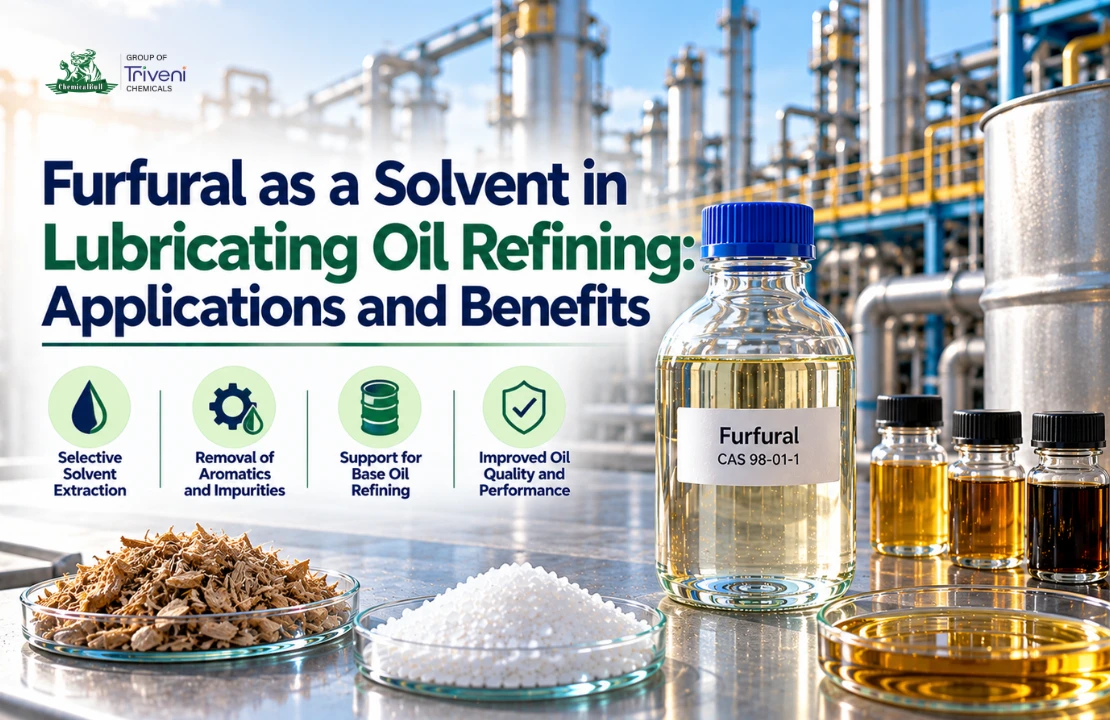
Furfural is an industrial chemical used as a selective solvent in lubricating base-oil refining. It helps separate undesirable aromatic compounds and other components from petroleum-derived oil fractions, supporting the production of refined base oils with improved viscosity index, colour and oxidation stability. Its effectiveness depends on the feedstock composition and the operating conditions of the extraction process.
ChemicalBull supports industrial chemical sourcing requirements by connecting buyers with suitable chemical supply options. For furfural requirements, buyers should confirm the required grade, purity, packaging and application before placing an order.
Quick Answer: What Is Furfural Used for in Lubricating Oil Refining?
Furfural is used as a selective extraction solvent to separate a portion of the aromatic and polar components from lubricating oil feedstocks. The process produces a refined oil-rich stream called the raffinate, which can undergo further processing to make lubricating base oils. The extracted stream contains a higher concentration of the components removed during refining.
What Is Furfural?
Furfural, also known as 2-furaldehyde or 2-furancarboxaldehyde, is an organic compound with the CAS number 98-01-1. It is commonly produced from pentose-rich biomass and is used as a chemical intermediate and industrial solvent.
In petroleum refining, furfural is valued for its ability to preferentially dissolve certain aromatic compounds compared with desirable components in the oil feedstock. This difference in solubility enables the separation of components with different chemical characteristics.
Furfural is not added to finished lubricating oil as a performance additive in this application. Instead, it is used during the processing of base-oil feedstocks and is subsequently recovered from the oil streams.
How Furfural Works in Lubricating Oil Refining
The main purpose of furfural extraction is to improve the quality of selected lubricating oil fractions by separating components that may negatively affect their performance.
A typical process involves the following stages:
Step 1: Feedstock preparation
Lubricating oil feedstock, often obtained from vacuum distillation, is prepared for solvent extraction. Feedstock properties such as viscosity, composition and temperature influence the operating conditions.
Step 2: Solvent extraction
The oil feedstock contacts furfural in an extraction unit, commonly operating with counter-current liquid-liquid contact. Under controlled conditions, furfural preferentially dissolves a portion of the aromatic and other less desirable components.
Step 3: Separation of the two streams
The extraction process produces two principal streams:
-
Raffinate: The oil-rich stream containing a greater proportion of the desired base-oil components.
-
Extract: The solvent-rich stream containing a greater proportion of the components removed from the feedstock.
Step 4: Solvent recovery
Furfural is separated from the raffinate and extract streams using suitable recovery operations, which may include evaporation, distillation and stripping. Recovered solvent can be returned to the process when it meets the required operating specifications.
Step 5: Further base-oil processing
The raffinate may undergo additional treatments, such as solvent dewaxing and finishing, depending on the desired base-oil grade and product specifications.
Applications of Furfural in Lubricating Oil Refining
Aromatic extraction
Furfural is used to extract a portion of the aromatic compounds present in lubricating oil feedstocks. The extent of extraction depends on the feedstock, solvent-to-oil ratio, temperature and other process variables.
Production of lubricating base oils
The refined raffinate can serve as an intermediate in manufacturing lubricating base oils used in automotive, industrial and machinery lubricants.
Improvement of viscosity index
Removing selected aromatic components can improve the viscosity index of the resulting base oil. Viscosity index describes how strongly an oil's viscosity changes with temperature. The actual improvement depends on the original feedstock and process conditions.
Refining of different oil fractions
Furfural extraction can be applied to suitable light and heavy lubricating oil distillates. Refinery operators determine the operating conditions according to feedstock characteristics and the target product properties.
Benefits of Furfural in Lubricating Oil Refining
|
Benefit |
Explanation |
|
Selective extraction |
Helps separate certain aromatic and polar components from suitable oil feedstocks. |
|
Improved viscosity index |
Can support production of base oils with less viscosity variation across temperatures. |
|
Improved colour |
Removing selected components can contribute to a lighter-coloured refined oil. |
|
Oxidation stability |
Extraction can reduce some components associated with undesirable oxidation behaviour; final performance depends on subsequent processing and testing. |
|
Process integration |
Furfural can be recovered and reused in a properly designed extraction system. |
|
Base-oil quality control |
Controlled extraction helps refiners adjust product properties to meet target specifications. |
Factors That Affect Furfural Extraction Performance
Feedstock composition
Different crude-oil sources and lubricating oil fractions contain different proportions of aromatic, paraffinic and naphthenic components. These differences affect solvent selectivity and the quality of the raffinate.
Extraction temperature
Temperature influences phase behaviour, solvent selectivity and the distribution of compounds between the raffinate and extract. Refinery operators establish an appropriate operating range through process design and testing.
Solvent-to-oil ratio
The amount of furfural used relative to the oil feedstock affects extraction performance, solvent circulation and recovery requirements. A suitable ratio must balance product quality with operating costs.
Contact efficiency
The design and operation of the extraction tower affect how effectively the solvent contacts the feedstock. Stable flow, suitable mixing and effective phase separation are important for consistent performance.
Solvent purity and condition
Impurities, moisture and changes in solvent condition may influence extraction behaviour and solvent recovery. Buyers and operators should verify that the furfural grade meets the requirements of the intended process.
Furfural Compared with Other Extraction Solvents
Furfural is one of several solvents used for lubricating base-oil extraction. Phenol and N-methyl-2-pyrrolidone (NMP) have also been used in solvent-refining processes.
|
Factor |
Furfural |
Phenol |
NMP |
|
Main role |
Selective extraction of undesirable components |
Selective solvent extraction |
Extraction of aromatic and polar components |
|
Key consideration |
Selectivity, solvent recovery and operating conditions |
Process performance and health and safety controls |
Solvent performance, recovery and applicable safety requirements |
|
Process suitability |
Depends on feedstock and refinery design |
Depends on process design and requirements |
Depends on process design and requirements |
These solvents are not interchangeable without evaluation. Refinery operators should compare selectivity, product quality, solvent recovery, energy requirements, safety and environmental considerations before selecting or changing a process solvent.
Handling and Storage Considerations
Furfural should be handled according to its current Safety Data Sheet (SDS), site procedures and applicable regulations.
Important considerations include:
-
Use appropriate protective equipment and suitable chemical-handling systems.
-
Provide adequate ventilation and minimise worker exposure.
-
Use compatible, properly closed containers and storage equipment.
-
Control exposure to heat and ignition sources in accordance with the SDS and facility risk assessment.
-
Prevent spills and uncontrolled releases; collect and dispose of waste through approved procedures.
-
Maintain suitable process equipment and inspect it for leaks, especially around pumps, valves, flanges and solvent-recovery units.
Industrial buyers should review the supplier's SDS and technical documentation before approving a material for use.
Selecting Furfural for Industrial Supply
Before sourcing furfural for lubricating oil refining, buyers should confirm the following:
-
Application: Confirm that the material is intended for solvent extraction in base-oil refining.
-
Purity and grade: Match the supplier's specification with the refinery's process requirements.
-
Quality documentation: Request the relevant Certificate of Analysis (COA), Technical Data Sheet (TDS) and Safety Data Sheet (SDS), where available.
-
Packaging and quantity: Confirm the required delivery volume, packaging type and handling arrangements.
-
Supply consistency: Evaluate the supplier's ability to meet the required quality and delivery schedule.
ChemicalBull is a chemical trader and reseller, not a manufacturer. Buyers can contact the team to discuss sourcing requirements and confirm product availability, grade and documentation before ordering.
Frequently Asked Questions
1. What is the main use of furfural in lubricating oil refining?
Furfural is mainly used as a selective solvent to remove a portion of the aromatic and other undesirable components from suitable lubricating oil feedstocks.
2. How does furfural improve base-oil quality?
By separating selected components, furfural extraction can help improve properties such as viscosity index and colour. Final performance also depends on feedstock composition and subsequent refining steps.
3. What is the difference between raffinate and extract?
Raffinate is the oil-rich stream containing a greater proportion of the desired base-oil components. Extract is the solvent-rich stream containing a higher concentration of the components removed during extraction.
4. Is furfural added to finished lubricating oil?
In conventional base-oil refining, furfural is a processing solvent rather than a finished-lubricant additive. It is recovered after extraction instead of being intentionally retained as a formulation ingredient.
5. Can furfural be recovered and reused?
Yes. Industrial extraction systems are designed to recover furfural from the process streams. Reuse depends on recovery efficiency and whether the recovered solvent meets the required process specifications.
6. What should buyers check before purchasing furfural?
Buyers should confirm the intended application, purity, grade, COA, TDS, SDS, packaging, quantity and delivery requirements.
Discuss Your Furfural Sourcing Requirements
For industrial furfural enquiries, contact ChemicalBull to discuss your required grade, quantity, packaging and documentation.



Comment Section