Chemical Bull
37
29-Oct-2026
Copper corrosion is an important consideration in industrial cooling-water treatment. Heat exchangers and circulation systems containing copper alloys need protection that matches their metallurgy, water chemistry and operating conditions.
Benzotriazole is used in suitable treatment programmes to help protect copper and copper-containing alloys. For manufacturers, selecting the right grade requires both formulation testing and clear procurement specifications.
Developing a cooling-water treatment formulation? Contact Chemical Bull to request benzotriazole specifications, sample availability and bulk pricing.
What Does Benzotriazole Do in Water Treatment?
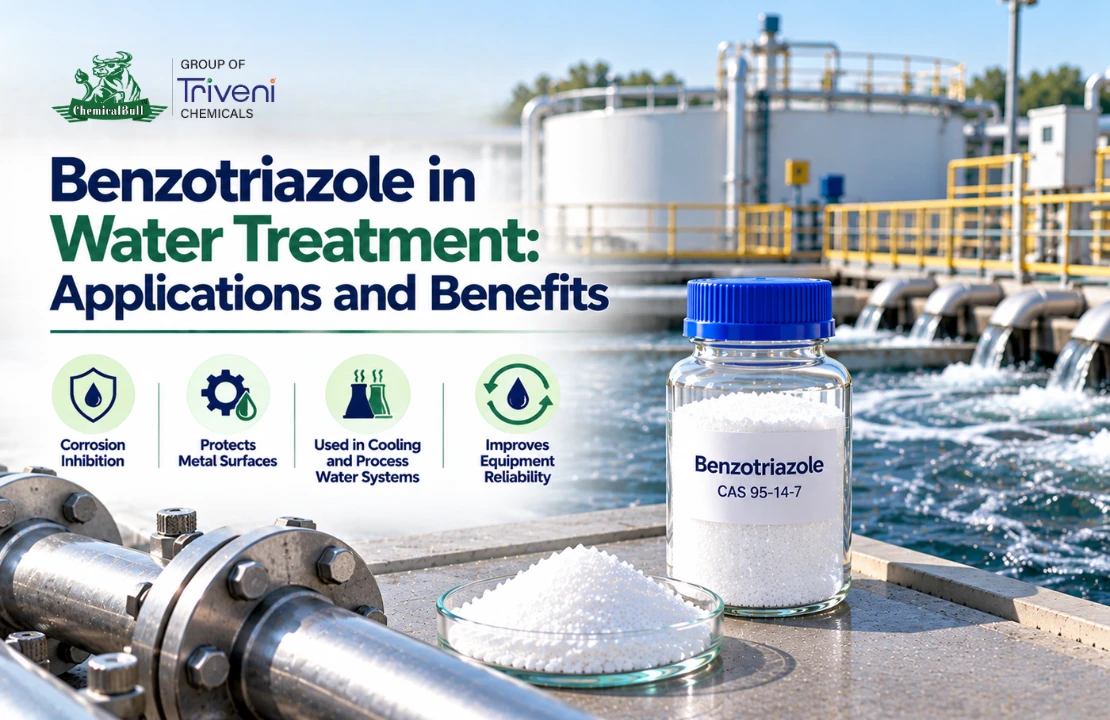
Benzotriazole acts as a copper corrosion inhibitor by forming a protective layer on suitable copper-containing surfaces. It is incorporated into cooling-water and closed-loop treatment programmes where copper-alloy components need targeted protection. It does not replace scale control, microbiological treatment or corrosion protection for other metals.
Commonly abbreviated as BTA, benzotriazole has CAS number 95-14-7. Buyers should confirm the chemical identity and supplied form before comparing grades or quotations.
How It Helps Protect Copper
Benzotriazole interacts with copper-containing surface species to form a protective film. Under suitable conditions, this film reduces corrosion reactions at the metal surface.
However, protection depends on more than the amount added. Surface condition, dissolved copper and the surrounding treatment chemistry affect inhibitor demand and performance.
For the underlying surface chemistry, read our guide to benzotriazole for copper corrosion inhibition.
In cooling-water applications, the practical objective is to establish protection and maintain it throughout operation.
Applications in Industrial Cooling Systems
Open Recirculating Cooling Water
Cooling-tower circuits containing copper-alloy equipment may use benzotriazole within a validated treatment programme.
Assessment should account for makeup-water quality, concentration cycles, blowdown, contamination and biocide exposure. These conditions help determine the treatment approach and monitoring requirements.
The inhibitor must remain effective alongside the other chemicals used to manage the circuit.
Closed Cooling Loops
Benzotriazole can be incorporated into suitable closed-loop systems requiring copper protection. Its use is documented in equipment-specific secondary cooling circuits.
Confirm compatibility with the full wetted assembly, including metals, seals and other formulation ingredients. Closed systems still require checks for leakage, contamination and changes in water quality.
Heat Exchangers and Mixed-Metal Circuits
Heat-exchange systems may contain copper alloys alongside steel or other metals. Each material needs to be considered within the overall corrosion-control programme.
In some copper-and-steel circuits, dissolved copper can deposit on steel and promote galvanic attack. Controlling copper dissolution therefore has a wider role in system protection.
Benzotriazole should not be assumed to provide equivalent protection for every metal present.
Water-Treatment Formulations
Water-treatment manufacturers can evaluate BTA as an ingredient in corrosion-inhibitor concentrates.
Approval should cover incorporation, storage stability, dosing behaviour and application performance. Raw benzotriazole is an ingredient for formulation development—not a complete cooling-water treatment package.
Benefits and Performance Expectations
Targeted Copper-Alloy Protection
The principal benefit is corrosion inhibition for copper and suitable copper-containing alloys. This makes benzotriazole relevant when system metallurgy requires yellow-metal protection.
Support for Equipment Reliability
Effective corrosion control can support equipment reliability and maintenance planning. Results depend on the complete treatment programme and should be verified through monitoring.
Water clarity or the absence of visible corrosion is insufficient evidence on its own.
Measurable Treatment Performance
Benzotriazole can be measured in cooling-water samples using suitable analytical methods. Residual analysis helps treatment teams assess inhibitor concentration alongside operating data.
A measured residual should complement corrosion assessment rather than replace it.
Conditions That Affect Performance
Before selecting the inhibitor, define the operating environment.
|
Evaluation area |
What to establish |
|
System metallurgy |
Copper alloys and other wetted metals |
|
Water chemistry |
pH, conductivity, chloride and relevant contaminants |
|
Operating conditions |
Temperature, circulation and water losses |
|
Surface condition |
Deposits, cleanliness and existing corrosion products |
|
Treatment programme |
Compatibility with inhibitors, dispersants and biocides |
|
Monitoring |
Methods and criteria used to confirm protection |
These details make laboratory and field evaluations more representative of actual service conditions.
Dosage and Biocide Compatibility
There is no universal benzotriazole dosage suitable for every cooling-water system.
Distinguish between the treatment-product addition, active inhibitor concentration and measured residual. A diluted concentrate and a solid ingredient require different calculations.
Establish trial levels using supplier guidance, representative testing and system requirements. Confirm performance through a controlled field evaluation before setting the routine treatment programme.
Oxidizing-biocide exposure requires particular attention. Excessive chlorination can deactivate triazoles and interfere with copper protection. Evaluate the actual dosing pattern rather than assuming compatibility from an initially clear blend.
When performance declines, investigate water chemistry, surface condition and treatment history before increasing the dose.
Selecting the Material for Manufacturing
A suitable benzotriazole supplier should provide information that supports both formulation approval and repeat procurement.
For solid material, agree on identity, assay, moisture, physical form and relevant impurity limits. For a liquid concentrate, confirm active content, chemical identity, carrier, pH and storage stability.
A BTA-containing liquid may be a solution, a salt formulation or a multi-component blend. These products should not be treated as interchangeable.
Request the current SDS, technical specification and representative COA. Sample testing should assess incorporation and finished-blend stability before commercial approval.
Bulk Pricing and Supply Planning
Benzotriazole price per kg depends on specification, physical form, quantity, packaging and delivery terms.
Compare quotations against the same requirements. Unit price alone does not account for active concentration, formulation work or validated treatment performance.
To obtain a relevant quotation, provide:
-
Required grade, specification and quantity.
-
Application and preferred packaging.
-
Delivery location and purchase timeline.
-
Sample, COA, SDS and TDS requirements.
Chemical Bull supports bulk benzotriazole enquiries for industrial formulations. Confirm grade availability, documentation and delivery arrangements against your production plan.
Frequently Asked Questions
Is benzotriazole a disinfectant?
Its role here is copper corrosion inhibition. It should not replace the system’s microbiological-control programme.
Can it protect every metal in a cooling circuit?
No. Its established role is targeted copper and copper-alloy protection. Other metals require separate assessment.
How is the appropriate dosage selected?
Use the system conditions, product concentration, treatment demand and monitoring results to establish a validated addition level.
Can it be used with chlorine-based treatment?
Compatibility must be evaluated. Excessive chlorination can interfere with triazole protection, so coordinate inhibitor selection with the biocide programme.
What should manufacturers check before ordering?
Review the specification, COA, SDS, incorporation behaviour, blend stability and application results. Follow laboratory approval with an appropriate trial.
How can buyers request bulk pricing?
Share the required specification, quantity, packaging, destination and purchase timeline. Include any sample or documentation requirements.
Request a Quotation for Your Requirement
For a new formulation or repeat procurement, share your approved specification and supply requirements with Chemical Bull. Request benzotriazole specifications and bulk pricing to confirm available grades, packaging and delivery terms.

Comment Section