Chemical Bull
59
28-Oct-2026
Chemicals Used in Paint and Coating Formulations: Applications and Uses
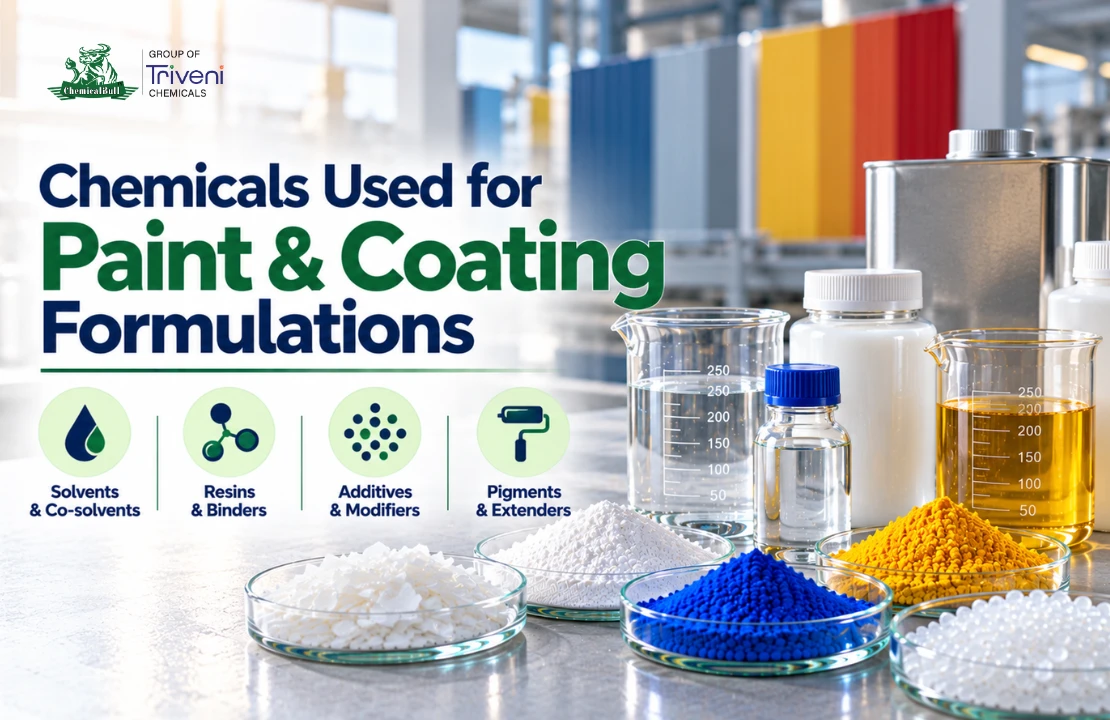
Paint and coating formulations contain a combination of resins, pigments, solvents, fillers, and specialised additives. Each ingredient serves a specific purpose, such as providing colour, forming a protective film, controlling viscosity, improving application, or supporting the durability of the finished coating.
Understanding the chemicals used in paint and coating formulations helps paint manufacturers, coating formulators, and industrial buyers select suitable raw materials for decorative paints, protective coatings, wood finishes, and other industrial applications.
The selection of raw materials depends on the coating type, application method, substrate, required finish, environmental conditions, and applicable safety and regulatory requirements.
Quick Answer: Which Chemicals Are Used in Paint and Coating Formulations?
The main chemicals used in paint and coating formulations include resins and binders, pigments, solvents or water, extenders, dispersants, wetting agents, defoamers, and rheology modifiers. Resins form the coating film, pigments provide colour and opacity, solvents or water help control application properties, and additives support dispersion, stability, flow, and other formulation requirements.
The exact combination varies according to whether the product is a water-based paint, solvent-based coating, protective coating, decorative paint, or specialty industrial coating.
Main Categories of Chemicals Used in Paint Manufacturing
Paint formulations generally contain several categories of raw materials. Their proportions and specifications depend on the intended application and the performance required from the finished product.
|
Chemical category |
Main function |
Common applications |
|
Resins and binders |
Form the coating film and contribute to adhesion and durability |
Decorative paints, industrial coatings |
|
Pigments |
Provide colour and opacity |
Interior paints, exterior paints, protective coatings |
|
Extenders and fillers |
Modify texture, solids content, and other physical properties |
Wall paints, primers, textured coatings |
|
Solvents and carriers |
Help control viscosity and application characteristics |
Solvent-based coatings, selected industrial formulations |
|
Dispersants and wetting agents |
Support pigment wetting and dispersion |
Paints and coatings |
|
Defoamers |
Help control unwanted foam |
Emulsion paints, industrial coatings |
|
Rheology modifiers |
Control viscosity, flow, and resistance to sagging or settling |
Decorative paints, textured coatings |
|
Drying and curing agents |
Support drying or chemical curing in suitable systems |
Alkyd coatings, two-component coatings |
|
Preservatives and stabilisers |
Help maintain product stability where appropriate |
Selected water-based formulations |
For a broader overview of relevant industrial raw materials, explore ChemicalBull's Paints, Coatings & Ink Chemicals
Binders and Resins Used in Paint Formulations
Binders, also called resins, are important components of paint formulations. They form the continuous film after application and influence adhesion, hardness, flexibility, durability, and resistance to environmental exposure.
Acrylic Resins
Acrylic resins are used in many decorative and industrial coating systems. Depending on their chemistry and formulation, they can provide colour retention, weathering resistance, adhesion, and flexibility.
Common applications include:
-
Interior and exterior decorative paints
-
Architectural coatings
-
Protective and maintenance coatings
-
Selected industrial coating systems
Alkyd Resins
Alkyd resins are used in various solvent-based coatings and certain water-reducible systems. Their performance depends on resin composition, curing conditions, and the complete formulation.
Common applications include:
-
Decorative enamels
-
Wood coatings
-
Metal primers and finishes
-
General-purpose industrial coatings
Epoxy Resins
Epoxy resins are commonly selected when adhesion, chemical resistance, and mechanical performance are important. Many epoxy coatings require a compatible curing agent to develop their final properties.
Common applications include:
-
Industrial floor coatings
-
Protective coatings for metal
-
Chemical-resistant linings
-
Maintenance and infrastructure coatings
Polyurethane Resins
Polyurethane coating systems can provide abrasion resistance, flexibility, and a durable surface finish. Their properties depend on the resin chemistry and whether the system is one-component or two-component.
Common applications include:
-
Wood and furniture coatings
-
Industrial topcoats
-
Automotive refinishing systems
-
Protective and decorative finishes
The correct resin should be selected according to the substrate, curing mechanism, required film properties, and compatibility with the other formulation ingredients.
Pigments and Fillers Used in Paint Manufacturing
Pigments and fillers influence colour, opacity, appearance, texture, and other physical properties. Although both are particulate materials, they serve different primary functions.
Titanium Dioxide
Titanium dioxide is widely used as a white pigment because of its strong light-scattering ability and contribution to opacity and brightness.
Applications include:
-
Interior and exterior paints
-
White primers and topcoats
-
Decorative coatings
-
Selected industrial coatings
The appropriate grade depends on the formulation, intended exposure, and whether the coating is water-based or solvent-based.
Iron Oxide Pigments
Iron oxide pigments are used to produce colours such as red, yellow, brown, and black, depending on the grade.
Applications include:
-
Decorative paints
-
Concrete and masonry coatings
-
Protective coatings
-
Industrial and architectural finishes
Colour consistency, tinting strength, dispersion behaviour, and weathering requirements should be considered when selecting a grade.
Carbon Black
Carbon black is used in formulations requiring black colour, tinting strength, or selected functional properties.
Applications include:
-
Black coatings
-
Industrial finishes
-
Primers and protective coatings
-
Specialty formulations
Its particle characteristics and surface properties can affect dispersion, colour development, viscosity, and final appearance.
Calcium Carbonate and Other Mineral Fillers
Calcium carbonate, talc, kaolin, and silica are examples of mineral materials used as extenders or fillers. Depending on the grade and particle characteristics, they can influence solids content, texture, opacity, rheology, and mechanical properties.
Applications include:
-
Emulsion paints
-
Primers
-
Wall coatings
-
Selected industrial formulations
The choice of filler should take account of particle size, purity, moisture content, compatibility, and the properties required from the finished coating.
Solvents Used in Paint and Coating Formulations
Solvents help control viscosity, support the incorporation of formulation ingredients, and influence application and drying behaviour. Their role depends on the binder chemistry and coating system.
Water is the principal carrier in many water-based paints, while organic solvents may be used in solvent-based coatings. Some formulations use a combination of solvents to achieve the required solvency and application characteristics.
Glycol Ethers Used in Paint and Coating Formulations
Glycol ethers are a family of solvents used in selected industrial and coating formulations. Depending on the chemical and grade, they can contribute to solvency, compatibility, flow, and drying characteristics.
Diethylene Glycol Monobutyl Ether
Also known as butyl carbitol, this glycol ether is used as a solvent or coupling component in selected industrial formulations, including certain paints and coatings. Its suitability depends on the binder system, solvent balance, and intended application.
Ethylene Glycol Monobutyl Ether
Also known as 2-butoxyethanol, this solvent is used in various industrial formulations, including selected paints, coatings, and cleaning products. Its water compatibility and organic solvency can be useful where the formulation requires interaction between different ingredients.
Methoxy Propanol, also known as propylene glycol monomethyl ether, is used as a solvent in selected coating and industrial formulations. Its suitability depends on the specific formulation, required evaporation characteristics, and compatibility with the other ingredients.
Other Solvent Types
Depending on the coating system, manufacturers may use alcohols, esters, ketones, aromatic or aliphatic hydrocarbons, and other specialised solvents.
Selection should consider:
-
Resin solubility and compatibility
-
Evaporation rate
-
Viscosity and application requirements
-
Flash point and handling requirements
-
Volatile organic compound (VOC) limits
-
Workplace exposure and environmental regulations
Solvents should not be selected solely on price or evaporation rate. Their impact on safety, film formation, application, and regulatory compliance must also be evaluated.
For formulations specifically designed around organic solvent systems, see the relevant Solvent-Based Coatings. Replace this placeholder with the live category URL before publishing.
Paint Additives and Their Functions
Paint additives are used in relatively small quantities to modify specific formulation properties. Depending on the additive, they can improve manufacturing efficiency, storage stability, application behaviour, or the final coating's performance.
Dispersants and Wetting Agents
Dispersants help distribute pigments and fillers throughout the formulation. Wetting agents help liquids spread over solid surfaces and support the wetting of pigments or fillers.
These materials can contribute to consistent colour development, dispersion stability, and application performance. Their selection depends on the pigment, binder chemistry, carrier, and manufacturing process.
Defoamers
Foam can develop during mixing, pumping, filling, or application. Defoamers help control unwanted foam and may reduce defects associated with trapped air.
The selected defoamer must be compatible with the formulation. Excessive or unsuitable use can cause surface defects or affect the coating's appearance.
Rheology Modifiers and Thickeners
Rheology modifiers control the flow behaviour of paint. They can help maintain suitable viscosity during storage and application, reduce settling, and improve resistance to sagging.
The appropriate type depends on the formulation's solids content, binder, application method, and required flow characteristics.
Drying Agents and Curing Agents
Some coating systems require ingredients that support drying or chemical curing.
-
Drying agents: Used in suitable oxidative-drying systems, including certain alkyd coatings, to help promote drying.
-
Curing agents: Used in reactive systems, such as many two-component epoxy coatings, to react with the resin and develop the required film properties.
These materials are not interchangeable. Their selection depends on the coating's chemistry and curing mechanism.
Nonyl Phenol Ethoxylate in Selected Paint Formulations
Nonyl Phenol Ethoxylate is a nonionic surfactant with documented applications in certain paint and coating systems. Depending on the grade and formulation, it may serve as a wetting, emulsifying, or stabilising component.
However, it is not suitable for every formulation or market. Environmental concerns and regulatory restrictions associated with nonylphenol ethoxylates mean that formulators should verify the intended grade, application, and local requirements before use.
Preservatives and Stabilising Additives
Water-based paints may require preservatives to help control microbial growth during storage and use. Other stabilising additives may support consistency under defined storage conditions.
Preservative selection must account for the formulation, intended use, local regulatory requirements, and permitted concentrations.
Chemicals Used in Different Types of Paint and Coatings
Different coating systems require different combinations of raw materials. A chemical suitable for one formulation may not be suitable for another.
|
Paint or coating type |
Typical raw material categories |
Main formulation considerations |
|
Water-based decorative paint |
Water, acrylic or other suitable binders, pigments, fillers, dispersants, thickeners, defoamers |
Stability, application, coverage, drying, and scrub performance |
|
Solvent-based enamel |
Alkyd or other compatible resins, pigments, organic solvents, selected additives |
Flow, levelling, drying, gloss, and film hardness |
|
Epoxy coating |
Epoxy resin, compatible curing agent, pigments, fillers, suitable additives |
Mixing ratio, pot life, adhesion, chemical resistance, and curing |
|
Polyurethane coating |
Suitable polyurethane resin system, pigments, solvents or carriers, compatible additives |
Abrasion resistance, appearance, flexibility, and curing |
|
Protective metal coating |
Suitable resin, corrosion-inhibiting pigments where applicable, fillers, solvents or water, additives |
Adhesion, corrosion protection, surface preparation, and exposure conditions |
|
Wood coating |
Suitable acrylic, alkyd, polyurethane, or other resin systems |
Surface appearance, flow, adhesion, hardness, and resistance to wear |
These are general examples rather than fixed recipes. The exact formulation depends on the product specification, manufacturing process, application environment, and required performance.
How to Select Raw Materials for Paint Manufacturing
Selecting the right raw materials is essential for consistent paint quality and performance. Manufacturers should assess more than the chemical name or purchase price when evaluating a material.
Check the Technical Specification
Review the technical data sheet (TDS) for relevant information, such as purity, viscosity, solids content, particle size, moisture content, or other grade-specific parameters.
Only compare specifications that are relevant to the material and intended formulation.
Confirm Compatibility
A raw material should be compatible with the binder, carrier, pigments, additives, and other formulation ingredients. Compatibility testing can help identify issues such as separation, flocculation, excessive viscosity changes, or poor film formation.
Evaluate Performance in the Intended Application
Test the material in the actual formulation under representative application conditions. Depending on the coating, evaluation may include adhesion, drying time, gloss, colour, opacity, hardness, flexibility, water resistance, or chemical resistance.
Review Safety and Regulatory Requirements
Read the safety data sheet (SDS) and assess relevant handling, storage, transport, workplace exposure, and environmental requirements. For solvents, pigments, preservatives, and other regulated materials, check the applicable restrictions for the target market and end use.
Confirm Documentation and Supply Requirements
Before purchasing, confirm the required grade, packaging, available documentation, lead time, and minimum order quantity. A certificate of analysis (CoA) may be available for certain materials and should be checked against the agreed specification.
Common Paint Formulation Problems and Their Causes
Formulation problems can arise from raw material incompatibility, unsuitable processing conditions, storage issues, or an imbalance in the formulation.
|
Common problem |
Possible contributing factors |
What to investigate |
|
Poor pigment dispersion |
Inadequate wetting, unsuitable dispersant, insufficient mixing |
Pigment compatibility, dispersant selection, and dispersion process |
|
Excessive foaming |
Mixing conditions, surfactants, unsuitable defoamer |
Addition sequence, mixing speed, and defoamer compatibility |
|
Settling during storage |
Particle characteristics, inadequate suspension, unsuitable rheology |
Filler or pigment properties and rheology system |
|
Poor flow or levelling |
Incorrect viscosity, solvent balance, or additive compatibility |
Application viscosity, flow additives, and drying behaviour |
|
Weak adhesion |
Incompatible binder, unsuitable substrate preparation, or poor curing |
Binder selection, surface preparation, and curing conditions |
|
Slow or uneven drying |
Resin chemistry, environmental conditions, solvent balance, or curing issues |
Formulation type, temperature, humidity, and application thickness |
|
Colour variation |
Pigment dispersion, raw material variation, inconsistent processing |
Pigment grade, batch specifications, and manufacturing controls |
These symptoms can have multiple causes. The table provides starting points for investigation rather than a definitive diagnosis. Changes should be validated through controlled laboratory testing before being introduced into production.
Why Choose ChemicalBull for Industrial Chemical Sourcing?
ChemicalBull supports businesses looking for industrial chemicals and formulation raw materials through a chemical sourcing and supply model. As a trader and reseller, ChemicalBull connects buyers with available products rather than claiming to manufacture every chemical listed on its website.
For paint and coating manufacturers, formulators, and procurement teams, the sourcing process should begin with the exact chemical name, required grade, quantity, intended application, and applicable technical specifications.
When enquiring about a raw material, buyers should share:
-
Chemical name and, where available, CAS number
-
Required grade and technical specification
-
Estimated order quantity
-
Intended application or formulation type
-
Preferred packaging and delivery destination
-
Required documents, such as TDS, SDS, or CoA, where applicable
This information helps clarify the requirement and assess supply options. Availability, specifications, documentation, lead times, and commercial terms should be confirmed for each enquiry.
Frequently Asked Questions About Chemicals Used in Paint Manufacturing
1. What are the main raw materials used in paint manufacturing?
The main raw materials include binders or resins, pigments, extenders or fillers, solvents or water, and performance additives. The exact ingredients depend on the type of paint, application method, substrate, and required properties.
2. Which chemicals are used in paint and coating formulations?
Commonly used materials include acrylic, alkyd, epoxy, or polyurethane resin systems; titanium dioxide and other pigments; mineral fillers; suitable solvents; dispersants; wetting agents; defoamers; and rheology modifiers. Not every formulation uses all these materials.
3. What is the role of resin in paint formulation?
Resin acts as the film-forming binder. It contributes to adhesion and influences properties such as hardness, flexibility, durability, and resistance to environmental exposure.
4. Which solvents are used in paint formulations?
Solvent selection depends on the binder and coating system. Formulations may use water, glycol ethers, alcohols, esters, ketones, hydrocarbons, or other compatible solvents. Selection should account for solvency, evaporation rate, application performance, safety, and regulatory requirements.
5. What are additives used for in paint manufacturing?
Additives modify specific formulation properties. Examples include dispersants for pigment distribution, wetting agents for improved wetting, defoamers for foam control, rheology modifiers for viscosity control, and suitable preservatives for microbial protection in water-based products.
6. How do manufacturers choose chemicals for industrial coatings?
Manufacturers evaluate required performance, resin compatibility, application conditions, substrate, environmental exposure, technical specifications, safety requirements, and cost. Laboratory testing is important to confirm that a material performs as expected in the complete formulation.
7. What documents should buyers request when sourcing paint raw materials?
Depending on the chemical and application, buyers may request a technical data sheet (TDS), safety data sheet (SDS), and certificate of analysis (CoA). Required documents and specifications should be confirmed with the supplier before placing an order.
8. Can ChemicalBull supply chemicals used in paint and coating formulations?
ChemicalBull is a chemical trader and reseller that handles industrial chemical sourcing enquiries. Buyers can share the chemical name, grade, quantity, specification, and delivery destination so the requirement can be reviewed. Availability, documentation, and commercial terms must be confirmed for each enquiry.
Enquire About Industrial Chemicals with ChemicalBull
Choosing suitable raw materials is an important step in developing reliable paint and coating formulations. Resins, pigments, fillers, solvents, and performance additives should all be evaluated for their intended role, compatibility, safety, and contribution to the finished coating.
For industrial chemical sourcing enquiries, visit the ChemicalBull Contact and provide the chemical name, required grade, quantity, and application details to help clarify your requirement.

Comment Section