Chemical Bull
39
28-Oct-2026
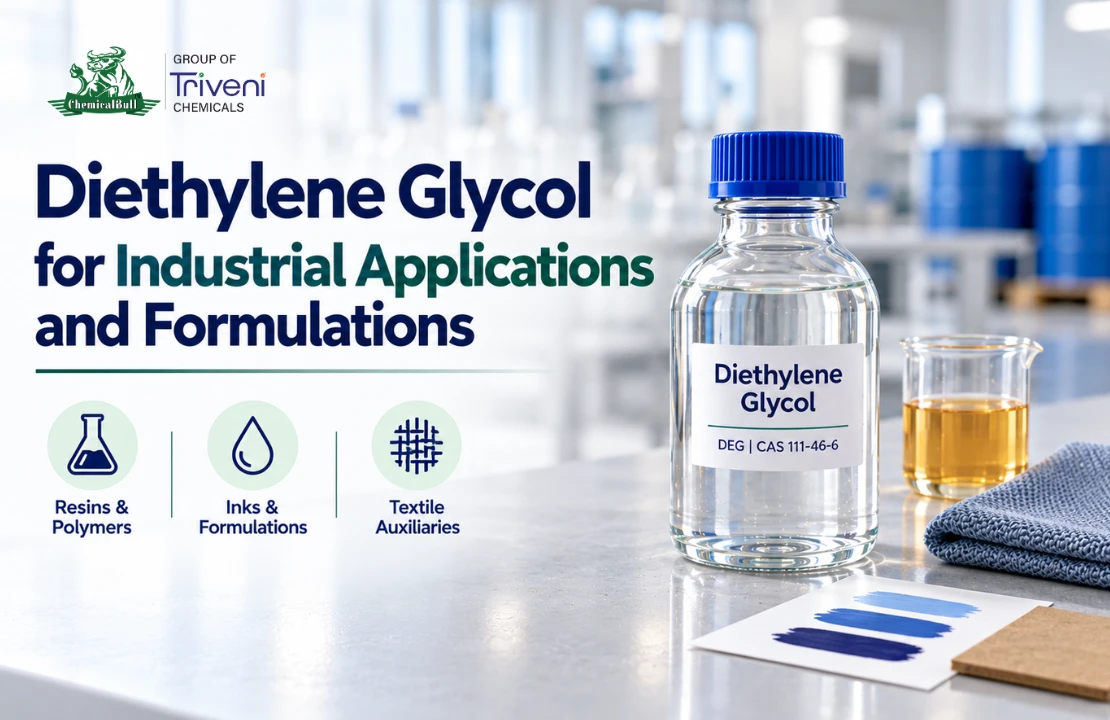
Diethylene Glycol is an industrial raw material used in resin manufacturing, printing inks, textile auxiliaries, adhesives and specialty chemical formulations. It functions as a reactive intermediate, solvent or supporting ingredient, depending on the application.
When evaluating a diethylene glycol manufacturer or supply partner, compare purity, water content, batch traceability and technical documentation against your manufacturing requirements.
Need DEG for industrial production? Contact us for specifications, availability and bulk pricing.
Understanding DEG and Its Properties
Diethylene Glycol, commonly abbreviated as DEG, is a colourless, hygroscopic liquid. It is completely miscible with water and compatible with many organic liquids. Its moisture affinity and low volatility support several industrial uses.
Another name for diethylene glycol is 2,2′-Oxydiethanol. It is also known as Bis(2-hydroxyethyl) Ether.
|
Property |
Identification or typical characteristic |
|
Chemical name |
Diethylene Glycol |
|
Common abbreviation |
DEG |
|
CAS number |
111-46-6 |
|
Molecular formula |
C₄H₁₀O₃ |
|
Molecular weight |
Approximately 106.12 g/mol |
|
Structure |
HO–CH₂–CH₂–O–CH₂–CH₂–OH |
|
Appearance |
Colourless liquid |
|
Water compatibility |
Completely miscible |
|
Normal boiling point |
Approximately 245°C at atmospheric pressure |
The diethylene glycol structure contains two terminal hydroxyl groups connected through an ether linkage. These features contribute to its chemical reactivity and formulation behaviour. Typical properties should be distinguished from the agreed specification for the supplied material.
Why It Is Selected for Industrial Formulations
The purpose of DEG depends on whether it reacts during manufacturing or remains in the finished formulation.
Its hydroxyl groups support chemical synthesis. Its low volatility provides slow evaporation, while water compatibility allows incorporation into suitable water-containing systems. Its hygroscopic nature is useful in selected applications requiring moisture retention.
These characteristics provide a starting point for selection. Compatibility and finished-product performance still require testing.
Applications Across Manufacturing Processes
Polyester Resins and Polyurethane Intermediates
Established diethylene glycol uses include unsaturated polyester resins, polyester polyols and selected polyurethane systems. In these applications, DEG contributes to the chemistry of the manufactured product rather than acting only as a solvent.
Resin manufacturers should evaluate water content, assay, acidity, colour and other glycol impurities against their approved process. Changes in the glycol component require review of reaction calculations and finished-resin properties.
Laboratory approval should be followed by a controlled production trial before adopting a new source.
Plasticizer Intermediates and Specialty Chemicals
DEG is used in the manufacture of plasticizer intermediates, emulsifiers and other chemical derivatives. The required specification depends on the reaction and intended downstream application.
Confirm whether the material will be chemically reacted or retained as an additive. This distinction helps establish qualification tests and relevant impurity limits.
Printing Inks, Dyes and Selected Coatings
Diethylene glycol industrial applications include solvent and coupling functions in suitable ink and dye systems. Selected coating formulations also use its solvency and moisture-related properties.
Evaluate viscosity, compatibility, drying behaviour and finished-film performance in the complete formulation. Slow evaporation can support working time in one system but delay drying in another.
DEG should not be confused with Diethylene Glycol Monobutyl Ether. These are different chemicals and should not be substituted without application testing.
Textile Auxiliaries and Fibre Finishes
DEG is used as a component of selected textile lubricants and fibre-finish formulations. Its suitability depends on the complete auxiliary system and processing conditions.
Textile formulators should assess application uniformity, compatibility, deposits and removal during subsequent processing. DEG is an ingredient within an auxiliary formulation, rather than a universal ready-to-use finishing product.
Adhesives, Paper and Bookbinding
Selected glues, adhesives, paper and bookbinding applications use DEG for plasticizing and moisture-related functions.
Performance checks should cover adhesion, flexibility, drying and moisture response. The required balance depends on the substrate and service conditions.
Grinding Aids and Process Formulations
DEG also has applications in selected cement- and glass-grinding aids. Its contribution should be evaluated within the complete additive system.
Compare process performance with an approved reference and confirm that the formulation meets downstream product-quality requirements.
Choosing a Suitable Specification
Chemical identity and quoted purity are only the starting point. Define the parameters that influence the intended manufacturing process.
|
Parameter |
Reason for evaluation |
|
DEG assay |
Establishes the concentration of the required component |
|
Water content |
Relevant to reaction calculations and moisture-sensitive processing |
|
Other glycol content |
May affect processing behaviour and consistency |
|
Acidity |
Important where reaction control or stability is sensitive |
|
Colour |
Relevant to colour-sensitive resins and formulations |
|
Trace impurities |
Should meet application-specific limits |
|
Test methods |
Enable meaningful comparison between batches |
Related materials such as Triethylene Glycol require separate specifications and validation. Similar names do not establish equivalent performance.
For repeat procurement, retain reference samples, agree on test methods and establish a process for reviewing material changes.
Handling and Storage
DEG requires controlled industrial handling. It is toxic when swallowed and can cause severe injury, including acute kidney injury, or death. It must not be substituted for glycerin or used as an ingredient in medicines.
Obtain the current Diethylene Glycol MSDS or SDS before use. Follow its instructions for protective equipment, ventilation, storage, incompatible materials and spill response.
Control moisture exposure during storage and transfer because DEG is hygroscopic. Maintain clear container identification and segregation from materials intended for food or pharmaceutical formulations.
Understanding Bulk Pricing
The diethylene glycol price per kg depends on specification, quantity, packaging, origin and delivery terms. Compare quotations on a consistent commercial basis.
When assessing the diethylene glycol price in India, confirm:
-
Product grade and approved specification.
-
Net quantity and packaging.
-
Dispatch and delivery locations.
-
Freight, taxes and payment terms.
-
Availability, lead time and quotation validity.
An ex-warehouse quotation and a delivered quotation represent different offers. Qualification requirements and batch consistency should also form part of the purchasing decision.
Sourcing and Supply Reliability
Procurement teams comparing diethylene glycol manufacturers in India and distributors should verify the actual manufacturing source, traceability and documentation.
Local proximity may help logistics, but a supplier’s office can differ from its dispatch location. Confirm the warehouse, delivery schedule and repeat-supply arrangements before ordering.
Request a technical data sheet, representative COA, current SDS and sample availability. Approve the specification and application performance before committing to regular procurement.
Chemical Bull supports industrial sourcing enquiries for DEG. Buyers can share their application, quantity and approved requirements to confirm suitable material and commercial terms.
Frequently Asked Questions
What is diethylene glycol used for?
DEG is used in polyester resins, polyester polyols, selected polyurethane systems, plasticizer intermediates, printing inks, textile auxiliaries, adhesives and grinding-aid formulations.
What is another name for diethylene glycol?
Common names include DEG, 2,2′-Oxydiethanol and Bis(2-hydroxyethyl) Ether. Its CAS number is 111-46-6.
Is diethylene glycol safe?
DEG requires appropriate industrial handling controls and is toxic when swallowed. Review the current SDS before storage, transfer or processing.
Can DEG replace another glycol?
Replacement requires evaluation of chemical functionality, physical properties, impurity profile and finished-product performance. Validate the change before modifying an approved formulation.
Where can I buy diethylene glycol in bulk?
Industrial buyers can source DEG through chemical producers and qualified distributors. Confirm the specification, COA, SDS, MOQ, packaging and delivery terms before approval.
Discuss Your DEG Requirement
Share your application, required specification, quantity, packaging and delivery location with Chemical Bull to request technical documents, sample availability and a current quotation.



Comment Section