Chemical Bull
1091
15-Sep-2025
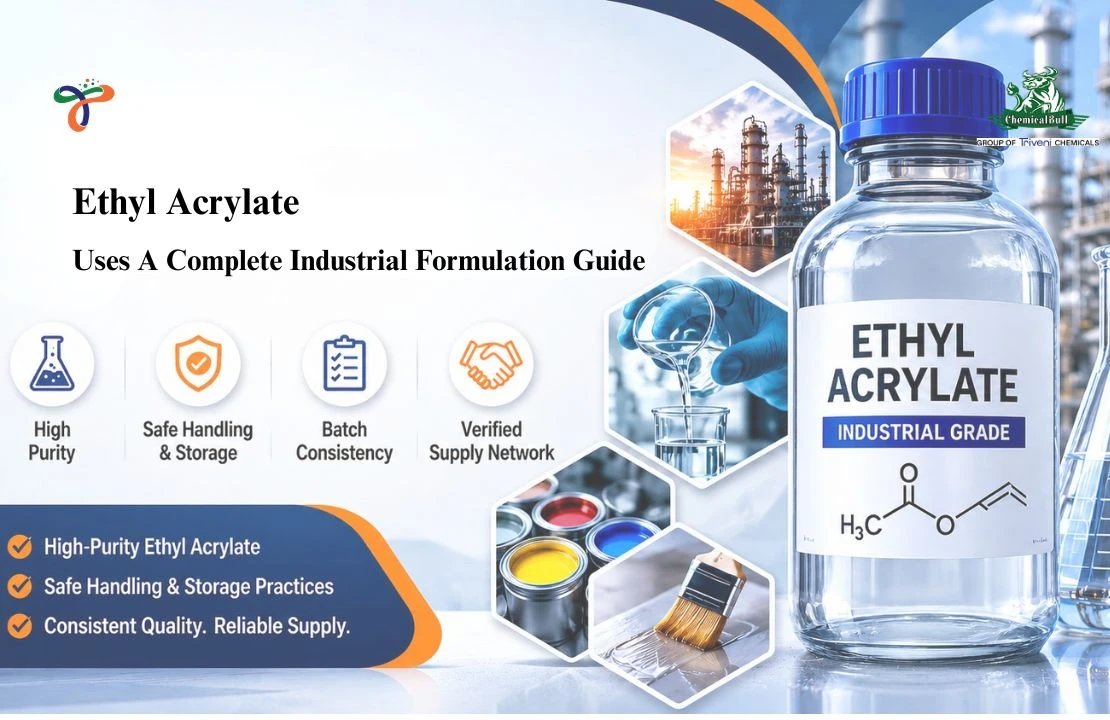
Ethyl Acrylate Uses: A Complete Industrial Formulation Guide
In the specialty chemical sector, securing high-purity raw materials is absolutely essential to ensure the success of any manufacturing process. Within the modern landscape of acrylic monomers, ethyl acrylate monomer has emerged as a highly versatile chemical intermediate.
Whether you are blending advanced polymer matrices or working on a niche formulation, having a comprehensive understanding of the technical properties and regulatory compliance of ethyl acrylate (cas no 140-88-5) is critical. In this technical guide, backed by live industrial market insights, we will look deep into the properties, applications, benefits, and global supply chain sourcing parameters of this chemical.
What is Ethyl Acrylate Used For in Modern Industry?
When examining the market demand for this volatile monomer at an industrial level, its use-cases can be broadly divided into two primary sectors. The core ethyl acrylate uses depend heavily on the dual-nature of this compound:
-
Specialty Scent & Flavor Sourcing: In its pure, concentrated form, this chemical exhibits a highly sharp and pungent ethyl acrylate smell. However, when down-diluted to parts-per-million (ppm) levels in professional compounding facilities, it transforms into a sweet, pineapple-like note. This unique property is the reason why, under strict regulatory standards, ethyl acrylate in food matrices and premium fragrance bases is widely utilized.
-
Resins and Adhesives Binding: Beyond the aroma sector, its largest volume is consumed in the production of structural cross-linking resins. To control the volatility and evaporation rates of industrial formulations, chemical blenders frequently mix it with other monomers such as Styrene, Butyl Acrylate, Methyl Methacrylate, Vinyl Acetate Monomeror core functional binders.
Industrial Applications of Ethyl Acrylate
Within the B2B procurement pipeline, formulation engineers evaluate this monomer across distinct industrial sectors. Its key industrial applications include:
Paints and Surface Coatings:
Deployed as a copolymer in architectural and industrial coatings to introduce a flexible, durable film.
Adhesives and Sealants Formulation:
Serves as a primary binding agent to enhance the shear strength and tackiness of pressure-sensitive adhesives.
Textile and Leather Finishes:
Utilized in fabric treatment processing to provide efficient cloth binding and superior dirt resistance.
Integration with Premium Fragrance & Flavour Formulations
In aroma chemistry and volatile processing labs, the controlled use of Ethyl Acrylate is applied to refine downstream matrices. If you are looking to balance your proprietary blends, you can cross-reference our verified portfolio:
-
Fine Fragrance Bases: Trace utilization of this monomer is deployed in international perfume compounding to give top-shelf profiles a distinct, fruity-sharp transition.
-
Detergent Fragrance & Soap Fragrance: Technical formulators select this intermediate derivative to enhance synthetic scent retention and stability within heavy alkaline matrices.
-
Beverage Flavours: Used to impart targeted pineapple and green apple ester profiles to niche synthetic blends under regulated global food-grade standards.
-
Essential Oils & Natural Isolates Integration: Technical blenders create sophisticated blends with natural organic fractions to accurately replicate natural aroma yields on a commercial scale.
Need a Deeper Dive into Aroma Chemistry?
To master the building blocks of professional compounding, you need to understand the full spectrum of aromatic compounds beyond just individual monomers. Learn more about the fundamentals of aroma chemicals, their types, and complex industrial applications by reading our comprehensive guide here.
Key Benefits of Ethyl Acrylate
Choosing ethyl acrylate over other standard components in formulation processing offers several distinct industrial advantages:
-
Low-Temperature Flexibility: Polymers derived from this chemical possess a very low Glass Transition Temperature (Tg approx - 43°C). Consequently, paints and rubbers formulated with it do not become brittle or crack under extreme cold conditions.
-
Superior Adhesion Strength: Its monomeric molecular structure generates a clean, powerful bonding binding force across diverse surfaces like plastics, metals, concrete, and wood.
-
Excellent UV & Weather Resistance: Acrylic acid ethyl ester-based polymer matrices deliver a clear finish that resists peeling or yellowing, even when subjected to prolonged sunlight (UV rays) exposure.
Sourcing via Certified Ethyl Acrylate Manufacturers in India
Finding a reliable ethyl acrylate supplier is the most critical step for any B2B procurement team aiming to keep their manufacturing lines running smoothly. In the high-speed industrial belts across India, supply chain velocity determines your competitive edge. Our procurement logs show an increasing demand for verified ethyl acrylate manufacturers capable of fulfilling bulk commercial orders without logistical delays.
Working directly with these ethyl acrylate manufacturers in india allows enterprises to significantly reduce lead times. Bulk procurement managers can further optimize logistics costs by shifting from standard liquid drums to high-capacity ISO tanks.
Whether your factory requires an independent ethyl acrylate wholesaler for local batch staging, or a continuous long-term contract with an international ethyl acrylate distributor—partnering with a robust, verified network ensures consistent batch uniformity and better price control.
Verifying Ethyl Acrylate CAS No 140-88-5 and Molecular Purity
For enterprise-level buyers and R&D laboratories, tracking the precise technical chemical nomenclature is crucial to eliminate batch errors during international trade and customs clearance.
The standard ethyl acrylate formula is C_5H_8O_2, registered in global chemical databases under its official alternative trade synonym, acrylic acid ethyl ester. Verifying the exact ethyl acrylate cas number (140-88-5) during sourcing ensures your final product quality remains completely stable.
Key Lab Metrics: Ethyl Acrylate Density, Solubility, and Boiling Point
For automated plant processing and safe warehouse management, technicians must monitor the following:
-
Ethyl Acrylate Density: Essential for volumetric batch automation, the exact ethyl acrylate density is approximately 0.922 g/cm³ at 20°C.
-
Ethyl Acrylate Boiling Point: The standard ethyl acrylate boiling point is 99°C. Monitoring temperature boundaries inside reaction vessels prevents unexpected vapor pressure flashing.
-
Solubility Parameters: According to ethyl acrylate solubility charts, it is fully miscible with organic solvents like alcohol and ethers, while its solubility in water remains highly limited.
Analyzing Poly Ethyl Acrylate Uses in Downstream Manufacturing
When evaluating major poly ethyl acrylate uses, product development teams leverage the polymer's exceptional elasticity and weather-proofing traits. It is widely used in the manufacturing of premium textile finishes, high-performance industrial adhesives, automotive gaskets, and UV-resistant architectural coatings.
Safe Handling & Operational Best Practices
Workplace safety takes absolute priority. Before initiating plant operations, managers must review the official ethyl acrylate sds and localized ethyl acrylate msds sheets:
-
Toxicity Concerns: Documented ethyl acrylate toxicity parameters indicate that prolonged exposure can trigger skin sensitization or a severe ethyl acrylate allergy.
-
Ventilation: Local exhaust ventilation is mandatory to prevent hazardous vapors from accumulating.
-
Storage: Keep cool (<25°C), well-ventilated, and away from ignition sources.
-
Stabilizers: Regular testing of MEHQ levels is compulsory to prevent runaway polymerization.\
Technical Specifications & Safety
|
Parameter |
Value |
Operational Focus |
|
Ethyl Acrylate CAS No |
140-88-5 |
Regulatory Tracking |
|
Purity Assay |
≥ 99.5% |
Eliminates Side Reactions |
|
Inhibitor (MEHQ) |
10 - 20 ppm |
Storage Stability |
Frequently Asked Questions
-
What is the shelf life of Ethyl Acrylate?
When stored correctly below 25°C, it has a shelf life of 6–12 months. Always monitor inhibitor levels to ensure stability. -
Why is MEHQ inhibitor used?
MEHQ acts as a "safety brake." It prevents the monomer from spontaneously hardening into a solid mass during transport or storage. -
Why source from a verified supplier?
Sourcing from a verified ethyl acrylate supplier guarantees ≥ 99.5% purity, which is essential for batch consistency and preventing production line failures.

Comment Section