Chemical Bull
558
26-Aug-2026
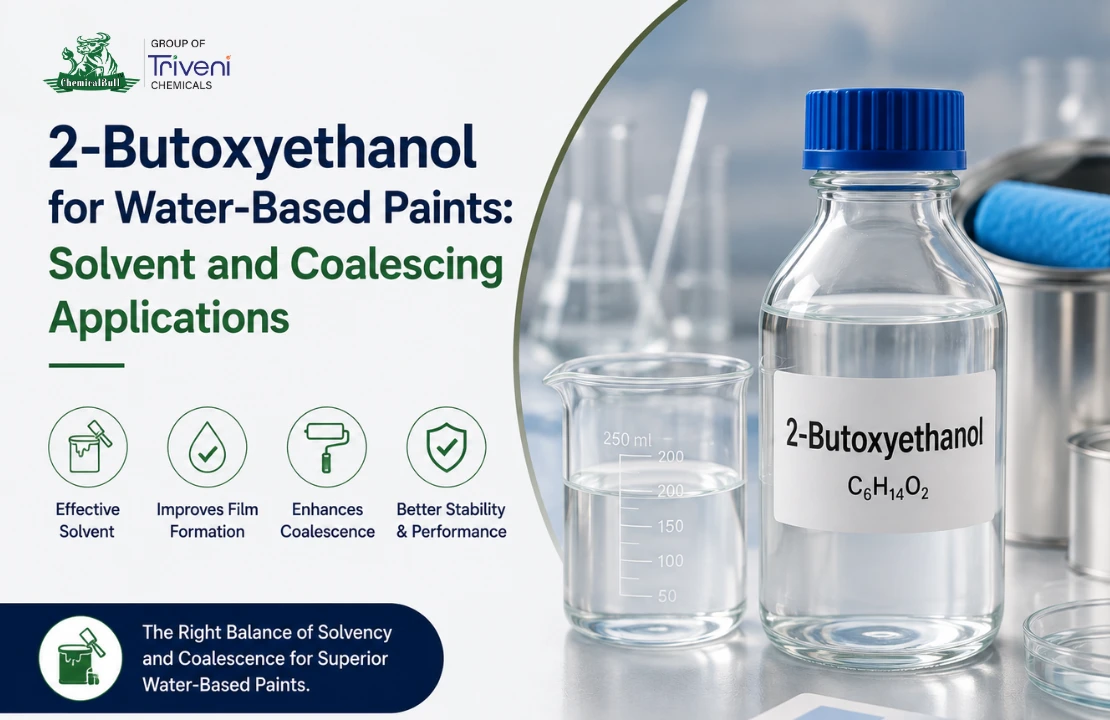
2-Butoxyethanol for Water-Based Paints: Solvent and Coalescing Applications
2-Butoxyethanol is a glycol ether solvent widely used in water-based paints and coatings because it combines water miscibility, organic solvency, slow evaporation and strong coupling efficiency. These properties help paint formulators manage resin compatibility, application flow and film formation in aqueous coating systems.
Also known as Ethylene Glycol Monobutyl Ether, Butyl Cellosolve, Butyl Glycol, Glycol Ether EB and EGBE, the chemical serves as both a solvent and coupling agent in coating formulations. Its balanced interaction with water and organic components makes it especially useful in architectural paints, industrial maintenance coatings and other waterborne systems.
Chemical Bull supports paint and coating manufacturers looking for a reliable 2-Butoxyethanol supplier for bulk requirements, and buyers can share their required quantity, application, packaging and delivery location to request current availability and commercial pricing.
For a wider view of applications outside coatings, read our guide to Ethylene Glycol Monobutyl Ether uses across industrial manufacturing.
Quick Answer: Why Is 2-Butoxyethanol Used in Water-Based Paints?
2-Butoxyethanol is used in water-based paints as a solvent, coupling agent and coalescing aid. It helps water and organic coating ingredients work together, supports resin compatibility, improves flow and levelling, slows solvent evaporation and assists the formation of a continuous paint film after application.
What Is 2-Butoxyethanol?
2-Butoxyethanol is a glycol ether solvent with the molecular formula C6H14O2 and CAS No. 111-76-2. It combines an alcohol group with an ether group, giving the molecule compatibility with both water and many organic materials.
|
Product Detail |
Information |
|
Chemical Name |
2-Butoxyethanol |
|
Other Names |
Ethylene Glycol Monobutyl Ether, Butyl Cellosolve, Butyl Glycol, Glycol Ether EB |
|
CAS Number |
111-76-2 |
|
Molecular Formula |
C6H14O2 |
|
Molecular Weight |
118.17 g/mol |
|
Boiling Point |
About 171°C |
|
Main Coating Role |
Solvent, coupling agent and coalescing aid |
The 2-Butoxyethanol structure contains both hydrophilic and hydrophobic portions. This balance explains its strong role in aqueous coating systems where water, resin and other organic ingredients must remain compatible. Its boiling point of about 171°C also contributes to its slower evaporation compared with many fast solvents.
Why 2-Butoxyethanol Is Valued in Water-Based Coatings
Water-based paints are not made from water alone. They contain binders, pigments, additives, surfactants, coalescing materials and other formulation components.
Some of these ingredients have greater affinity for water, while others have stronger affinity for organic materials. A suitable coupling solvent helps maintain compatibility throughout manufacturing, storage and application.
2-Butoxyethanol is valued in water-based coatings for:
-
Complete water miscibility
-
Strong coupling efficiency
-
Good solvent activity
-
Slow evaporation
-
Low surface tension
-
Resin compatibility
-
Improved flow and levelling
-
Film-formation support
These characteristics make it especially effective in amine-solubilized water-based coatings and latex paint systems.
2-Butoxyethanol as a Solvent for Water-Based Paints
A solvent performs several jobs inside a paint formulation. It helps dissolve or carry resin components, controls application behaviour and influences how the coating flows before the film fully forms.
2-Butoxyethanol provides good solvent activity for several coating resin types, including alkyd, epoxy, phenolic, maleic and nitrocellulose resins.
In water-based formulations, it helps:
-
Maintain resin compatibility
-
Adjust formulation viscosity
-
Improve wetting
-
Support pigment and binder interaction
-
Improve application flow
-
Reduce premature solvent loss
-
Support smooth coating formation
This balance makes 2-Butoxyethanol for water-based paints useful where formulators need more than simple dilution.
How 2-Butoxyethanol Works as a Coupling Solvent
A coupling solvent helps components with different solubility characteristics remain compatible in one formulation.
In a waterborne paint, this function is important because the formulation contains an aqueous phase alongside organic resin components and additives.
2-Butoxyethanol acts as a bridge between these phases. Its complete miscibility with water and affinity for organic materials improve formulation uniformity and reduce separation problems.
For paint manufacturers, strong coupling performance supports:
-
Stable liquid formulations
-
Better ingredient distribution
-
Consistent application behaviour
-
Improved resin incorporation
-
Reliable production batches
This is one of the main reasons Glycol Ether EB remains relevant in aqueous coatings.
Coalescing Applications in Latex and Waterborne Paints
Coalescence is the stage where dispersed polymer particles come together after paint application and form a continuous film.
2-Butoxyethanol acts as an effective coalescent in architectural and industrial maintenance latex paints. It supports film integrity as the water and other volatile components leave the coating.
Its slow evaporation keeps the formulation workable during the early stages of film formation.
A properly formulated coating gains:
-
Better film continuity
-
Improved surface appearance
-
Better flow-out
-
More uniform application
-
Stronger film integrity
The final dosage depends on the complete coating formulation, resin system, application method and required film properties.
Role of Slow Evaporation in Paint Performance
Evaporation rate directly affects paint application.
A solvent that evaporates too quickly reduces open time and causes poor flow before the coating levels. A slower solvent remains present long enough to support resin movement and film development.
The relatively high 2-Butoxyethanol boiling point, about 171°C, contributes to its slow evaporation behaviour.
In coating formulations, this supports:
-
Longer working time
-
Better levelling
-
Reduced premature drying
-
Improved flow-out
-
More consistent film formation
This property is particularly useful in architectural and industrial coatings where smooth application matters.
2-Butoxyethanol Solubility in Water and Why It Matters
2-Butoxyethanol is miscible with water, which is one of its defining advantages for water-based coatings.
Water miscibility allows the solvent to distribute efficiently through the aqueous phase instead of separating into a distinct layer.
At the same time, its organic solvent character helps interact with coating resins and other less water-compatible components.
This dual behaviour makes 2-Butoxyethanol effective as both a solvent and coupling agent.
Where Paint Manufacturers Use 2-Butoxyethanol
The product is used across several coating categories.
|
Coating Application |
Main Function of 2-Butoxyethanol |
|
Water-Based Paints |
Coupling solvent and flow support |
|
Architectural Latex Paints |
Coalescing and film-formation support |
|
Industrial Maintenance Coatings |
Solvent and coalescent |
|
Automotive Coatings |
Solvent and formulation aid |
|
Protective Coatings |
Resin solvency and application control |
|
Wood Coatings |
Solvent and flow support |
|
Industrial Finishes |
Resin compatibility and controlled evaporation |
Its coating applications also extend to automotive OEM, automotive refinish, aerospace, coil, protective and wood coating systems.
2-Butoxyethanol for Water-Based Paints in India
Paint, coating, construction chemical and industrial formulation manufacturers in India use glycol ether solvents in waterborne and solvent-containing systems.
When sourcing 2-Butoxyethanol for water-based paints in India, procurement teams should verify:
-
CAS No. 111-76-2
-
Product purity
-
Water content
-
Colour and appearance
-
Batch consistency
-
Packaging
-
COA availability
-
SDS
-
TDS
-
Monthly quantity
-
Delivery schedule
For continuous manufacturing, repeat specification and reliable availability directly support production planning.
2-Butoxyethanol for Automotive Water-Based Paints
Automotive coatings require controlled application, uniform film formation and compatibility between coating components.
2-Butoxyethanol is used across automotive OEM and automotive refinish coating applications as a glycol ether solvent.
In waterborne automotive formulations, its solvent and coupling properties support resin compatibility, application flow and controlled solvent release.
Paint manufacturers should select the final solvent package according to the resin system, coating technology, VOC requirements and target application performance.
What Paint Manufacturers Should Check Before Bulk Buying
Paint manufacturers purchasing 2-Butoxyethanol in bulk should evaluate both technical and commercial requirements.
Important factors include:
-
Product identity and CAS number
-
Required purity
-
Batch consistency
-
COA
-
2-Butoxyethanol SDS
-
TDS
-
Packaging
-
Monthly consumption
-
Storage capacity
-
Lead time
-
Delivery reliability
-
Commercial pricing
Consistent solvent quality reduces formulation adjustments and helps maintain repeat production performance.
2-Butoxyethanol Price for Bulk Buyers
2-Butoxyethanol price depends on product purity, order quantity, packaging, current market conditions, freight and delivery location.
Paint and coating manufacturers requesting a commercial quotation should provide:
-
Required quantity
-
Monthly consumption
-
Paint or coating application
-
Packaging preference
-
Delivery location
-
Required documentation
For regular production, buyers should evaluate landed cost and supply reliability together rather than comparing only the basic product rate.
Safety, SDS and Industrial Handling
2-Butoxyethanol requires controlled workplace handling. Exposure occurs through inhalation and skin contact, so workers should follow the current 2-Butoxyethanol SDS and applicable occupational exposure controls.
Industrial handling requires:
-
Suitable gloves
-
Eye protection
-
Protective clothing
-
Adequate ventilation
-
Closed and labelled containers
-
Proper storage
-
Spill-response procedures
-
Trained handling personnel
The latest supplier SDS should guide handling, storage, first aid and emergency procedures.
What Are the Alternatives to 2-Butoxyethanol?
Coating formulators also work with other glycol ethers and specialty coalescents when formulation requirements call for different evaporation rates, VOC profiles, odour characteristics or film-performance targets.
The correct 2-Butoxyethanol alternative depends on:
-
Resin type
-
Waterborne coating system
-
Required evaporation rate
-
VOC target
-
Coalescing requirement
-
Odour requirement
-
Application temperature
-
Final film performance
Alternative selection requires formulation testing because replacing one solvent directly with another changes solvency, evaporation and film-formation behaviour.
Frequently Asked Questions
-
What is 2-Butoxyethanol used for?
2-Butoxyethanol is used as a solvent, coupling agent and coalescing aid in water-based paints, architectural coatings, industrial maintenance coatings and other coating systems. It is also used in inks and cleaning formulations. -
What are the other names for 2-Butoxyethanol?
2-Butoxyethanol is also known as Ethylene Glycol Monobutyl Ether, Butyl Cellosolve, Butyl Glycol, Glycol Ether EB and EGBE. -
What is the CAS number of 2-Butoxyethanol?
The 2-Butoxyethanol CAS number is 111-76-2. Its molecular formula is C6H14O2. -
Is 2-Butoxyethanol soluble in water?
Yes. 2-Butoxyethanol is miscible with water, which supports its use as a coupling solvent in aqueous paint and coating formulations. -
What is the boiling point of 2-Butoxyethanol?
The boiling point is approximately 171°C. Its relatively slow evaporation supports flow, levelling and film formation in coating applications. -
Is 2-Butoxyethanol safe?
2-Butoxyethanol requires controlled industrial handling and appropriate exposure protection. Users should follow the current SDS, use suitable PPE and maintain proper workplace ventilation. -
What affects 2-Butoxyethanol price?
Price depends on purity, order volume, packaging, market conditions, freight and delivery location. -
What documents should paint manufacturers request?
Bulk buyers should request the applicable COA, SDS, TDS, product specification and packaging details before approving 2-Butoxyethanol for regular production.
Conclusion
2-Butoxyethanol plays an important role in modern water-based paints because it combines solvent activity, complete water miscibility, coupling efficiency, slow evaporation and coalescing performance. These characteristics support resin compatibility, paint flow, levelling and continuous film formation in architectural, industrial maintenance, automotive and other coating systems.
For paint manufacturers, the right purchasing decision depends on product purity, batch consistency, documentation, packaging, commercial price and reliable supply rather than price alone. Chemical Bull supports bulk 2-Butoxyethanol requirements for paint and coating manufacturers, and buyers can share their required quantity, application, packaging and delivery location to receive availability details and commercial pricing.

Comment Section