Chemical Bull
361
26-Aug-2026
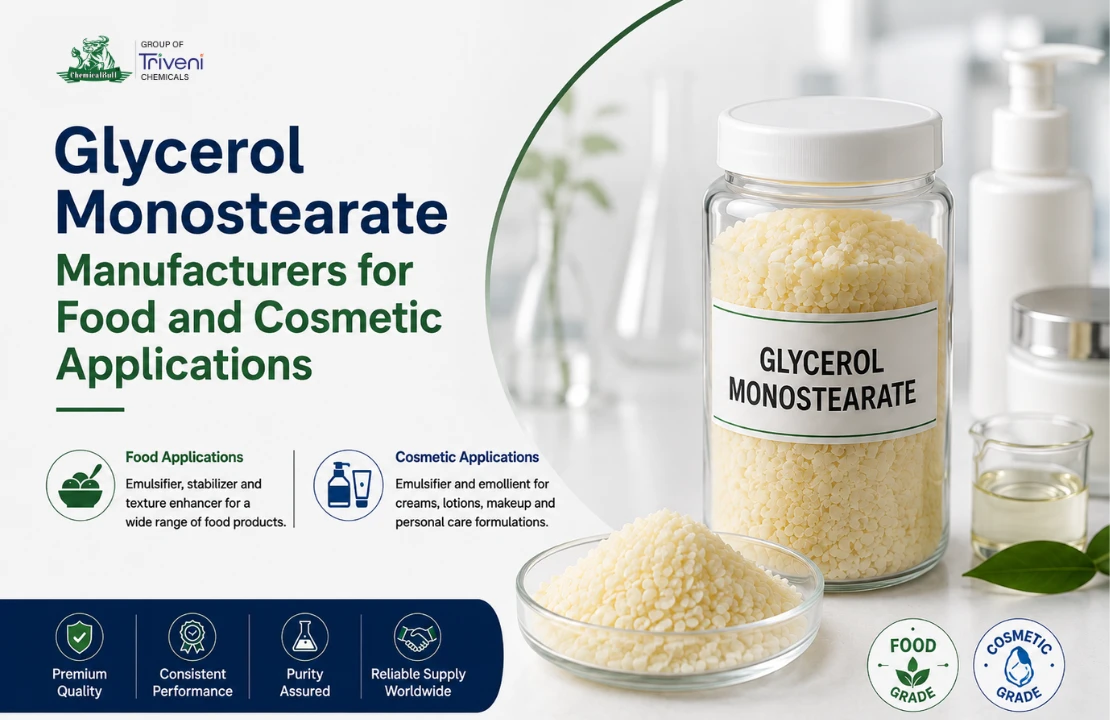
Glycerol Monostearate Manufacturers for Food and Cosmetic
Glycerol Monostearate Manufacturers supply GMS for applications across food, cosmetics, personal care, pharmaceuticals, and other formulated products. Also known as Glyceryl Monostearate (GMS), it is a versatile fatty-acid glyceride commonly used as an emulsifier, stabilizer, texture modifier, and consistency agent.
For manufacturers and formulators sourcing GMS in commercial quantities, ChemicalBull provides product information and sourcing support based on application, grade, specification, and quantity requirements. Request a quote for Glycerol Monostearate when you need commercial supply or technical documentation.
Quick Answer: What Is Glycerol Monostearate?
Glycerol Monostearate (GMS) is a glycerol ester of stearic acid used mainly as an emulsifier, stabilizer, and texture modifier. It is widely used in food and cosmetic formulations, including bakery products, ice cream, creams, lotions, and personal care products.
The commonly referenced CAS Number is 31566-31-1, although commercial GMS products can differ in composition and grade.
What Is Glycerol Monostearate?
Glycerol Monostearate is an ester derived from glycerol and stearic acid. Commercial GMS can contain mono- and diglycerides of fatty acids, depending on the manufacturing process and product specification.
It is generally supplied as a white to off-white waxy solid, flakes, beads, or powder, depending on the grade.
Glycerol Monostearate Chemical Information
|
Property |
Typical Information |
|
Common Name |
Glycerol Monostearate / Glyceryl Monostearate |
|
Abbreviation |
GMS |
|
CAS Number |
31566-31-1 |
|
Molecular Formula |
C₂₁H₄₂O₄ |
|
Molecular Weight |
Approx. 358.56 g/mol |
|
Physical Form |
Waxy solid, flakes, beads or powder |
|
Main Function |
Emulsifier, stabilizer, texture modifier |
|
Major Industries |
Food, cosmetics, personal care, pharmaceuticals |
How Does Glycerol Monostearate Work?
GMS has both hydrophilic and lipophilic characteristics, allowing it to interact with oil and water phases in formulated systems.
This makes it useful where manufacturers need to improve:
- Emulsion stability
- Texture
- Consistency
- Dispersion
- Product structure
- Processing characteristics
Its performance depends on the formulation rather than simply the presence of GMS. Factors such as temperature, concentration, other emulsifiers, oil composition, and processing conditions can influence the final result.
Glycerol Monostearate in Food Applications
Glycerol Monostearate is widely used in food formulations where emulsification, texture, and product stability are important.
Common applications include:
Bakery Products
GMS can be used in bread, cakes, pastries, and other bakery formulations to support texture and product structure. In some formulations, emulsifiers such as GMS can also contribute to maintaining desirable freshness and crumb characteristics.
Ice Cream and Frozen Desserts
GMS can help with emulsification and contribute to the texture and stability of ice cream and frozen dessert systems.
Margarine and Shortenings
In fat-based formulations, GMS can assist with emulsification and help achieve the desired consistency.
Whipping Cream
GMS may be used with other formulation ingredients to support the structure and stability of whipped products.
Confectionery
It can be incorporated into selected confectionery formulations where emulsification and texture control are required.
Other Food Applications
Depending on the grade and applicable regulations, GMS may also be used in:
- Coffee whiteners
- Dairy-based products
- Peanut butter
- Spreads
- Edible fat systems
- Processed food formulations
The permitted use and dosage should always be determined according to the specific food grade, formulation, and applicable regulations.
Glycerol Monostearate in Cosmetic Applications
GMS is also widely used in cosmetic and personal care formulations, particularly in products containing oil and water phases.
Common applications include:
|
Cosmetic Application |
Typical Role of GMS |
|
Face creams |
Emulsification and consistency |
|
Body lotions |
Texture and emulsion support |
|
Moisturizers |
Consistency and formulation structure |
|
Hair conditioners |
Emulsion and texture support |
|
Cream formulations |
Stabilization and consistency |
|
Makeup products |
Texture and formulation support |
|
Personal care emulsions |
Emulsification and structure |
GMS can provide a smooth, structured feel in suitable cosmetic formulations. However, its performance depends on the complete formulation and the other emulsifiers, oils, surfactants, and stabilizers used.
Glycerol Monostearate Grades
Commercial GMS is available in different grades and concentrations. Commonly encountered designations include GMS 40, GMS 60, and GMS 90.
These designations generally relate to the concentration of monoglycerides, but buyers should not assume that grade numbers have identical specifications between suppliers.
|
Grade |
General Description |
Typical Consideration |
|
GMS 40 |
Lower monoglyceride concentration |
Selected food and industrial applications |
|
GMS 60 |
Intermediate concentration |
Food and formulated products |
|
GMS 90 |
Higher monoglyceride concentration |
Applications requiring higher purity |
|
Distilled GMS |
Higher-purity distilled monoglyceride material |
Food, cosmetic and specialty formulations |
GMS 40 vs GMS 60 vs GMS 90
The main difference between these commercial grades is generally the monoglyceride content and associated product characteristics.
|
Parameter |
GMS 40 |
GMS 60 |
GMS 90 |
|
Monoglyceride level |
Lower |
Medium |
Higher |
|
Purity requirement |
Application dependent |
Application dependent |
Generally higher |
|
Typical use |
Selected food/formulation applications |
Food and industrial formulations |
Food, cosmetic and specialty applications |
|
Selection basis |
Cost and formulation requirements |
Balance of performance and specification |
Higher monoglyceride requirement |
Why Is Glycerol Monostearate Used in Food and Cosmetics?
GMS is valued because one ingredient can contribute to several formulation properties.
Emulsification
It can help improve the interaction and distribution of oil and water phases.
Texture Modification
GMS can influence the texture and consistency of food and cosmetic products.
Stabilization
It can support physical stability in suitable formulations.
Consistency
In creams, lotions, bakery products, and other formulated systems, GMS can contribute to a consistent product structure.
Processing Support
Depending on the formulation, GMS may also influence processing and handling characteristics.
Factors That Affect GMS Performance
Simply adding GMS does not guarantee formulation stability. Its performance can be influenced by:
- GMS concentration
- Processing temperature
- Oil phase composition
- Water phase composition
- pH
- Other emulsifiers
- Surfactants
- Stabilizers
- Mixing conditions
- Storage temperature
This is particularly important when changing from one GMS supplier or grade to another.
Expert Insight: GMS Formulation Stability
Formulator's Note
A useful practical point when evaluating GMS is to compare the new material against the existing grade under the same processing conditions before changing the production formula.
Two products sold under a similar GMS grade name can behave differently because of variations in mono-/diglyceride composition, free glycerol, free fatty acids, moisture, melting characteristics, or processing history.
For commercial formulation trials, evaluate the material for:
- Emulsion stability
- Melting behavior
- Dispersion
- Final viscosity
- Texture
- Storage stability
This simple side-by-side evaluation can identify compatibility issues before a full production changeover.
Glycerol Monostearate Manufacturers and Suppliers in India
India has a significant oleochemical and specialty ingredient industry supplying raw materials to food, cosmetic, pharmaceutical, and industrial manufacturers.
When evaluating Glycerol Monostearate manufacturers in India, commercial buyers should consider:
- Manufacturing capability
- Product grade
- Quality specifications
- Production capacity
- Packaging options
- Batch consistency
- Documentation
- Domestic and export supply capability
ChemicalBull supports commercial sourcing enquiries for Glycerol Monostearate based on grade, application, quantity, packaging, and destination requirements.
For related chemical and specialty ingredient sourcing, you can also explore ChemicalBull's relevant product categories and individual product pages.
Food-Grade vs Cosmetic-Grade Glycerol Monostearate
Food and cosmetic applications can have different specification and documentation requirements.
|
Consideration |
Food Application |
Cosmetic Application |
|
Primary purpose |
Emulsification, texture, stability |
Emulsification, texture, consistency |
|
Product selection |
Food-use suitability |
Cosmetic-use suitability |
|
Documentation |
Food-related specifications |
Cosmetic/raw-material specifications |
|
Formulation focus |
Taste, texture, stability |
Sensory properties, texture, stability |
|
Regulatory requirements |
Applicable food regulations |
Applicable cosmetic regulations |
A GMS product should not automatically be considered suitable for both applications simply because the chemical name is the same.
Common Applications of Glycerol Monostearate
GMS can be found across several industries:
|
Industry |
Examples of Applications |
|
Food |
Bakery, ice cream, confectionery, margarine |
|
Cosmetics |
Creams, lotions, moisturizers |
|
Personal Care |
Hair and skin care formulations |
|
Pharmaceutical |
Selected excipient and formulation applications |
|
Industrial |
Emulsification and specialty formulations |
Frequently Asked Questions About Glycerol Monostearate
-
What is Glycerol Monostearate?
Glycerol Monostearate, commonly abbreviated as GMS, is a glycerol ester of stearic acid used primarily as an emulsifier, stabilizer, and texture modifier. -
What is the CAS number of Glycerol Monostearate?
The commonly referenced CAS number for Glycerol Monostearate is 31566-31-1. -
Is Glycerol Monostearate used in food?
Yes. Suitable food-grade GMS is used in applications such as bakery products, ice cream, confectionery, margarine, whipped products, and other formulated foods, subject to applicable regulations. -
Is Glycerol Monostearate used in cosmetics?
Yes. GMS is used in creams, lotions, moisturizers, conditioners, makeup, and other cosmetic formulations where emulsification and texture are required. -
What is the difference between GMS 40 and GMS 90?
The grades generally differ in monoglyceride concentration. GMS 90 generally has a higher monoglyceride content than GMS 40, but buyers should verify the manufacturer's specification before purchasing. -
How should GMS be selected for food applications?
Consider the required grade, monoglyceride content, food-use suitability, technical specification, documentation, formulation requirements, and applicable regulations. -
How should I choose Glycerol Monostearate manufacturers in India?
Compare manufacturers based on specification consistency, application grade, quality documentation, production capability, packaging, commercial quantity, and supply reliability.
Conclusion
Glycerol Monostearate is an important functional ingredient used in food, cosmetics, personal care, and other formulated products. Its primary roles include emulsification, stabilization, texture modification, and consistency control.
For food manufacturers, GMS can be relevant to bakery products, ice cream, confectionery, margarine, whipping products, and other food systems. Cosmetic manufacturers commonly use it in creams, lotions, moisturizers, conditioners, and emulsion-based formulations.
When sourcing GMS from India, buyers should evaluate grade, monoglyceride content, technical specifications, documentation, application suitability, and batch consistency rather than comparing suppliers on price alone.
Businesses looking for reliable Glycerol Monostearate Manufacturers can contact ChemicalBull with their required grade, quantity, application, and specification for commercial sourcing support.





Comment Section



