Chemical Bull
14
24-Oct-2026
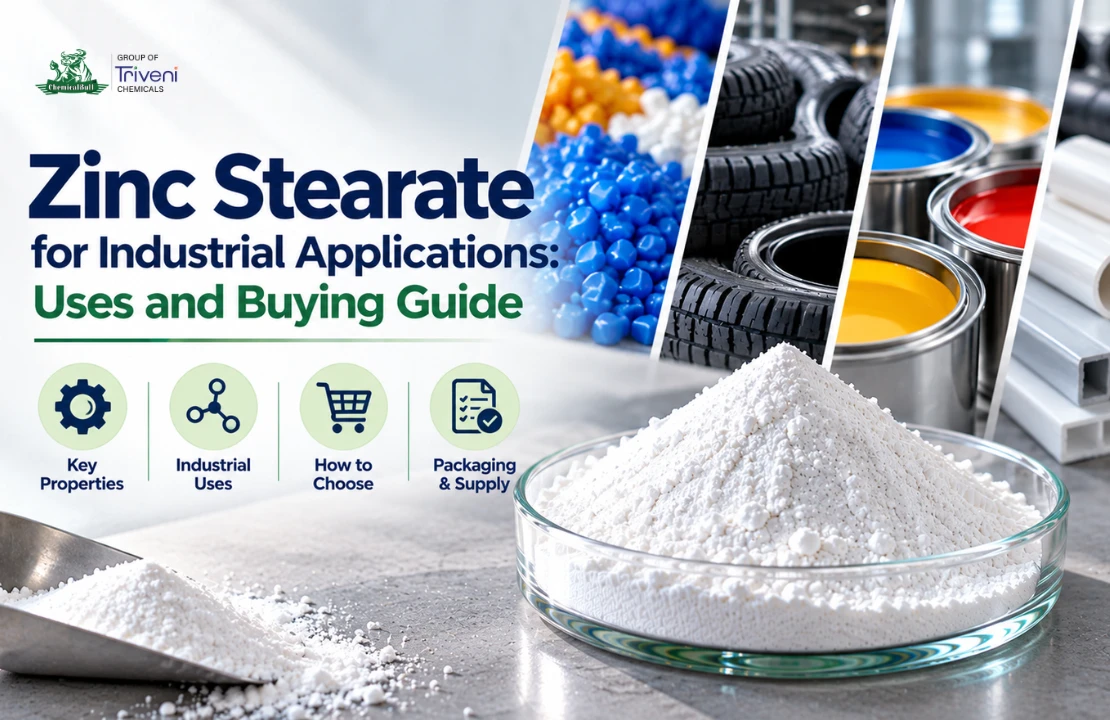
Zinc Stearate for Industrial Applications: Uses and Buying Guide
Zinc stearate is a metallic stearate widely used in industrial manufacturing as a lubricant, mould-release agent, processing aid, and surface-modifying additive. Its applications include plastics, rubber, paints and coatings, masterbatches, and selected powder metallurgy and construction formulations. The performance of zinc stearate depends on its grade, physical characteristics, formulation, and processing conditions.
For industrial sourcing, explore Zinc Stearate from ChemicalBull to discuss your application, required specifications, and bulk supply requirements.
Quick Answer: What Is Zinc Stearate Used For?
Zinc stearate is primarily used to reduce friction, improve mould release, limit sticking, and assist processing in suitable industrial formulations. In plastics and rubber, it can support manufacturing efficiency; in paints and coatings, it can influence surface finish and sanding properties. It is also used in selected masterbatch, powder metallurgy, and moisture-resistant formulations. The appropriate grade and dosage depend on the intended application and must be established through technical evaluation.
What Is Zinc Stearate?
Zinc stearate is a zinc salt of stearic acid, belonging to the family of metal stearates commonly used as functional additives. It is generally supplied as a white or off-white powder and is valued for its lubricating behaviour, hydrophobic character, and ability to reduce adhesion between surfaces.
In industrial processing, zinc stearate is used to support specific manufacturing requirements rather than to perform the same function in every formulation. Depending on the application, it can help reduce friction, improve release from mould surfaces, support powder handling, or modify the surface characteristics of finished materials.
Its performance depends on factors such as particle size, moisture content, fatty-acid composition, zinc content, dispersion, and compatibility with other ingredients.
Zinc Stearate: Chemical Properties
|
Property |
Information |
|
Chemical name |
Zinc stearate |
|
CAS number |
557-05-1 |
|
Molecular formula |
C₃₆H₇₀O₄Zn |
|
Molecular weight |
Approximately 632.33 g/mol |
|
Appearance |
Generally white to off-white powder |
|
Water solubility |
Insoluble in water |
|
Main functional properties |
Lubrication, mould release, hydrophobicity |
|
Common industrial sectors |
Plastics, rubber, coatings, masterbatches, and selected powder-processing applications |
These are general reference details. Actual commercial specifications should be checked against the technical data sheet (TDS) and certificate of analysis (CoA) for the grade being purchased.
Major Industrial Applications of Zinc Stearate
1. Zinc Stearate in the Plastics Industry
The plastics industry uses zinc stearate as a lubricant, mould-release agent, and processing additive in compatible polymer systems. During compounding, extrusion, or moulding, it can influence friction between materials and processing surfaces.
Common areas of application include:
-
PVC compounds: Used in selected formulations as part of the lubrication and processing system.
-
Polyethylene and polypropylene: May support processing and mould release, depending on the polymer grade and formulation.
-
Plastic moulding: Can help reduce sticking and facilitate the release of moulded components.
-
Colour masterbatches: May assist processing and powder dispersion when compatible with the carrier resin and pigment system.
-
Specialty plastic compounds: Can be evaluated where controlled lubrication or surface modification is required.
Zinc stearate should not automatically be described as a universal PVC heat stabilizer. Its role depends on the formulation, and it is not a direct substitute for every stabilizer or lubricant used in polymer processing.
Excessive or incompatible addition can cause surface deposits, plate-out, reduced adhesion, or other processing defects. The appropriate grade and concentration should be established through trials.
2. Zinc Stearate in Rubber Manufacturing
In rubber manufacturing, zinc stearate can serve as a processing lubricant, anti-tack additive, dusting agent, or mould-release agent in suitable applications.
Its potential uses include:
-
Rubber moulding and demoulding.
-
Reducing unwanted adhesion between rubber surfaces.
-
Supporting the handling of selected rubber compounds.
-
Facilitating release from mould surfaces during production.
The effectiveness of zinc stearate depends on the elastomer, compounding ingredients, cure system, and application method. Internal use within a rubber compound and external use as a release agent are different applications and may require different grades or procedures.
Zinc stearate should also not be confused with zinc oxide, which has a distinct and important role in many rubber vulcanization systems.
3. Zinc Stearate in Paints and Coatings
Zinc stearate is used in selected paint, lacquer, coating, and related formulations to influence surface finish, sanding performance, and moisture-related characteristics.
Depending on the formulation, it may:
-
Support sanding properties in suitable primer systems.
-
Help achieve a flatter or more matte surface finish.
-
Influence surface texture and slip.
-
Contribute to water repellency in compatible coatings.
-
Affect the dispersion and distribution of selected formulation ingredients.
Its performance depends on the coating binder, solvent system, particle characteristics, and other additives. Compatibility testing is essential because unsuitable concentrations may affect adhesion, appearance, or coating uniformity.
Zinc stearate should not automatically be classified as a primary pigment dispersant or universal viscosity modifier; those functions depend on the formulation and the intended role of the additive.
4. Zinc Stearate in Masterbatches and Pigment Processing
Masterbatches contain concentrated pigments or functional additives dispersed in a polymer carrier. During production, manufacturers need consistent dispersion, suitable flow behaviour, and controlled interaction between the additive and the carrier material.
Zinc stearate may be incorporated into selected masterbatch formulations as a processing lubricant or additive that supports powder handling and dispersion.
Before selecting a grade, manufacturers should consider:
-
Compatibility with the carrier polymer.
-
Pigment and filler characteristics.
-
Extrusion temperature and processing conditions.
-
Dispersion requirements.
-
Final surface quality and mechanical performance.
The goal is to improve processing without compromising the final polymer's properties or creating surface defects during subsequent conversion.
5. Zinc Stearate in Powder Metallurgy
Powder metallurgy involves compacting metal powders into a desired shape before subsequent processing, such as sintering. In selected systems, zinc stearate can be used as a lubricant to influence friction during compaction and ejection.
Its suitability depends on the metal powder, compaction pressure, die design, lubricant addition method, and downstream thermal process.
Buyers and manufacturers should evaluate the effects on compact strength, ejection behaviour, residue formation, and the quality of the finished component. A grade suitable for polymer processing should not automatically be assumed suitable for powder metallurgy.
6. Zinc Stearate in Construction Materials
Zinc stearate may be considered in selected construction-related formulations where hydrophobicity or surface modification is required.
Potential applications include certain cementitious products, mortar formulations, and surface-treatment systems. Its suitability depends on the binder, water demand, dispersion method, and required mechanical and moisture-resistance properties.
Testing is necessary to determine whether the additive improves the intended performance without adversely affecting setting behaviour, strength development, adhesion, or other critical properties.
Key Industrial Benefits of Zinc Stearate
The benefits of zinc stearate arise from its physical and interfacial properties. Not every benefit will occur in every formulation.
|
Functional property |
Potential industrial benefit |
What to verify |
|
Lubricating behaviour |
Can reduce friction during processing |
Polymer, compound, or powder compatibility |
|
Mould-release performance |
Can help reduce sticking to mould surfaces |
Release quality and surface finish |
|
Hydrophobic character |
May support moisture-resistant formulations |
Water absorption and finished-product performance |
|
Surface modification |
Can influence texture, sanding, or matting |
Coating appearance and adhesion |
|
Processing assistance |
May improve handling in selected systems |
Dispersion, deposits, and process consistency |
Selecting zinc stearate should be based on the actual manufacturing requirement rather than assuming that every grade provides all these benefits.
Zinc Stearate vs. Calcium Stearate and Magnesium Stearate
Zinc stearate, calcium stearate, and magnesium stearate are related metallic stearates, but they are not interchangeable in every formulation.
|
Comparison factor |
Zinc stearate |
Calcium stearate |
Magnesium stearate |
|
Material type |
Zinc salt of stearic acid |
Calcium salt of stearic acid |
Magnesium salt of stearic acid |
|
Common functional roles |
Lubrication and mould release |
Lubrication and processing assistance |
Lubrication and anti-adherent functions in selected systems |
|
Industrial applications |
Plastics, rubber, coatings, and other selected processes |
Plastics, rubber, and selected construction formulations |
Selected polymer and powder-processing applications |
|
Selection priority |
Release performance and formulation compatibility |
Compatibility and processing requirements |
Application-specific performance and grade requirements |
Zinc Stearate Buying Guide: What Should Industrial Buyers Check?
Choosing a suitable zinc stearate grade involves more than comparing the price per kilogram. The buyer should match the offered material to the technical requirements of the intended process.
1. Define the Application and Required Grade
Specify whether zinc stearate is intended for plastics, rubber, coatings, masterbatches, powder metallurgy, construction materials, or another application.
The intended use helps determine the relevant performance characteristics, purity requirements, and documentation.
2. Check Chemical Composition and Assay
Review the agreed specifications for zinc content, fatty-acid composition, moisture, free fatty acid, and other relevant parameters.
Do not assume that every product labelled zinc stearate has an identical composition or meets the same assay limits. Confirm the test method and acceptance criteria where they are important to your process.
3. Evaluate Particle Size and Powder Characteristics
Particle size distribution may influence dispersion, surface appearance, dust generation, and handling.
A finer grade may be beneficial in some applications, but finer particles are not automatically better for every process. Consider the mixing equipment, dispersion method, target surface quality, and dust-control requirements.
4. Review Moisture Content
Moisture can influence powder handling and may cause processing problems in moisture-sensitive formulations.
Ask for the moisture specification where relevant and compare the reported result with your purchasing requirements. Store the product under the supplier's recommended conditions to help maintain consistent quality.
5. Match the Product to Its Regulatory Requirements
Industrial, cosmetic, pharmaceutical, and food-contact applications can have different requirements.
If the material is intended for a regulated application, request evidence that the specific grade meets the applicable requirements. Do not assume that an industrial grade is suitable for pharmaceutical, food-contact, or cosmetic use simply because it has the same chemical name.
6. Compare the TDS and Certificate of Analysis
A technical data sheet describes the product's specified or typical characteristics, while a certificate of analysis reports test results for a particular batch.
Check the following before approval:
-
Product name and grade.
-
Batch or lot identification.
-
Required specification limits.
-
Reported test results and units.
-
Relevant test methods, where supplied.
-
Document date and traceability.
A product can meet one headline purity requirement while failing another parameter that matters to the manufacturing process. Compare all mandatory specifications before approving the material.
7. Confirm Packaging and Supply Requirements
Before placing an order, confirm the required quantity, packaging, destination, lead time, and available documentation.
For a new supplier or application, a sample or additional technical evaluation may be appropriate if available. Record the agreed specification and commercial conditions clearly so that the supplied material can be checked against the original requirement.
Expert Insight: Best Practices for Zinc Stearate Stability and Processing
Zinc stearate is hydrophobic, and its performance depends partly on how well it is incorporated into the formulation. Poor dispersion, unsuitable addition levels, or incompatible ingredients can reduce its effectiveness even when the supplied material meets its specification.
For more consistent processing:
-
Keep the product in properly sealed packaging when not in use.
-
Store it in a cool, dry area according to the supplier's handling instructions.
-
Prevent contamination during weighing, transfer, and blending.
-
Establish the addition sequence and mixing conditions through application-specific trials.
-
Monitor surface deposits, plate-out, mould release, coating adhesion, and other relevant process indicators.
-
Evaluate the finished product, not only the ease of processing, before approving a formulation change.
Zinc Stearate Safety, Storage, and Handling
Zinc stearate should be handled according to the safety data sheet for the specific grade supplied and the workplace risk assessment.
General precautions include:
-
Minimize airborne dust during handling and transfer.
-
Use appropriate ventilation and dust-control measures.
-
Wear protective equipment specified by the applicable safety documentation.
-
Avoid unnecessary eye and skin contact.
-
Keep containers properly closed and labelled.
-
Follow the supplier's recommendations for storage, spill management, and disposal.
Safety classifications and handling requirements can vary by product and jurisdiction. Do not assume that every grade is universally non-toxic or free from relevant hazards.
Frequently Asked Questions About Zinc Stearate
1. What is zinc stearate mainly used for?
Zinc stearate is mainly used as a lubricant, mould-release agent, and processing additive in suitable plastics and rubber formulations. It also has applications in selected coatings, masterbatches, powder metallurgy, and other industrial processes.
2. What is the CAS number of zinc stearate?
The commonly listed CAS number for zinc stearate is 557-05-1. Buyers should verify the chemical identity and specification against the documentation supplied for the particular grade.
3. Is zinc stearate soluble in water?
No. Zinc stearate is insoluble in water. Its hydrophobic character contributes to its use in selected lubrication, release, and moisture-resistant applications.
4. Why is zinc stearate used in plastics?
Zinc stearate can help reduce friction, support mould release, and assist processing in compatible polymer systems. Its effectiveness depends on the resin, grade, concentration, and processing conditions.
5. Is zinc stearate used in rubber manufacturing?
Yes. It can serve as a processing lubricant, anti-tack additive, or mould-release agent in selected rubber applications. The appropriate grade and application method depend on the rubber compound and manufacturing process.
6. What is the difference between zinc stearate and calcium stearate?
Both are metallic stearates, but their chemical composition and performance differ. They may serve similar functional roles in selected formulations, but substitution requires compatibility and performance testing.
7. What specifications should buyers check before purchasing zinc stearate?
Buyers should review the application, grade, chemical composition, zinc content, moisture, particle size where relevant, packaging, and available technical documentation. The final specification should reflect the intended process.
8. How should zinc stearate be stored?
Store zinc stearate in properly sealed packaging in a cool, dry area, following the supplier's storage instructions. Protect the material from moisture, contamination, and unsuitable storage conditions.
9. How can industrial buyers evaluate a zinc stearate supplier?
Review the offered grade, available technical documents, batch-specific specifications, packaging, delivery arrangements, and the supplier's ability to address your application requirements. Confirm that the material meets the agreed specification before commercial approval.
10. Is zinc stearate suitable for every industrial application?
No. Its suitability depends on the grade, formulation, processing conditions, and required performance. Application-specific evaluation is necessary before adopting the material in a new or critical manufacturing process.
Zinc Stearate for Industrial Applications: Final Considerations
Zinc stearate is a versatile functional additive used in plastics, rubber, coatings, masterbatches, and selected powder-processing and construction applications. Its value lies in its ability to support lubrication, release, and other formulation-dependent functions.
For industrial buyers, selecting the correct grade requires attention to composition, particle characteristics, moisture, compatibility, documentation, and the intended manufacturing process. A technically suitable grade can help achieve more consistent processing, while an unsuitable grade or addition level may create quality problems.
For sourcing enquiries, visit the ChemicalBull to discuss your application, required specifications, and bulk supply requirements.



Comment Section