Chemical Bull
13
29-Aug-2026
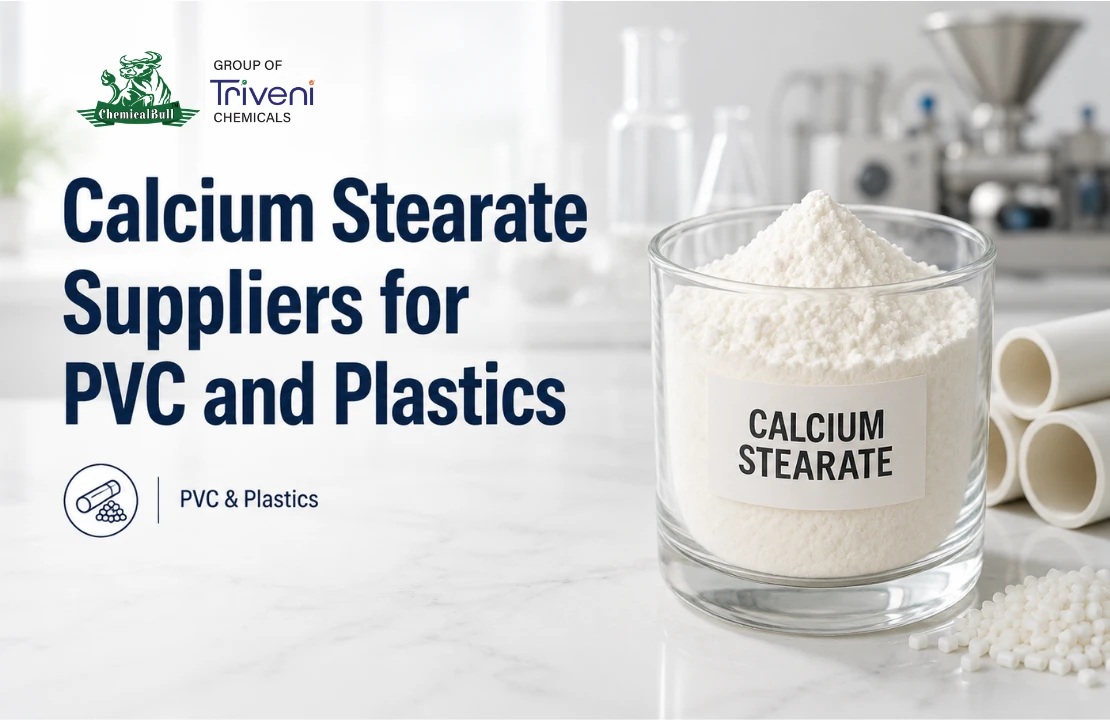
Calcium Stearate Suppliers for PVC and Plastics
PVC pipe, profile, and plastic compound manufacturers across India depend on a steady, quality-consistent supply of Calcium Stearate to keep production lines running without interruption. While the additive's technical role as a lubricant and processing aid is well documented, the supplier relationship behind it- grade consistency, documentation practices, and logistics reliability- is often what actually determines whether a production run goes smoothly.
For processors sourcing at scale, partnering with an established calcium stearate manufacturer means fewer surprises on the shop floor and more predictable batch-to-batch performance across extrusion, calendering, and molding operations.
Grade Selection Guidance for Different PVC and Plastic Applications
Not every Calcium Stearate grade performs the same way across different processing methods, which is why grade selection deserves attention before finalizing a supplier. Rigid PVC applications, such as pipe and profile extrusion, typically call for a finer, more consistent particle size to support even dispersion and predictable lubrication behavior throughout the extrusion process. Flexible PVC and molded plastic parts, on the other hand, may tolerate a slightly different particle profile, since the processing dynamics and equipment involved differ from continuous extrusion lines.
Masterbatch and compounding operations often have their own grade preferences as well, since the additive needs to disperse evenly within a carrier resin before being let down into the final compound. Buyers working across multiple product lines, such as a manufacturer producing both rigid pipe and flexible cable compounds, may need to source more than one grade to match each application's specific requirements. A supplier who can clearly explain which grade fits which process, rather than offering a single generic product across all applications, is generally better positioned to support a diverse manufacturing operation.
Common Sourcing Mistakes PVC and Plastics Buyers Should Avoid
Choosing Solely on Price:
The lowest quoted price per kilogram doesn't always reflect the true cost of a supplier relationship. A cheaper grade that causes inconsistent dispersion, higher rejection rates, or unplanned downtime can end up costing more than a slightly higher-priced, better-documented alternative.
Skipping Trial Orders:
Committing to a large bulk order without first validating a new grade or supplier in an actual production run increases the risk of formulation surprises. Requesting a smaller trial quantity before scaling up is a low-cost way to confirm compatibility with your specific process and equipment.
Overlooking Documentation Gaps:
Some suppliers provide only a basic product data sheet rather than batch-specific testing data. Without a proper CoA tied to the actual batch being shipped, buyers have limited ability to verify that what arrives matches what was quoted.
Ignoring Lead Time Variability:
Suppliers who perform well on price but struggle with consistent lead times can create scheduling risk for manufacturers running tight production calendars. It's worth asking about typical lead times for both first orders and repeat orders before committing to a long-term supply relationship.
What PVC and Plastics Processors Should Look for in a Supplier
Grade and Form Consistency:
Calcium Stearate is available in powder and emulsion forms, and PVC processors typically require a specific particle size range and bulk density for consistent dosing in automated feeding systems. A supplier who can confirm these specifications batch-to-batch, rather than shipping generic industrial-grade material, reduces the risk of dosing inconsistencies during extrusion or compounding.
Purity and Contaminant Control:
Free fatty acid content, moisture level, and heavy metal traces (particularly relevant for food-contact or pharma-adjacent PVC applications) should be within specification for the intended end use. Buyers manufacturing pipes or profiles destined for potable water or medical applications need extra assurance around these parameters.
Batch-to-Batch Uniformity:
Since even small variations in Calcium Stearate can affect fusion behavior and surface finish, processors running continuous extrusion lines benefit from suppliers with tight internal quality control and consistent raw material sourcing for their own manufacturing process.
Documentation and Testing Parameters to Request
Before finalizing a supplier relationship, PVC and plastics manufacturers should request the following as standard practice:
- Certificate of Analysis (CoA) for every batch, confirming acid value, moisture content, and particle size distribution.
- Technical Data Sheet (TDS) outlining recommended dosage ranges and compatibility notes for common PVC stabilizer systems.
- Safety Data Sheet (SDS) for workplace handling and storage compliance.
- Particle size distribution reports, particularly important for processors using automated dosing equipment where consistent flowability matters.
Suppliers who provide this documentation proactively, rather than only on request, are generally a good signal of a more mature, quality-focused manufacturing operation.
Packaging and Bulk Supply Considerations
Indian PVC and plastics manufacturers typically source Calcium Stearate in standard 25 kg multi-wall paper or HDPE-lined bags for powder grades, with jumbo bag (500 kg–1,000 kg) options available for high-volume continuous production lines. Emulsion grades are usually supplied in drums, given their liquid form and shorter shelf-life sensitivity. When evaluating a supplier, confirm whether packaging formats align with your material handling infrastructure, and whether the supplier can support both trial-order quantities and scaled-up bulk requirements as your production volume grows.
Supplier Evaluation Checklist for PVC and Plastics Buyers
- Confirm grade suitability for your specific process (rigid PVC extrusion, flexible PVC, masterbatch compounding, or molded parts)
- Request CoA and TDS for the exact grade being quoted, not a generic product sheet.
- Verify minimum order quantities (MOQ) align with your typical purchase cycle.
- Ask about lead times for repeat orders versus first-time trial quantities.
- Confirm the supplier's ability to support custom particle size or purity requirements if your formulation needs them.
- Check whether technical support is available for troubleshooting dosage or dispersion issues during scale-up
Why Domestic Sourcing Matters for Indian Manufacturers
India's PVC and plastics manufacturing base is concentrated across several industrial clusters, including Gujarat's chemical corridor, where domestic Calcium Stearate production supports shorter lead times and more predictable logistics compared to imported material. For manufacturers running continuous production schedules, working with a domestic supplier reduces exposure to customs delays, currency fluctuations, and the longer replenishment cycles that come with overseas sourcing. It also simplifies documentation, since GST-compliant invoicing and HSN classification are handled within a familiar regulatory framework.
Frequently Asked Questions
-
What packaging options are available for bulk Calcium Stearate orders?
Powder grades are commonly supplied in 25 kg bags or jumbo bags for high-volume orders, while emulsion grades are typically supplied in drums. -
What documentation should PVC manufacturers request from a Calcium Stearate supplier?
At minimum, request a Certificate of Analysis, Technical Data Sheet, and Safety Data Sheet for each batch, along with particle size distribution data if using automated dosing systems. -
Is there a difference between sourcing powder versus emulsion grades?
Yes. Powder grades are more common in PVC and plastics processing, while emulsion grades are typically used in water-based or surface-treatment applications and require different storage and handling considerations. -
How do I know if a supplier's grade is suitable for my PVC formulation?
Confirm the grade's particle size, purity specifications, and compatibility with your stabilizer system, and request a trial quantity to validate performance before committing to bulk orders. -
Why does batch-to-batch consistency matter for PVC processors?
Inconsistent Calcium Stearate quality can affect fusion behavior, surface finish, and processing stability, leading to increased rejection rates and production downtime. -
Should I prioritize domestic suppliers over imported material?
For most Indian PVC and plastics manufacturers, domestic sourcing offers shorter lead times, simpler logistics, and fewer compliance complications, though buyers should always verify quality documentation regardless of origin.
Conclusion
Choosing the right Calcium Stearate supplier for PVC and plastics manufacturing comes down to more than just price; grade consistency, documentation practices, and logistics reliability all play a direct role in production stability. Indian manufacturers who evaluate suppliers on these factors, rather than price alone, tend to see fewer processing disruptions and more predictable output across production runs.
Comment Section