
Chemical Bull
23
26-May-2026
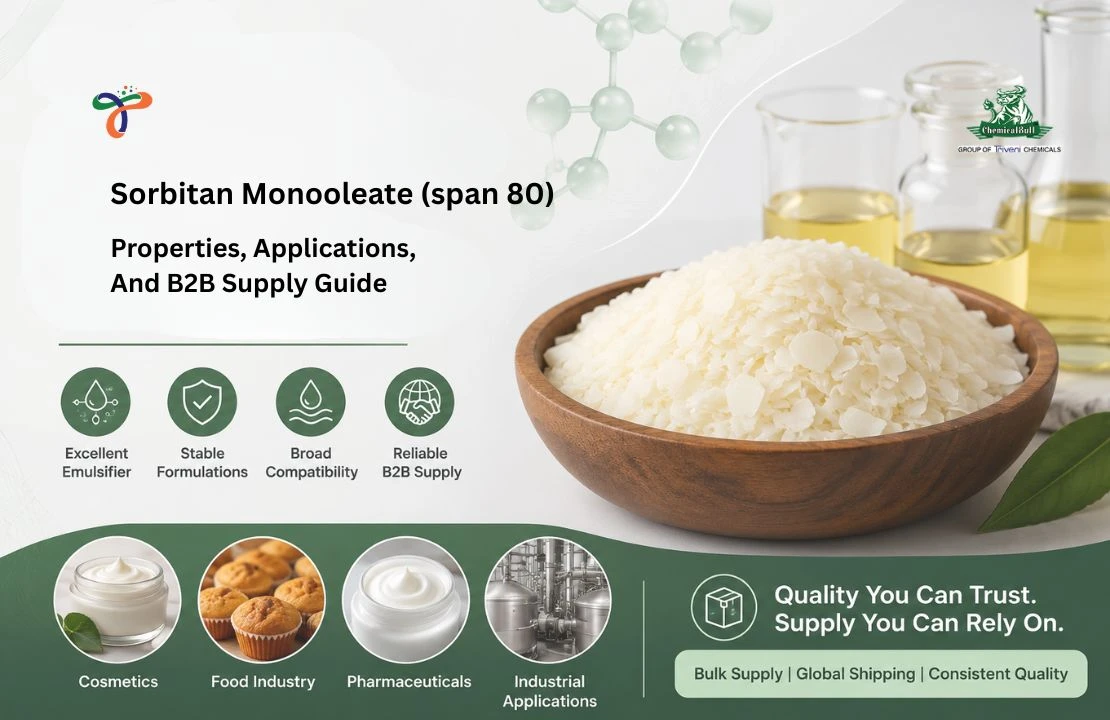
In the world of industrial formulation, achieving perfect emulsion stability is often the key to product excellence. Whether you are manufacturing high-performance agrochemicals or specialized personal care products, the surfactant you choose determines the structural integrity of your final batch. Among the most trusted emulsifiers, Sorbitan Monooleate (commonly known as Span 80) stands out for its versatility and reliability.
Understanding Sorbitan Monooleate (Span 80)
Sorbitan Monooleate is a non-ionic surfactant characterized by its lipophilic nature. It is widely valued for its ability to lower interfacial tension, making it an essential component for stabilizing water-in-oil (W/O) emulsions.
Key Characteristics
-
Chemical Structure: It is a fatty acid ester of sorbitan, specifically formed by the esterification of sorbitol with oleic acid.
-
Solubility: Highly lipophilic, it displays excellent solubility in oils and organic solvents but limited solubility in water.
-
Stability: Provides exceptional shelf-life stability to formulations, preventing phase separation even in complex chemical mixtures.
Benefits for Industrial Formulators
-
Emulsification Efficiency: Acts as a powerful emulsifier that bridges the gap between immiscible oil and water phases.
-
Versatility: Compatible with a wide range of other surfactants and chemical additives, allowing for highly customized formulations.
-
Performance: Enhances the smooth texture, spreadability, and active ingredient delivery in end-user applications.
How is it Made?
Industrially, Sorbitan Monooleate is synthesized through the direct esterification of sorbitol with oleic acid in the presence of a catalyst. The process is strictly controlled to ensure the desired HLB (Hydrophilic-Lipophilic Balance) value, followed by refining steps to achieve the high-purity standards required for commercial distribution.
Primary Applications: Where is it Used?
Formulators leverage the unique properties of Span 80 across a variety of sectors:
Agrochemicals:
Used as a vital emulsifier in pesticide and herbicide formulations to ensure active ingredients are evenly dispersed for maximum field coverage.
Paints & Coatings:
Acts as a dispersing agent to improve pigment distribution, ensuring high gloss retention and weather resistance.
Industrial Lubricants:
Enhances the stability of metalworking fluids, providing superior corrosion protection and prolonging equipment life.
Personal Care:
Stabilizes creams and lotions, providing the smooth, consistent texture required in modern cosmetic formulations.
The B2B Marketplace and Sourcing
As a procurement manager in the industrial sector, your supply chain must be resilient. Partnering with reputable Sorbitan Monooleate manufacturers ensures that you receive consistent, batch-verified material. To manage large-scale requirements, many firms engage with professional Sorbitan Monooleate suppliers who provide comprehensive technical documentation, including safety data sheets.
For businesses needing localized support and faster lead times in industrial hubs like the Vapi-Valsad belt, Sorbitan Monooleate distributors play a critical role in inventory management and just-in-time delivery. Furthermore, firms looking to optimize procurement costs often consolidate their supply chain by sourcing from established Sorbitan Monooleate wholesalers who offer flexible packaging—from standard drums to bulk ISO tank deliveries.
Why Choose Chemical Bull for Your Sorbitan Monooleate Needs?
At Chemical Bull, we do not just trade chemicals; we act as your strategic formulation partner. Here is why industry leaders trust us as their primary source:
-
Manufacturing Excellence: As a premier Sorbitan Monooleate manufacturer, we eliminate the middleman, providing you with direct, factory-grade purity that meets global standards.
-
Reliable Inventory Capacity: As established Sorbitan Monooleate wholesalers, we maintain a massive, 24/7 ready stock to ensure your production lines remain uninterrupted, regardless of market volatility.
-
Technical Authority: We go beyond supply. Our team provides the essential technical documentation and SDS support required to keep your team compliant and your formulations stable.
-
Pan-Industry Distribution: Whether you are looking for dedicated Sorbitan Monooleate distributors for regional logistics or high-volume Sorbitan Monooleate suppliers for international trade, our network handles everything from standard drum quantities to bulk ISO tank deliveries.
Related Products for Cross-Formulation
To streamline your production, formulators often combine Span 80 with other specialty chemicals:
-
Ethyl Acrylate: Enhances binding strength and flexibility in industrial coatings.
-
Specialty Solvents: Essential for thinning and cleaning applications.
-
Aroma Chemicals: Used in personal care to ensure consistent fragrance release.
-
Pharma Intermediates: Used in stable ointment bases and controlled-release matrices.
Frequently Asked Questions (FAQ)
-
What is the primary use of Sorbitan Monooleate?
It is primarily used as a non-ionic surfactant to stabilize water-in-oil emulsions in agrochemicals, cosmetics, and industrial lubricants. -
Why is Span 80 preferred in industrial formulations?
It is preferred for its exceptional lipophilic properties, which prevent phase separation and ensure long-term stability in complex mixtures. -
How can I ensure the quality of the surfactants I source?
Always request a Certificate of Analysis (COA) and ensure your partner provides full technical documentation and compliance support for every batch. -
Are you ready to optimize your formulation stability?
Contact the Chemical Bull team today to request a commercial quote, review our technical specifications, or discuss your bulk requirements for Sorbitan Monooleate and other industrial raw materials.
Conclusion
Sorbitan Monooleate (Span 80) serves as a fundamental pillar for stability and performance in industrial formulations. From agrochemicals to personal care, the right choice of emulsifier can redefine your product’s quality and market success. By leveraging a resilient supply chain and prioritizing technical transparency, manufacturers can ensure consistent production, minimize phase separation issues, and significantly enhance operational efficiency.
Comment Section