Chemical Bull
631
24-Jul-2026
Sodium Stearoyl Lactylate For Food Manufacturing and Bakery Products
Commercial bakeries need dough that performs consistently during mixing, fermentation, shaping, proofing and baking. Variations in flour quality, moisture, processing temperature and ingredient interaction can affect volume, crumb texture and production efficiency. Sodium Stearoyl Lactylate helps manufacturers manage these challenges by supporting dough strength, ingredient distribution and finished-product consistency.
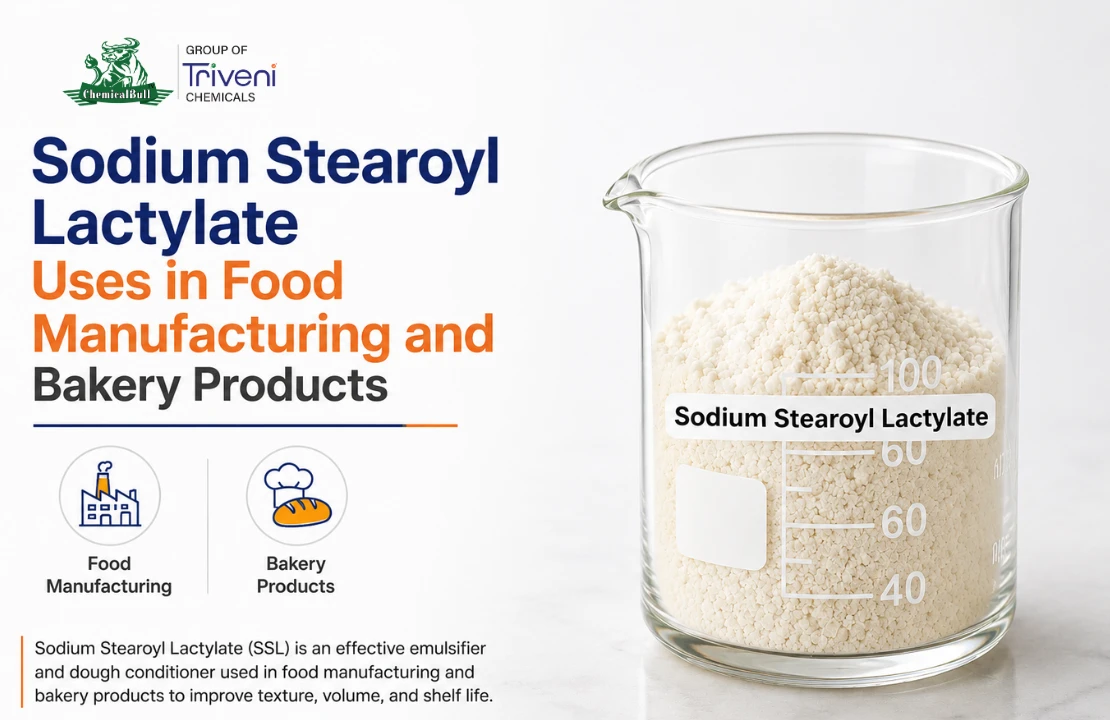
Sodium Stearoyl Lactylate, commonly known as SSL or E481, is a food emulsifier and dough-conditioning ingredient used mainly in bread and commercial bakery formulations. Manufacturers evaluating SSL for production can review the required food grade, specification and technical documentation from a reliable Sodium Stearoyl Lactylate supplier before beginning application trials.
Quick Answer
Sodium Stearoyl Lactylate is used in bread and bakery products to support dough strength, crumb softness and processing consistency. It is commonly evaluated in commercial bread, buns, rolls, pizza dough and frozen bakery products.
Its actual performance depends on the flour, formulation balance, processing conditions and interaction with other bakery ingredients.
What Is Sodium Stearoyl Lactylate (SSL)?
Sodium Stearoyl Lactylate is a lactylate-based food emulsifier produced through stearic acid and lactic acid chemistry. It is identified as E481 in relevant food-additive labelling systems.
Its structure contains water-compatible and fat-compatible portions. This allows SSL to interact with flour proteins, starch, fats and water within a bakery formulation. These interactions can influence dough development, emulsification, ingredient distribution and the texture of the finished product.
SSL is mainly selected when a bakery formulation requires better dough handling, improved structure and more consistent product quality.
Chemical Information of Sodium Stearoyl Lactylate
|
Property |
Description |
|
Chemical Name |
Sodium Stearoyl Lactylate |
|
Common Name |
SSL |
|
CAS Number |
25383-99-7 |
|
Food Additive Number |
E481 |
|
Chemical Class |
Lactylate emulsifier |
|
Function |
Emulsifier, dough conditioner, stabilizer |
|
Appearance |
White to off-white powder |
|
Solubility |
Slightly soluble in water; soluble in ethanol |
|
Main Raw Materials |
Stearic acid and lactic acid derivatives |
Why Is Sodium Stearoyl Lactylate Used in Food Manufacturing?
Food manufacturers use Sodium Stearoyl Lactylate because it provides multiple functional benefits during processing and storage.
As part of modern food formulation, manufacturers rely on different food additives to improve texture, stability, processing efficiency, and overall product quality across various applications.
1. Improves Dough Strength and Handling
In bakery production, dough quality directly affects the final product. SSL helps strengthen dough structure, making it easier to process during mixing, shaping, and production.
Benefits include:
- Improved dough elasticity
- Better machinability
- Consistent processing performance
- Reduced production variations
This makes SSL especially valuable for large-scale bakeries where uniform product quality is essential.
2. Enhances Bread Volume and Texture
One of the major Sodium Stearoyl Lactylate uses in bakery products is improving bread quality.
SSL helps create a stable dough structure that supports better gas retention during fermentation and baking. This contributes to:
- Improved loaf volume
- Softer crumb structure
- Uniform texture
- Better appearance
For commercial bread manufacturers, maintaining consistent volume and softness across batches is a major advantage.
3. Improves Freshness and Shelf Life
Consumers expect bakery products to remain soft and fresh for longer periods. SSL helps improve moisture distribution and texture stability, which can support better product freshness.
Applications include:
- Packaged bread
- Hamburger buns
- Sandwich rolls
- Frozen bakery products
By maintaining product texture, SSL helps reduce quality changes during storage.
Sodium Stearoyl Lactylate Uses in Bakery Products
Bakery applications represent one of the largest usage areas for Sodium Stearoyl Lactylate. Its emulsification and dough-conditioning properties make it suitable for multiple commercial bakery products.
Commercial bakeries also combine SSL with other functional ingredients, including bakery flavours and ingredients, to improve product taste, aroma, texture, and consumer appeal.
Sodium Stearoyl Lactylate in Bread Manufacturing
Bread production requires careful control of dough development, fermentation, and baking conditions. SSL is widely used in bread formulations to improve processing efficiency and finished product quality.
Bread manufacturers typically combine SSL with other emulsifiers and bakery additives to optimize dough strength, volume, and softness.
Benefits of SSL in bread include:
Bread manufacturers typically combine SSL with other emulsifiers and bakery additives to optimize dough strength, volume, and softness.
- Better dough development
- Improved loaf structure
- Softer crumb
- Enhanced volume
- Longer freshness
Commercial bakeries use SSL to maintain consistent bread quality across high-volume production.
Sodium Stearoyl Lactylate in Cakes and Muffins
Cake and muffin manufacturers require emulsifiers that help create smooth texture and consistent appearance.
SSL helps improve:
- Batter stability
- Texture uniformity
- Moisture retention
- Product softness
It supports manufacturers in producing cakes and muffins with improved eating quality and longer shelf stability.
Sodium Stearoyl Lactylate in Buns and Rolls
Buns and rolls used in restaurants, fast-food chains, and packaged food industries require softness and structural stability.
SSL helps provide:
- Soft texture
- Better handling properties
- Improved freshness
- Consistent shape
This makes it valuable in hamburger buns, sandwich rolls, and other commercial bakery products.
Sodium Stearoyl Lactylate in Biscuits and Cookies
Although biscuits and cookies have different formulations compared with bread products, emulsifiers play an important role in achieving consistent texture.
SSL may support:
- Improved dough processing
- Better ingredient distribution
- Controlled texture development
This helps manufacturers maintain product consistency during large-scale production.
Sodium Stearoyl Lactylate in Pizza Dough and Frozen Dough
Frozen dough products require stability during freezing, storage, and baking.
SSL helps improve:
- Dough strength
- Processing performance
- Texture after baking
- Product consistency
It is commonly used in industrial frozen bakery applications where manufacturers need reliable performance after storage.
Key Benefits of Sodium Stearoyl Lactylate in Food Manufacturing
Sodium Stearoyl Lactylate provides multiple advantages for industrial food production. These benefits depend on product formulation, processing conditions, and desired quality parameters.
|
Benefit |
Importance in Food Manufacturing |
|
Improved Dough Strength |
Helps maintain better dough structure during processing |
|
Better Texture Control |
Supports softer and more consistent finished products |
|
Enhanced Product Volume |
Helps improve structure and appearance of bakery items |
|
Moisture Retention |
Supports freshness and softness during storage |
|
Improved Ingredient Distribution |
Helps achieve uniform product quality |
|
Better Processing Efficiency |
Supports consistent large-scale production |
For food manufacturers, these benefits help reduce production variation and improve customer satisfaction.
Sodium Stearoyl Lactylate Applications Beyond Bakery Products
Although bakery products are the primary application area, SSL is also used in other food manufacturing segments where emulsification, texture improvement, and stability are required.
In processed food formulations, manufacturers often combine emulsifiers with food stabilizers to improve consistency, texture retention, and product performance during storage.
Processed Food Applications
In processed food formulations, SSL helps improve ingredient interaction and product consistency.
Applications may include:
- Processed food mixes
- Ready-to-eat products
- Convenience foods
- Frozen food products
- Specialty food formulations
Food manufacturers use SSL to achieve stable texture and improve overall product performance.
Dairy and Dairy Alternative Products
Emulsifiers play an important role in maintaining smooth texture and stability in dairy-based and plant-based formulations.
SSL can support:
- Improved texture consistency
- Better ingredient dispersion
- Enhanced product stability
It is useful where manufacturers require controlled texture and uniform quality.
Instant Food and Premix Products
Instant mixes require ingredients that distribute evenly and maintain consistent performance during preparation.
SSL may help improve:
- Powder blending performance
- Ingredient compatibility
- Final product texture
This makes it useful in different commercial food preparation applications.
Sodium Stearoyl Lactylate vs Other Food Emulsifiers
Food manufacturers often select emulsifiers based on the desired product performance. Different emulsifiers provide different functional benefits.
|
Ingredient |
Primary Function |
Common Applications |
|
Sodium Stearoyl Lactylate (SSL) |
Dough conditioning, emulsification, texture improvement |
Bread, buns, cakes, bakery products |
|
DATEM |
Dough strengthening and volume improvement |
Bread and bakery products |
|
Natural emulsification and texture improvement |
Bakery, chocolate, dairy products |
|
|
Mono & Diglycerides |
Texture stabilization and emulsification |
Bakery, processed foods |
The choice between different emulsifiers depends on product requirements, processing conditions, clean-label considerations, and desired performance.
Food manufacturers evaluating emulsifier options can explore the differences between natural and synthetic emulsifiers to understand their functional applications.
Factors Affecting Sodium Stearoyl Lactylate Performance
The effectiveness of SSL depends on several formulation and processing factors.
Flour Quality
For bakery applications, flour characteristics influence dough development and final product quality. SSL performance may vary depending on protein content, gluten strength, and flour composition.
Mixing Conditions
Mixing time, speed, and temperature affect dough development. Proper processing conditions help manufacturers achieve consistent results.
Product Formulation
The performance of SSL depends on the combination of ingredients, including:
- Flour
- Fats and oils
- Sugar
- Proteins
- Other emulsifiers
Formulators optimize ingredient ratios to achieve the desired texture and stability.
Baking and Processing Conditions
Temperature, baking time, and storage conditions influence final product performance.
Manufacturers adjust processing parameters to maximize the benefits of SSL in finished products.
Sodium Stearoyl Lactylate Use Level in Food Applications
The Sodium Stearoyl Lactylate use level depends on several factors, including:
- Food product type
- Desired texture characteristics
- Formulation requirements
- Regional food regulations
- Manufacturing process
Food manufacturers typically optimize SSL concentration during product development to achieve the required balance of texture, stability, and processing performance.
The ideal usage level may vary between bread, cakes, biscuits, frozen dough, and other food applications.
Why Food Manufacturers Choose Sodium Stearoyl Lactylate
Commercial food producers select SSL because it helps them achieve consistent quality while improving manufacturing efficiency.
Major reasons include:
- Better product uniformity
- Improved texture and softness
- Enhanced processing performance
- Longer product freshness
- Reliable performance in industrial production
As consumer demand for high-quality bakery and convenience foods continues to increase, functional ingredients such as Sodium Stearoyl Lactylate remain important in modern food manufacturing.
Frequently Asked Questions (FAQ)
-
What is Sodium Stearoyl Lactylate used for?
Sodium Stearoyl Lactylate is used as a food emulsifier and dough conditioner to improve texture, dough strength, softness, and consistency in bakery and processed food products. -
Why is Sodium Stearoyl Lactylate used in bread?
SSL is used in bread manufacturing to improve dough strength, loaf volume, crumb softness, and product consistency during commercial baking. -
Is Sodium Stearoyl Lactylate a food additive?
Yes, Sodium Stearoyl Lactylate is a food-grade emulsifier commonly identified as E481 and is used in various food applications. -
What bakery products use Sodium Stearoyl Lactylate?
SSL is commonly used in bread, buns, cakes, muffins, biscuits, cookies, pizza dough, and frozen bakery products. -
Does Sodium Stearoyl Lactylate improve shelf life?
SSL can help maintain product softness and texture stability, which may contribute to improved freshness during storage. -
What is the role of SSL in dough?
SSL acts as a dough conditioner that helps improve dough strength, handling properties, and consistency during bakery production. -
Is Sodium Stearoyl Lactylate used in processed foods?
Yes, SSL is used in certain processed food applications where emulsification, texture improvement, and ingredient stability are required. -
What is the difference between SSL and DATEM?
Both are bakery emulsifiers, but SSL is commonly used for dough conditioning and texture improvement, while DATEM is mainly known for dough strengthening and volume enhancement.
Conclusion
Sodium Stearoyl Lactylate is an important functional ingredient used in modern food manufacturing, particularly in bakery applications. Its ability to improve dough strength, texture, softness, moisture retention, and product consistency makes it valuable for commercial food producers.
From bread and cakes to buns, biscuits, frozen dough, and processed foods, SSL helps manufacturers achieve reliable product quality and efficient production performance.
As the demand for high-quality bakery products and convenience foods continues to grow, Sodium Stearoyl Lactylate remains a widely used emulsifier supporting innovation and consistency in food manufacturing.
Source Reliable Sodium Stearoyl Lactylate for Food Manufacturing Applications
ChemicalBull supplies Sodium Stearoyl Lactylate and other food-grade ingredients for bakery and food manufacturing applications, supporting manufacturers with reliable supply, documentation, and bulk requirements.
Contact ChemicalBull for Sodium Stearoyl Lactylate availability, specifications, and food industry supply solutions.
Comment Section