Chemical Bull
936
25-Jul-2026
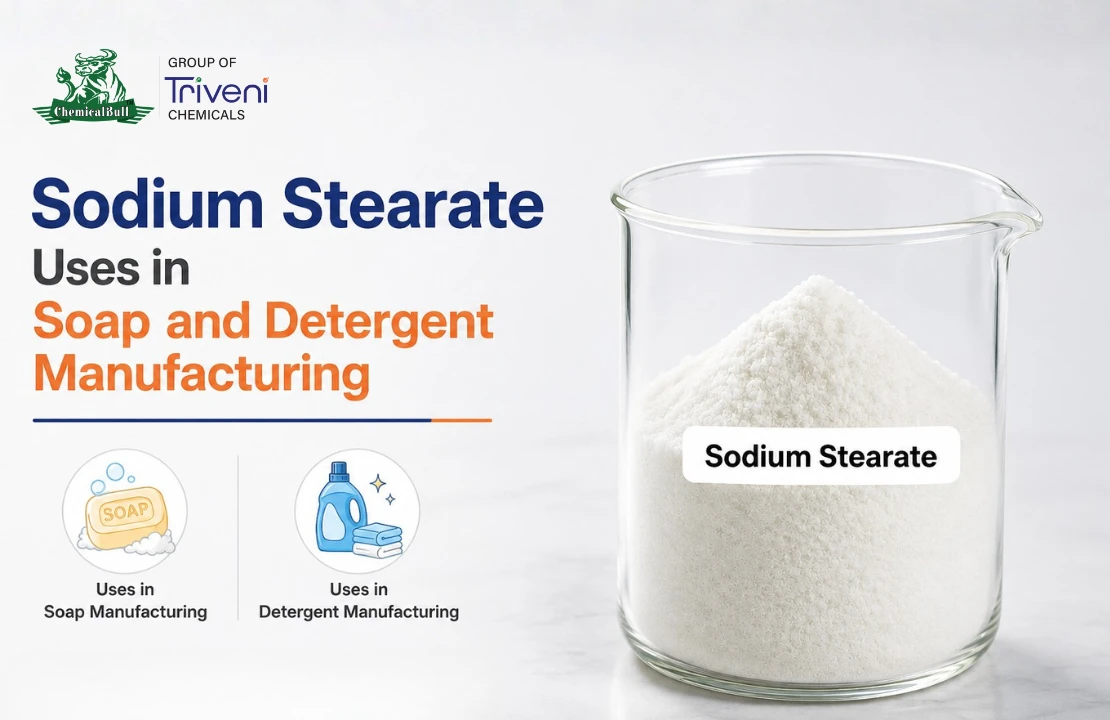
Sodium Stearate Uses in Soap and Detergent Manufacturing
Sodium Stearate is one of the oldest and most widely used surfactants in soap and detergent manufacturing. It is the primary active ingredient in most commercial bar soaps and plays an important structural and functional role in a range of cleaning, personal care, and industrial products. Understanding what sodium stearate is chemically, how it works, and where it is used helps manufacturers, formulators, and buyers make better sourcing and formulation decisions.
This guide covers sodium stearate uses in soap and detergent manufacturing in detail, along with answers to the most commonly asked questions about its chemistry, safety, and how it compares to other sodium compounds.
For bulk supply with COA, MSDS, and consistent batch quality, Chemical Bull is a trusted Sodium Stearate supplier serving soap manufacturers, detergent producers, personal care brands, and industrial buyers across India and global markets.
Sodium Stearate Is Chemically: Identity and Structure
Sodium stearate is chemically the sodium salt of stearic acid. It is created through the reaction of stearic acid (a saturated fatty acid in C18) together with sodium hydroxide (NaOH) in an acidification process called saponification. This results in a light waxy substance with a mild fat odor.
|
Property |
Details |
|
Chemical Name |
Sodium Stearate (Sodium Octadecanoate) |
|
Synonyms |
Octadecanoic acid sodium salt, Stearic acid sodium salt |
|
CAS Number |
822-16-2 |
|
Molecular Formula |
C18H35NaO2 |
|
Molecular Weight |
306.46 g/mol |
|
Physical Form |
White waxy solid or powder |
|
Melting Point |
230°C |
|
Solubility |
Soluble in water |
|
Surfactant Type |
Anionic |
|
Charge |
Negative (carboxylate group) |
Is Sodium Stearate Saturated or Unsaturated?
Sodium stearate is a saturated compound. The stearic acid from which it is derived is an 18-carbon fatty acid with no carbon-carbon double bonds. This fully saturated chain is the reason sodium stearate is a solid at room temperature with a relatively high melting point of 230°C, and why it produces firm, hard bar soaps compared to soaps made from unsaturated fatty acids.
Is Sodium Stearate an Anionic Detergent?
Is sodium stearate an anionic detergent?
Yes. Sodium stearate is an anionic detergent by classification. It carries a negatively charged carboxylate group (-COO-) on the stearate end of the molecule. This negative charge makes it anionic.
How it works as an anionic surfactant:
- The long C18 fatty chain (hydrophobic tail) is attracted to oils, grease, and dirt.
- The negatively charged carboxylate head is attracted to water.
- When soap contacts water and soiled surfaces, the fatty tails surround oil and dirt particles while the carboxylate heads face outward into the water, forming micelles that lift and carry dirt away during rinsing.
This amphiphilic mechanism is the fundamental basis of all soap cleansing action.
Sodium Stearate in Soap: Functions and Uses
Sodium Stearate in Soap Manufacturing
Sodium stearate in soap is the core structural and functional ingredient of bar soap. It is the compound that gives bar soap its solid form, cleansing ability, foam, and skin feel. In industrial soap manufacturing, it is produced either by direct saponification of tallow or vegetable oils with sodium hydroxide, or by neutralizing purified stearic acid with sodium hydroxide.
Functions of sodium stearate in bar soap:
- Primary surfactant: Removes oils, sebum, and dirt from the skin surface through micelle formation
- Structuring agent: Gives the soap bar its firm, solid form at room temperature
- Foam builder: Produces the rich, dense lather consumers associate with effective cleansing
- Skin conditioning: Leaves a smooth skin feel after rinsing in well-formulated soap bars
- Emulsifier: Helps distribute fragrance, color, and skin-benefit additives uniformly through the soap bar
While Sodium Stearate is mainly valued for structure, cleansing, and lather in soap systems, liquid formulations may also use Cocamide DEA for foam and viscosity support to improve texture and foam stability.
Sodium Stearate Uses in Soap: Product Types
|
Soap Product Type |
Role of Sodium Stearate |
|
Traditional bar soap |
Primary soap base, structure, and surfactant |
|
Luxury soap bars |
High-stearate content for hardness and creamy lather |
|
Hotel and hospitality soap |
Provides consistent firmness and high-quality foam |
|
Antibacterial bar soap |
Carrier base for antimicrobial active ingredients |
|
Glycerin soap (clear soap) |
Co-ingredient alongside glycerin in transparent bar formulations |
|
Syndet bar (synthetic detergent) |
Used in combination with synthetic surfactants for milder soap alternatives |
|
Shaving soap |
Combined with potassium stearate for a softer, more lathering consistency |
How to Make Soap with Sodium Stearate
How to make soap with sodium stearate in industrial manufacturing follows a well-established process:
Saponification method (traditional):
- Heat animal tallow or vegetable oil (high in stearic acid) with sodium hydroxide solution
- The saponification reaction converts the fatty acid triglycerides into sodium stearate (soap) and glycerol
- Salt is added to precipitate the soap out of solution (salting out)
- The soap curd is separated, refined, and processed into bar form with additives
Neutralization method (for pre-made stearic acid):
- Melt stearic acid to liquid form (above 70°C)
- Add a stoichiometric quantity of sodium hydroxide solution slowly with agitation
- The neutralization reaction produces sodium stearate directly
- Add fragrance, colorants, skin-benefit additives, and pour or extrude into final bar form
The neutralization method gives manufacturers more control over the final soap composition and is preferred when targeting specific stearic acid purity and soap hardness specifications.
Sodium Stearate in Detergent Manufacturing
What Is Sodium Stearate Used in Liquid Laundry Detergent?
Its primary roles are as a thickener and viscosity modifier (forming a gel structure that contributes to product consistency), emulsifier for fragrance oils and oil-phase ingredients, foam stabilizer, and suspending agent for solid particles. However, sodium stearate is not the primary surfactant in modern liquid laundry detergents because it forms insoluble calcium and magnesium salts (soap scum) in hard water. Modern liquid laundry formulas use synthetic anionic surfactants (SLES, LAS) as primary surfactants, with sodium stearate as a functional co-ingredient.
In powdered laundry detergents, sodium stearate contributes anti-caking properties, lubrication during manufacturing, and acts as a carrier for other active powder ingredients.
Sodium Stearate for Skin
Sodium stearate for skin is generally considered safe and mild in rinse-off personal care products. Key points:
- In well-formulated bar soaps, it effectively removes sebum and dirt while leaving skin clean and smooth.
- Bar soaps are typically pH 9 to 10, higher than the skin's natural pH of 4.5 to 5.5. Superfatting agents and pH adjusters improve mildness for sensitive skin
- In leave-on formulations such as lotions and creams, sodium stearate is used as an emulsifier at low concentrations rather than as a primary surfactant.
- It has a well-established safety profile, reviewed and permitted by major cosmetic regulatory bodies globally.
Sodium Stearate Industrial Uses
Beyond soap and detergent, sodium stearate industrial uses include:
|
Industrial Application |
Function |
|
Plastic and rubber processing |
Release agent, lubricant, anti-tack additive |
|
Textile manufacturing |
Lubricant and sizing agent |
|
Deodorant sticks |
Gelling and structuring agent in stick base |
|
Shaving creams |
Co-surfactant for lather quality |
|
Toothpaste |
Binder, thickener, dispersant |
|
Pharmaceutical ointments |
Emulsifier in topical formulations |
|
Paper manufacturing |
Sizing and coating agent |
|
Metalworking |
Lubricant in drawing and stamping operations |
Frequently Asked Questions
1. What is sodium stearate used for in soap?
It is the primary surfactant and structuring agent in bar soap, providing cleansing action, firm texture, and rich foam through its anionic amphiphilic structure.
2. Is sodium stearate an anionic detergent?
Yes. Sodium stearate carries a negatively charged carboxylate group, classifying it as an anionic surfactant and the active cleansing component of traditional soap.
3. Is sodium stearate saturated or unsaturated?
Saturated. It is derived from stearic acid, an 18-carbon fatty acid with no double bonds, which gives sodium stearate its solid form and high melting point.
4. Is sodium stearate safe for skin?
Yes, in rinse-off products at standard soap concentrations. It has a long history of safe use in bar soap globally and is reviewed and permitted by cosmetic regulatory bodies.
5. What is sodium stearate chemically?
It's a sodium salt from the acid stearic (C18H35NaO2 C18H35NaO2, CAS 822-16-2). It is created by neutralization or saponification of stearic acid with sodium hydroxide.
6. Is sodium stearate the same as sodium bicarbonate, sodium chloride, or SDS?
No to all three. Sodium bicarbonate is NaHCO3 (baking soda), sodium chloride is NaCl (table salt), and sodium dodecyl sulfate (SDS) is a synthetic sulfate surfactant. None are the same as sodium stearate.
7. What is sodium stearate used for in liquid laundry detergent?
In liquid laundry products, it functions primarily as a thickener, emulsifier, foam stabilizer, and suspending agent rather than as the primary surfactant.
Conclusion
Sodium stearate is one of the most chemically important and historically significant ingredients in soap and detergent manufacturing. As the primary anionic surfactant and structural agent in bar soap, it delivers cleansing, lather, firmness, and skin feel through a simple but highly effective amphiphilic mechanism. In liquid detergents, it contributes thickening, emulsification, and suspension stability. Beyond cleaning products, its industrial uses span deodorant sticks, toothpaste, rubber processing, textile manufacturing, and pharmaceutical emulsification.
For bulk sodium stearate with COA, MSDS, and consistent quality documentation, connect with ChemicalBull, a trusted Sodium Stearate supplier serving soap manufacturers, detergent producers, personal care brands, and industrial buyers across India and global export markets.

Comment Section



