Chemical Bull
32
02-Nov-2026
Oxidation can affect the quality of industrial oils, polymers, rubber and other formulated products. Over time, it may cause changes in viscosity, colour, odour or mechanical performance.
Butylated Hydroxytoluene, commonly known as BHT, is an antioxidant used to slow oxidative deterioration in suitable materials. Manufacturers select it according to the formulation, processing conditions and required stability.
When evaluating a butylated hydroxytoluene manufacturer, compare grade specifications, batch consistency and technical documentation against your application requirements.
For BHT specifications, availability and bulk pricing, contact Chemical Bull with your application, required grade, quantity and delivery location.
What Is BHT?
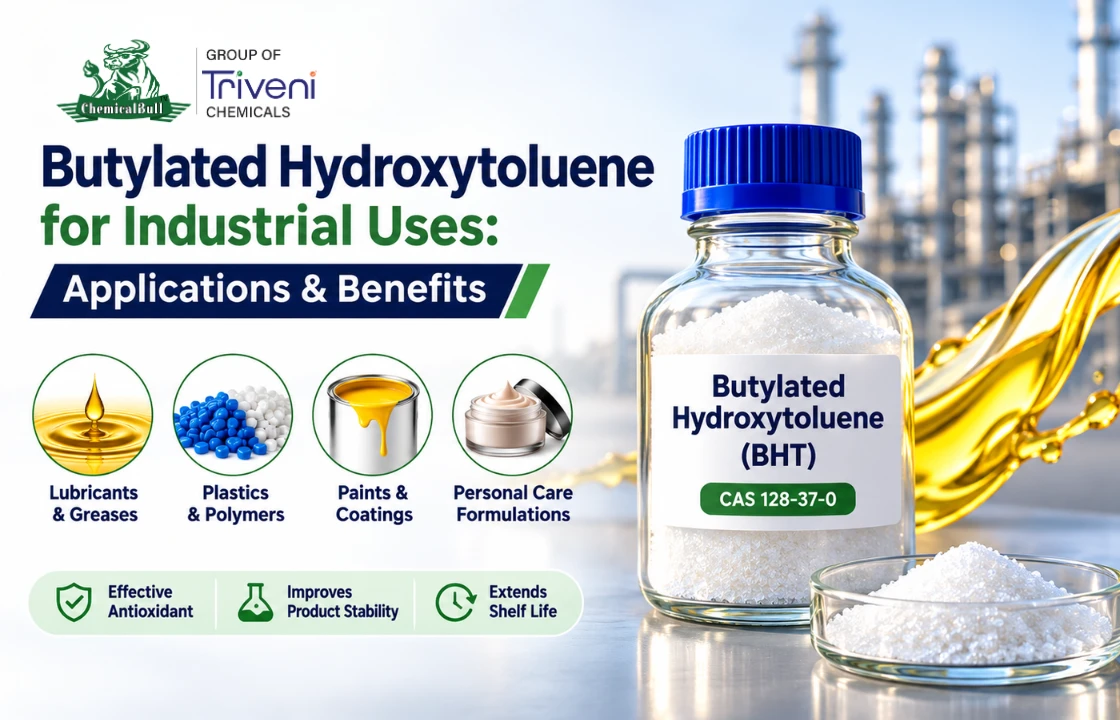
BHT is a synthetic phenolic antioxidant, also called 2,6-di-tert-butyl-4-methylphenol, with CAS number 128-37-0. It is typically supplied as a white crystalline solid.
Its primary function is to help protect oxidation-sensitive ingredients. Established applications include industrial lubricants, rubber, plastics and selected specialty formulations.
For formulators and procurement teams, selecting BHT involves more than confirming its chemical name. The grade, solubility, impurity profile and performance in the finished product also matter.
How Does BHT Work?
Oxidation can proceed through a chain reaction involving reactive free radicals. Heat and oxygen exposure can accelerate this process.
BHT acts as a chain-breaking antioxidant. Its phenolic group donates hydrogen to reactive radicals, helping interrupt the reactions that contribute to material deterioration.
Depending on the application, BHT may work alongside other stabilisers. Research on synthetic lubricant formulations describes its use with additional antioxidant components to improve oxidative stability.
BHT helps slow further oxidation; it cannot restore properties already lost through degradation.
Industrial Applications of BHT
|
Application |
Main purpose |
Important selection checks |
|
Lubricants and industrial oils |
Slow oxidative deterioration |
Solubility, oxidation stability and additive compatibility |
|
Plastics and polymers |
Support oxidative stabilisation |
Processing temperature, colour and antioxidant retention |
|
Rubber compounds |
Help manage oxidative ageing |
Mechanical-property retention, migration and appearance |
|
Specialty formulations |
Protect susceptible ingredients |
Compatibility, storage stability and downstream performance |
Lubricants and Industrial Oils
Lubricants can oxidise during storage and operation. This can contribute to increased acidity, viscosity changes and deposit formation.
BHT is used in suitable lubricant antioxidant systems to help manage these changes. Manufacturer literature identifies a BHT-based phenolic antioxidant for industrial oils, metalworking fluids and biodegradable lubricants.
Formulators should evaluate its performance in the intended base oil and complete additive package. Dissolution, low-temperature storage stability and operating conditions influence suitability.
BHT provides oxidation control. Antiwear, extreme-pressure and corrosion protection may require separate ingredients.
Plastics and Polymers
Polymer materials may undergo oxidation during processing, storage and service. BHT can help stabilise selected plastic systems against oxidation-related quality changes.
Selection depends on the polymer, processing temperature and expected service conditions. Manufacturers should examine colour, mechanical-property retention and compatibility with other additives.
For demanding temperatures or extended service periods, a different antioxidant or combined stabiliser package may be necessary.
Rubber Compounds
Rubber manufacturers use antioxidants to help limit deterioration associated with oxygen and heat. BHT is an established option for selected rubber applications.
Its effectiveness should be assessed in the actual compound. Ageing tests can compare changes in tensile strength, elongation, hardness and appearance.
The elastomer, fillers, curing system and other additives all influence performance. Approval in one rubber formulation does not establish suitability for every compound.
Specialty Formulations
BHT can also protect oxidation-sensitive ingredients in selected specialty products, including fragrance-containing formulations.
Development teams should evaluate odour, colour, clarity and storage stability. Where manufacturing relies on radical reactions, they should also check whether the antioxidant affects curing or other processing steps.
Benefits for Chemicals Manufacturers
Improved Oxidation Stability
BHT can help slow oxidative changes in compatible materials. This supports more consistent product properties when the concentration and incorporation method are appropriate.
Performance should be demonstrated through testing against an untreated control or an existing formulation.
Support for Storage Stability
Oxidation-sensitive ingredients may deteriorate before the finished product reaches its intended use. A suitable antioxidant system can help protect these components during storage.
Any shelf-life extension should be supported by stability data rather than assumed from adding BHT.
Options Across Multiple Industries
BHT has applications across lubricants, polymers, rubber and specialty chemicals. This makes it relevant to manufacturers handling different oxidation-sensitive materials.
However, each application requires its own technical assessment. Compatibility is a selection requirement rather than a universal benefit.
Choosing the Right BHT Grade
Start with the finished-product requirements and establish a purchasing specification. Relevant parameters may include assay, appearance, moisture, impurities and physical form.
Check how the material will dissolve or disperse during manufacturing. Inadequate incorporation can affect performance even when the raw material meets its assay specification.
Processing temperature, mixing conditions and addition sequence should follow the technical supplier’s guidance and be confirmed through production evaluation.
There is no universal BHT dosage for industrial formulations. The effective concentration depends on oxidation sensitivity, processing conditions, service requirements and other stabilisers.
Bulk Buying and Price Considerations
When comparing BHT suppliers, assess technical suitability alongside price. Quotations should cover the same specification, quantity, packaging and delivery terms.
Bulk costs can vary with grade, origin, order size, freight and availability. Confirm whether the quoted material meets the required application specification before approving a purchase.
Request a current certificate of analysis, safety data sheet and available technical information. Batch traceability, packaging condition and storage instructions are also important for sourcing consistency.
Chemical Bull supports BHT sourcing enquiries. Share your specification so the appropriate grade, documentation and commercial supply options can be reviewed.
Frequently Asked Questions
What is BHT mainly used for in industry?
BHT is used as an antioxidant in suitable lubricants, rubber, polymers and specialty formulations to help slow oxidative deterioration.
Does BHT stop oxidation completely?
It helps interrupt oxidation reactions. Its effectiveness depends on the material, concentration and exposure conditions.
Can BHT be used in industrial lubricants?
Yes. It has documented lubricant applications, subject to base-oil compatibility and finished-formulation testing.
Is BHT suitable for every polymer or rubber compound?
No. Processing temperature, compatibility, antioxidant retention and ageing performance must be evaluated for the specific material.
How is the correct BHT dosage determined?
Use supplier recommendations as a starting point, then establish the appropriate concentration through relevant stability and performance tests.
How can buyers request BHT pricing?
Contact Chemical Bull with the required grade or specification, application, quantity, packaging, destination and delivery timeline.
Comment Section