Chemical Bull
16
03-Nov-2026
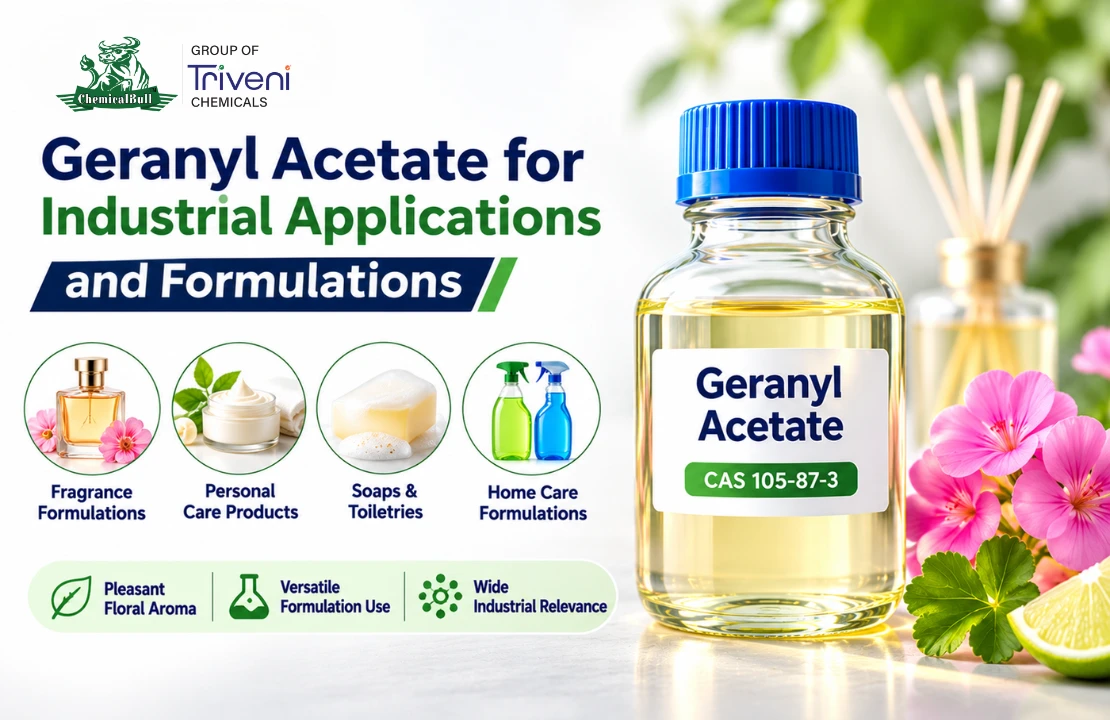
Geranyl Acetate for Industrial Applications and Formulations
Geranyl Acetate is an aroma chemical valued for its sweet, floral, fruity scent with fresh green and rose-lavender notes. It is widely used by fragrance and flavor houses and by manufacturers of soaps, detergents, candles, and household products that need a reliable, pleasant-smelling ingredient.
Because odor quality and purity vary between sources, buying Geranyl Acetate from a dependable supplier helps formulators keep scent profiles consistent from batch to batch. Chemical Bull supplies Geranyl Acetate in bulk quantities with competitive pricing for industrial and formulation buyers.
Chemical Identity & Properties
|
Property |
Detail |
|
CAS Number |
105-87-3 |
|
Chemical Formula |
C₁₂H₂₀O₂ |
|
Molar Mass |
196.29 g/mol |
|
Appearance |
Colorless to pale yellow liquid |
|
Odor |
Sweet, floral, fruity, with rose, lavender, and green notes |
|
Solubility |
Practically insoluble in water; soluble in alcohol, oils, and most fragrance solvents |
|
Classification |
Terpene ester (acetate ester of geraniol) |
What Is Geranyl Acetate?
Geranyl Acetate is the ester formed from geraniol and acetic acid. It occurs naturally in small amounts in essential oils such as citronella, palmarosa, lemongrass, lavender, and coriander, and it is also produced industrially for consistent quality and supply. Its mild, long-lasting scent makes it a useful blending ingredient rather than a single-note fragrance.
Industrial Applications of Geranyl Acetate
- Fine Fragrance and Perfumery: Adds a fresh floral-fruity lift to rose, lavender, geranium, and fougere-style compositions.
- Soaps and Detergents: Used to give cleaning products a clean, pleasant floral scent that holds up in many bases.
- Personal Care and Cosmetics: Included in creams, lotions, shampoos, and body washes as part of fragrance compounds, within recommended usage limits.
- Flavors: Used at very low levels in fruit flavors such as apple, pear, citrus, and berry, where it is recognized as a flavoring substance.
- Household Products: Found in air fresheners, surface cleaners, and fabric care products.
- Candles and Home Fragrance: Contributes a soft floral note to candles, diffusers, and room sprays.
- Technical Odor Masking: Used in some industrial products to soften unwanted base odors.
Why Formulators Choose Geranyl Acetate
|
Factor |
Why It Matters |
|
Versatile Scent Profile |
Blends well with floral, citrus, woody, and herbal notes |
|
Good Stability |
Holds up better than many aldehydes in soaps and detergents |
|
Cost Efficiency |
A practical way to add floral character without using expensive natural oils |
|
Broad Compatibility |
Works in alcohol-based, oil-based, and surfactant-based systems |
|
Natural-Identical Option |
Chemically the same compound found in essential oils |
Geranyl Acetate vs. Related Aroma Chemicals
|
Aroma Chemical |
Scent Character |
Typical Role |
|
Geranyl Acetate |
Sweet, fruity-floral, rose and lavender |
Floral and fruity heart notes |
|
Geraniol |
Fresh rose, slightly sharper |
Core rose and geranium notes |
|
Linalyl Acetate |
Soft, fresh lavender and bergamot |
Lavender, citrus, and fougere accords |
|
Citronellyl Acetate |
Fresh, rosy, slightly fruity |
Rose and fresh floral blends |
Perfumers often combine these to build depth, using Geranyl Acetate to round off sharper notes.
Basic Fragrance Blending Approach
- Define the Scent Direction: Decide on the character, such as fresh floral, fruity, or herbal.
- Build the Heart Notes: Use Geranyl Acetate with related floral ingredients to form the main body of the scent.
- Balance Top and Base Notes: Add citrus or green top notes and woody or musky base notes for longevity.
- Dilute for Testing: Blend in a suitable carrier such as ethanol or a perfumery solvent, since the pure material is strong.
- Test in the Final Base: Check odor, color, and stability in the actual soap, detergent, or cosmetic base before scaling up.
Manufacturing Process Overview
Geranyl Acetate is made by esterifying geraniol with acetic acid or acetic anhydride, usually with a catalyst, and then washing, neutralizing, and distilling the product to remove unreacted material. The geraniol starting material can come from natural sources such as citronella or palmarosa oils, or from synthetic routes, which is why the same compound is sold in natural-derived and synthetic grades.
Grade Selection Guidance
|
Application |
What to Prioritize |
|
Fine fragrance |
High purity, clean odor, and low off-notes |
|
Soaps and detergents |
Good stability in alkaline bases and consistent scent |
|
Flavors |
Food-grade documentation and suitable purity |
|
Candles and household products |
Cost efficiency and reliable odor performance |
What to Check When Sourcing Geranyl Acetate in Bulk
- Assay and Odor Profile: Confirm purity and request an odor evaluation or sample.
- Geraniol and Impurity Levels: Check residual geraniol and by-products, since they affect scent and labeling.
- Grade and Origin: Clarify whether the material is synthetic or natural-derived, and whether food-grade is available.
- Batch Documentation: Request a Certificate of Analysis (CoA) and Safety Data Sheet (SDS) for every shipment.
- Regulatory Support: Confirm the supplier can provide documents that support IFRA and local rules for your product category.
- Packaging and Lead Times: Confirm drums or smaller packs that match your volumes, and reliable delivery.
Storage and Handling Considerations
Store Geranyl Acetate in tightly closed containers in a cool, dry place away from heat, light, and strong oxidizers. It is a combustible liquid, so keep it away from ignition sources. Use gloves and eye protection, since fragrance ingredients can irritate the skin and eyes or cause sensitization in some people, and ensure good ventilation. Always review the current Safety Data Sheet.
Regulatory Notes for Fragrance and Flavor Use
- Fragrance Rules: Fragrance ingredients are guided by IFRA standards and local cosmetic rules, so confirm current limits for your product category.
- Allergen Labeling: Related ingredients such as geraniol may require declaration in some markets, so review the full fragrance composition.
- Flavor Use: Food use requires food-grade material and compliance with applicable flavoring regulations.
Supply Chain and Sourcing Considerations
- Raw Material Links: Pricing can follow essential oil and geraniol markets.
- Lead Time Planning: Plan reorders ahead of seasonal fragrance and soap production peaks.
- Volume-Based Pricing: Ask about tiered pricing for larger recurring orders to stabilize costs.
- Consistent Odor Quality: Staying with one supplier and grade keeps scent profiles uniform across batches.
Common Buyer Mistakes to Avoid
- Buying on Price Alone: Low-cost material can carry off-notes that spoil a fragrance.
- Skipping Odor Approval: Always approve a sample before ordering bulk volumes.
- Ignoring Regulatory Limits: Usage limits and labeling rules vary by product type and region.
- Poor Storage: Heat and light can slowly change the scent over time.
Frequently Asked Questions
-
What is Geranyl Acetate used for?
It is used in perfumes, soaps, detergents, cosmetics, household products, candles, and low-level fruit flavors. -
What does Geranyl Acetate smell like?
It smells sweet, floral, and fruity, with rose, lavender, and green notes. -
Is Geranyl Acetate natural?
It occurs naturally in several essential oils and is also made industrially from geraniol and acetic acid. -
What is the CAS number of Geranyl Acetate?
The CAS number is 105-87-3. -
Does Chemical Bull supply Geranyl Acetate in bulk?
Yes, Chemical Bull supplies Geranyl Acetate in bulk quantities with competitive pricing.
Conclusion
Geranyl Acetate offers formulators a versatile, stable floral-fruity note for fragrances, flavors, soaps, and household products. Sourcing it from a supplier with consistent odor quality, clear documentation, and reliable bulk supply helps manufacturers keep every batch smelling the same.
Comment Section