Chemical Bull
32
02-Nov-2026
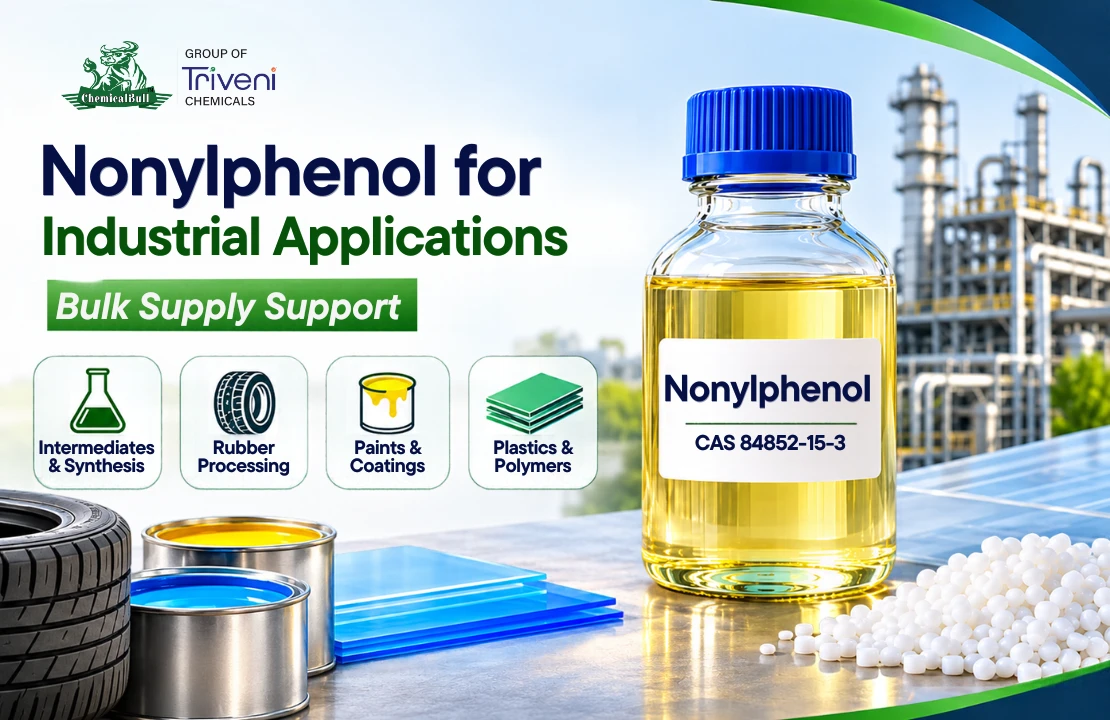
Nonylphenol for Industrial Applications: Bulk Supply Support
Nonylphenol is an alkylphenol used mainly as a chemical intermediate, meaning it is a building block for other products rather than something sold directly to consumers. Its largest role is as the starting material for nonylphenol ethoxylate surfactants, but it also feeds into phenolic resins, plastic stabilizers, and lubricant additives.
Because Nonylphenol is a regulated material, purity, documentation, and compliance support matter as much as price. Working with an established nonylphenol supplier helps manufacturers stay consistent and informed. Chemical Bull supplies Nonylphenol in bulk quantities with competitive pricing for industrial buyers.
Chemical Identity & Properties
|
Property |
Detail |
|
CAS Number |
25154-52-3 (nonylphenol, mixed isomers); 84852-15-3 (branched) |
|
Chemical Formula |
C₁₅H₂₄O |
|
Molar Mass |
220.35 g/mol |
|
Appearance |
Pale yellow, viscous liquid with a phenolic odor |
|
Solubility |
Very low in water; soluble in most organic solvents |
|
Classification |
Alkylphenol, industrial chemical intermediate |
What Is Nonylphenol?
Nonylphenol is made by attaching a nine-carbon alkyl group (nonyl) to a phenol ring. Commercial material is usually a mixture of branched isomers, which is why more than one CAS number appears in the market. Its water-repelling alkyl chain and reactive phenol group are what make it useful for building surfactants and resins.
Industrial Applications of Nonylphenol
- Nonylphenol Ethoxylates (NPEs): The largest use is reacting Nonylphenol with ethylene oxide to make nonionic surfactants for industrial processes, where permitted.
- Phenolic Resins: Used to make alkylphenol-formaldehyde resins that act as tackifiers in rubber and adhesives and as modifiers in coatings.
- Plastic and Rubber Stabilizers: A raw material for phosphite antioxidants such as tris(nonylphenyl) phosphite, which protect polymers from heat and oxidation during processing.
- Lubricant Additives: Used to produce alkylphenate detergent and dispersant additives for lubricating oils.
- Epoxy Systems: Serves as a modifier or accelerator in some epoxy curing formulations.
- Chemical Intermediate: A starting material for other specialty phenolic and ethoxylated products.
Why Manufacturers Use Nonylphenol as a Raw Material
|
Factor |
Why It Matters |
|
Reactive Phenol Group |
Easy to ethoxylate or react into resins and phosphites |
|
Hydrophobic Nonyl Chain |
Gives derived surfactants strong oil-wetting and emulsifying power |
|
Established Chemistry |
Decades of use in surfactant, resin, and additive manufacturing |
|
Cost Efficiency |
Historically an economical route to high-performing derivatives |
Regulatory and Environmental Considerations
Nonylphenol and its ethoxylates face tighter rules in many regions because the compound is toxic to aquatic life and is treated as an environmental endocrine-disrupting concern. Buyers should plan around the following:
- Regional Restrictions: The EU restricts Nonylphenol and NPEs in many open-use applications such as cleaning, textile, and leather processing, and lists Nonylphenol as a Substance of Very High Concern.
- Other Markets: Several countries and eco-label programs discourage or exclude NPEs, so check the rules where your finished product will be sold.
- Controlled Intermediate Use: Rules for closed, controlled industrial processes can differ from those for products that reach consumers or wastewater.
- Alternatives: Many formulators now use alcohol ethoxylates or other surfactants where restrictions apply.
- Documentation: Keep supplier documentation, intended use records, and wastewater handling plans ready for audits.
Nonylphenol-Based Products vs. Common Alternatives
|
Option |
Key Characteristic |
Consideration |
|
Nonylphenol Ethoxylates |
Strong wetting and emulsifying performance, low cost |
Restricted in several regions |
|
Alcohol Ethoxylates |
Readily biodegradable, widely accepted |
May need a different EO grade to match performance |
|
Fatty Amine Ethoxylates |
Good uptake and specialty performance |
Application-specific and regionally regulated |
|
Castor Oil Ethoxylates |
Good emulsifier for oil-based systems |
Often blended with other surfactants |
Handling and Safety Considerations
Nonylphenol should be handled carefully because it can cause skin burns and serious eye damage, It is harmful if swallowed, and it is very toxic to the aquatic life. Under some regulatory frameworks, it also carries a reproductive toxicity classification for certain isomers.
- Protective Equipment: Use chemical-resistant gloves, eye or face protection, and protective clothing.
- Ventilation: Work in well-ventilated areas, since heated material can release irritating vapors.
- Storage: Keep in tightly closed containers away from strong oxidizers and heat. It may thicken in cool conditions, so storage temperature should suit the grade.
- Spill and Waste Control: Prevent release to drains and waterways, and dispose of waste according to local regulations.
- Documentation: Review the current Safety Data Sheet and follow local transport rules for hazardous goods.
Manufacturing Process Overview
Nonylphenol is produced by alkylating phenol with nonene (propylene trimer) in the presence of an acid catalyst. The reaction yields mainly para-substituted, branched nonylphenol, which is then purified by distillation to remove unreacted phenol and by-products. The ratio of isomers and the level of residual phenol can differ by producer, which is why batch specifications matter.
Grade Selection Guidance
|
End Use |
What to Prioritize |
|
Ethoxylate production |
Low color, low residual phenol, and consistent isomer profile |
|
Phenolic resins |
High para-isomer content and tight water control |
|
Phosphite stabilizers |
Low impurities that could affect color or stability |
|
Lubricant additives |
Consistent composition and low residual phenol |
What to Check When Sourcing Nonylphenol in Bulk
- Assay and Isomer Profile: Confirm purity and the isomer distribution your process needs.
- Residual Phenol and Water: Request limits on residual phenol and moisture.
- Color: Request color specifications, since this affects derived products.
- Batch Documentation: Request a Certificate of Analysis (CoA) and Safety Data Sheet (SDS) for every shipment.
- Regulatory Support: Confirm the supplier can provide compliance documents for your region and intended use.
- Packaging and Lead Times: Confirm drums, IBC totes, or bulk delivery and a reliable delivery schedule.
Supply Chain and Sourcing Considerations
- Feedstock Linkage: Nonylphenol pricing follows phenol and nonene markets.
- Lead Time Planning: Plan reorders ahead of production schedules, especially for regulated shipments.
- Volume-Based Pricing: Ask about tiered pricing for larger recurring orders to stabilize costs.
- Consistent Grades: Staying with the same grade and supplier keeps derivative quality predictable.
Common Buyer Mistakes to Avoid
- Ignoring Regulatory Status: Rules can differ sharply by region and end use, so check before every new product launch.
- Overlooking Residual Phenol: Higher levels can affect downstream reactions and worker safety.
- Skipping Batch Documentation: A generic data sheet does not confirm that the delivered batch meets your specification.
- Weak Waste Planning: Aquatic toxicity means spill and wastewater controls need to be in place before delivery.
Frequently Asked Questions
-
What is Nonylphenol used for?
It is mainly used to make nonylphenol ethoxylate surfactants, phenolic resins, plastic stabilizers, and lubricant additives. -
What is the CAS number of Nonylphenol?
The mixed-isomer CAS number is 25154-52-3, and branched nonylphenol is also listed under 84852-15-3. -
Is Nonylphenol regulated?
Yes, regions such as the EU restrict it and its ethoxylates in many applications because of its aquatic toxicity and environmental effects. -
Is Nonylphenol hazardous to handle?
Yes, it can burn skin, damage eyes, and is very toxic to aquatic life, so protective equipment and spill control are required. -
Does Chemical Bull supply Nonylphenol in bulk?
Yes, Chemical Bull supplies Nonylphenol in bulk quantities with competitive pricing.
Conclusion
Nonylphenol remains an important intermediate for surfactants, resins, stabilizers, and lubricant additives, but it must be sourced and used with regulatory and safety requirements in mind. Choosing a supplier with consistent quality, clear documentation, and reliable bulk supply helps industrial buyers stay compliant and keep production on schedule.
Comment Section