Chemical Bull
390
22-Aug-2026
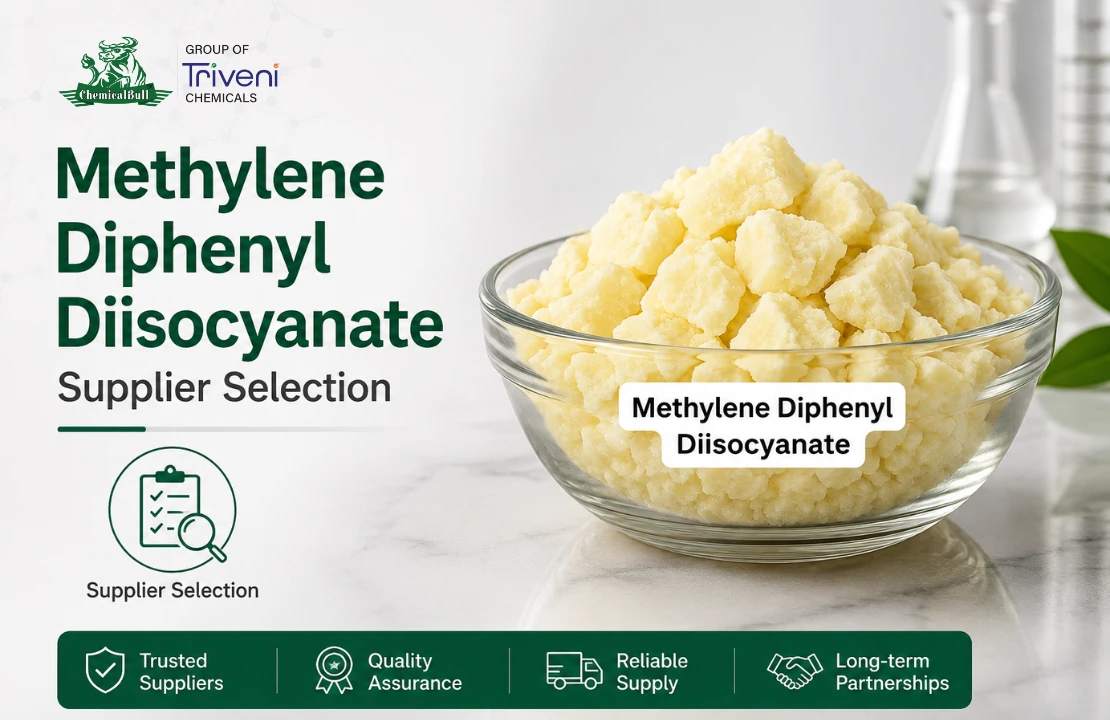
Methylene Diphenyl Diisocyanate Supplier Selection
Methylene Diphenyl Diisocyanate, commonly abbreviated as MDI, is one of the two major diisocyanates used in polyurethane production worldwide, alongside toluene diisocyanate (TDI). It reacts with polyols to form the polyurethane polymers found in rigid insulation foam, flexible foam, elastomers, coatings, and structural adhesives.
Because MDI's reactivity and purity directly affect polymer performance, choosing a reliable Methylene Diphenyl Diisocyanate manufacturer and supplier in India with consistent batch quality and proper handling documentation is essential for manufacturers running continuous production processes.
Chemical Bull supplies Methylene Diphenyl Diisocyanate chemical in bulk quantity and with competitive pricing across internationally.
Chemical Identity & Properties
|
Property |
Detail |
|
CAS Number |
101-68-8 (4,4'-MDI) |
|
Chemical Formula |
C₁₅H₁₀N₂O₂ |
|
Molar Mass |
250.25 g/mol |
|
Appearance |
Pale yellow solid or molten liquid (handled molten in industrial use) |
|
Melting Point |
Approx. 100°F (38°C) for pure 4,4'-MDI |
|
Common Forms |
Pure MDI, polymeric MDI (pMDI), modified/liquid MDI |
What Is Methylene Diphenyl Diisocyanate Used For?
MDI is primarily used as a key building block in polyurethane chemistry. When reacted with polyols, it forms polymer chains that make up a wide range of finished products:
- Rigid polyurethane foam: Used extensively in building insulation, refrigeration, and cold-chain packaging due to its low thermal conductivity.
- Flexible polyurethane foam: Found in furniture cushioning, mattresses, and automotive seating.
- Elastomers: Used in rollers, wheels, gaskets, and other components requiring abrasion resistance and durability.
- Adhesives and sealants: Provides strong bonding performance in construction, automotive, and industrial adhesive formulations.
- Coatings: Contributes to chemical- and abrasion-resistant polyurethane coatings used in flooring and protective finishes.
- Engineered wood binders: Polymeric MDI is a primary binder in oriented strand board (OSB) and other engineered wood products.
MDI vs. TDI: Understanding the Difference
MDI and toluene diisocyanate (TDI) are the two dominant diisocyanates in polyurethane manufacturing, but they serve different roles. TDI is primarily used in flexible slabstock foam production for furniture and bedding, where its higher volatility and reactivity profile suit continuous slab-foam processes. MDI, by contrast, has lower volatility, making it a safer option for applications like rigid foam, elastomers, and engineered wood binders where operator exposure during processing is a greater concern. This lower volatility, combined with MDI's versatility across both rigid and specialty polyurethane systems, is a major reason it has steadily gained market share relative to TDI over the past two decades.
Methylene Diphenyl Diisocyanate Manufacturing Process
MDI is produced through a two-step industrial process. First, aniline reacts with formaldehyde under acidic conditions to produce methylene dianiline (MDA), a mixture of diaminodiphenylmethane isomers. In the second step, MDA undergoes phosgenation, reacting with phosgene to convert the amine groups into isocyanate groups, yielding crude MDI. This crude mixture is then separated through distillation into pure 4,4'-MDI and polymeric MDI (pMDI) grades, each suited to different downstream applications. Because phosgene is used as a reactant in this process, MDI manufacturing is concentrated among a relatively small number of large-scale producers with the infrastructure to handle it safely.
Methylene Diphenyl Diisocyanate Market Overview
MDI represents one of the largest volume isocyanates produced globally, driven primarily by demand from the construction and insulation sector, where rigid polyurethane foam is used for energy-efficient building envelopes. Automotive lightweighting trends, growth in cold-chain logistics and refrigeration, and continued demand for engineered wood products have also contributed to steady market growth. Polymeric MDI accounts for the largest share of overall demand due to its widespread use in rigid foam and OSB binder applications, while pure MDI serves more specialized elastomer, coating, and specialty foam markets.
Methylene Diphenyl Diisocyanate Solubility
MDI is not soluble in water; in fact, it reacts with water in a hydrolysis reaction that generates carbon dioxide and forms urea linkages, which is part of why moisture control is critical during storage and processing.MDI is easily soluble in many organic solvents such as Toluene, acetone, as well as other aprotic solvents that are commonly utilized in coatings and adhesive formulations. Due to its affinity with water, MDI is typically stored in dry, inert environments inside nitrogen-blanketed tanks in order to stop early curing and changes in viscosity prior to usage.
Compatibility with Polyols and Additives
MDI's reactivity is engineered to work with specific polyol systems depending on the target product. Polyether polyols are commonly paired with MDI in flexible and rigid foam applications, while polyester polyols are favored in elastomer and coating systems requiring higher abrasion and chemical resistance. Catalysts, like organometallic compounds and tertiary amines, can be used in conjunction with MDI to manage reaction speeds and the characteristics of foam rise, and surfactants aid in regulating cell structure and function in foam formulations. Formulators usually work together with the MDI supplier to ensure that their grade's reactivity profile is compatible with the specific polyol used and processing equipment since mismatches could result in inconsistent time to cure or even foam problems with density.
Storage and Shelf Life
Since MDI is highly receptive to humidity in the air, it is essential to store the MDI in a proper manner to maintain the quality of MDI between the time of delivery and when it is used. Containers must be sealed tightly, and any used containers should be surrounded by dry nitrogen as often as possible to prevent moisture from entering. Pure 4,4'-MDI may also undergo the process of dimerization, especially in storage at higher temperatures, which may affect its ability to react if it is not checked. The majority of suppliers suggest storage temperatures of between 68°F and 77°F (20degC up to 25 degrees Celsius) for liquid MDI grades. It is recommended to conduct regular quality checks for customers who have larger quantities of inventory for longer periods of time.
Handling and Safety Considerations
MDI is classified as a respiratory sensitizer, and occupational exposure limits are enforced under OSHA regulations in the United States, along with similar frameworks internationally. Facilities working with MDI require proper ventilation, personal protective equipment, and adherence to exposure monitoring protocols. Because of its reactivity with water and its sensitizing potential, buyers should request a current Safety Data Sheet (SDS) and confirm that the supplier's packaging and transport methods meet DOT and workplace safety requirements before placing an order.
How to Choose a Reliable MDI Supplier
- Consistent isocyanate (NCO%) content: Confirm the NCO percentage is verified batch-to-batch, since this directly affects polyurethane reaction performance.
- Proper documentation: Request SDS, Certificate of Analysis, and, where relevant, REACH or regional regulatory compliance records.
- Handling and packaging expertise: MDI requires temperature-controlled, moisture-free packaging; confirm the supplier's logistics experience with reactive chemicals.
- Grade availability: Ensure the supplier can provide the specific grade needed, whether pure 4,4'-MDI, polymeric MDI, or modified liquid MDI.
- Technical support: A supplier who can advise on formulation compatibility adds value, particularly for buyers new to isocyanate-based systems.
Frequently Asked Questions
-
What is Methylene Diphenyl Diisocyanate used for?
MDI is used to manufacture polyurethane products, including rigid and flexible foams, elastomers, adhesives, coatings, and engineered wood binders. -
Is MDI soluble in water?
No, MDI is not water-soluble and instead reacts with water in a hydrolysis reaction, which is why it must be stored and handled under dry conditions. -
How is Methylene Diphenyl Diisocyanate manufactured?
It is produced by reacting aniline with formaldehyde to form methylene dianiline, which is then phosgenated to produce crude MDI, later separated into pure and polymeric MDI grades. -
What's the difference between pure MDI and polymeric MDI?
Pure 4,4'-MDI is used in applications like elastomers and specialty foams requiring precise reactivity, while polymeric MDI (pMDI) is used in high-volume applications like rigid foam and engineered wood binders. -
What industries drive the MDI market?
Construction and insulation, automotive, cold-chain refrigeration, furniture, and engineered wood panel manufacturing are the primary demand drivers. -
Is MDI hazardous to work with?
MDI is classified as a respiratory sensitizer and requires proper ventilation, PPE, and adherence to OSHA exposure limits during handling. -
What should I check before ordering MDI in bulk?
Confirm NCO% consistency, request current SDS and CoA documentation, and verify the supplier's experience packaging and shipping moisture-sensitive, reactive chemicals.
Conclusion
Methylene Diphenyl Diisocyanate remains a foundational raw material for polyurethane manufacturing across insulation, automotive, furniture, and construction applications. Selecting a supplier who can consistently deliver the right grade, verified NCO content, and proper handling documentation is central to maintaining product quality across production runs.
Comment Section