Chemical Bull
2172
25-Jun-2026
Role of Polysorbate 20 in Shampoo and Hair Care Formulations
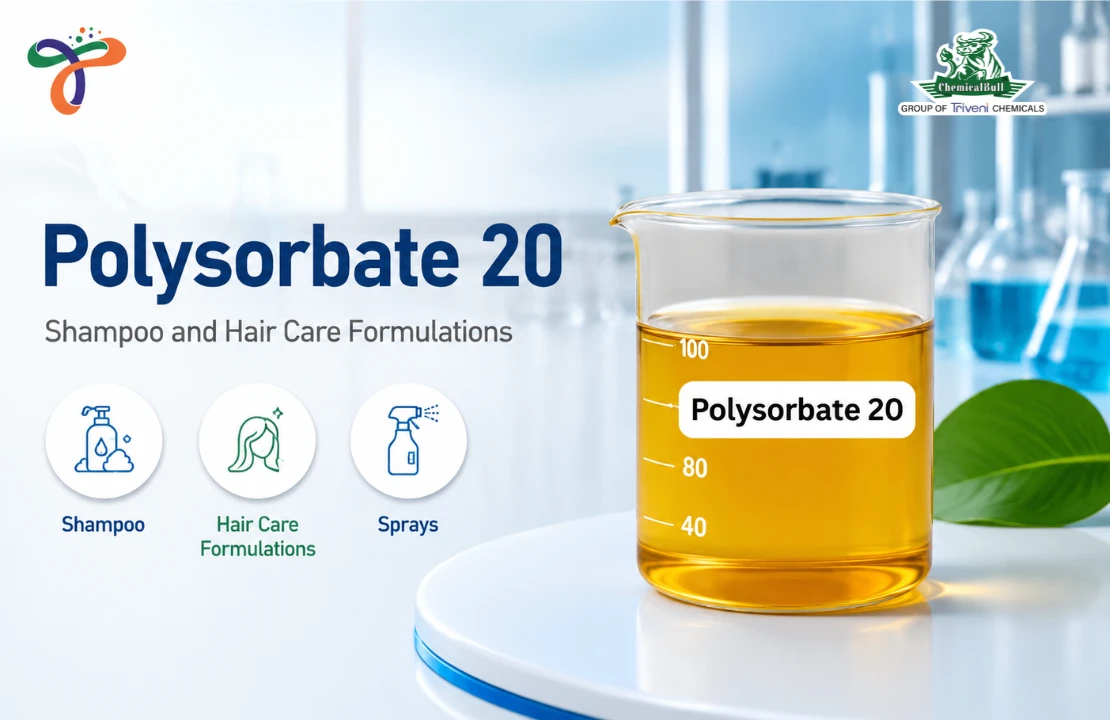
Polysorbate 20 — commercially known as Tween 20 and listed on product labels under its INCI name Polysorbate 20 — is one of the most functionally versatile non-ionic surfactants used in hair care formulation today. While it is widely recognized as a solubilizer in skin care and fragrance products, its specific role in shampoo, conditioner, scalp treatment, hair mist, and other hair care product formats is equally important and deserves dedicated attention from formulators developing in this category.
In hair care systems, Polysorbate 20 does far more than dissolve fragrance oils. It improves the compatibility of oil-based conditioning agents within aqueous shampoo bases, supports the even distribution of active scalp ingredients, contributes to product clarity and aesthetics, and enables the formulation of lightweight, rinse-off-friendly hair product formats that consumers expect.
Whether you are developing a sulfate-free shampoo, a scalp serum, a hair fragrance mist, or a clarifying treatment, understanding how Polysorbate 20 behaves in hair care systems will help you build more stable, more effective formulations. For bulk cosmetic-grade supply with full documentation, connect with trusted polysorbate 20 suppliers who can support your formulation and production requirements.
Note: If you are evaluating Polysorbate 20 against PEG-40 Hydrogenated Castor Oil as a solubilizer for fragrance or skincare applications, refer to our dedicated comparison guide — PEG-40 Hydrogenated Castor Oil vs Polysorbate 20: Which Solubilizer Should You Choose? This blog focuses exclusively on Polysorbate 20 in the context of shampoo and hair care formulations.
What Is Polysorbate 20? A Quick Identity Reference for Hair Care Formulators
Polysorbate 20 is produced by ethoxylating sorbitan monolaurate — a sorbitan ester of lauric acid — with approximately 20 moles of ethylene oxide. The result is a highly hydrophilic, non-ionic liquid surfactant with an HLB value of approximately 16.7, making it one of the most water-compatible surfactants available in cosmetic formulation.
|
Property |
Details |
|
INCI Name |
Polysorbate 20 |
|
Trade Name |
Tween 20 |
|
CAS Number |
9005-64-5 |
|
HLB Value |
~16.7 |
|
Physical Form |
Clear to pale yellow viscous liquid |
|
Solubility |
Fully miscible with water |
|
Ionic Character |
Non-ionic |
|
pH Stability |
Stable across pH 3–10 |
|
Regulatory Status |
Permitted in cosmetics (EU CosIng, US FDA, India BIS) |
Its high HLB value means Polysorbate 20 is strongly water-preferring — ideal for aqueous-continuous product systems like shampoos, conditioners, and hair rinses where oil-phase ingredients need to be kept uniformly dispersed in a predominantly water-based formulation.
Why Polysorbate 20 Is Used in Hair Care: The Core Functions
1. Fragrance and Essential Oil Solubilization in Shampoo
The most common reason Polysorbate 20 appears in shampoo and hair care formulations is to solubilize fragrance oils, essential oils, and aroma compounds into aqueous surfactant systems.
Shampoo bases are primarily water-continuous systems. Fragrance compounds — even at low concentrations of 0.5%–2% — are inherently oil-soluble and will not disperse uniformly in a water-based shampoo without a solubilizer. Without proper solubilization, fragrance separates, causes cloudiness, and creates stability failures in the finished product.
Polysorbate 20 bridges this compatibility gap. At a typical solubilizer-to-fragrance ratio of 4:1 to 8:1, it forms stable, clear or translucent dispersions of fragrance compounds within the shampoo base — maintaining product clarity, scent throw, and long-term stability across temperature variations.
Why Polysorbate 20 is preferred for fragrance in shampoo specifically:
- Its high HLB ensures it remains compatible with the highly aqueous, surfactant-rich shampoo base.
- It does not add viscosity or heaviness — important in shampoo systems where viscosity is controlled by salt or other rheology modifiers.
- It rinses off cleanly with water, leaving no residue on the hair or scalp.
- It is stable across the slightly acidic to neutral pH range typical of shampoo formulations (pH 5.0–6.5)
2. Compatibility Improvement Between Surfactants and Conditioning Agents
Modern shampoo formulations, particularly 2-in-1 shampoos and conditioning shampoos, contain both anionic surfactants (such as sodium laureth sulfate or sodium cocoyl isethionate) and cationic conditioning agents (such as polyquaternium compounds, guar hydroxypropyltrimonium chloride, or behentrimonium chloride).
Anionic surfactants and cationic conditioning agents are inherently incompatible — they attract each other electrostatically and form precipitates that cause cloudiness, viscosity loss, and stability failure. Non-ionic surfactants like Polysorbate 20 act as compatibility bridges, reducing electrostatic interference and allowing both functional ingredient classes to coexist in a stable, homogeneous formula.
Polysorbate 20 achieves this by orienting at the interface between ionic species, reducing their direct contact and allowing the conditioning agents to remain evenly dispersed throughout the shampoo base rather than precipitating out.
3. Oil and Active Ingredient Dispersion in Scalp Treatments
Scalp treatment products — including scalp serums, pre-shampoo treatments, and medicated scalp solutions — often contain oil-soluble active ingredients such as:
- Tea tree oil (antifungal, anti-dandruff)
- Peppermint oil (stimulating, cooling)
- Rosemary oil (scalp circulation support)
- Vitamin E (tocopherol) (antioxidant, scalp conditioning)
- Salicylic acid (keratolytic, dandruff control — typically oil-soluble at relevant concentrations)
Polysorbate 20 solubilizes these oil-soluble actives into the aqueous base of the scalp treatment, ensuring they are evenly distributed and bioavailable at the scalp surface rather than floating as discrete oil droplets. This uniform distribution is critical for consistent activity and for meeting label claims on finished products.
4. Emulsification in Leave-In Conditioners and Hair Creams
In leave-in conditioners, hair creams, and detangling sprays, Polysorbate 20 functions as a co-emulsifier or solubilizer for the light oil and silicone components that provide conditioning and shine.
Cyclopentasiloxane, dimethicone, argan oil, and other conditioning oils used in leave-in products need to remain uniformly dispersed in the predominantly water-based formula. Polysorbate 20 — often combined with a co-emulsifier — helps maintain this dispersion, preventing oil separation on standing and ensuring consistent conditioning performance with each use.
Its lightweight, non-greasy character is particularly suited to leave-in formats where product residue and hair weighing down are concerns for the consumer.
5. Clarifying and Build-Up Removal Shampoos
Clarifying shampoos are designed to remove build-up of silicones, styling products, mineral deposits, and excess sebum from the hair shaft and scalp. Polysorbate 20 is a key functional ingredient in these formulations because:
- Its high HLB and surfactant character help break down and solubilize silicone and oil deposits that standard shampoo surfactants may not fully remove.
- It aids in the uniform distribution of chelating agents (such as EDTA or citric acid) and clarifying agents throughout the formula.
- It contributes to the lightweight, clean-rinse feel that consumers associate with effective clarifying products.
6. Hair Mists, Sprays, and Scalp Tonics
Hair fragrance mists, thermal protection sprays, scalp tonics, and leave-on hair sprays are aqueous products in very thin, low-viscosity formats. These products often contain:
- Fragrance compounds
- Botanical extracts (often oil-soluble or alcohol-based)
- Silicones or light oils for shine
- Active scalp ingredients
In these water-thin systems, Polysorbate 20 is the standard solubilizer of choice. Its ability to create clear, stable solutions at very low viscosity — without thickening or affecting the spray or mist behaviour — makes it ideal for pump spray and aerosol hair care formats.
Typical fragrance-to-Polysorbate 20 ratio in hair mists: 1:5 to 1:8 (fragrance:Polysorbate 20)
7. Co-Wash and Conditioner-Only Washing Products
Co-wash products (conditioner washing, or "no-poo" cleansing conditioners) are used primarily by consumers with curly, coily, or chemically treated hair who avoid sulfate-based surfactants. These products use mild, non-ionic, or amphoteric surfactants as the cleansing base.
Polysorbate 20 plays a dual role in co-wash formulations:
- As a mild cleansing surfactant contributing gentle oil removal without disrupting the hair's moisture balance
- As a solubilizer for conditioning oils, fragrance, and botanical extracts within the conditioning base
Its mildness and non-ionic character make it compatible with the conditioning-heavy ingredient profile of co-wash products.
Polysorbate 20 in Hair Care: Usage Levels by Product Type
|
Hair Care Product Type |
Typical Polysorbate 20 Usage Level |
Primary Function |
|
Shampoo (fragrance solubilization) |
0.5% – 2% |
Fragrance and essential oil solubilization |
|
2-in-1 Conditioning Shampoo |
1% – 3% |
Surfactant-conditioner compatibility bridge |
|
Scalp Serum / Scalp Treatment |
1% – 5% |
Active ingredient solubilization |
|
Leave-In Conditioner |
0.5% – 2% |
Co-emulsifier / oil dispersant |
|
Hair Mist / Hair Fragrance Spray |
3% – 10% |
Primary solubilizer for fragrance |
|
Clarifying Shampoo |
0.5% – 2% |
Build-up solubilization |
|
Co-Wash / Cleansing Conditioner |
1% – 3% |
Mild cleansing surfactant and solubilizer |
These ranges are indicative. Optimum usage levels should be confirmed through bench formulation and stability testing specific to each formula and oil/fragrance load.
Scalp Safety and Hair Compatibility
Polysorbate 20 has an established safety profile for rinse-off and leave-on hair and scalp applications. Relevant safety attributes for hair care formulators:
- Non-ionic and non-irritating — does not carry a charge; does not disrupt the scalp's acid mantle (naturally pH 4.5–5.5)
- Mild on scalp — well tolerated by normal, sensitive, and dry scalp types at recommended usage levels
- Rinse-off friendly — highly water-soluble; rinses cleanly from hair and scalp without residue.
- Compatible with colour-treated and chemically processed hair — non-ionic character means it does not interfere with colour molecules or keratin-treatment bonds
- Stable in acidic pH — maintains performance in the slightly acidic pH range of hair care formulations (pH 4.5–6.5) without hydrolysis or degradation.
Formulation Tips for Using Polysorbate 20 in Hair Care
- Pre-mix with fragrance or oil before adding to the base. Always combine Polysorbate 20 with the fragrance oil or essential oil first, mixing until fully homogeneous, before adding the blend to the aqueous shampoo base. This pre-solubilization step produces clearer, more stable final products.
- Add at room temperature or slightly warm. Unlike solid wax-based ingredients, Polysorbate 20 is a liquid and does not require heating. It can be added to the formulation at room temperature, making it suitable for cold-process hair care manufacturing.
- Check clarity at target pH. Solubilization efficiency can change as pH is adjusted. Always check product clarity after pH adjustment to the target value and perform freeze-thaw stability testing.
- Adjust the ratio for heavy oil loads. For richer conditioning shampoos or products containing higher levels of silicone or heavier conditioning oils, increase the Polysorbate 20 level or consider combining with a co-solubilizer for optimal stability.
- Test with the preservative system. Polysorbate 20 is compatible with most cosmetic preservatives, but always confirm compatibility with your specific preservative system in the finished formula.
Frequently Asked Questions
1. What does Polysorbate 20 do in shampoo?
Polysorbate 20 solubilizes fragrance oils and essential oils into the aqueous shampoo base, preventing cloudiness and phase separation while also improving compatibility between surfactants and conditioning agents.
2. Is Polysorbate 20 safe for the scalp?
Yes. Polysorbate 20 is a non-ionic, non-irritating ingredient with a well-documented safety profile. It is widely used in rinse-off and leave-on hair and scalp products and is listed as a permitted ingredient under EU, US, and Indian cosmetic regulations.
3. What is the INCI name for Polysorbate 20 in hair care products?
The INCI name is Polysorbate 20, which is how it appears on finished product ingredient lists. It is also known by the trade name Tween 20.
4. What is the typical usage level of Polysorbate 20 in shampoo?
For fragrance solubilization in shampoo, Polysorbate 20 is typically used at 0.5%–2% of the formula. Higher levels (3%–10%) are used in hair mists and sprays, where it is the primary solubilizer.
5. Can Polysorbate 20 be used in sulfate-free shampoos?
Yes. Polysorbate 20 is fully compatible with mild, sulfate-free surfactant systems and is a good choice for natural or gentle shampoo formulations targeting sensitive scalp or colour-treated hair.
6. How does Polysorbate 20 help in 2-in-1 shampoo formulations?
In 2-in-1 products, Polysorbate 20 acts as a non-ionic bridge between anionic surfactants and cationic conditioning agents, reducing electrostatic incompatibility and preventing precipitate formation or cloudiness.
7. What is the solubilizer-to-fragrance ratio for Polysorbate 20 in hair mists?
A typical starting ratio for hair mists is 5:1 to 8:1 (Polysorbate 20 to fragrance oil by weight). The optimal ratio depends on the specific fragrance composition and should be confirmed through bench testing.
Conclusion
Polysorbate 20 is a high-performing, multifunctional ingredient in shampoo and hair care formulations — far beyond its familiar role as a simple fragrance solubilizer. From enabling fragrance clarity in shampoos and improving surfactant-conditioner compatibility in 2-in-1 systems, to supporting active ingredient delivery in scalp treatments and creating lightweight, clean-rinse hair mists, its non-ionic character, high HLB, and water-soluble profile make it one of the most reliable workhorses in hair care formulation.
For cosmetic-grade Polysorbate 20 with Certificate of Analysis, Technical Data Sheet, SDS, and compliant supply chain documentation, connect with trusted polysorbate 20 suppliers at ChemicalBull — serving hair care and personal care manufacturers across India and global export markets.
Comment Section