Chemical Bull
27
15-Jul-2026
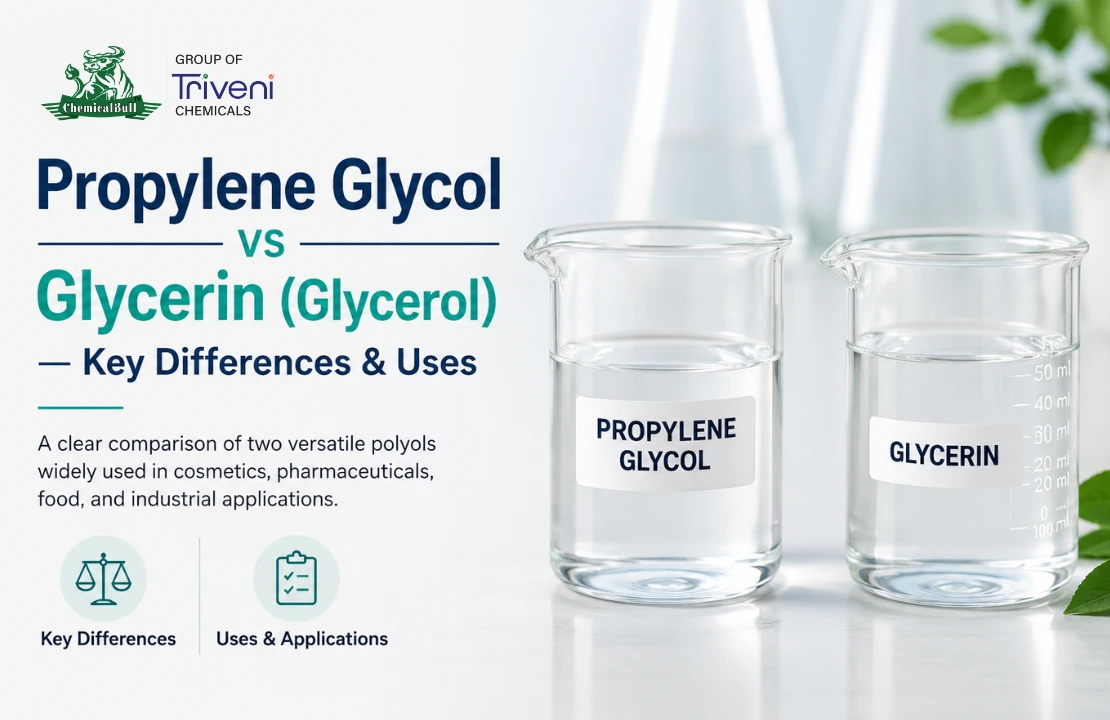
Propylene Glycol vs Glycerin (Glycerol): Key Differences and Uses
Two of the most commonly used ingredients in skin care, personal care, food, and pharmaceutical products are propylene glycol and glycerin (also called glycerine or glycerol). Both are clear, water-soluble liquids. Both attract and hold moisture. And both appear on the ingredient lists of hundreds of everyday products.
But they are different chemicals with different origins, different properties, and some important differences in how they are used. This guide answers the most common questions about both, compares them side by side, and helps you understand which one is right for your skin, your formulation, or your application.
For bulk supply of pharmaceutical- and cosmetic-grade propylene glycol with COA and MSDS, ChemicalBull is a trusted source among propylene glycol manufacturers in India, serving personal care brands, pharma companies, and industrial buyers across India and global markets.
What Is Propylene Glycol?
Propylene glycol is a synthetic, water-soluble liquid produced from petroleum-derived propylene oxide. It has the molecular formula C3H8O2 and CAS number 57-55-6. It is clear, odorless, and has a very mild sweet taste.
|
Property |
Details |
|
Chemical Name |
Propylene Glycol (1,2-Propanediol) |
|
CAS Number |
57-55-6 |
|
Molecular Formula |
C3H8O2 |
|
Molecular Weight |
76.09 g/mol |
|
Physical Form |
Clear, colorless liquid |
|
Boiling Point |
187°C |
|
Melting Point |
-60°C |
|
Flash Point |
107°C |
|
Solubility |
Miscible with water, ethanol, and acetone |
|
Taste |
Mild, slightly sweet |
Is Propylene Glycol Alcohol?
Is propylene glycol alcohol? and is propylene glycol is it alcohol? are very common question.
The answer is: not exactly. Propylene glycol belongs to a chemical class called glycols or diols. It does have two hydroxyl (-OH) groups, which technically make it a type of organic compound related to alcohols. However, it is not the same as drinking alcohol (ethanol) or rubbing alcohol (isopropanol). It does not cause intoxication, and it behaves very differently from common alcohols in formulations. It is more accurately described as a diol or polyol.
What Is Glycerin?
What is glycerin? And what is glycerine?
Glycerin (also spelled glycerine) is the common name for glycerol (IUPAC: 1,2,3-propanetriol). It is a naturally occurring compound that is derived from the plant oils (vegetable Glycerin) and animal fats that are byproducts of soap production as well as biodiesel production. The compound can also be produced by synthetic means.
Is Glycerine and Glycerol the Same?
Is glycerine and glycerol same? Yes, completely. All three names refer to the same compound:
- Glycerol is the chemical name
- Glycerin is the common commercial name (mainly used in the US)
- Glycerine is an alternative spelling (commonly used in the UK, India, and other markets)
They are all the same molecule with three hydroxyl groups, CAS number 56-81-5.
They are all the same molecule with three hydroxyl groups, CAS number 56-81-5.
|
Property |
Details |
|
Chemical Name |
Glycerol (1,2,3-Propanetriol) |
|
Common Names |
Glycerin, Glycerine |
|
CAS Number |
56-81-5 |
|
Physical Form |
Clear, viscous liquid |
|
Taste |
Sweet |
|
Solubility |
Fully miscible with water |
|
Boiling Point |
290°C |
|
Origin |
Plant-derived (vegetable), animal-derived, or synthetic |
Propylene Glycol vs Glycerin: Side-by-Side Comparison
|
Feature |
Propylene Glycol |
Glycerin (Glycerol) |
|
Chemical class |
Diol (2 OH groups) |
Triol (3 OH groups) |
|
Origin |
Synthetic (petroleum-derived) |
Natural or synthetic |
|
Viscosity |
Low (thin liquid) |
High (thick, syrupy) |
|
Skin feel |
Light, non-greasy |
Rich, slightly sticky |
|
Humectant strength |
Good |
Excellent (stronger) |
|
Skin penetration |
Better penetration enhancer |
Stays more on surface |
|
Solvent power |
Stronger solvent for actives |
Weaker solvent |
|
Safety for skin |
Safe at approved levels |
Very safe, widely used |
|
Natural claim |
No (synthetic) |
Yes (if vegetable-derived) |
|
Common uses |
Pharma, cosmetics, food, industrial |
Cosmetics, food, pharma, soap |
Propylene Glycol: Uses and Benefits
Propylene Glycol Uses in Skin Care
Propylene glycol for skin is used in many personal care and cosmetic formulations. It functions as a humectant that draws water to the skin and also as a penetration enhancer, aiding active ingredients in absorbing better.
Is propylene glycol safe for skin?
Yes. When used at the concentrations found in standard cosmetic and pharmaceutical products, propylene glycol is considered safe by major regulatory bodies, including the FDA, EU Cosmetics Regulation, and Health Canada.
Common products containing propylene glycol for skin:
- Face creams, moisturizers, and serums
- Sunscreens and body lotions
- Deodorants and hair conditioners
- Makeup foundations and primers
Propylene Glycol Cream Uses
Propylene glycol cream formulations are widely used in pharmaceutical dermatology. It acts as both a solvent and a carrier, helping active ingredients such as salicylic acid, urea, or antifungal agents penetrate the skin. Propylene glycol cream uses include treatment of dry skin conditions, psoriasis, eczema, fungal skin infections, and callus softening.
Propylene Glycol Side Effects
Propylene glycol side effects are uncommon at the levels used in consumer products. In rare cases, mainly in individuals with sensitive skin, it can cause mild irritation or contact dermatitis.
Is propylene glycol safe?
Yes, for most people and most uses. At standard cosmetic and pharmaceutical concentrations, it is well tolerated by the vast majority of people.
Glycerin: Uses and Benefits for Skin and Face
What Is Glycerin Used For?
What is the use of glycerin? And what is glycerine used for?
Glycerin is one of the most commonly used components in cosmetics. It's a potent humidifier that pulls water from the air as well as the deeper layers of skin on the surface to keep the skin moist.
Why glycerine is used in so many products: it is safe, effective, inexpensive, natural when vegetable-derived, and compatible with almost every other cosmetic ingredient.
What is the use of glycerine extends across skin care, hair care, pharmaceuticals, and food. It moisturizes, softens, preserves, and stabilizes formulations.
Glycerin for Skin and Face
Glycerin for skin, glycerine for skin, glycerin for face, and glycerine for face all refer to the same thing. Glycerin is one of the most effective and well-studied moisturizing ingredients for both face and body use.
Glycerin skin benefits:
- Draws water from the air and the deeper skin layer onto the outer layer.
- Increases the strength of the barrier to skin over time.
- Softens dry, rough, and flaky skin
- Eliminates the look of lines that are caused by dehydration
- Soothes sensitive or inflamed skin
- compatible with every skin type
Is glycerin good for skin? And is glycerine good for the skin?
Yes. It is one of the safest and most effective moisturizing ingredients in cosmetics, recommended for all skin types, including sensitive skin.
Is glycerin good for face?
Yes. Glycerine for face use provides deep hydration, helps makeup sit smoothly, calms redness, and keeps skin looking plump and healthy. Benefits of glycerin on face are well established in dermatology.
Glycerine benefits for skin and glycerine uses for face extend beyond just moisturization. Glycerin supports the skin's natural repair processes, reduces water loss through the skin surface, and improves overall skin texture with regular use.
How to Apply Glycerin on Face
How to apply glycerin on face and how to use glycerine:
- Pure glycerin is thick and sticky when used undiluted. Mix it with water or rose water (1 part glycerin to 3 parts water) before applying.
- Use a small amount of oil on the skin after washing it.
- Use it as a last step before SPF in the morning or as a hydrating step at night.
- Mix into your regular moisturizer for a hydration boost.
Which One Should You Use: Propylene Glycol or Glycerin?
|
If you need... |
Choose... |
|
A strong humectant for dry skin |
Glycerin |
|
A lighter, non-sticky moisturizer |
Propylene Glycol |
|
A natural-origin ingredient |
Glycerin (vegetable-derived) |
|
A penetration enhancer for actives |
Propylene Glycol |
|
A thick, rich feel for creams |
Glycerin |
|
A solvent for difficult-to-dissolve actives |
Propylene Glycol |
|
Maximum skin hydration on the face |
Glycerin |
|
A pharmaceutical carrier for topical medicines |
Propylene Glycol |
Both ingredients are safe. Both are effective. Many formulations use them together to combine their complementary properties: propylene glycol for its solvent and penetration enhancement, and glycerin for its superior humectant strength.
Frequently Asked Questions
1. What is propylene glycol?
It is a synthetic, water-miscible diol used as a humectant, solvent, and penetration enhancer in cosmetics, pharmaceuticals, and food products.
2. Is propylene glycol safe for skin?
Yes, at standard cosmetic and pharmaceutical concentrations, it is considered safe. Rare irritation can occur in sensitive individuals with concentrated products.
3. Is propylene glycol alcohol?
It belongs to the diol/glycol family and has chemical similarities to alcohols, but it is not ethanol or isopropanol and does not cause intoxication.
4. What is glycerin made from?
Glycerin is made from vegetable oils (vegetable glycerin), animal fats, or can be produced synthetically. It is a natural byproduct of soap making and biodiesel production.
5. Is glycerine and glycerol the same?
Yes. Glycerol, glycerin, and glycerine are all the same compound (1,2,3-propanetriol, CAS 56-81-5), just different names.
6. How to apply glycerin on face?
Dilute pure glycerin with water in a 1:3 ratio and apply to damp skin after cleansing. It can also be mixed into your regular moisturizer.
7. Can I use glycerine on my face every day?
Yes. Glycerine is gentle, safe, and suitable for daily use on all skin types when appropriately diluted.
Conclusion
Propylene glycol and glycerin are both valuable, safe, and widely used ingredients in skin care, personal care, food, and pharmaceutical products. Glycerin is the stronger humectant and the more natural option, making it ideal for facial moisturization, body care, and products where skin hydration is the primary goal. Propylene glycol is the more effective solvent and penetration enhancer, making it the preferred choice in pharmaceutical topicals, technical formulations, and products where carrying active ingredients into the skin matters most. In many formulations, both are used together for optimal performance.
For bulk pharmaceutical- and cosmetic-grade propylene glycol with COA, MSDS, and technical support, connect with Chemical Bull, a trusted name among propylene glycol manufacturers in India serving personal care brands, pharmaceutical manufacturers, and industrial buyers across India and global export markets.
Comment Section