Chemical Bull
602
10-Aug-2026
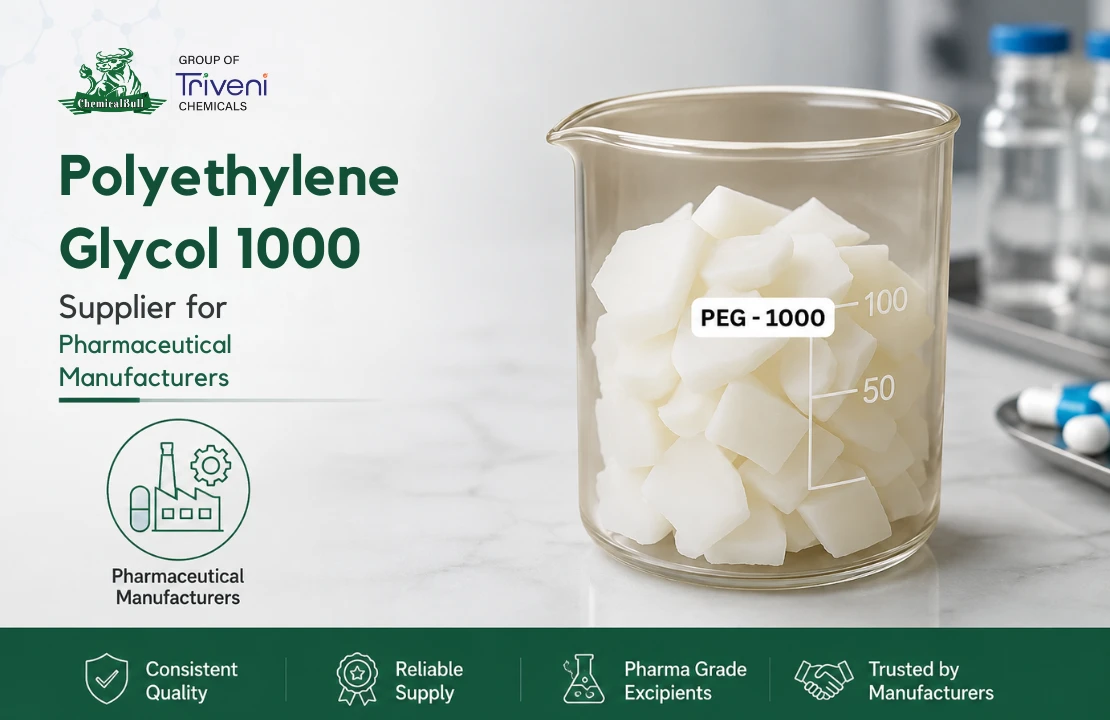
Polyethylene Glycol 1000 Supplier for Pharmaceutical Manufacturers
Polyethylene Glycol 1000 (PEG 1000) is a pharmaceutical-grade excipient with a long-established record of safe and effective use across multiple dosage form types. Listed in the United States Pharmacopeia (USP-NF), the British Pharmacopoeia (BP), and the European Pharmacopoeia (EP), PEG 1000 is accepted as a pharmaceutical ingredient globally and is used as a suppository base, tablet lubricant, ointment base, semi-solid capsule fill medium, and film coating plasticizer in both generic and innovator pharmaceutical manufacturing.
For pharmaceutical manufacturers, selecting the right PEG 1000 supplier is not simply a procurement decision. It is a quality assurance, regulatory compliance, and supply continuity decision that affects manufacturing operations, product quality, and audit readiness. Chemical Bull is a trusted polyethylene glycol 1000 supplier providing pharmaceutical-grade PEG 1000 with batch-specific COA, MSDS, and technical documentation to pharmaceutical manufacturers across India and international export markets. Contact our team today for bulk pricing, grade specifications, and sample requests.
What Is Polyethylene Glycol 1000?
Polyethylene Glycol 1000 is a synthetic polyether produced by polymerization of ethylene oxide to an average molecular weight of approximately 1000 g/mol. It is a white to off-white, soft waxy solid at room temperature with a melting point of approximately 37 to 40°C. This melting point is close to body temperature, giving PEG 1000 a unique combination of room-temperature structural integrity and body-temperature softening that is directly relevant to its pharmaceutical applications.
|
Property |
Details |
|
Chemical Name |
Polyethylene Glycol 1000 |
|
Molecular Weight |
1000 g/mol |
|
Physical Form |
White to off-white waxy solid |
|
Melting Point |
37 to 40°C |
|
Boiling Point |
235°C |
|
Flash Point |
160°C |
|
Solubility |
Soluble in water |
|
Pharmacopoeia Listing |
USP-NF, BP, EP |
|
CAS Number |
25322-68-3 |
|
Regulatory Status |
Approved pharmaceutical excipient (GRAS, FDA IIG listed) |
PEG 1000 as a Pharmaceutical Excipient: Key Applications
1. Suppository Base
Suppository formulation is one of the most established and critical pharmaceutical applications of PEG 1000. Suppository bases must meet demanding performance requirements: they must be solid and handleable at room temperature, melt or dissolve in rectal or vaginal fluids at body temperature (37°C), and release the active pharmaceutical ingredient (API) reliably for absorption.
Why PEG 1000 is used in suppository bases:
PEG 1000 is typically blended with higher molecular weight PEG grades such as PEG 4000 or PEG 6000 to achieve a suppository base with the correct melting range and consistency. Because PEG-based suppositories dissolve in rectal fluids rather than melting at body temperature (unlike fatty acid bases such as cocoa butter), they release the API by dissolution. This dissolution-based release mechanism is more predictable and temperature-stable during storage and distribution.
|
PEG Suppository Base Blend |
Characteristics |
|
PEG 1000 (high proportion) + PEG 4000 |
Softer base; faster dissolution; suitable for APIs requiring rapid release |
|
PEG 1000 (low proportion) + PEG 4000 |
Firmer base; slower dissolution; suitable for sustained effect |
|
PEG 1000 + PEG 6000 blend |
Harder base; suitable for tropical climate storage |
PEG-based suppository bases are preferred in tropical and warm climates because their dissolution-based release mechanism is unaffected by storage temperatures that would cause fatty acid bases to soften unacceptably.
2. Tablet Lubricant
As a water-soluble lubricant in tablet manufacturing, PEG 1000 (in solid or melt form) reduces friction between tablet granules and the die wall during compression, preventing tablet sticking and ejection problems.
Advantages of PEG 1000 as a tablet lubricant:
- Water-soluble: Unlike magnesium stearate, PEG 1000 does not create a hydrophobic film on granule surfaces. Water-soluble lubricants do not retard tablet disintegration or dissolution, which is critical for immediate-release tablet formulations.
- Melt lubrication: PEG 1000 can be applied as a melt lubricant by heating it above its melting point and spraying or blending it onto granules before compression.
- Compatible with most APIs and excipients: PEG 1000 does not react with most pharmaceutical ingredients, making it broadly compatible across tablet formulation platforms
- Acceptable for regulated markets: Listed in the FDA Inactive Ingredient Database and pharmacopoeia monographs for tablet lubricant use
Typical usage level in tablet formulation: 1% to 5%
3. Ointment Base
In topical pharmaceutical preparations, PEG 1000 is used in combination with other PEG grades to formulate official PEG ointment bases. The classic PEG ointment base formula blends a liquid PEG grade (PEG 400) with a solid grade (PEG 1000 or PEG 3350) to achieve the desired consistency.
Advantages of PEG ointment bases in pharmaceutical topical products:
- Water-washable: PEG ointment bases can be removed from skin with water, unlike petrolatum or lanolin bases
- Non-staining: Do not stain clothing or wound dressings
- Compatible with aqueous wound exudate: Suitable for wound care and burns topical products
- Good API release: Water miscibility facilitates API release from the base
- Stable: Longer shelf life than fatty acid-based ointments in some climates
PEG 1000 ointment base formulations are used in dermatological antibiotics, antifungal topical preparations, wound care products, and hemorrhoid preparations.
4. Semi-Solid Capsule Fill (Hard Capsule Melt Fill)
In hard gelatin capsule melt-fill technology, PEG 1000 serves as a semi-solid carrier for APIs. The API is dissolved or dispersed in molten PEG 1000 at temperatures above 40°C, filled into hard capsule shells at the melt stage, and allowed to solidify at room temperature.
Why PEG 1000 is used in melt-fill capsules:
- Melts cleanly above 37 to 40°C, allowing liquid fill at low process temperatures
- Dissolves or disperses many poorly water-soluble APIs effectively
- Forms a stable, homogeneous solid dispersion on cooling
- The melt-fill process can improve the apparent solubility and bioavailability of poorly soluble APIs by maintaining them in an amorphous or finely dispersed state in the PEG matrix.
5. Film Coating Plasticizer
For aqueous coatings of films for pellets and tablets, PEG 1000 is used as a plasticizer in polymer solutions (typically HPMC, hydroxypropylmethylcellulose HPMC or polyvinyl alcohol (PVA).
The plasticizer decreases the temperature of the glass transition (Tg) for the coating polymer. This makes the film more flexible and less susceptible to breaking during Tumbling and coating of the pan or tablet handling, as well as downstream processing procedures. PEG 1000's form is solid. It permits precise weighing and disintegrates completely inside the aqueous coating process.
Pharmaceutical Grade Requirements for PEG 1000
When sourcing PEG 1000 for pharmaceutical manufacturing, the grade and purity must conform to the applicable pharmacopoeia monograph; the USP-NF, BP, and EP each maintain specific monographs for PEG 1000 that define acceptable limits for:
|
Quality Parameter |
Pharmacopoeia Specification Purpose |
|
Average molecular weight |
Confirms product is PEG 1000 and not another grade |
|
Hydroxyl value |
Confirms degree of polymerization and end-group chemistry |
|
Melting point range |
Confirms correct grade for suppository and ointment base use |
|
Acid value |
Low acid value confirms chemical stability |
|
Water content (Karl Fischer) |
Low moisture prevents degradation and formulation issues |
|
Heavy metals |
Critical for oral and topical safety |
|
Residual ethylene oxide |
Critical for parenteral and oral use |
|
1,4-Dioxane |
Residual impurity from ethylene oxide reaction; strictly limited |
|
Colour (APHA) |
Low colour required for cosmetic-quality pharmaceutical products |
|
pH (5% solution) |
Confirms absence of acidic or alkaline impurities |
What Pharmaceutical Manufacturers Should Look for in a PEG 1000 Supplier
Choosing a PEG 1000 supplier for pharmaceutical use involves more than price comparison. The following criteria are standard in pharmaceutical supplier qualification:
Documentation and Regulatory Compliance
- Certificate of Analysis (COA): Batch-specific COA confirming all pharmacopoeia parameters for the specific grade supplied
- MSDS / SDS: Current Safety Data Sheet for safe handling, storage, and emergency response
- Technical Data Sheet (TDS): Full product specification and recommended use parameters
- Drug Master File (DMF): For regulated market supply (US FDA, EMA), a DMF or Active Substance Master File (ASMF) filed by the supplier enables pharmaceutical manufacturers to reference the supplier's quality documentation in their own regulatory submissions.
- GMP Certification: Manufacturing site Good Manufacturing Practice compliance documentation
- Pharmacopoeia Grade Certificate: Confirmation that the supplied material meets USP, BP, or EP monograph specifications as applicable
Supply Reliability
- Consistent batch-to-batch quality with low inter-batch variation in molecular weight and key quality parameters
- Secure supply chain with sufficient inventory capacity for commercial production requirements
- Flexible packaging options: 25 kg bags, 50 kg drums, bulk pallet quantities
- Domestic and international export capability with appropriate export documentation
Technical Support
- Availability of grade-specific application guidance for suppository, tablet, ointment, and capsule formulation use
- Responsive technical team for formulation support and documentation requests
- Sample availability for new supplier qualification processes
ChemicalBull as a PEG 1000 Supplier for Pharmaceutical Manufacturers
ChemicalBull supplies Polyethylene Glycol 1000 to pharmaceutical manufacturers across India and international markets with:
- Pharmaceutical-grade PEG 1000 meeting USP-NF, BP, and EP pharmacopoeia monograph requirements
- Batch-specific COA confirming molecular weight, hydroxyl value, melting point, water content, heavy metals, and other pharmacopoeia parameters.
- MSDS and TDS documentation for safe handling and formulation development
- Drug licence compliance for pharmaceutical ingredient supply in India
- ISO certification supporting quality management system requirements
- Bulk supply capability for commercial pharmaceutical manufacturing requirements
- Export-ready packaging with full documentation for international shipment
- 25 kg and 50 kg packaging as standard, with bulk options available on request
Frequently Asked Questions
1. What pharmacopoeia grades does PEG 1000 meet?
PEG 1000 is listed in and can be supplied to USP-NF, BP, and EP pharmacopoeia monograph specifications. Confirm the required pharmacopoeia grade with your supplier and request grade-specific COA documentation.
2. What is the melting point of pharmaceutical-grade PEG 1000?
Approximately 37 to 40°C, which is close to body temperature. This property is particularly relevant for suppository base formulation where body-temperature dissolution is part of the drug delivery mechanism.
3. What documentation is required when sourcing PEG 1000 for pharmaceutical use?
Standard requirements include batch-specific COA, MSDS, TDS, GMP certification from the manufacturing site, and a Drug Master File (DMF) or ASMF reference for regulated market submissions.
4. Can PEG 1000 be used as a suppository base alone?
PEG 1000 is usually blended with higher molecular weight PEG grades (PEG 4000, PEG 6000) to achieve the correct consistency and melting range for suppository use. The blend ratio is adjusted based on the target hardness, release rate, and storage climate requirements.
5. Is PEG 1000 approved for oral pharmaceutical formulations?
Yes. PEG 1000 is listed in the FDA Inactive Ingredient Database for oral dosage forms and is listed in the USP-NF. Confirm the specific route-of-administration approval and concentration limits applicable to your formulation with your regulatory team.
6. What packaging sizes are available for pharmaceutical-grade PEG 1000?
Standard packaging includes 25 kg bags and 50 kg containers. Bulk packaging and export-ready options are available on request. Contact your supplier to confirm available pack sizes and lead times.
7. How should pharmaceutical-grade PEG 1000 be stored?
Place in a cool, well-ventilated, dry area away from sources of heat in sealed containers. PEG 1000 can be hygroscopic. It must be kept away from humidity. It is recommended to store it at temperatures below 30°C.
Conclusion
For pharmaceutical manufacturers, PEG 1000 is a versatile, pharmacopoeia-listed excipient with established and validated use across suppository bases, tablet lubricants, ointment bases, hard capsule melt-fill systems, and film coating plasticizer applications. Qualifying the right supplier is as important as the product itself: pharmaceutical-grade PEG 1000 must be sourced from a supplier who can consistently deliver pharmacopoeia-compliant material with complete documentation, a GMP-compliant supply chain, and the technical support to assist formulation and regulatory teams through the supplier qualification process.
ChemicalBull meets these requirements as a trusted polyethylene glycol 1000 supplier with drug licence compliance, ISO certification, pharmaceutical-grade COA and MSDS documentation, and reliable bulk supply capability for pharmaceutical manufacturers across India and global export markets.
Comment Section