Chemical Bull
137
07-Aug-2026
Quick Answer
Carbitol (diethylene glycol monoethyl ether, CAS 111-90-0) is used in textile printing mainly as a dye and pigment solvent, helping dissolve dyestuffs for even distribution in printing pastes, and as a carrier solvent that improves dye penetration and leveling on fabric during screen and roller printing. Its strong solvency for a wide range of dyes, combined with water miscibility and a relatively high boiling point, makes it useful for maintaining print paste stability and consistent color yield during textile printing operations.
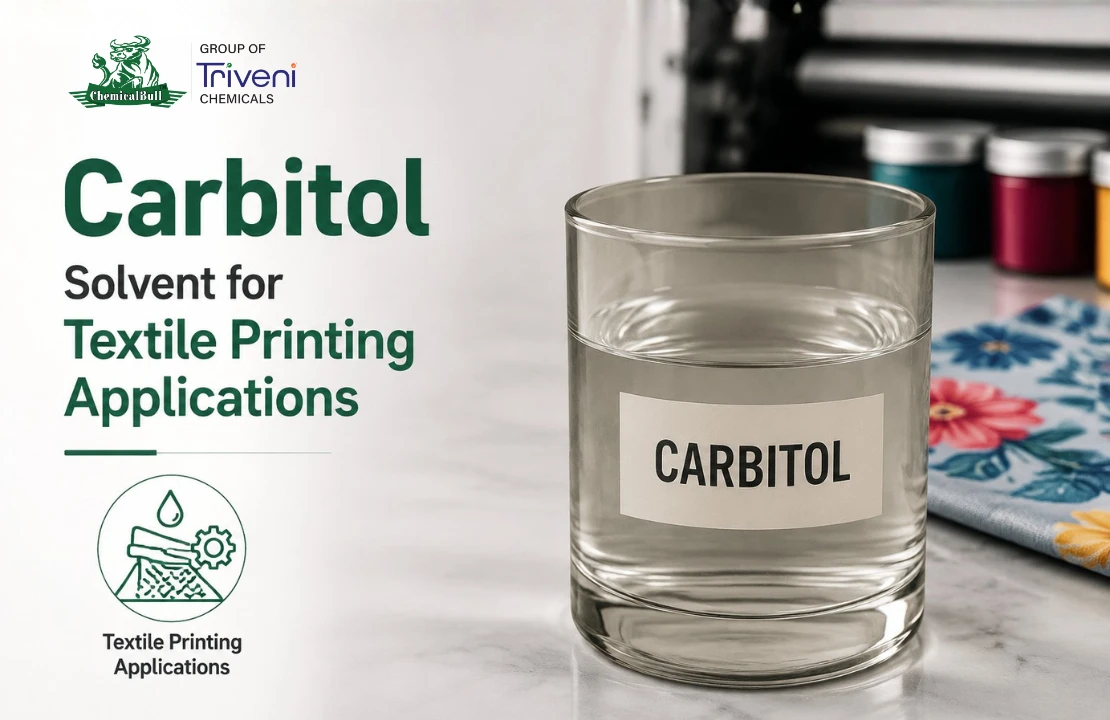
Carbitol plays a particularly established role in the field of textile printing, which is distinct from its wider usage as a solvent for industrial coatings, inks, and brake fluids. Carbitol acts as a carrier and solvent for dyestuffs used in printing pastes. It helps dyes dissolve completely and spread uniformly before applying to fabrics. Since textile printing demands precise control of paste viscosity, dry performance, and choosing the right solvent directly affects the quality of print, the consistency of color, as well as the shelf stability of the paste. This document focuses on the role of Carbitol in formulations for printing -- its properties that make it effective and how it can be applied to various printing techniques, and the things to consider when defining its use in a printing paste.
Sourcing Carbitol for a textile printing paste formulation?
Chemical Bull is adependable Carbitol supplier can help ensure consistent purity and moisture content, which matters for predictable dye solubility and print paste behavior batch to batch.
Chemical Identity and Properties
|
Property |
Details |
|
Chemical Name |
Diethylene Glycol Monoethyl Ether (Carbitol) |
|
CAS Number |
111-90-0 |
|
Chemical Formula |
C₆H₁₄O₃ |
|
Molecular Weight |
134.17 g/mol |
|
Appearance |
Colorless, stable liquid with a mild, pleasant odor |
|
Boiling Point |
~196°C |
|
Density |
~0.99 g/cm³ (25°C) |
|
Solubility |
Fully miscible with water, alcohols, and most organic solvents |
|
Hygroscopicity |
Hygroscopic; absorbs moisture from air if left uncapped |
|
Flash Point |
~96°C (closed cup) |
Why Carbitol Works Well in Textile Printing Pastes
Broad dye solvency:
Carbitol's ether-alcohol structure gives it strong solvency for a wide range of dyestuffs, including disperse, acid, and reactive dyes used across different fiber types. This versatility is one reason it remains a standard carrier solvent across multiple printing dye classes, rather than requiring a different solvent for each dye chemistry.
Water miscibility with controlled evaporation:
Because Carbitol is fully miscible with water, it integrates smoothly into aqueous print paste systems without requiring co-solvents or emulsifying aids. At the same time, its relatively high boiling point (~196°C) slows evaporation during printing and drying, helping maintain paste consistency during a printing run rather than drying out prematurely on the screen or roller a common problem with lower-boiling glycol ethers in continuous printing operations.
Supports even dye penetration:
By keeping dye fully dissolved and distributed within the paste, Carbitol helps promote uniform dye uptake into the fabric, supporting more consistent color depth across a printed run and reducing the risk of uneven, patchy printing that can occur when dye particles aren't fully solubilized before application.
Compatibility with print paste thickening systems:
Carbitol generally integrates well with the thickening agents commonly used in textile print pastes, including natural thickeners like sodium alginate and various synthetic thickener systems, without disrupting paste rheology when used at appropriate concentrations.
How Carbitol Is Used in Textile Printing
1. Dye Solubilization in Print Pastes
Carbitol dissolves dyestuffs fully into the print paste base, preventing undissolved dye particles that could cause specking, uneven color, or blocked screens during printing. This is particularly important for dyes with limited water solubility on their own, where a co-solvent like Carbitol is what allows the dye to fully dissolve into an otherwise aqueous paste system.
2. Carrier Solvent for Dye Penetration
As a carrier, Carbitol helps dye molecules move into the fiber structure more effectively during the fixation stage that follows printing (whether steaming, curing, or thermofixation). Better dye penetration supports improved color yield and wash/rub fastness properties in the finished printed fabric, since dye that penetrates the fiber rather than sitting on the surface tends to bond more securely.
3. Print Paste Viscosity and Stability Support
Beyond dissolving dye, Carbitol's compatibility with common thickening agents supports a stable paste consistency throughout a printing run. This matters especially in rotary and flat-bed screen printing, where viscosity drift over the course of a run can visibly affect print sharpness, edge definition, and color consistency from the first meter of fabric printed to the last.
4. Slow-Drying Solvent for Screen and Roller Printing
Its relatively slow evaporation rate compared to lower-boiling glycol ethers (such as Cellosolve/ethylene glycol monoethyl ether) helps prevent premature drying on screens or rollers during continuous printing operations. This is particularly relevant in rotary screen printing, where the print paste sits on the screen surface for extended periods between print cycles, and premature drying can cause screen blocking and require frequent cleaning stops.
5. Pigment Printing Applications
While most associated with dye-based printing, Carbitol also finds use in pigment printing formulations as a co-solvent that assists binder film formation and helps achieve smoother, more even pigment distribution across the printed surface.
Carbitol vs. Other Glycol Ether Solvents Used in Textile Printing
|
Solvent |
Boiling Point |
Relative Evaporation Rate |
Typical Textile Printing Role |
|
Carbitol (DEGEE) |
~196°C |
Slow |
General dye solvent, extended open-time printing |
|
Butyl Carbitol (DEGBE) |
~231°C |
Very slow |
Used where even longer open time is needed |
|
Cellosolve (EGEE) |
~135°C |
Fast |
Faster-drying applications; less common in continuous runs |
|
Ethylene Glycol |
~197°C |
Slow |
Occasionally used as a humectant/co-solvent in paste formulations |
Choosing between these solvents largely comes down to the printing method and run length — faster continuous rotary printing generally favors slower-evaporating solvents like Carbitol or Butyl Carbitol to avoid mid-run screen drying, while shorter batch print runs have more flexibility.
Formulation Guidance
|
Textile Printing Application |
Typical Usage Level |
|
Disperse dye print pastes |
3% to 8% of paste formulation |
|
Reactive dye print pastes |
2% to 6% |
|
Acid dye print pastes (protein fibers) |
3% to 7% |
|
Pigment print paste co-solvent |
1% to 4% |
Key formulation notes:
- Confirm compatibility between Carbitol and your specific thickener system (alginate vs. synthetic) during trial runs, since interaction with the thickening agent affects final paste rheology and can shift viscosity outside your target range if not accounted for
- Because Carbitol is hygroscopic, store it in tightly sealed containers to avoid moisture pickup that could subtly shift paste viscosity and dye solubility over time — this is a common, avoidable cause of batch-to-batch inconsistency in printing operations.
- Print paste performance should always be validated with a small trial batch on your actual fabric and dye combination before scaling to full production, since fiber type and dye class both influence optimal Carbitol loading.
- When switching between dye classes or fiber types, re-verify your Carbitol loading rather than assuming a fixed percentage works universally, since solvency requirements differ meaningfully between disperse dyes (used on synthetics) and reactive dyes (used on cellulosic fibers)
Storage and Handling for Printing Operations
- Container integrity: Keep containers tightly sealed between uses; Carbitol's hygroscopic nature means even brief open-air exposure in humid printing floor environments can allow moisture uptake
- Storage temperature: Store at moderate ambient temperature away from direct heat sources, given its flash point of approximately 96°C
- Oxidation note: Like other glycol ethers, Carbitol can slowly form peroxides on prolonged exposure to air; avoid long-term storage of partially used containers and rotate stock using a first-in, first-out approach
- Handling area ventilation: Standard solvent-handling ventilation practices apply in paste mixing areas, consistent with general industrial solvent handling protocols
Frequently Asked Questions
1. What is Carbitol used for in textile printing?
Carbitol is used as a dye and pigment solvent in print pastes, helping dissolve dyestuffs evenly and improving dye penetration and leveling on fabric during screen and roller printing.
2. What is the CAS number for Carbitol?
CAS 111-90-0, also known as diethylene glycol monoethyl ether or DEGEE.
3. Why is Carbitol preferred over faster-evaporating solvents in print pastes?
Its relatively high boiling point (~196°C) slows evaporation during printing, helping maintain consistent paste viscosity and preventing premature drying on screens or rollers during a printing run, particularly in continuous rotary printing.
4. Is Carbitol compatible with different dye classes?
Yes, Carbitol's solvency profile works across disperse, acid, and reactive dye systems, though usage levels should be validated for your specific dye and fiber combination since optimal loading varies by dye chemistry.
5. Does Carbitol affect print paste viscosity?
It can interact with the thickening agent used in the paste (such as alginate or synthetic thickeners), so compatibility should be confirmed during formulation trials to avoid unwanted viscosity drift over a printing run.
6. How does Carbitol compare to Butyl Carbitol in textile printing?
Both are slow-evaporating glycol ethers suited to extended print runs, but Butyl Carbitol has an even higher boiling point and slower evaporation rate, making it preferable where exceptionally long open time is required, while Carbitol offers a good general-purpose balance for most standard printing operations.
7. Does Carbitol need special storage precautions in a textile printing facility?
Yes because it's hygroscopic and can slowly form peroxides on prolonged air exposure, containers should be kept tightly sealed, stored away from heat sources, and used on a first-in, first-out basis rather than holding partially used containers for extended periods.

Comment Section