Chemical Bull
218
06-Aug-2026
Introduction: Why Sodium Tripolyphosphate Is Important for Industries
Many industries need raw materials that can improve cleaning performance, water softening, dispersion, processing stability and product quality. Sodium Tripolyphosphate, commonly known as STPP, is one such industrial chemical used across detergent manufacturing, industrial cleaning, water treatment, ceramic processing, textile processing, food-grade applications and specialty formulations.
Sodium Tripolyphosphate is mainly valued because it can bind hardness minerals, support surfactant performance, disperse particles and help formulations work more consistently. This makes it useful for manufacturers who need better cleaning action, stable processing and reliable product performance.
For B2B buyers, Sodium Tripolyphosphate should not be selected only by price. Grade, purity, solubility, particle size, packing size, COA, TDS, SDS and application suitability should also be checked before bulk purchase. This blog explains Sodium Tripolyphosphate applications across industries in simple language for manufacturers, formulators, traders and procurement teams.
Quick Answer: What Is Sodium Tripolyphosphate Used For?
Sodium Tripolyphosphate is used in detergent manufacturing, industrial cleaning, water treatment, ceramic processing, textile processing, food processing and specialty industrial formulations. It works as a water softener, detergent builder, dispersing agent, sequestrant and processing aid depending on the application.
For bulk requirements, buyers should choose a reliable Sodium Tripolyphosphate Supplier that can provide suitable grade options, packing details, COA, TDS, SDS and consistent supply support for industrial production.
What Is Sodium Tripolyphosphate?
Sodium Tripolyphosphate is an inorganic phosphate compound used in different manufacturing and formulation processes. It is commonly available as a white powder or granular material. In many industries, it is known for its water-softening, dispersing and cleaning-support properties.
In detergent and cleaning products, Sodium Tripolyphosphate helps improve cleaning efficiency by reducing the effect of hard water. In ceramic processing, it helps disperse particles in slurry systems. In water treatment and industrial processes, it may support sequestration and mineral control. In selected food applications, food-grade STPP may be used where permitted and properly approved.
Industrial grade and food grade Sodium Tripolyphosphate are not the same. Buyers should always select the correct grade according to their application and documentation requirement.
Sodium Tripolyphosphate Basic Details
|
Point |
Details |
|
Product Name |
Sodium Tripolyphosphate |
|
Short Name |
STPP |
|
Chemical Formula |
Na5P3O10 |
|
CAS Number |
7758-29-4 |
|
Appearance |
White powder or granules |
|
Chemical Type |
Inorganic phosphate |
|
Common Role |
Water softener, builder, dispersing agent and processing aid |
|
Main Industries |
Detergents, cleaning, water treatment, ceramics, textiles and food processing |
|
Documents Buyers Check |
COA, TDS and SDS |
Why Manufacturers Use Sodium Tripolyphosphate
Manufacturers use Sodium Tripolyphosphate because it can support different industrial needs. It is not limited to one sector. It is useful in formulations where water quality, cleaning strength, particle dispersion or processing consistency matters.
Supports Water Softening
Hard water contains minerals such as calcium and magnesium. These minerals can reduce cleaning efficiency and affect formulation performance. Sodium Tripolyphosphate helps bind hardness ions, making it useful in detergents and cleaning products.
Improves Detergent Performance
In detergent formulations, STPP works as a builder. It helps surfactants perform better by reducing water hardness and improving soil removal. This is one of the main reasons it is widely used in powdered detergents and industrial cleaning systems.
Helps Disperse Particles
In ceramic, pigment and industrial systems, particle dispersion is important. Sodium Tripolyphosphate helps distribute particles more evenly, making processing smoother and more consistent.
Supports Industrial Processing
STPP can support processing in ceramics, textiles, water treatment and industrial formulations. Its role depends on grade, dosage, process conditions and the complete formulation.
Major Sodium Tripolyphosphate Applications Across Industries
Sodium Tripolyphosphate is used in many industries because it can support cleaning, dispersion, water softening and processing control. Below are the major application areas.
Sodium Tripolyphosphate in Detergent Manufacturing
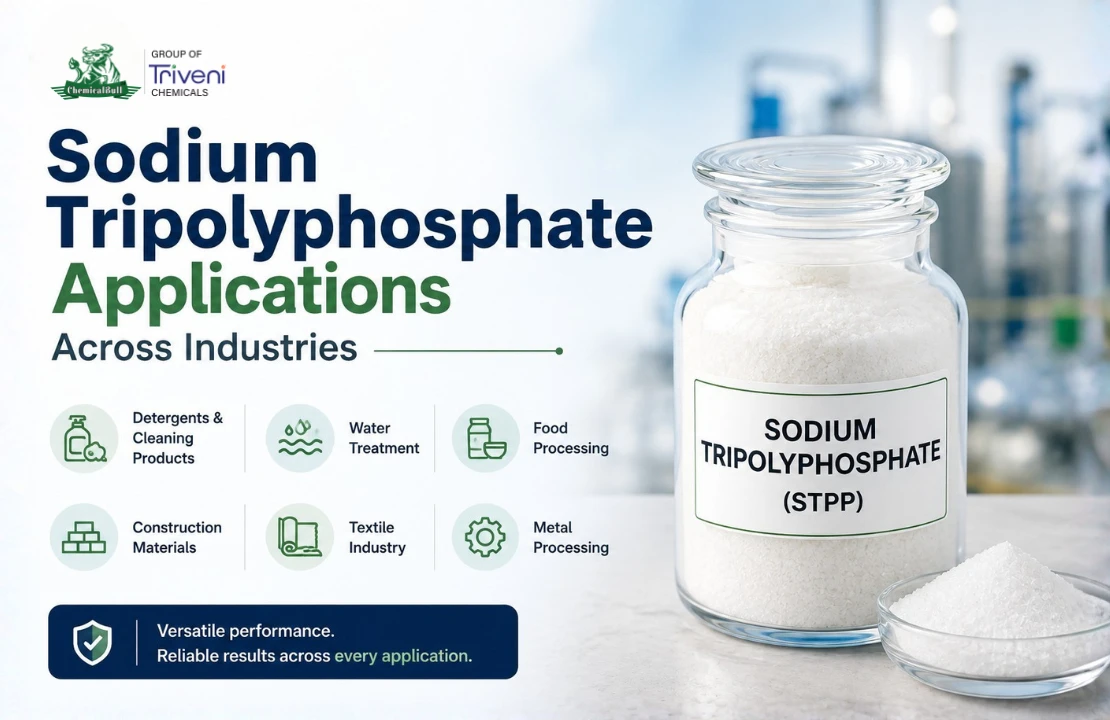
One of the most common uses of Sodium Tripolyphosphate is in detergent manufacturing. It is widely used as a detergent builder, especially in powdered detergent formulations.
In laundry detergents, STPP helps soften water and improve the performance of surfactants. It supports better removal of dirt, grease and stains. It also helps keep soil particles suspended in the wash water, reducing redeposition on fabrics.
In dishwashing powders and cleaning products, Sodium Tripolyphosphate can improve cleaning efficiency and help maintain formulation performance in hard water conditions.
Common detergent applications include:
-
laundry detergent powders
-
dishwashing powders
-
household cleaning products
-
institutional cleaning products
-
industrial detergent formulations
Sodium Tripolyphosphate in Industrial Cleaning Products
Industrial cleaning products often need stronger performance than regular household cleaners. They may be used in factories, workshops, processing units, commercial kitchens and institutional cleaning systems.
Sodium Tripolyphosphate helps improve cleaning performance by supporting water softening and soil dispersion. It can help cleaning products work better in hard water and support removal of grease, oil, dirt and industrial residues.
In these applications, STPP is usually used with surfactants, alkalies, solvents or other cleaning ingredients. The final performance depends on the full formula, surface type, dosage and cleaning method.
Sodium Tripolyphosphate in Water Treatment
Sodium Tripolyphosphate may be used in water treatment and industrial water systems where mineral control, sequestration or scale-control support is required. It can help bind metal ions and reduce the effect of hardness minerals.
In some industrial processes, water quality can affect equipment performance, cleaning efficiency and product consistency. STPP may support better control of hardness minerals in selected systems.
However, its use in water treatment should always be checked according to local regulations, system design, dosage and water chemistry.
Sodium Tripolyphosphate in Ceramic Processing
Sodium Tripolyphosphate is used in ceramic processing as a dispersing agent. Ceramic manufacturing often uses slurry systems where fine particles must remain evenly distributed.
STPP helps improve dispersion of ceramic particles and may reduce slurry viscosity. This can make the ceramic mixture easier to process and more consistent during production.
Common ceramic applications include:
-
ceramic slurry preparation
-
tile manufacturing
-
sanitaryware production
-
ceramic body processing
-
glaze preparation
In ceramic processing, the right dosage is important. Too much or too little dispersing agent can affect slurry behaviour and final product quality.
Sodium Tripolyphosphate in Textile Processing
Sodium Tripolyphosphate may be used in textile processing where water softening, cleaning support or process control is required. Textile operations often depend on water quality, especially during washing, scouring and treatment stages.
STPP can help reduce the effect of hardness minerals and support better cleaning or processing performance. It may be used in selected textile auxiliary systems depending on fabric type, dye compatibility and process conditions.
Before commercial use, textile processors should check compatibility with dyes, surfactants, finishing agents and other process chemicals.
Sodium Tripolyphosphate in Food Processing
Food-grade Sodium Tripolyphosphate may be used in selected food processing applications where permitted. It is commonly associated with moisture retention, texture support and processing control in approved food systems.
Food-grade STPP may be used in seafood, processed meat and other food applications depending on local regulations and permitted use levels. However, buyers must be very careful here. Industrial-grade Sodium Tripolyphosphate should not be used in food applications.
Food processors should confirm:
-
food-grade quality
-
permitted usage
-
regulatory documents
-
purity specification
-
supplier compliance support
-
correct documentation
Sodium Tripolyphosphate in Paints, Pigments and Industrial Formulations
Sodium Tripolyphosphate may be used in selected industrial formulations where dispersion support is required. It can help improve distribution of solid particles in water-based systems.
In paints, pigments and specialty formulations, STPP may support pigment dispersion, suspension stability and processing control. Its suitability depends on pH, solids content, additive system and final application.
Manufacturers should test the product in the actual formulation before using it in bulk production.
Sodium Tripolyphosphate Industrial Application
|
Industry |
Main Role of Sodium Tripolyphosphate |
|
Detergent manufacturing |
Builder and water softener |
|
Industrial cleaning |
Cleaning support and hardness control |
|
Water treatment |
Sequestration and scale-control support |
|
Ceramic processing |
Dispersing agent for slurry systems |
|
Textile processing |
Water softening and processing support |
|
Food processing |
Moisture and texture support in approved food-grade applications |
|
Paints and pigments |
Dispersion and formulation support |
|
Specialty formulations |
Processing aid and compatibility support |
Benefits of Sodium Tripolyphosphate for Industrial Buyers
Sodium Tripolyphosphate is selected by industrial buyers because it supports many production and formulation requirements.
|
Benefit |
Why It Matters |
|
Water softening support |
Helps improve cleaning performance in hard water |
|
Builder action |
Supports detergent and cleaning formulations |
|
Dispersing ability |
Helps distribute particles in ceramics and industrial systems |
|
Multi-industry use |
Useful in detergents, ceramics, textiles, water treatment and more |
|
Processing support |
Helps improve consistency in selected manufacturing processes |
|
Bulk availability |
Suitable for industrial procurement and repeat production |
|
Document support |
COA, TDS and SDS help quality, safety and purchase teams |
How to Select Sodium Tripolyphosphate for Industrial Use
B2B buyers should select Sodium Tripolyphosphate based on the final application. The same grade may not be suitable for every industry. A detergent-grade product may not meet food-grade requirements, and a food-grade product may not be necessary for technical use.
Check Grade and Purity
Grade and purity are important because they affect product performance and compliance. Buyers should confirm whether the material is suitable for detergent, ceramic, textile, food, water treatment or industrial formulation use.
Check Physical Form and Solubility
Sodium Tripolyphosphate is generally available as powder or granules. Buyers should check particle size, solubility and handling properties according to their production process.
Check Application Suitability
Before using STPP in large-scale manufacturing, buyers should test it in the actual formulation or process. This helps confirm cleaning performance, dispersion, stability, compatibility and final product quality.
Check COA, TDS and SDS
COA confirms batch quality. TDS provides technical product information. SDS gives safety, handling and storage guidance. These documents are important for purchase teams, quality teams, production teams and safety teams.
Verify Packing and Bulk Supply Availability
Bulk buyers should confirm packing size, availability, lead time, delivery location and supply consistency. This helps avoid production delays and last-minute procurement issues.
Sodium Tripolyphosphate Buying Support
When sourcing Sodium Tripolyphosphate for industrial applications, buyers should review grade, purity, solubility, particle size, packing size, COA, TDS, SDS, availability and delivery timeline.
Pricing may vary based on grade, specification, order quantity, packaging, documentation and delivery location. For quotation support, share your required quantity, application, packing preference and destination with Chemical Bull.
Conclusion
Sodium Tripolyphosphate is a widely used industrial chemical with applications in detergent manufacturing, industrial cleaning, water treatment, ceramic processing, textile processing, food-grade applications, paints, pigments and specialty formulations. It is valued for water softening, builder action, dispersion support and processing benefits.
For B2B buyers, the right STPP selection depends on grade, purity, physical form, solubility, application, COA, TDS, SDS, packing and bulk availability. Choosing the correct grade and testing it in the final process can help improve product quality, consistency and production reliability.
Frequently Asked Questions
-
What is Sodium Tripolyphosphate used for?
Sodium Tripolyphosphate is used in detergents, industrial cleaning, water treatment, ceramics, textile processing, food processing and industrial formulations. It works as a water softener, builder, dispersing agent and processing aid. -
What is the formula of Sodium Tripolyphosphate?
The chemical formula of Sodium Tripolyphosphate is Na5P3O10. -
What is the CAS number of Sodium Tripolyphosphate?
The CAS number of Sodium Tripolyphosphate is 7758-29-4. -
Why is Sodium Tripolyphosphate used in detergent manufacturing?
Sodium Tripolyphosphate is used in detergent manufacturing because it softens water, supports surfactant performance and helps improve cleaning efficiency. -
Is Sodium Tripolyphosphate used in ceramics?
Yes, Sodium Tripolyphosphate is used in ceramic processing as a dispersing agent. It helps improve slurry dispersion and processing consistency. -
Is Sodium Tripolyphosphate used in food processing?
Food-grade Sodium Tripolyphosphate may be used in selected food processing applications where permitted. Buyers must use proper food-grade material and check regulatory requirements. -
Where can I buy Sodium Tripolyphosphate in bulk?
B2B buyers can source Sodium Tripolyphosphate in bulk from chemical suppliers that provide grade details, packing support, COA, TDS, SDS and delivery assistance. Chemical Bull supports industrial buyers with bulk chemical sourcing and quotation support.

Comment Section