Chemical Bull
413
05-Aug-2026
Introduction: Why Cosmetic Manufacturers Use PEG-40 HCO
Cosmetic manufacturers often need ingredients that help oil-based materials mix properly into water-based products. Fragrance oils, essential oils and other oil-soluble ingredients may separate, turn cloudy or affect product appearance when they are not properly solubilized.
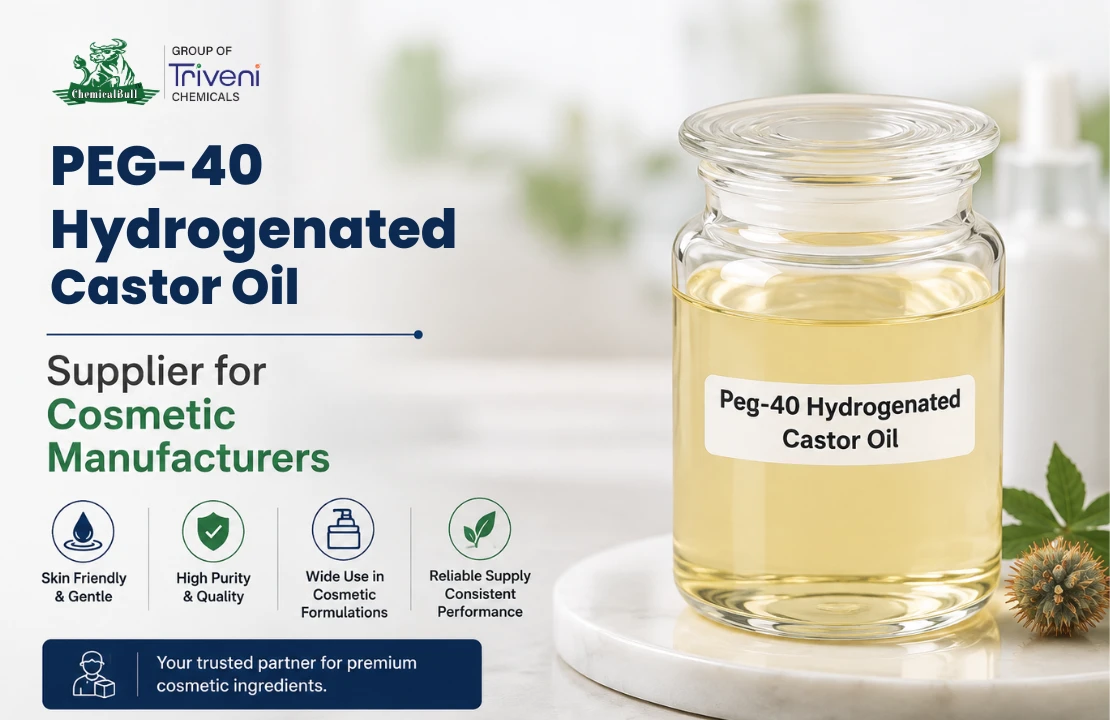
PEG-40 Hydrogenated Castor Oil, also known as PEG-40 HCO, is widely used in cosmetic and personal care formulations as a solubilizer, emulsifier and non-ionic surfactant. It helps disperse fragrance oils, essential oils and selected oil-soluble ingredients in products such as face wash, shampoo, body wash, toner, micellar water, perfume sprays, creams and lotions.
For B2B buyers, the right PEG-40 HCO should be selected by checking appearance, odour, HLB value, solubilizing performance, COA, TDS, SDS, packing size and bulk availability. Cosmetic manufacturers should choose a reliable PEG-40 Hydrogenated Castor Oil supplier that can support consistent quality, wholesale packaging and documentation for repeat production.
Quick Answer: What Is PEG-40 Hydrogenated Castor Oil Used For?
PEG-40 Hydrogenated Castor Oil is used in cosmetics as a solubilizer, emulsifier, non-ionic surfactant and oil-dispersing ingredient. It helps mix fragrance oils, essential oils and other oil-soluble materials into water-based and emulsion-based cosmetic products. It is commonly used in skin care, hair care, face wash, body wash, shampoo, toners, micellar water, perfume sprays, creams and lotions.
What Is PEG-40 Hydrogenated Castor Oil?
PEG-40 Hydrogenated Castor Oil is a hydrogenated castor-oil-based ingredient modified with polyethylene glycol chains. In simple words, it helps oil-based ingredients become more compatible with water-based cosmetic formulations.
It is mainly used where clarity, fragrance solubilization, product stability and uniform appearance are important. PEG-40 HCO is not a direct-use skin care product. It is a formulation ingredient used inside finished cosmetic and personal care products.
PEG-40 HCO CAS No., HLB Value and Basic Details
|
Point |
Details |
|
Product Name |
PEG-40 Hydrogenated Castor Oil |
|
Short Name |
PEG-40 HCO |
|
CAS No. |
61788-85-0 |
|
INCI Name |
PEG-40 Hydrogenated Castor Oil |
|
HLB Value |
Around 14–16, commonly listed near 15 |
|
Product Type |
Ethoxylated hydrogenated castor oil derivative |
|
Common Function |
Solubilizer, emulsifier and non-ionic surfactant |
|
Appearance |
Clear to pale yellow liquid or semi-solid, depending on grade and temperature |
|
Main Use |
Cosmetic and personal care formulations |
|
Documents Buyers Check |
COA, TDS and SDS |
Why PEG-40 HCO Is Used in Cosmetic Formulations
Cosmetic products often contain water, fragrance, oils, surfactants and skin-feel ingredients. Oil-based ingredients do not mix easily in water-rich products. PEG-40 HCO helps reduce this issue by improving oil dispersion and supporting a more uniform product.
Helps Solubilize Fragrance Oils
Fragrance oils are commonly used in personal care products, but they can separate in water-based formulas. PEG-40 HCO helps disperse fragrance oils more evenly in toners, sprays, micellar water, cleansers and body care formulations.
For a deeper explanation of how this ingredient supports oil dispersion in water-based systems, read our detailed guide on how PEG-40 Hydrogenated Castor Oil works as a solubilizer.
Supports Essential Oil Dispersion
Essential oils are also oil-soluble and may not blend properly in water-based cosmetic products. PEG-40 HCO helps improve dispersion depending on the oil type, use level, fragrance load and complete formulation.
Works as a Non-Ionic Surfactant
PEG-40 HCO is a non-ionic surfactant. This means it can work in many cosmetic systems without carrying a strong electrical charge. It may be suitable in selected skin care, hair care, cleansing and fragrance products.
Helps Improve Product Clarity and Stability
In products such as toners, sprays and micellar water, clarity and stability are important. PEG-40 HCO can help reduce separation and support a more uniform appearance when used at the right level.
PEG-40 HCO Uses in Cosmetic and Personal Care Products
PEG-40 HCO is used in many cosmetic and personal care products because it supports fragrance solubilization, emulsification and product uniformity.
PEG-40 HCO is one of the many cosmetic ingredients used in daily-use personal care products. Buyers can also explore our guide on the usage of cosmetics chemicals in daily life to understand how raw materials support products such as cleansers, shampoos, creams, lotions and fragrances.
Skin Care Products
In skin care formulations, PEG-40 HCO helps solubilize oils, fragrance and selected oil-soluble materials. It may be used in toners, face mists, serums, lotions, creams and cleansing products.
Face Wash and Cleansers
Face wash and cleansers often contain surfactants, fragrance and conditioning ingredients. PEG-40 HCO can help incorporate fragrance oils and improve the overall blend of the formula.
Its suitability depends on the surfactant system, pH, fragrance load and clarity requirement.
Toners and Micellar Water
Toners and micellar water are usually water-based products where clarity and stability matter. PEG-40 HCO can help solubilize small amounts of fragrance, essential oils or oily ingredients in these systems.
Manufacturers should test the final product for clarity, odour, stability and skin feel before commercial use.
Shampoos and Body Wash
In shampoo and body wash, PEG-40 HCO may help with fragrance solubilization and oil dispersion. It supports uniform distribution of fragrance and oil-based components in rinse-off formulations.
The final result depends on surfactant type, salt level, fragrance load, viscosity and formulation pH.
Perfume Sprays and Fragrance Products
PEG-40 HCO is used in selected fragrance products where fragrance oils need to be dispersed into water or water-alcohol systems. It can help improve fragrance distribution and reduce separation.
For clear spray products, formulators should balance fragrance oil, solubilizer level, alcohol content and water content.
Creams, Lotions and Personal Care Formulations
In creams and lotions, PEG-40 HCO may support emulsification and oil-phase compatibility. It can help improve the distribution of fragrance and selected oily materials in emulsion systems.
It is generally used along with other emulsifiers, thickeners, emollients and stabilizers depending on the formula.
Benefits of PEG-40 HCO for Cosmetic Manufacturers
PEG-40 HCO is selected by cosmetic manufacturers because it supports smoother formulation development and product consistency.
|
Benefit |
Why It Matters |
|
Helps solubilize fragrance oils |
Supports better fragrance distribution |
|
Supports essential oil dispersion |
Helps reduce separation in water-based products |
|
Non-ionic nature |
Useful in many cosmetic systems |
|
Helps improve clarity |
Important for toners, sprays and micellar water |
|
Supports product stability |
Helps create a more uniform formulation |
|
Multi-product use |
Suitable for skin care, hair care, cleansers and sprays |
|
Bulk supply suitability |
Supports repeat production needs |
|
Document support |
COA, TDS and SDS help quality and purchase teams |
PEG-40 Hydrogenated Castor Oil vs. Castor Oil Ethoxylate: What’s the Difference?
PEG-40 Hydrogenated Castor Oil and Castor Oil Ethoxylate are both castor-oil-based surfactant ingredients, but they are not always used in the same way.
|
Point |
||
|
Base |
Hydrogenated castor oil derivative |
Castor oil ethoxylate derivative |
|
Common Use |
Cosmetics and personal care solubilization |
Agrochemical, textile, cleaning and industrial formulations |
|
Main Function |
Solubilizer, emulsifier and non-ionic surfactant |
Emulsifier, wetting agent and dispersing aid |
|
Typical Applications |
Toners, cleansers, sprays, creams and lotions |
EC, EW, SC, SE, OD, cleaning and textile systems |
|
Selection Factor |
Fragrance solubilization and cosmetic compatibility |
EO grade, HLB, active compatibility and formulation type |
Cosmetic manufacturers should not treat all castor-oil-based surfactants as interchangeable. The right product depends on formulation type, clarity target, oil load, fragrance level and end-use application.
How to Select a Cosmetic Grade PEG-40 HCO Supplier
For cosmetic production, buyers should check more than only price. The selected grade should match the final product requirement and should come with proper documents and supply support.
Check Appearance and Odour
Appearance and odour are important for cosmetic use. Buyers should check whether the product is suitable for clear, lightly coloured or fragrance-sensitive formulations.
Check Solubilizing Performance
Different fragrance oils and essential oils need different solubilizer levels. Cosmetic manufacturers should test PEG-40 HCO with their actual fragrance or oil blend before final approval.
Check Product Clarity
For toners, sprays and micellar water, clarity can be important. The product should be tested in the final formula to confirm whether it gives the required appearance.
Check COA, TDS and SDS
COA confirms batch details. TDS provides technical information. SDS supports safe handling, storage and use. These documents are important for quality, purchase and production teams.
Verify Wholesale Packaging and Bulk Supply Availability
For repeat manufacturing, buyers should confirm wholesale packaging, packing size, availability, lead time and supply consistency. This helps avoid production delays and last-minute sourcing issues.
Common Buying Mistakes to Avoid
Selecting Only by Price
Low price may not always give the best formulation result. Cosmetic manufacturers should compare price with clarity, odour, performance, documentation and batch consistency.
Not Testing With Actual Fragrance Oil
A solubilizer may work well with one fragrance but not with another. Testing should be done with the actual fragrance or essential oil used in the final product.
Ignoring Clarity Requirement
Clear toners, sprays and micellar water may need careful solubilizer balance. Buyers should confirm performance before bulk use.
Not Checking SDS
SDS is important for safe handling, storage and transport. It should be checked before industrial or cosmetic manufacturing use.
Bulk PEG-40 HCO Commercial Supply & Support
When sourcing PEG-40 Hydrogenated Castor Oil for cosmetic and personal care manufacturing, buyers should review grade, appearance, odour, HLB value, solubilizing performance, packing size, COA, TDS, SDS, availability and delivery timeline.
Pricing may vary based on specification, order quantity, packaging, document requirements and delivery location. For quotation support, share your required quantity, application, packing preference and destination with Chemical Bull.
Conclusion
PEG-40 Hydrogenated Castor Oil is an important cosmetic formulation ingredient used as a solubilizer, emulsifier and non-ionic surfactant. It helps cosmetic manufacturers incorporate fragrance oils, essential oils and oily ingredients into water-based and emulsion-based products.
It is commonly used in skin care, face wash, shampoo, body wash, toners, micellar water, perfume sprays, creams and lotions. For B2B buyers, the right selection depends on grade, appearance, odour, HLB value, solubilizing performance, packing, COA, TDS, SDS and bulk availability.
Choosing a reliable PEG-40 Hydrogenated Castor Oil supplier can help cosmetic manufacturers improve product consistency, stability and production planning.
Frequently Asked Questions
-
What is PEG-40 Hydrogenated Castor Oil used for?
PEG-40 Hydrogenated Castor Oil is used in cosmetics and personal care products as a solubilizer, emulsifier and non-ionic surfactant. It helps mix fragrance oils, essential oils and oily ingredients into water-based products such as toners, micellar water, face wash, shampoo, body wash, perfume sprays, creams and lotions. -
Is PEG-40 Hydrogenated Castor Oil a solubilizer?
Yes, PEG-40 Hydrogenated Castor Oil is commonly used as a solubilizer in cosmetic formulations. It helps disperse fragrance oils, essential oils and other oil-soluble ingredients into water-based or emulsion-based products, reducing separation and supporting better product clarity. -
What is the CAS number and HLB value of PEG-40 Hydrogenated Castor Oil?
PEG-40 Hydrogenated Castor Oil is commonly listed with CAS No. 61788-85-0. Its HLB value is usually around 15, commonly in the 14–16 range, depending on the grade. Buyers should confirm the exact details from COA, TDS and SDS. -
Is PEG-40 Hydrogenated Castor Oil safe for skin?
PEG-40 Hydrogenated Castor Oil may be suitable for skin care and personal care products when used at the right level in a tested finished formulation. Final suitability depends on product type, concentration, formulation balance, raw material quality and regulatory requirements. -
What should cosmetic manufacturers check before buying PEG-40 HCO?
Cosmetic manufacturers should check appearance, odour, HLB value, solubilizing performance, grade, packing size, COA, TDS, SDS, bulk availability and delivery timeline before buying PEG-40 HCO. Testing with the actual fragrance or oil blend is also important before large-scale production. -
Is PEG-40 Castor Oil considered natural or synthetic?
PEG-40 Hydrogenated Castor Oil is derived from castor oil but chemically modified through hydrogenation and ethoxylation. It is generally considered semi-synthetic, not fully natural. Buyers should check supplier documents for natural-origin, vegan or claim-specific requirements. -
Is PEG-40 Hydrogenated Castor Oil safe for acne-prone skin?
PEG-40 Hydrogenated Castor Oil may be suitable for acne-prone skin products when used correctly. Final suitability depends on concentration, fragrance load, oil phase and full formulation testing. Brands should test the finished product before making acne-prone or non-comedogenic claims.

Comment Section



