Chemical Bull
751
30-Jul-2026
PEG 300 Uses in Pharmaceutical Formulations
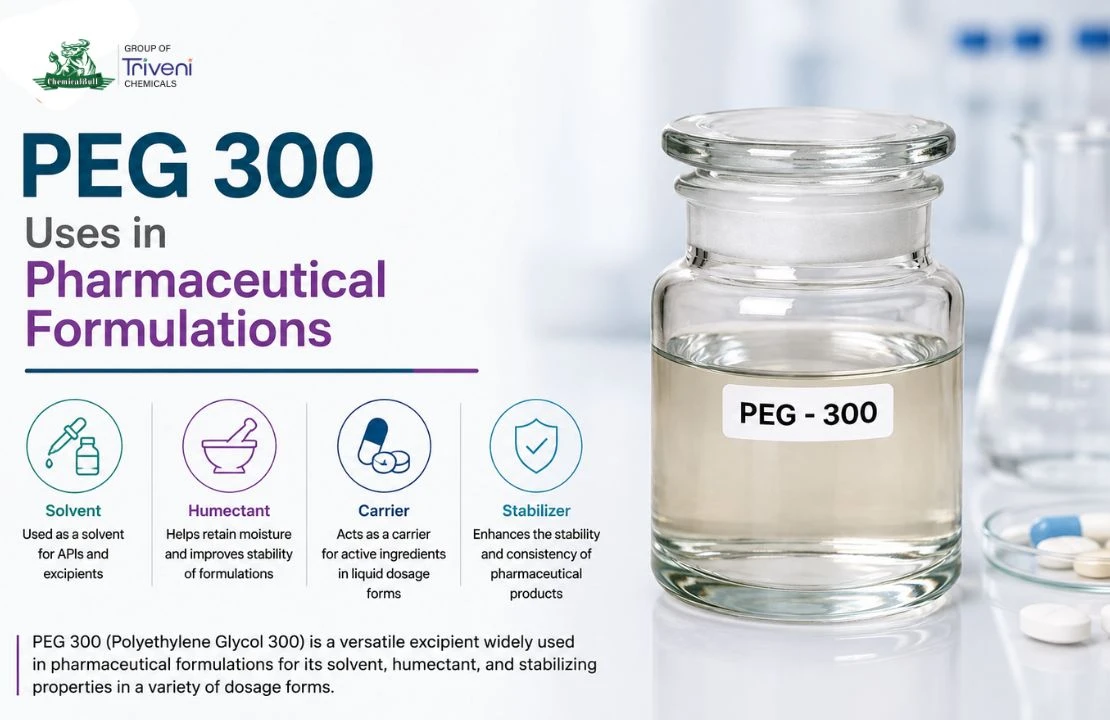
PEG 300 (Polyethylene Glycol 300) is a liquid, water-soluble excipient used as a solvent and co-solvent in oral liquids, softgel capsule fills, topical formulations, and parenteral drug delivery systems. ChemicalBull is a bulk PEG 300 supplier for pharmaceutical formulators and contract manufacturers.
Its low viscosity and strong solvency make it a practical choice when a formulation needs to dissolve poorly water-soluble actives without introducing a solid excipient. Looking for PEG 300 for your formulation? Contact ChemicalBull for a quote today.
Quick Answer
PEG 300 is used in pharmaceutical formulations as a solvent and co-solvent for oral liquids, softgel capsule fills, topical and semi-solid formulations, and parenteral drug delivery systems. As the lightest commonly used liquid PEG grade, it has low viscosity and strong solvency for poorly water-soluble active pharmaceutical ingredients, while remaining fully water-miscible for predictable dilution and mixing behavior. It is also used as a blend component with solid PEG grades in suppository base formulation.
PEG 300 Uses
What is PEG 300 used for? It functions primarily as a solvent and co-solvent across several dosage forms:
- Oral liquid formulations — solvent for actives in syrups and oral solutions
- Softgel capsule fills — co-solvent component in liquid fill matrices
- Topical and semi-solid formulations — vehicle component in creams and gels
- Parenteral (injectable) formulations — co-solvent for poorly water-soluble drugs, subject to formulation-specific purity requirements
- Suppository bases — liquid blend component with solid PEG grades
Across these uses, PEG 300's defining role is consistent: dissolving actives that don't dissolve well in water alone, while staying fully miscible with aqueous and other pharmaceutical solvent systems.
Role of PEG 300 in Pharmaceutical Formulations
PEG 300 is the lightest liquid PEG grade commonly used in pharmaceutical formulation, sitting just below PEG 400 in average molecular weight. This makes it the thinnest, fastest-mixing liquid PEG available, which is exactly why it's favored in applications where low viscosity matters most — softgel fill matrices that need to flow and fill accurately, and parenteral formulations where injection viscosity is a practical handling concern. Formulators reach for PEG 300 specifically when PEG 400 is slightly too viscous for the process or delivery route in question.
What Is PEG 300?
PEG 300 is a polyethylene glycol polymer with an average molecular weight of approximately 285–315 g/mol, produced by the polymerization of ethylene oxide. Like other PEG grades, the "300" designation refers to the average molecular weight of a distribution of polymer chains rather than a single fixed molecule. Its two terminal hydroxyl groups make it fully water-miscible, while its short polyether backbone gives it low viscosity and strong solvency for a range of pharmaceutical actives.
Why Is PEG 300 Used in Pharmaceutical Formulations?
Formulators select PEG 300 for three practical reasons:
- Low viscosity — the thinnest commonly used liquid PEG grade, supporting easy processing and accurate dosing in liquid and softgel systems.
- Strong solvency for poorly soluble actives — dissolves a range of active pharmaceutical ingredients that don't dissolve well in water alone.
- Regulatory familiarity — an established excipient with a long history of pharmaceutical use across oral, topical, and parenteral routes.
PEG 300 Technical Specifications
|
Property |
Typical Value |
|
Average Molecular Weight |
~285–315 g/mol |
|
Appearance |
Colorless to pale yellow liquid |
|
Freezing Point |
~-15 to -8°C |
|
Viscosity (20°C) |
~80–100 cSt |
|
Hydroxyl Value |
~340–394 mg KOH/g |
|
pH (5% aqueous solution) |
~4.5–7.5 |
|
Solubility |
Fully miscible with water and many organic solvents |
|
Purity (pharmaceutical grade) |
≥99% |
How Is PEG 300 Manufactured?
PEG 300 is produced by the ring-opening polymerization of ethylene oxide, controlled until the polymer chains reach an average molecular weight of around 300 g/mol — a shorter reaction than PEG 400 or PEG 600, and considerably shorter than solid grades like PEG 2000.
Since this is a statistical process, commercial PEG 300 is always a distribution of chain lengths, which is why pharmacopoeial specifications are expressed as molecular weight and hydroxyl value ranges rather than a single fixed number. Reputable manufacturers verify this distribution on every batch, since a wider-than-normal spread can subtly affect viscosity and solvency, even when the average molecular weight looks correct on the certificate of analysis.
Pharmacopoeial Status and Regulatory Recognition
PEG 300 (referenced as Macrogol 300 in pharmacopoeial nomenclature) falls within the polyethylene glycol excipient monographs recognized across major pharmacopoeias, including the USP-NF (Polyethylene Glycol), the European Pharmacopoeia (Macrogols), and the Indian Pharmacopoeia. For parenteral applications specifically, additional purity and endotoxin testing requirements typically apply beyond the standard excipient monograph — always confirm the grade and testing requirements applicable to your specific route of administration and target market before finalizing a formulation.
Safety, Handling, and Storage Guidelines
- Storage — store in tightly sealed containers in a cool, dry area to limit moisture uptake.
- Container sealing — PEG 300 is hygroscopic; minimize headspace exposure during transfer to prevent water content drift.
- Material compatibility — compatible with most standard pharmaceutical processing equipment (stainless steel, HDPE, glass).
- Shelf life — properly sealed and stored PEG 300 typically maintains stable specifications for 2 years.
Applications in Pharmaceutical Formulations
1. Oral Liquid Formulations
Used as a solvent to dissolve poorly water-soluble actives in syrups and oral solutions, improving formulation clarity and consistency of dosing.
2. Softgel Capsule Fills
How Does PEG 300 Work in Softgel Fill Formulations?
In softgel capsules, PEG 300 functions as a co-solvent within the liquid fill matrix, helping dissolve the active ingredient and maintain a stable, pourable fill viscosity during the encapsulation process. Its low viscosity supports accurate fill-weight dosing on high-speed encapsulation equipment.
3. Topical and Semi-Solid Formulations
Serves as a vehicle component in creams, gels, and other semi-solid formulations, contributing to spreadability and solvency for actives that don't dissolve well in water alone.
4. Parenteral (Injectable) Formulations
Used as a co-solvent in select parenteral formulations to solubilize poorly water-soluble drugs, subject to formulation-specific purity, endotoxin, and compatibility testing appropriate to the injectable route.
5. Suppository Base Blending
Used as a liquid blend component with solid PEG grades such as PEG 2000, helping formulators fine-tune the melting point and hardness of the finished suppository base.
Typical PEG 300 Usage Levels by Application
|
Application |
Typical Usage Level (wt%) |
Primary Function |
|
Oral liquid formulations |
5–20% |
Solvent for actives |
|
Softgel capsule fills |
10–40% |
Co-solvent, viscosity control |
|
Topical/semi-solid formulations |
5–15% |
Vehicle, solvency |
|
Parenteral formulations |
Formulation-specific |
Co-solvent |
|
Suppository base blends |
10–30% (blended) |
Melting point/hardness adjustment |
Advantages of PEG 300 in Pharmaceutical Formulation
- Lowest viscosity among common liquid PEG grades — supports accurate processing and dosing.
- Strong solvency for poorly soluble actives — improves formulation options for challenging APIs.
- Full water miscibility — predictable dilution and mixing behavior.
- Established compendial status — long history of use across multiple dosage forms.
- Blending compatibility — combines predictably with solid PEG grades to fine-tune melting point in suppository bases.
- Formulation flexibility — supports oral, topical, and (with appropriate testing) parenteral routes.
Formulator's Note: Best Practices for Solvency and Stability
A detail experienced formulators watch closely: PEG 300's strong solvency, while useful for dissolving poorly soluble actives, can also make it more prone to extracting plasticizers or other leachable components from certain packaging materials over extended contact time, particularly in liquid-filled softgel and oral solution formulations. A compatibility study with your specific container-closure or capsule shell material is worth running early in development, rather than assuming compatibility based on general PEG literature, since leachable profiles can vary meaningfully between packaging suppliers.
A second point worth flagging for parenteral formulation work: PEG 300 used in injectable co-solvent systems requires tighter control of impurities like ethylene oxide, ethylene glycol, and diethylene glycol residuals than PEG grades used in oral or topical formulations. Sourcing a parenteral-grade certificate of analysis specifically, not just a standard pharmaceutical-grade CoA, is essential before using PEG 300 in any injectable formulation.
Difference Between PEG 300 and PEG 400?
PEG 300 has a slightly lower average molecular weight than PEG 400, giving it marginally lower viscosity and a slightly stronger solvency profile per unit weight, though both remain fully water-miscible liquids. PEG 400 is more commonly used as a general-purpose vehicle across oral and topical formulations, while PEG 300 is often preferred specifically when the lowest possible viscosity matters, such as in high-speed softgel encapsulation. In many formulations, the two grades are functionally interchangeable, and the choice often comes down to specific process requirements or existing formulation precedent.
PEG 300 vs. Other Common PEG Grades in Pharma
|
PEG Grade |
Physical Form |
Typical Pharmaceutical Use Case |
|
PEG 300 |
Liquid (lowest viscosity) |
Softgel fills, parenteral co-solvent |
|
Liquid |
General-purpose oral/topical vehicle |
|
|
Liquid |
Humectant, solvent, suppository blend component |
|
|
Solid |
Suppository bases, solid dispersion carrier |
For related PEG grade applications, see our PEG 600 Uses in Cosmetic and Industrial Applications and PEG 2000 Uses in Pharmaceutical Formulations guides.
Other Uses and Applications of PEG 300
Beyond core pharmaceutical use, PEG 300 is also used in:
- Cosmetic formulations — as a humectant and solvent in select liquid cosmetic products
- Industrial applications — as a solvent and processing aid in select formulation types
- Chemical intermediate synthesis — as a building block in select downstream processes
Consistent molecular weight distribution, hydroxyl value, and impurity profile from batch to batch matter directly to pharmaceutical formulation performance, since drift in any of these specs can affect solvency, viscosity, and — for parenteral use — patient safety margins.
Frequently Asked Questions
-
What is PEG 300 used for?
It is used as a solvent and co-solvent in oral liquid formulations, softgel capsule fills, topical and semi-solid formulations, parenteral drug delivery systems, and as a blend component in suppository bases. -
Is PEG 300 liquid or solid at room temperature?
PEG 300 is liquid at room temperature, with a freezing point of approximately -15 to -8°C, making it liquid across normal storage and processing conditions. -
What is the difference between PEG 300 and PEG 400?
PEG 300 has a slightly lower molecular weight and viscosity than PEG 400, making it the preferred choice when the lowest possible viscosity is needed, such as in high-speed softgel encapsulation. -
Can PEG 300 be used in injectable (parenteral) formulations?
Yes, PEG 300 is used as a co-solvent in select parenteral formulations, though it requires a parenteral-grade certificate of analysis with tighter impurity control than standard pharmaceutical-grade material. -
Is PEG 300 used alone or blended with other PEG grades?
It is used both alone as a solvent and blended with solid PEG grades such as PEG 2000 in suppository base formulation to adjust melting point and hardness.
Conclusion
PEG 300 fills a specific role in pharmaceutical formulation as the lightest, lowest-viscosity liquid PEG grade in common use — valued wherever a formulation needs strong solvency and easy processing without added viscosity. Whether it's dissolving an active in a softgel fill, serving as a co-solvent in a parenteral formulation, or fine-tuning a suppository base blend, its performance comes down to that combination of low viscosity and dependable water miscibility. For formulators comparing it against PEG 400, the choice often comes down to how much viscosity the process can tolerate.
Comment Section