Chemical Bull
241
29-Jul-2026
PEG 2000 Uses in Pharmaceutical Formulations
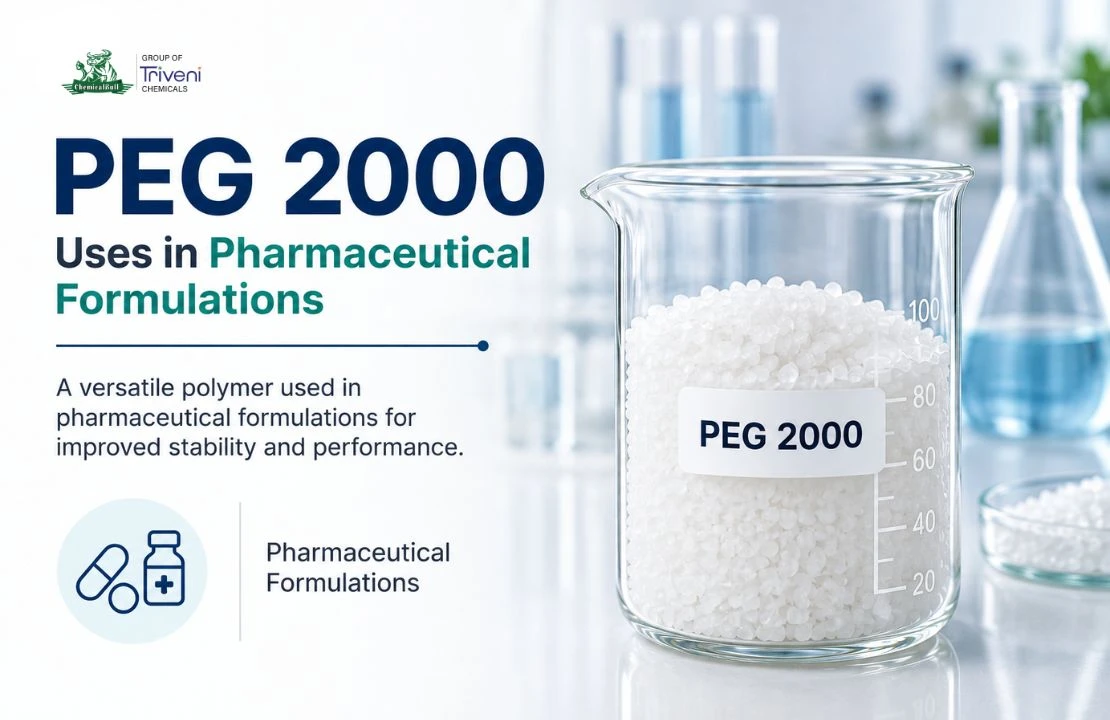
PEG 2000 (Polyethylene Glycol 2000) is a solid, water-soluble excipient used in suppository bases, ointments, tablet coatings, and solid dispersion systems. ChemicalBull is a bulk PEG-2000 Supplier for pharmaceutical formulators and contract manufacturers.
Its waxy solid form and sharp melting point make it a reliable base and processing aid across multiple dosage forms. Looking for PEG 2000 for your formulation? Contact ChemicalBull for a quote today.
Quick Answer
PEG 2000 is used in pharmaceutical formulations as an excipient in suppository bases, ointment bases, tablet film coatings, and solid dispersion systems for poorly water-soluble drugs. As a solid, water-soluble polyethylene glycol with a melting point around 50–53°C, it provides a predictable, non-oily base that melts at body temperature, dissolves readily in aqueous fluids, and can improve the dissolution rate of certain active pharmaceutical ingredients when used as a solid dispersion carrier.
PEG 2000 Uses
What is PEG 2000 used for? It functions as a multi-role pharmaceutical excipient:
- Suppository bases — solid, water-soluble base that melts at body temperature
- Ointment and cream bases — semi-solid vehicle for topical formulations
- Tablet film coatings — plasticizer and film-forming aid
- Solid dispersion systems — carrier for improving dissolution of poorly soluble drugs
- Tablet lubricant — reduces friction during compression
Across these uses, PEG 2000's defining trait is consistency: a solid at room temperature with a sharp, predictable melting point, and full water solubility once melted or dissolved.
Role of PEG 2000 in Pharmaceutical Formulations
PEG 2000 sits in the solid-grade portion of the PEG family, heavier than liquid grades like PEG 400 and PEG 600, but lighter than very high-molecular-weight PEGs used mainly as tablet binders. This mid-solid range gives it a melting point close to body temperature, which is exactly what a suppository base needs, and a hydrophilic backbone that supports drug dissolution when used in solid dispersion formulations. Formulators reach for it specifically when a dosage form needs a solid, non-oily excipient that behaves predictably at both room and body temperature.
What Is PEG 2000?
PEG 2000 is a polyethylene glycol polymer with an average molecular weight of approximately 1,800–2,200 g/mol, produced by polymerizing ethylene oxide. Like other PEG grades, the "2000" refers to the average molecular weight of a distribution of polymer chains, not a single fixed molecule. Its two terminal hydroxyl groups make it fully water-soluble, while the longer polyether backbone (compared to lighter grades) gives it a solid, waxy physical form at room temperature.
Why Is PEG 2000 Used in Pharmaceutical Formulations?
Formulators select PEG 2000 for three practical reasons:
- Predictable melting behavior — a sharp melting point around 50–53°C makes it reliable for suppository bases designed to melt at body temperature.
- Water solubility — dissolves readily once melted or in aqueous fluids, supporting drug release.
- Regulatory familiarity — an established, well-characterized pharmaceutical excipient with a long history of compendial use.
PEG 2000 Technical Specifications
|
Property |
Typical Value |
|
Average Molecular Weight |
~1,800–2,200 g/mol |
|
Appearance |
White waxy solid or flakes |
|
Melting Point |
~50–53°C |
|
Hydroxyl Value |
~51–64 mg KOH/g |
|
pH (5% aqueous solution) |
~4.5–7.5 |
|
Loss on Drying |
≤1% |
|
Solubility |
Freely soluble in water; soluble in many organic solvents |
|
Purity (pharmaceutical grade) |
≥99% |
Applications in Pharmaceutical Formulations
1. Suppository Bases
PEG 2000 is used, often blended with lower-molecular-weight PEG grades, to formulate water-soluble suppository bases that melt at body temperature and dissolve in mucosal fluids, offering an alternative to fatty (cocoa butter-type) bases.
2. Ointment and Cream Bases
Serves as a solid component in water-soluble ointment bases, contributing structure and a non-greasy after-feel compared to petrolatum-based systems.
3. Tablet Film Coatings
How Does PEG 2000 Work in Tablet Coating?
In film-coating formulations, PEG 2000 functions as a plasticizer, softening the coating polymer film so it can withstand handling stress without cracking. Its water solubility also supports rapid coating dissolution once the tablet reaches gastric or intestinal fluid.
4. Solid Dispersion Systems
PEG 2000 is used as a hydrophilic carrier in solid dispersion formulations, where a poorly water-soluble drug is dispersed at the molecular or amorphous level within the PEG matrix. This can improve the drug's dissolution rate and bioavailability compared to the crystalline drug alone.
5. Tablet Lubricant
Used in select formulations as a lubricant during tablet compression, reducing friction between the tablet mass and the die/punch surfaces.
Typical PEG 2000 Usage Levels by Application
|
Application |
Typical Usage Level (wt%) |
Primary Function |
|
Suppository bases |
30–70% (blended with other PEG grades) |
Base structure, melting behavior |
|
Ointment/cream bases |
10–40% |
Solid structure, water solubility |
|
Tablet film coatings |
1–5% (of coating solution) |
Plasticizer |
|
Solid dispersion systems |
20–80% (of dispersion) |
Dissolution carrier |
|
Tablet lubricant |
0.5–2% |
Compression aid |
Advantages of PEG 2000 in Pharmaceutical Formulation
- Predictable, sharp melting point — supports reliable suppository and ointment base behavior.
- Full water solubility — dissolves cleanly in aqueous physiological fluids, supporting drug release.
- Dissolution enhancement potential — effective carrier for improving bioavailability of poorly soluble actives in solid dispersion systems.
- Non-oily, non-greasy character — supports patient acceptability in topical and suppository products.
- Established compendial status — long history of pharmaceutical use supports regulatory familiarity.
- Compatibility with blending — combines predictably with other PEG grades to fine-tune melting point and hardness.
Formulator's Note: Best Practices for Suppository Base Stability
Experienced formulators know: PEG 2000 alone isn't used to make suppositories. It's blended with a liquid PEG like PEG 400 or PEG 600 to get the right melting point and hardness. PEG 2000 alone is too hard and slow-dissolving; an all-liquid blend won't hold shape. Always bench-test the blend ratio with your actual drug loading — the active ingredient itself can change the melting point, and you won't see this on a spec sheet.
For solid dispersions: PEG 2000-based dispersions can look stable at first but the drug can slowly recrystallize over time. Always run real-time stability tests at actual storage conditions, not just accelerated tests — accelerated results don't reliably predict recrystallization risk.
Difference Between PEG 2000 and PEG 600?
PEG 2000 is a solid at room temperature with a melting point around 50–53°C, while PEG 600 is liquid with a melting point around 15–25°C — a direct result of PEG 2000's higher average molecular weight and longer polymer chains. This makes PEG 600 suitable for liquid vehicles and solubilizing applications, while PEG 2000 is used where a solid, structure-giving excipient is needed, such as suppository bases and solid dispersion carriers. Formulators often use both grades together, blending them to hit a target melting point that neither grade achieves on its own. For more on PEG 600's liquid-form applications, see our PEG 600 Uses in Cosmetic and Industrial Applications guide.
PEG 2000 vs. Other Common PEG Grades
|
PEG Grade |
Physical Form |
Typical Pharmaceutical Use Case |
|
Liquid |
Solubilizing vehicle, softer ointment bases |
|
|
Liquid |
Humectant, solvent, blend component for suppository bases |
|
|
Solid (waxy) |
Suppository bases, solid dispersions, film coatings |
|
|
Solid (waxy) |
Tablet coatings, higher-melting suppository blends |
|
|
Solid (harder wax) |
Tablet binders, higher-hardness solid dispersions |
Industrial and Commercial Importance
Beyond core pharmaceutical use, PEG 2000 is also used in:
- Cosmetic formulations — as a thickening and structuring agent in select solid or semi-solid cosmetic products
- Industrial mold release and lubricant blends — where a water-soluble solid PEG is preferred over oil-based alternatives
- Ceramic and binder processing — as a temporary binder aid in select forming processes
Consistent melting point, hydroxyl value, and moisture content from batch to batch matter directly to pharmaceutical formulation performance, since drift in any of these specs can shift suppository melting behavior or solid dispersion stability in ways that are difficult to trace back to the raw material after release testing.
Frequently Asked Questions
-
What is PEG 2000 used for?
It is used as a pharmaceutical excipient in suppository bases, ointment bases, tablet film coatings, solid dispersion systems, and as a tablet lubricant. -
Is PEG 2000 solid or liquid at room temperature?
PEG 2000 is a solid, waxy material at room temperature, with a melting point of approximately 50–53°C. -
What is the difference between PEG 2000 and PEG 600?
PEG 2000 is a solid excipient with a higher molecular weight and melting point, used for structure-giving applications like suppository bases, while PEG 600 is a liquid used as a humectant and solvent. -
Can PEG 2000 improve drug bioavailability?
Yes, when used as a solid dispersion carrier, PEG 2000 can improve the dissolution rate of poorly water-soluble drugs by dispersing them at the molecular or amorphous level within the PEG matrix, though formulation-specific testing is needed to confirm bioavailability improvement. -
Is PEG 2000 used alone or blended in suppository bases?
It is typically blended with lower-molecular-weight PEG grades such as PEG 400 or PEG 600 to achieve a target melting point and hardness that a single grade cannot provide on its own.
Conclusion
PEG 2000 fills a specific, well-defined role in pharmaceutical formulation: a solid, water-soluble excipient with a predictable melting point near body temperature. Whether it's structuring a suppository base, carrying a poorly soluble drug in a solid dispersion, or plasticizing a tablet coating, its performance comes down to that combination of solid form and clean water solubility. For formulators comparing it against lighter liquid PEG grades, the choice generally comes down to whether the formulation needs structure or flow.
Looking for a reliable PEG-2000 supplier for your pharmaceutical formulation? Request a quote from ChemicalBull — bulk quantities with CoA documentation on every batch.


Comment Section