Chemical Bull
15
20-Nov-2026
Dextrose Monohydrate for Industrial Uses: Applications and Benefits
Quick Answer
Dextrose Monohydrate is a form of glucose that contains one molecule of water inside its crystal structure. Dextrose Monohydrate usually comes as an odourless powder. Dextrose Monohydrate has a sweet taste and dissolves very well in water. Dextrose Monohydrate is used by industries. Dextrose Monohydrate serves as a source of carbohydrates. Dextrose Monohydrate is used as a substrate for fermentation. Dextrose Monohydrate is used as a sweetening ingredient. Dextrose Monohydrate is a raw material in many manufacturing processes. Dextrose Monohydrate finds uses in food processing, pharmaceuticals, biotechnology, fermentation, adhesives, chemical production and other industrial sectors.
For industrial manufacturers looking for a consistent raw material supply, Chemical Bull offers sourcing support as a dextrose monohydrate supplier for different industrial requirements.
What Is Dextrose Monohydrate?
Dextrose Monohydrate is a sugar that comes from starch. People usually get it by breaking down corn starch with water. Its chemical name is D-glucose monohydrate. It is part of the monosaccharide carbohydrate family.
The word monohydrate means that each glucose molecule is tied to one water molecule in its crystal structure. Because of this, it behaves differently from dextrose, which has no water.
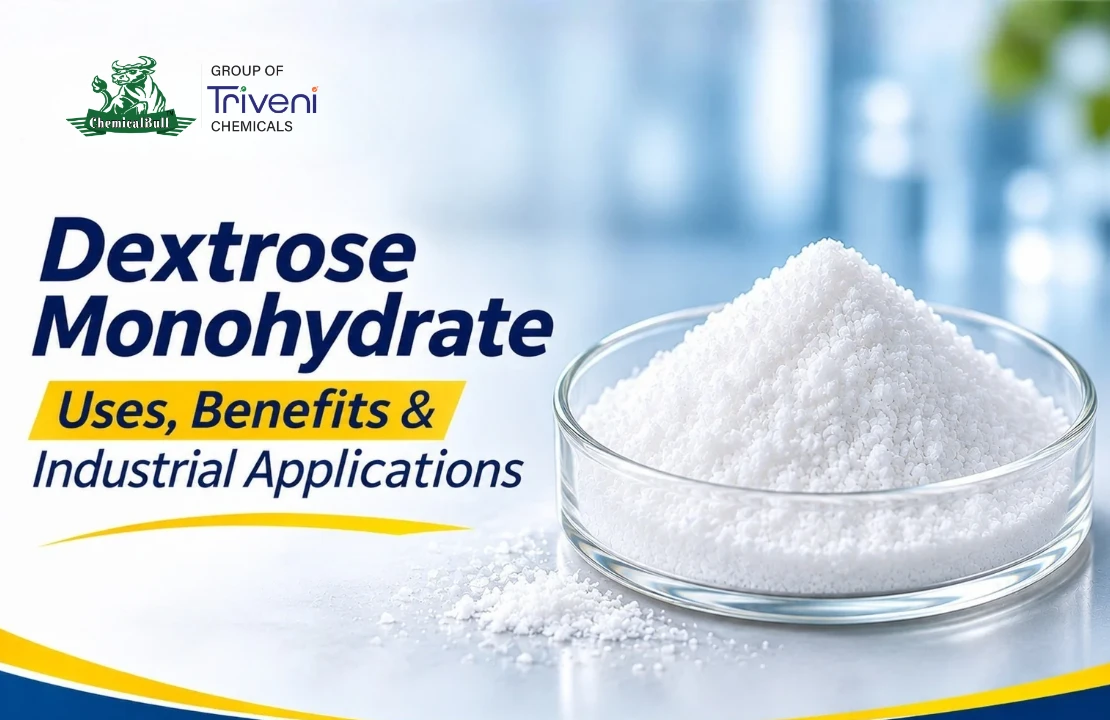
Dextrose Monohydrate usually comes as a crystalline powder or in a powder form. It mixes easily with water. This makes it a quick source of glucose for industrial uses.
Its functional properties make it useful in applications where manufacturers require a soluble carbohydrate, fermentable sugar, or reducing agent.
Major Dextrose Monohydrate Uses in Different Industries
Dextrose Monohydrate has several applications because of its solubility, glucose content, and ability to participate in fermentation and chemical reactions.
Let's understand its major industrial applications.
1. Food and Beverage Manufacturing
The food and beverage industry is one of the major application areas for Dextrose Monohydrate.
Manufacturers use it as a sweetening ingredient and carbohydrate source in different food formulations. Its sweetness is generally lower than that of sucrose, allowing manufacturers to adjust the sweetness profile of their products.
Common applications include:
- Bakery Products: Used in bread, biscuits, cakes, and other baked goods to support yeast fermentation and contribute to browning during baking.
- Confectionery: Used in candies, chewing gums, chocolates, and sweet fillings to provide sweetness and contribute to product texture.
- Beverages: Added to beverage mixes, energy drinks, and nutritional drinks as a glucose source.
- Dairy Products: Used in selected dairy formulations and frozen desserts to contribute sweetness and influence freezing behaviour.
- Processed Foods: Incorporated into sauces, seasonings, and other processed food formulations to balance taste and provide carbohydrate solids.
2. Pharmaceutical Manufacturing
Dextrose Monohydrate is used in pharmaceutical manufacturing as a carbohydrate ingredient and in selected formulation applications.
Depending on its grade and applicable pharmacopoeial requirements, it can be used in:
- Oral pharmaceutical preparations.
- Powder-based medicinal formulations.
- Nutritional and carbohydrate supplement products.
- Selected pharmaceutical excipient applications.
- Pharmaceutical processing and formulation development.
Its suitability depends on purity, microbial limits, impurity levels, and compliance with the relevant pharmaceutical standards.
Food-grade material should not automatically be considered suitable for pharmaceutical applications.
3. Fermentation and Biotechnology
Fermentation is another important industrial application of Dextrose Monohydrate.
Microorganisms such as yeast and certain bacteria use glucose as a carbon and energy source. Manufacturers add it to fermentation media to support microbial growth and product formation.
Its applications include:
- Industrial Enzyme Production: Used as a carbon source in selected fermentation processes for producing industrial enzymes.
- Organic Acid Production: Supports microbial fermentation processes involved in producing organic acids.
- Amino Acid Manufacturing: Used in fermentation media for selected amino acid production processes.
- Yeast Cultivation: Provides a readily available carbohydrate for yeast growth.
- Microbial Culture Preparation: Incorporated into suitable culture media to support microbial activity.
The quantity used depends on the microorganism, fermentation conditions, nutrient requirements, and desired production output.
4. Chemical Manufacturing
Dextrose Monohydrate can serve as a renewable carbohydrate-based raw material in selected chemical manufacturing processes.
Its glucose structure allows it to participate in different chemical and biochemical conversion processes.
Some applications include:
- Production of gluconic acid through chemical or microbial oxidation.
- Manufacturing of glucose-derived chemical intermediates.
- Development of certain carbohydrate-based surfactant ingredients.
- Production of selected glucose derivatives.
- Use as a reducing sugar in suitable chemical processes.
These applications make it useful for manufacturers exploring starch-derived and renewable raw material alternatives.
5. Adhesives and Resin Manufacturing
Certain adhesive and resin formulations use Dextrose Monohydrate as a functional carbohydrate ingredient.
Depending on the formulation, it may contribute to solids content, processing characteristics, or specific formulation properties.
Its potential applications include:
- Selected water-based adhesive formulations.
- Carbohydrate-based adhesive systems.
- Certain resin processing applications.
- Formulations requiring glucose-derived raw materials.
The exact function depends on the adhesive chemistry and formulation requirements. It is not a universal replacement for conventional adhesive additives.
6. Metal Treatment and Industrial Processing
Dextrose Monohydrate can also be used in selected metal treatment applications because glucose has reducing properties.
In suitable processes, it can participate in chemical reactions involving metal ions and help support specific metal treatment operations.
Its industrial applications may include:
- Selected metal surface treatment processes.
- Reducing agent applications.
- Specialised chemical processing.
- Metal finishing formulations.
The suitability of dextrose depends on the metal, process chemistry, operating conditions, and required surface characteristics.
Dextrose Monohydrate Benefits for Industrial Manufacturers
Dextrose Monohydrate offers several functional benefits that make it useful across different manufacturing sectors.
1. Readily Available Carbon Source
Dextrose provides glucose that many microorganisms can metabolise directly. This makes it a useful carbon source in fermentation and biotechnology processes.
2. Good Water Solubility
Its ability to dissolve readily in water makes it convenient for preparing liquid formulations, fermentation media, and other aqueous industrial mixtures.
3. Supports Fermentation Processes
It can support microbial growth and fermentation activity when used in suitable concentrations and under controlled processing conditions.
4. Versatile Industrial Applications
Manufacturers can use it in different sectors, including food processing, pharmaceuticals, biotechnology, and selected chemical manufacturing applications.
5. Renewable Raw Material Source
Since it is commonly produced from starch, Dextrose Monohydrate provides a carbohydrate-based raw material that can be used in selected renewable chemical production processes.
6. Easy Handling and Storage
Its crystalline powder form allows convenient weighing, handling, blending, and transportation when appropriate moisture-control practices are followed.
Dextrose Monohydrate Powder vs Dextrose Anhydrous
Dextrose Monohydrate and Dextrose Anhydrous are two common crystalline forms of glucose. The main difference is their water content.
|
Comparison |
Dextrose Monohydrate |
Dextrose Anhydrous |
|
Water Content |
Contains one molecule of crystallisation water |
Contains no water of crystallisation |
|
Molecular Formula |
C₆H₁₂O₆·H₂O |
C₆H₁₂O₆ |
|
Molecular Weight |
198.17 g/mol |
180.16 g/mol |
|
Physical Form |
White crystalline powder or granules |
White crystalline powder |
|
Glucose Content by Weight |
Lower due to crystallisation water |
Higher due to absence of crystallisation water |
|
Common Applications |
Food, fermentation, and pharmaceutical formulations |
Food, pharmaceutical, and specialised formulations |
Both forms have useful industrial applications. The selection depends on the required moisture content, formulation, processing conditions, and product specifications.
Factors to Consider When Selecting Dextrose Monohydrate
Choosing the correct grade of Dextrose Monohydrate is important for maintaining consistent manufacturing quality.
Before purchasing, industrial buyers should evaluate the following factors:
1. Purity and Assay: Check the dextrose content and ensure it meets the requirements of the intended application.
2. Moisture Content: Since it is a monohydrate, water content is an important specification to verify.
3. Particle Size: Powder fineness and particle-size distribution can influence dissolution, mixing, and handling.
4. Solubility: Confirm that the material dissolves properly under the temperature and concentration conditions used in the manufacturing process.
5. Application-Specific Grade: Select food, pharmaceutical, or industrial grade according to the intended use and applicable regulatory requirements.
6. Quality Documentation: Review the Certificate of Analysis (COA), Technical Data Sheet (TDS), and Material Safety Data Sheet (MSDS/SDS) before approving the material.
7. Packaging and Storage: Ensure suitable moisture-resistant packaging and store the material in a clean, dry environment away from excessive humidity.
Frequently Asked Questions About Dextrose Monohydrate
1. What is Dextrose Monohydrate mainly used for?
Dextrose Monohydrate is mainly used as a carbohydrate source, sweetening ingredient, and fermentation substrate. Its applications include food processing, beverage manufacturing, pharmaceuticals, biotechnology, and selected industrial chemical processes.
2. What are the main Dextrose Monohydrate benefits?
The main benefits include good water solubility, readily available glucose, fermentation support, convenient powder handling, and versatility across different manufacturing applications.
3. What is Dextrose Monohydrate powder made from?
It is commonly produced from corn starch through hydrolysis, purification, concentration, and crystallisation processes. Other starch sources may also be used depending on the manufacturing process.
4. Is Dextrose Monohydrate soluble in water?
Yes. Dextrose Monohydrate is freely soluble in water, making it suitable for various liquid formulations, food processing applications, and fermentation media.
5. What is the difference between Dextrose Monohydrate and glucose?
Dextrose is another name for D-glucose. Dextrose Monohydrate is the crystalline form of glucose that contains one molecule of water of crystallisation.
6. Can Dextrose Monohydrate be used in fermentation?
Yes. It is commonly used as a carbon and energy source in fermentation processes. It can support the growth of yeast and selected microorganisms used in industrial biotechnology.
7. How should Dextrose Monohydrate be stored?
It should be stored in a cool, dry, and clean place in properly sealed packaging. Protection from moisture and excessive humidity helps prevent lump formation and maintain product quality.
Conclusion
Dextrose Monohydrate is a versatile carbohydrate raw material with applications across food processing, pharmaceutical manufacturing, fermentation, biotechnology, and selected industrial chemical processes. Its good water solubility, glucose content, and reducing properties make it useful for different manufacturing requirements.
Understanding its properties, industrial applications, and grade requirements helps manufacturers select the right material for their production processes. Proper quality evaluation, storage, and supplier documentation are equally important for maintaining consistent product performance.



Comment Section