Chemical Bull
26
21-Nov-2026
A detergent manufacturer may need stronger foam, while a latex producer needs a surfactant suited to its polymerisation process. Both requirements can involve sodium dodecyl sulfate, but the appropriate grade, concentration and performance criteria will differ.
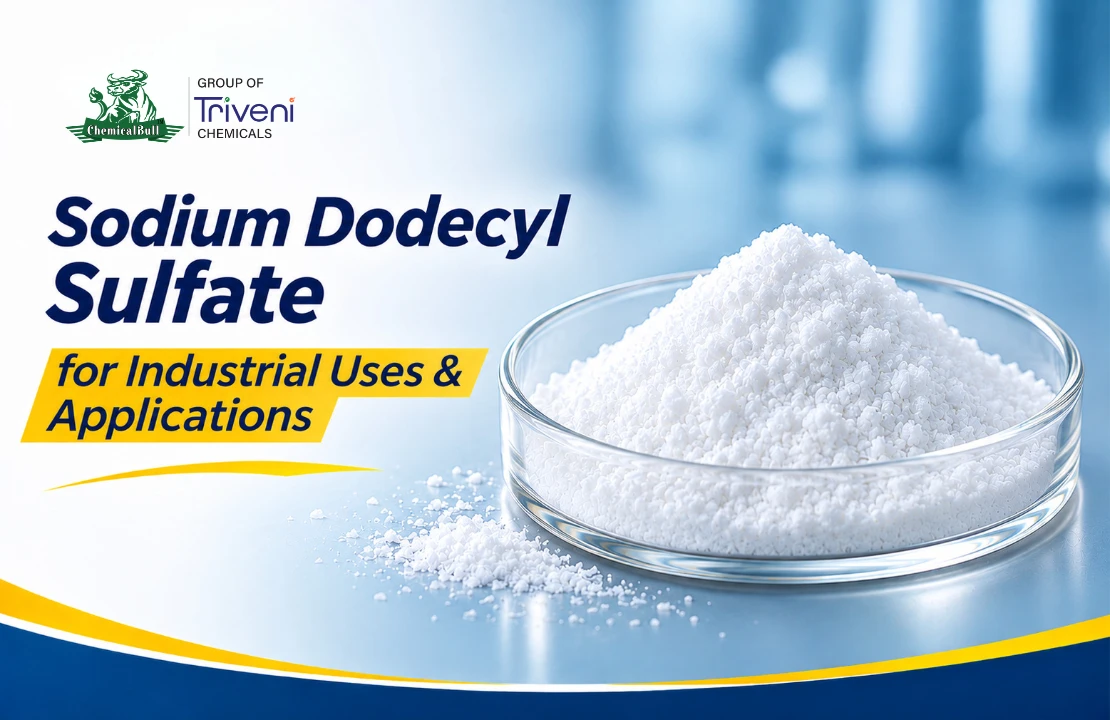
Sodium dodecyl sulfate is an anionic surfactant used for cleaning, foaming, wetting and selected emulsification applications. Commercial uses include detergent manufacturing, personal-care products and latex production, while specialised grades serve biochemical testing.
For specifications, availability and bulk pricing, contact Chemical Bull with your application, required grade, quantity and delivery location.
What Is Sodium Dodecyl Sulfate?
Sodium dodecyl sulfate is a surface-active chemical commonly abbreviated as SDS. Another widely used name is sodium lauryl sulfate, or SLS.
Its principal identifiers are:
- CAS number: 151-21-3.
- Molecular formula: C₁₂H₂₅NaO₄S.
- Structural formula: CH₃(CH₂)₁₁OSO₃Na.
- Molecular weight: approximately 288.38 g/mol.
Buyers should distinguish a specified dodecyl sulfate grade from commercial alkyl sulfate products sold under broader SLS descriptions. Commercial grades can differ in composition, active matter, residual salts and physical form.
Use the supplier’s specification and safety data sheet to establish the exact product identity rather than relying on the abbreviation alone.
How Does It Work?
The molecule contains a water-attracting sulfate group and an oil-attracting hydrocarbon chain. This structure allows it to interact with water and hydrophobic materials, supporting its detergent function.
In manufacturing, the relevant performance depends on the complete formulation. Cleaning efficiency, foam, viscosity and compatibility cannot be predicted from the surfactant name alone.
For example, a high-foam product may suit a manually applied cleaner but create difficulties in equipment that requires controlled foam. Define the intended result before selecting the grade.
What Is Sodium Dodecyl Sulfate Used For?
The main applications involve surface activity, but each industry has different approval requirements.
| Application | Main function | Important evaluation points |
|---|---|---|
| Detergents and cleaning products | Cleaning and foam generation | Soil removal, rinsing, foam and formulation stability |
| Shampoos and rinse-off cleansers | Cleansing and lather | Finished-product performance and suitability |
| Toothpaste | Surfactant and foaming component | Appropriate grade and complete-formulation compatibility |
| Textile processing | Surfactant component in selected formulations | Wetting, cleaning and process foam |
| Emulsion polymerisation | Emulsifier in selected latex systems | Latex stability and process consistency |
| Biochemical testing | Protein solubilisation and denaturation | Method-specific purity and impurity controls |
Producer literature documents these uses for particular SDS or SLS grades. An established application does not mean that every commercial grade is interchangeable.
Detergent and Cleaning-Product Manufacturing
Sodium lauryl sulfate grades are used in products such as liquid hand cleaners, dishwashing formulations, fine-fabric washes and other detergent systems. Powder grades are also available for suitable formulations.
For a cleaning-product manufacturer, selection should begin with the intended application:
- What type of soil must the product remove?
- Is high foam desirable?
- How will users dilute and rinse the product?
- What water quality and storage conditions are expected?
Evaluate cleaning and foam separately. A product that produces more lather does not automatically provide better soil removal.
Also check the complete formulation for clarity, viscosity, separation and rinsing behaviour. Compare candidate grades at a defined active-surfactant level so differences in supplied concentration do not distort the trial.
Personal Care and Oral Care Applications
Suitable SLS grades have documented applications in shampoos, liquid hand soaps, bath products and toothpaste.
In these products, the surfactant contributes to cleansing and foam. Selection should consider the finished product, intended use and interaction with other ingredients.
For shampoo development, assess cleansing, lather, viscosity and compatibility with the complete surfactant system. For toothpaste, confirm that the offered grade meets the required oral-care specification and performs appropriately with the abrasive, binder, flavour and other ingredients.
An industrial detergent grade should not automatically be approved for personal or oral care. The application requires its own technical and quality review.
Emulsion Polymerisation and Latex Production
Selected sodium lauryl sulfate grades are used as anionic surfactants in latex manufacture. This is a distinct industrial application from cleaning-product formulation.
Polymer manufacturers should evaluate the material within the intended monomer system and processing route. Relevant trial observations may include coagulum, particle characteristics, mechanical stability and consistency between production runs.
A surfactant that performs well in a cleaner is not automatically suitable for a polymerisation process. Confirm the manufacturer’s recommended application and approve the grade through process-specific testing.
Textile Processing and Specialist Testing
Commercial SLS products also have documented textile applications. Textile processors should assess the intended wetting or cleaning function alongside foam generation and downstream compatibility.
In analytical work, specialised sodium dodecyl sulfate grades are used for protein extraction and SDS-PAGE, where the surfactant helps denature proteins.
Laboratory-grade requirements should remain separate from bulk formulation specifications. A lower-cost industrial material may lack the impurity controls required by an analytical method.
Is Sodium Dodecyl Sulfate Soluble in Water?
Yes, sodium dodecyl sulfate is soluble in water. However, practical dissolution and solution appearance depend on the grade and preparation conditions. Supplier specifications may describe an opalescent solution rather than guaranteeing complete optical clarity.
For manufacturing trials, assess:
- Required concentration and mixing conditions.
- Water quality and temperature.
- Addition sequence.
- Dissolution time.
- Appearance after cooling and storage.
Do not interpret initial dissolution as proof of long-term formulation stability. Check the finished system under its expected storage conditions.
Follow the technical supplier’s incorporation guidance and avoid unnecessary mixing that creates excessive foam.
Is SDS the Same as SLES?
SDS and SLS are commonly used names for sodium dodecyl sulfate. SLES—sodium laureth sulfate—is a different surfactant type.
SLES contains ethoxylated alcohol units; producer literature describes sodium laureth sulfate grades made by ethoxylating fatty alcohol before sulfation.
The distinction matters when purchasing or reformulating. Substitution can change active matter, processing behaviour and finished-product properties.
Confirm the chemical identity, supplied concentration and approved formulation before accepting an alternative.
Choosing Sodium Dodecyl Sulfate Powder
Powder selection involves more than choosing the highest stated percentage.
Commercial SLS powder grades with different active contents are available. For example, producer literature identifies a 93% active powder and other high-active grades. These figures belong to the particular products and should not be treated as a universal specification.
Before approval, review the parameters relevant to your process:
- Identity and composition.
- Active matter or assay, including the test method.
- Moisture.
- Residual salts and unsulfated material, where specified.
- pH at a defined test concentration.
- Physical form and handling characteristics.
- Application-specific documentation.
Analytical assay and commercial active-matter values may use different methods. Compare equivalent measurements rather than treating every percentage as directly comparable.
There is no universal dosage for industrial formulations. Establish the addition level through supplier guidance and application testing.
Handling and Production Controls
For powder handling, review the current safety data sheet and workplace assessment before establishing transfer procedures, ventilation and protective equipment.
Minimise dust generation during weighing and charging. Keep containers closed when not in use and follow the supplier’s storage instructions.
Production controls should also address weighing accuracy, complete incorporation and cleaning between batches. These factors can influence consistency even when the raw material meets specification.
What Is the Price of Sodium Dodecyl Sulfate?
There is no single price that represents every SDS grade and order size. A meaningful quotation must identify the specification, quantity, packaging and delivery terms.
Laboratory packs, application-specific grades and commercial surfactant powders should not be compared solely by price per kilogram.
For formulation procurement, a useful comparison is:
Cost per kilogram of active surfactant = Price per kilogram supplied ÷ Active fraction
Use this calculation only when the products have comparable functionality and the active-content measurements are equivalent. It does not replace performance testing.
Also confirm freight, taxes, lead time, quotation validity and the documentation included.
Bulk Sourcing for Manufacturing
Before placing a commercial order, request a current certificate of analysis, safety data sheet and available technical information. Confirm batch traceability, packaging and the specification that will apply to repeat deliveries.
A representative sample can help the technical team assess incorporation and performance before purchasing larger quantities.
For Sodium dodecyl sulfate in bulk, share your application, required grade, quantity and delivery location with Chemical Bull to request specifications and pricing.
Include the approved manufacturer grade or reference specification where available so the offer can be assessed against a clear requirement.
Frequently Asked Questions
What is another name for sodium dodecyl sulfate?
It is commonly called sodium lauryl sulfate, abbreviated SLS. Other names include dodecyl sulfate sodium salt.
What is it mainly used for?
Its uses include cleaning and foaming formulations, selected latex manufacturing processes and specialised biochemical testing.
What are its CAS number and formula?
The CAS number is 151-21-3, and the molecular formula is C₁₂H₂₅NaO₄S.
Is it soluble in water?
Yes. Confirm the required concentration and preparation conditions using the supplied grade’s technical information.
Can every grade be used in shampoo or toothpaste?
No. Confirm application suitability, documentation and finished-product performance before approving a grade.
How can buyers obtain an accurate bulk price?
Provide the required specification, application, quantity, packaging, destination and delivery timeline. Compare quotations on equivalent technical and commercial terms.
Comment Section