Chemical Bull
25
21-Nov-2026
A phenolic moulding compound may meet its blending specification but still fall short during curing. For manufacturers, the hardening component must work consistently with the resin, fillers and production cycle. Selecting the correct raw-material grade is therefore part of controlling finished-product quality.
Hexamethylenetetramine, commonly called hexamine, is an industrial chemical used as a curing agent for novolac phenolic resins and as an intermediate in selected chemical manufacturing processes. Application-specific grades also serve rubber and tyre production.
For specifications, available grades and bulk pricing, contact Chemical Bull with your application, quantity and delivery location.
What Is Hexamethylenetetramine?
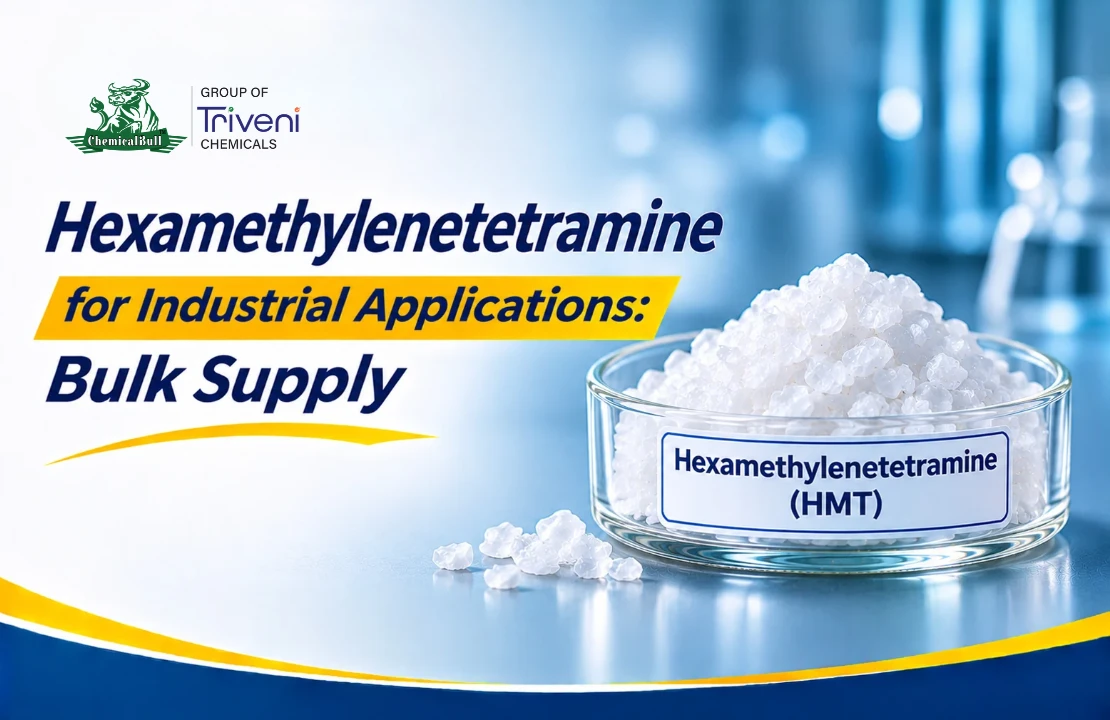
Hexamethylenetetramine is a nitrogen-containing organic compound typically supplied as white crystals, granules or powder.
Its main identifiers are:
- Common names: Hexamine, methenamine and HMTA.
- CAS number: 100-97-0.
- Molecular formula: C₆H₁₂N₄.
- Physical form: White crystalline solid.
- Water solubility: Soluble in water.
Commercial materials can differ in particle characteristics, assay and additives. Producers offer crystalline, free-flowing and stabilised grades for different applications.
For buyers, these differences matter because the chemical name alone does not establish how a material will handle, blend or perform in a manufacturing process.
Main Industrial Applications
The strongest application focus is phenolic resin curing. Other uses require their own grade and process assessment.
|
Manufacturing application |
Role of hexamine |
Main selection checks |
|
Novolac phenolic resins |
Curing or crosslinking component |
Resin compatibility and cure behaviour |
|
Phenolic moulding compounds |
Hardening component within the formulation |
Distribution, processing and finished-part performance |
|
Friction-material resin systems |
Crosslinker in selected phenolic powder resins |
Resin specification and validated processing cycle |
|
Rubber and tyre compounds |
Component in selected crosslinking or bonding systems |
Compound-specific performance and grade suitability |
|
Chemical and pharmaceutical intermediates |
Reaction intermediate or reagent |
Purity, impurities and downstream requirements |
Producer literature identifies these applications and distinguishes grades intended for different manufacturing requirements.
Hexamine in Phenolic Resin Manufacturing
Hexamine is an established curing agent for novolac phenolic resins. Its function is to support the development of a crosslinked structure during the specified curing process.
For a resin manufacturer, approval should cover more than incoming purity. The material must work with the particular resin and production conditions.
Relevant evaluation points can include:
- Cure response under the intended conditions.
- Distribution throughout the resin blend.
- Processing consistency.
- Appearance and properties of the cured material.
- Storage behaviour of the formulated product.
A result obtained with one resin does not establish suitability for every phenolic system. The resin supplier’s guidance and the manufacturer’s own testing should determine the approved combination.
Why Addition Level Requires Validation
There is no universal hexamine dosage for all phenolic formulations.
The appropriate level depends on the resin, fillers, processing route and required finished-product properties. Increasing the quantity without assessing the complete system may change processing behaviour rather than improve performance.
Record the approved grade, addition level and calculation basis in the manufacturing specification.
Moulding Compounds and Friction Materials
Hexamine is relevant to selected phenolic moulding and friction-material systems because of its curing function.
For example, a friction-material resin producer describes phenolic novolac powders ground with hexamine as the crosslinking component. Its published grades contain different hexamine levels, illustrating why the binder specification must be considered as a complete system.
Before adding hexamine separately, confirm whether the purchased resin already contains it. A preformulated resin and an unmodified novolac should not be treated as equivalent starting materials.
Manufacturers should validate blend uniformity, moulding behaviour and relevant cured-product properties. Finished friction performance depends on the complete compound, not on hexamine alone.
Rubber and Tyre Applications
Application-specific hexamine grades are supplied for rubber and tyre manufacturing. Producer literature also identifies crosslinking uses in selected rubber systems.
Selection should follow the intended compound and bonding requirements. Hexamine should not be presented as a universal replacement for the curing package used in rubber production.
Evaluate the offered grade within the actual formulation, including the elastomer, fillers and other additives. Relevant checks may include processing behaviour, cure characteristics and the required mechanical or bonding performance.
Where a specialised grade contains a stabiliser or processing additive, confirm its identity and concentration before approval.
Chemical Intermediate Applications
Hexamethylenetetramine is also used as a chemical intermediate. Producers distinguish grades for general synthesis and pharmaceutical-intermediate requirements.
In these applications, purchasing requirements should reflect the downstream process. An impurity acceptable in one resin application may be unsuitable for a synthesis route with different purification or product-quality requirements.
Specify the relevant assay method, moisture limits and impurity controls. An industrial designation does not establish pharmaceutical suitability.
Choosing Between Powder, Crystalline and Free-Flowing Grades
Physical form can affect material transfer, weighing and incorporation.
A fine powder may suit one blending operation, while another plant may prefer a coarser crystalline grade. Producers specifically offer coarse grades associated with reduced dust emissions, alongside ground and free-flowing products.
The appropriate choice depends on the equipment and process. Assess:
- Particle-size requirements.
- Flow through the dosing system.
- Dust generation during transfer.
- Mixing and distribution.
- Caking or handling changes during storage.
Also confirm whether the product is unstabilised or contains an additive. Commercial offerings include silica-stabilised and benzoic-acid-stabilised grades. These should not be substituted without reviewing their effect on the formulation.
Benefits for Industrial Manufacturers
The practical benefits depend on matching the material to a defined manufacturing requirement.
Established Curing Function
Hexamine provides a recognised curing route for suitable novolac phenolic systems. This makes it relevant where the resin formulation is designed around that chemistry.
Choice of Physical Forms
Available crystalline, powder and free-flowing grades allow manufacturers to consider handling requirements alongside chemical specifications.
Clear Purchasing Specifications
Defining assay, physical form, additives and application requirements helps procurement teams compare equivalent offers. It also gives quality teams a consistent basis for assessing repeat deliveries.
These advantages support material selection; they do not guarantee improved strength, shorter cycle times or reduced costs without production evidence.
Quality Checks Before Commercial Approval
Begin with the process requirements and establish a written purchasing specification.
Depending on the application, relevant parameters may include identity, assay, moisture, particle size, appearance, residue and specified impurities. Confirm any stabiliser or flow aid included in the material.
Request a current certificate of analysis, safety data sheet and available technical data sheet. The documents should identify the offered grade clearly.
Where practical, evaluate a representative sample before ordering commercial quantities. Retain the approved specification and trial records so subsequent batches can be assessed consistently.
Handling and Storage
Hexamine is classified as a flammable solid and may cause an allergic skin reaction. Handling controls should follow the current SDS for the supplied grade and the site’s workplace assessment.
Control dust during transfer, weighing and blending. Establish appropriate ventilation, ignition controls and protective equipment.
Store the material in suitable, closed packaging under the supplier’s recommended conditions. Include packaging condition and evidence of contamination or moisture ingress in receiving checks.
The factory should also assess emissions associated with its particular processing and curing operations.
Hexamine Price and Bulk Purchasing
A meaningful price comparison requires equivalent grades and commercial terms.
Assay, physical form, additives, quantity, packaging, origin and delivery requirements can affect the offered price. Compare the material that meets the approved specification rather than selecting only by cost per kilogram.
For repeat requirements, provide expected consumption and delivery frequency. Confirm lead time, quotation validity, available documentation and how changes in source or specification will be communicated.
Chemical Bull supports industrial chemical sourcing enquiries. To request hexamethylenetetramine in bulk, contact Chemical Bull with:
- Application and approved specification.
- Required physical form and grade.
- Trial or commercial quantity.
- Packaging preference.
- Delivery destination and timeline.
- Documentation requirements.
Frequently Asked Questions
What is another name for hexamethylenetetramine?
It is commonly called hexamine or methenamine. HMTA and HMT are also used as abbreviations.
What is its main industrial use?
One of its principal applications is as a curing agent for novolac phenolic resins.
Is hexamine soluble in water?
Yes. Confirm the preparation requirements using the technical information for the supplied grade.
Can every grade be used in rubber compounds?
No. Confirm the intended application, composition and performance in the specific compound before approval.
Is free-flowing hexamine the same as additive-free material?
Not necessarily. Check whether the offered grade contains a stabiliser or flow aid.
What information is needed for a bulk quotation?
Provide the required specification, physical form, application, quantity, packaging preference, destination and delivery timeline.
Comment Section