Chemical Bull
10
31-Oct-2026
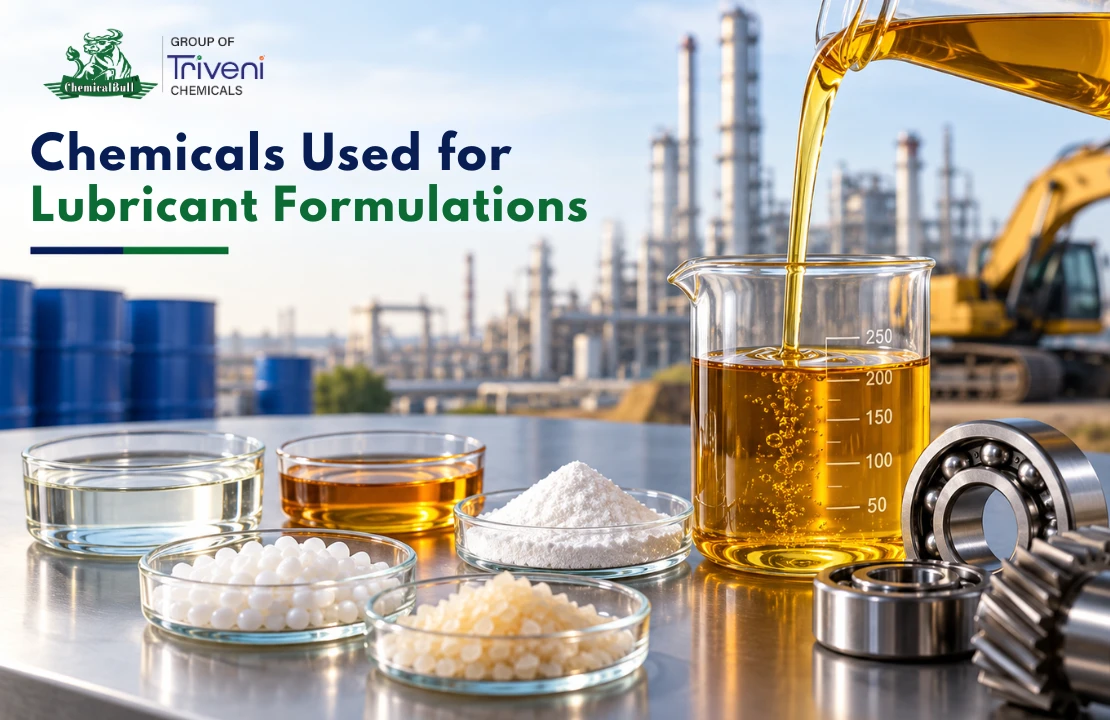
Lubricant formulations combine base oils with selected additives to control friction, oxidation, corrosion and fluid performance. The right ingredients depend on operating temperature, load, metal surfaces and whether the finished product is an oil-based lubricant or a water-dilutable metalworking fluid.
For raw material specifications and bulk pricing, contact Chemical Bull with your application, required grade, quantity and delivery location.
What Chemicals Are Used in Lubricant Formulations?
Lubricant ingredients include mineral or synthetic base oils, antioxidants, friction modifiers, corrosion inhibitors and other performance additives. Water-dilutable metalworking fluids also require suitable emulsifiers and pH-control ingredients.
Relevant examples include Butylated Hydroxytoluene (BHT), Benzotriazole, Glycerol Monooleate, selected 2-Ethylhexyl Esters, Sorbitan Monooleate, Lauryl Alcohol Ethoxylate and Triethanolamine. Caprylic Acid has a different role: it is a raw material for manufacturing selected synthetic esters.
These ingredients perform different functions and are not all required in one formulation.
Lubricant Ingredients and Their Functions
|
Ingredient |
Main function |
Relevant formulation context |
|
Mineral oils, PAO and selected synthetic esters |
Provide the base fluid |
Industrial and automotive lubricants |
|
Butylated Hydroxytoluene / BHT |
Antioxidant |
Suitable oil-based lubricant systems |
|
Benzotriazole |
Copper and copper-alloy corrosion inhibition |
Compatible metalworking and specialty fluid systems |
|
Glycerol Monooleate |
Friction modification and lubricity |
Selected lubricating oils and metalworking fluids |
|
2-Ethylhexyl Laurate, Palmitate and Stearate |
Synthetic ester components |
Selected lubricant blends |
|
Sorbitan Monooleate |
Emulsification and lubricity support |
Soluble oils and emulsifiable metalworking concentrates |
|
Lauryl Alcohol Ethoxylate |
Nonionic emulsification |
Water-dilutable metalworking fluids |
|
Triethanolamine 85% and 99% |
Neutralization and pH buffering |
Water-based metalworking fluids |
|
Caprylic Acid |
Feedstock for ester synthesis |
Synthetic lubricant ingredient manufacturing |
Base Oils Establish the Formulation’s Performance
The base oil provides the main lubricating medium. Its viscosity, oxidation stability, low-temperature behaviour and compatibility influence how the finished lubricant performs.
Mineral oils are used across many industrial lubricant applications. Synthetic options include polyalphaolefins, commonly called PAO, and several ester families. Selection should follow the equipment requirements and finished-fluid performance targets.
2-Ethylhexyl Esters as Lubricant Components
2-Ethylhexyl Laurate, 2-Ethylhexyl Palmitate and 2-Ethylhexyl Stearate are fatty acid esters available for synthetic lubricant applications. Their different fatty acid structures affect physical properties, so they should be evaluated individually. Manufacturer literature includes these ester types within synthetic lubricant ranges.
Before selecting a grade, compare viscosity, acid value, moisture, pour point, oxidation performance and compatibility with the rest of the blend. A cosmetic specification alone does not demonstrate suitability for an industrial lubricant.
Where Caprylic Acid Fits
Caprylic Acid, also known as octanoic acid, is relevant to the manufacture of selected synthetic ester ingredients.
It belongs in the raw-material discussion because ester manufacturers use fatty acids as building blocks. Free Caprylic Acid should not be treated as a direct replacement for a finished ester base stock; residual acidity and the final ester specification require control.
BHT Helps Control Oxidative Degradation
Butylated Hydroxytoluene is a hindered phenolic antioxidant used to slow oxidative deterioration in suitable formulations.
Oxidation can contribute to changes in lubricant viscosity, acidity and deposit formation. Antioxidant selection therefore depends on the base fluid, operating conditions and other additives.
For BHT, formulators should assess dissolution, blend stability and oxidation performance at the intended concentration. A universal dosage is unsuitable because different base oils and service conditions require different antioxidant packages.
Benzotriazole Supports Copper Protection
Benzotriazole is relevant where copper or copper-alloy protection is required. Its protective action involves interaction with the metal surface, helping reduce corrosion under suitable conditions.
Selection must account for solubility and the fluid’s chemistry. Benzotriazole and oil-soluble benzotriazole derivatives are distinct materials; buyers should confirm the exact identity and recommended application.
Copper protection also does not establish protection for steel or every other metal. Mixed-metal systems may require additional corrosion-control components.
Glycerol Monooleate Provides Friction Modification
Glycerol Monooleate is an organic friction modifier evaluated in lubricant formulations for reducing friction at contacting surfaces. Research demonstrates that its performance depends on lubricant composition and test conditions.
Commercial grades can differ in monoester content and accompanying components. Procurement specifications should therefore address ester composition, acid value, moisture and batch consistency.
Friction reduction should be assessed alongside wear performance, corrosion and compatibility. Glycerol Monooleate does not automatically replace an antiwear or extreme-pressure additive package.
Emulsifiers for Water-Dilutable Metalworking Fluids
Soluble cutting oils and semi-synthetic metalworking fluids require an emulsifier system that remains effective after dilution with water. This creates different formulation requirements from lubricants designed to separate from water.
Sorbitan Monooleate
Sorbitan Monooleate can contribute emulsification and lubricity in suitable metalworking fluids. It is commonly considered as part of a blended emulsifier system rather than selected solely on an ingredient name.
Evaluate concentrate stability, dilution behaviour, water hardness tolerance and separation during storage.
Lauryl Alcohol Ethoxylate: 7-Mole and 9-Mole Grades
Lauryl Alcohol Ethoxylate, including C12–C14 7-mole and 9-mole grades, can be evaluated as a nonionic emulsifier component. Linear alcohol ethoxylates have established uses in metalworking formulations.
Changing the ethoxylation level changes the balance between oil and water affinity. Compare the actual grades for cloud point, foam, emulsion stability and compatibility with the selected base oil. Neither grade is universally better.
Triethanolamine for Neutralization and pH Control
Triethanolamine is used in water-dilutable metalworking fluids for neutralization, pH buffering and corrosion-control support. Its role is different from that of the base oil or emulsifier.
Triethanolamine 85% and 99% require separate specification checks. Confirm assay, water and other ethanolamine content before calculating additions. The balance of an 85% grade should not automatically be assumed to be water.
Evaluate pH after dilution at the intended working concentration, alongside metal compatibility and fluid stability.
Selecting and Sourcing Lubricant Raw Materials
Begin with the finished product: hydraulic oil, circulating oil, cutting fluid or another defined application. Then establish the required viscosity, temperature range, metal compatibility, water behaviour and performance tests.
Other ingredients may be necessary, including antiwear additives, extreme-pressure additives, antifoams, demulsifiers or viscosity modifiers. The products discussed here represent selected formulation functions rather than a complete lubricant recipe.
For procurement, request a current COA, SDS and available technical data. Compare material identity, specification limits, packaging, lead time and delivered cost before approving a commercial batch.
To request a quotation, contact Chemical Bull with the product name, grade, application, quantity, packaging preference and destination. Include your required specification so the quotation addresses a technically suitable material.
Frequently Asked Questions
What is the difference between a base oil and a lubricant additive?
The base oil provides the main lubricating fluid. Additives provide specific functions such as oxidation control, friction modification or corrosion protection.
Can BHT and Benzotriazole perform the same function?
Their primary roles differ. BHT is an antioxidant, while Benzotriazole is used for copper and copper-alloy protection. Compatibility must be checked when combining them.
Is Glycerol Monooleate an extreme-pressure additive?
It is primarily discussed as a friction modifier and lubricity component. Extreme-pressure performance requires separate testing and suitable additive selection.
Which is better: Triethanolamine 85% or 99%?
The choice depends on composition, formulation requirements and cost in use. Compare the complete specifications rather than assay alone.
Should every lubricant contain an emulsifier?
No. Water-dilutable metalworking fluids need controlled emulsification, while many industrial oils require effective water separation.
What determines lubricant raw material prices?
Grade, specification, order quantity, packaging, origin, freight and delivery terms influence pricing. Comparable quotations should use the same technical and delivery requirements.
Comment Section